


Run your final payroll with verified employee data, post every bonus and taxable fringe benefit, then reconcile all year-to-date totals before you touch a W-2 form. The deadlines that matter most: employee copies of Form W-2 go out by the statutory deadline of January 31, and your federal returns follow close behind. Everything else on your payroll year end checklist supports those two moments, and Kelliworks built a payroll compliance checklist to help you get there without missing a step.
TL;DR:
- Verifying Social Security numbers and collecting W-9s must be completed before year-end to prevent costly corrections later.
- Running W-2 preview reports and reconciling tax deposits help identify discrepancies and avoid IRS penalties.
- Final federal deadlines are January 31 for employee W-2 copies, quarterly forms, and 1099s, with state deadlines varying by jurisdiction.
- Reconciliation of payroll records against the general ledger and tax liability reports is essential to catch errors and ensure accurate filings.
- Small businesses should prioritize SSN verification, taxable wages finalization, and tax deposit reconciliation, especially when managing payroll alone.
Table of Contents
- Payroll Year End Checklist: Tasks to Finish Before Your Last Payroll
- After Your Last Payroll: Finalizing Totals Before You Issue Forms
- Key Filing Forms and Deadlines Employers Cannot Miss
- How to Reconcile Payroll to Your Books Before You File Anything
- Special Situations That Trip Up Otherwise Careful Employers
- Getting Your Payroll System Ready for the New Year
- Your One-Page Payroll Closing Checklist
- Why Outsourcing Year-End Payroll Makes Sense for Small Teams
- What I’d Prioritize If You’re Running a Lean Team
- Let Kelliworks Close Out Your Payroll Year the Right Way
- Sources
- FAQ
Payroll Year End Checklist: Tasks to Finish Before Your Last Payroll
The final payroll of the year isn’t just another pay cycle. It’s the last chance to correct anything before it becomes permanent on a W-2. Get these tasks done while you still have time to fix mistakes.
- Verify every employee’s identifying information. Pull current names, Social Security numbers, and mailing addresses from your records and compare them against W-4 forms on file. If anything looks off, run it through the Social Security Administration’s verification tools before you assume it’s correct.
- Post every taxable event that happened this year. Bonuses, commissions, expense reimbursements that don’t qualify as accountable-plan expenses, and taxable fringe benefits all need to hit payroll before your last run and not after.
- Collect outstanding W-9s and confirm worker classification. Anyone you paid $600 or more as a contractor needs a completed W-9 on file, and you need certainty that they’re actually a contractor and not a misclassified employee. Kelliworks’ guide on classifying 1099 vs. W-2 workers walks through the test in plain language.
- Check deduction limits and 401(k) deferral maximums. Coordinate with your benefits vendor now so you have accurate year-end contribution figures before you generate any reports.
- Schedule bonus runs with real lead time. Supplemental wages carry their own withholding rules, and a rushed bonus run close to December 31 can throw off your deposit schedule.
Small businesses that claimed the Work Opportunity Tax Credit should also confirm timing before year-end, since that program runs on its own calendar separate from your payroll close.
Pro Tip: Set a hard internal cutoff, like December 20, for any bonus or off-cycle payment request. That buffer gives you time to catch errors before the check clears, instead of after.
After Your Last Payroll: Finalizing Totals Before You Issue Forms
Once your final payroll of the year has processed, you enter a short window where accuracy matters more than speed. This is where most of the year end payroll procedures that actually prevent IRS notices happen.
- Run W-2 and 1099-NEC preview reports and check every box against your payroll register and general ledger. A preview report catches mismatches while you can still fix them for free.
- Reconcile your federal and state tax deposits against your actual liabilities, and correct any underpayment before you file anything.
- Finalize taxable fringe benefits, third-party sick pay entries, retirement contributions, and any termination pay that needs to land in this tax year.
- Confirm your distribution method for W-2s. If you’re sending them electronically, you need documented employee consent on file, not just an assumption that everyone prefers email.
- Correct any invalid or missing Social Security numbers before you transmit files to the SSA. A rejected batch means resubmitting and mailing corrected forms later, which costs more time than checking now.
Running a W-2 preview early enough to catch SSN and name mismatches is one of the highest-leverage moves on this entire checklist. It’s a five-minute check that prevents a multi-week correction cycle in February.
Key Filing Forms and Deadlines Employers Cannot Miss
Every payroll year end procedure eventually funnels into a handful of federal forms, and missing any of these creates penalties that compound the longer they sit unresolved.
Employees need their W-2 copies by January 31, 2027. The same deadline applies to filing W-2s with the Social Security Administration by January 31, whether you file on paper or electronically.
- Form 941 (quarterly filers) covers the fourth quarter and is due by January 31 as well, unless you’ve made timely deposits, which extends it slightly.
- Form 944 applies if the IRS has approved you as an annual filer, replacing the four quarterly 941 filings with one annual return.
- Form 940 reports your federal unemployment tax liability for the full year and is also due January 31.
- Form 1099-NEC for independent contractors follows the same January 31 deadline for both the recipient copy and the IRS filing, per the IRS’s own instructions.
State filing requirements often shadow the federal timeline but rarely match it exactly. Many states require a separate W-2 reconciliation submission with its own due date, and state rules vary enough that you should confirm your specific state’s requirements rather than assume they mirror federal deadlines. One deposit pitfall worth flagging: the IRS counts electronic deposits by the date they’re received, not the date you initiated them, which trips up employers who wait until the deadline afternoon to submit.
How to Reconcile Payroll to Your Books Before You File Anything
Yearly payroll reconciliation isn’t optional busywork. It’s the single best defense against an IRS notice arriving six months from now asking why your 941 totals don’t match your W-2s.
- Pull four reports: your payroll register, tax liability report, tax deposit history, and general ledger detail for the full year.
- Compare gross wages, tax boxes, and employer tax liabilities line by line between the payroll register and the GL. Discrepancies here are the most common source of W-2 corrections.
- Check for voided or off-cycle checks that might have posted twice or not at all, since these distort year-to-date totals in ways that aren’t obvious from a summary report.
- Document any discrepancy you find, note the root cause, and decide whether it requires a corrected filing like Form 941-X or a corrected W-2 and W-3.
- Keep every supporting document, from bank statements to benefits vendor reports, in a labeled file in case the IRS or SSA ever asks questions.
A bank-level reconciliation is worth the extra half hour it takes. Outstanding or voided payroll checks are notoriously easy to miss when you’re only looking at summary totals instead of the bank feed itself.
Pro Tip: Reconcile in the order listed above, not backward. Starting from the GL and working toward the payroll register tends to hide discrepancies that jump out immediately when you start from the payroll side.
Special Situations That Trip Up Otherwise Careful Employers
Some payroll items don’t fit the standard checklist, and they’re exactly the ones that generate corrected filings months later.
- Supplemental wages like bonuses carry different withholding rules than regular pay, and the timing of a bonus check can shift your deposit schedule if you’re not planning for it.
- Taxable fringe benefits need to be added to payroll before year-end closes. IRS Publication 15-B covers which benefits qualify as taxable, and it’s a longer list than most owners expect.
- S-corp shareholder health and HSA contributions get reported differently than standard employee benefits, and this is one of the most commonly botched items on any small business payroll close.
- Third-party sick pay requires documentation from your insurer before you can report it correctly, so request that paperwork well before your final payroll, not after.
- Nonresident alien employees may need Form 1042-S instead of a standard W-2, and this is a case where consulting payroll counsel beats guessing.
Getting Your Payroll System Ready for the New Year
Loading the wrong tax tables into January’s first payroll run creates errors that follow you for months. Handle these updates before that first check goes out.
- Load new federal and state tax tables along with the updated Social Security wage base and retirement contribution limits, since the IRS adjusts these figures annually.
- Reset year-to-date accumulators and confirm PTO accrual rules and deduction schedules carried over correctly.
- Audit your filing agent’s permissions and vendor settings, including bank deposit windows and tax deposit methods.
- Assign an owner for post-close corrections and keep a running issues log for anything that needs attention in January.
Pro Tip: Test your first January payroll with a dummy run against the new tax tables before processing it live. A five-minute test catches table-loading errors before they hit a real paycheck.
Your One-Page Payroll Closing Checklist
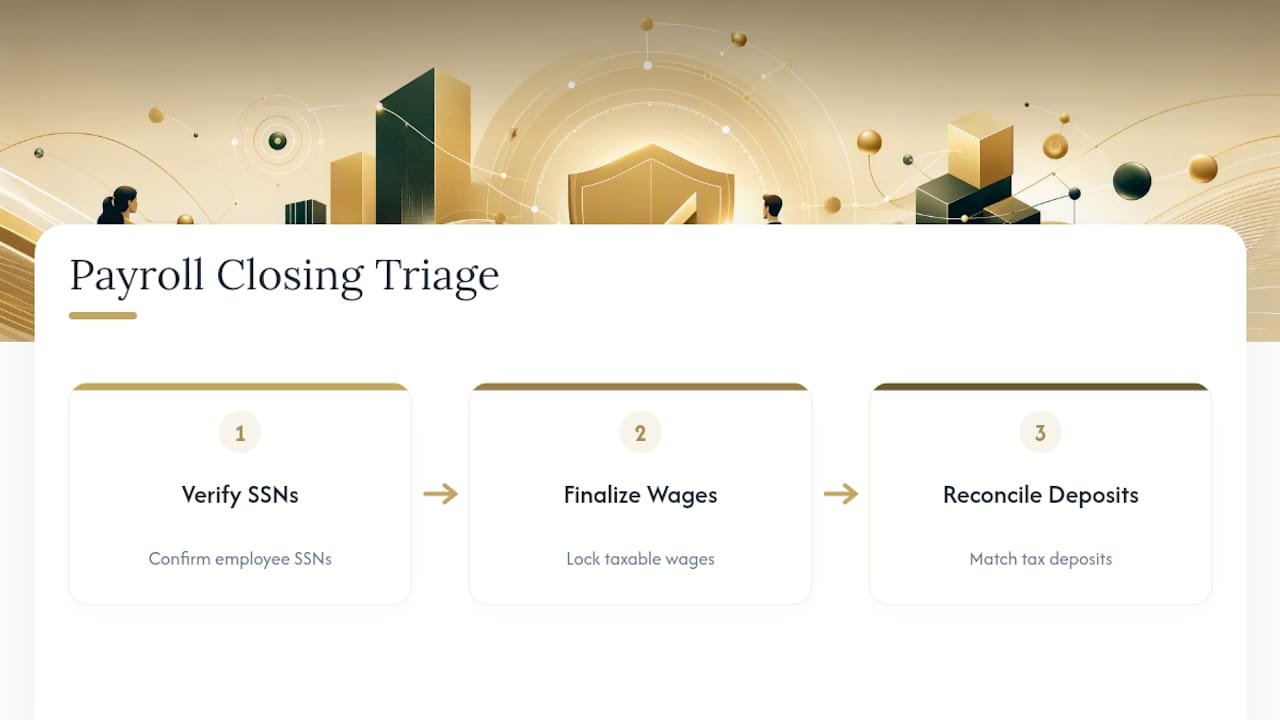
If you’re short on time, triage in three steps: verify SSNs first, finalize taxable wages second, reconcile tax deposits third. Everything else can follow once those three are locked.
Why Outsourcing Year-End Payroll Makes Sense for Small Teams
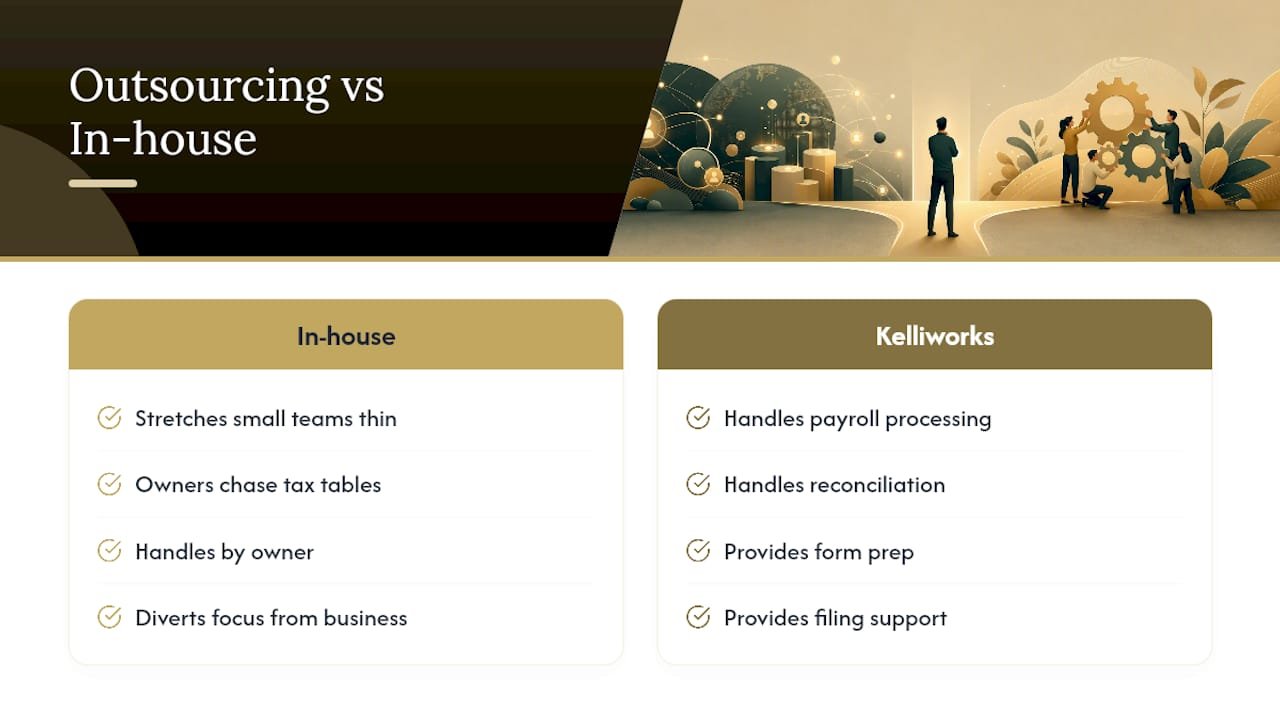
Handling reconciliation, form prep, and filing support alongside daily operations stretches most small teams thin. Kelliworks handles payroll processing and reconciliation so owners can focus on running the business instead of chasing tax tables.
What I’d Prioritize If You’re Running a Lean Team
If you’re managing payroll alone or with minimal support, don’t try to do everything at once. Verify Social Security numbers first, since a rejected W-2 batch costs more time than any other mistake on this list. Finalize taxable wages second, and reconcile tax deposits third. Tell employees your distribution timeline early, and keep every reconciliation document you generate. You’ll want it if a question ever comes up.
— Kelli
Let Kelliworks Close Out Your Payroll Year the Right Way
Kelliworks gives small business owners a full-service alternative to handling payroll year-end alone, backed by real bookkeeping and tax expertise rather than a software subscription you have to figure out yourself. Instead of spending your December reconciling registers against the general ledger, you hand that work to a team that manages payroll processing services alongside your books and your tax filings, so nothing falls through the gap between departments.

That means one point of contact for reconciliation, W-2 and 1099 preparation, and the federal filings that follow, instead of juggling a payroll vendor, a bookkeeper, and a tax preparer who don’t talk to each other. If you’re heading into year-end unsure whether your books and payroll actually match, schedule a consultation with Kelliworks and bring your most recent payroll register and general ledger export. That’s all it takes to get a clear read on where you stand before the January 31 deadlines arrive.
Sources
State agencies set their own variations on these rules, so confirm specifics with your state’s department of revenue before filing.
FAQ
What Is a Payroll Checklist?
A payroll checklist is a structured list of tasks employers complete to process pay accurately, from verifying employee data to filing tax forms. At year-end, it expands to cover reconciliation, W-2 and 1099 preparation, and federal filing deadlines like the Form 940 due date.
What Are the 5 Essential Components of Payroll?
Most payroll processes rest on five components: employee data and classification, gross wage calculation, tax withholding, deductions and benefits, and net pay distribution. Year-end work touches every one of these, since errors in any component show up on the final W-2.
How Do I Reconcile Payroll at Year End?
Compare your payroll register, tax liability report, and tax deposit history against your general ledger, checking gross wages, tax boxes, and employer tax totals line by line. Document any mismatch, determine the cause, and file a corrected return like Form 941-X if the discrepancy affects amounts already reported.
What Documents Do I Need for Payroll Processing?
You need current W-4 forms for employees, W-9 forms for contractors, verified Social Security numbers, and documentation for any taxable fringe benefits or third-party sick pay. Kelliworks’ 1099 filing guide covers exactly what’s required for contractor reporting.
How Much Does Kelliworks Charge for Payroll Help?
Kelliworks doesn’t publish a flat rate for payroll processing since pricing depends on your business size and needs. Current pricing details are available directly on the accounting services page.