


FUTA is the federal unemployment tax employers pay on the first $7,000 of each employee’s wages; SUTA is the matching state unemployment tax with its own rates and wage base. Both are employer paid, and both fund the same safety net, but FUTA is federal and SUTA is state. Pay your SUTA on time, in full, and your FUTA liability usually drops to an effective 0.6%. Miss that deadline and your federal bill climbs fast.
TL;DR:
- Paying your SUTA on time can reduce your effective FUTA rate to 0.6%, but missing deadlines can significantly increase your federal unemployment tax.
- State SUTA rates and wage bases vary widely, and experience rating influences your specific SUTA rate, impacting your total unemployment tax bill.
- Exemptions from FUTA mostly apply to nonprofits and government entities, but misclassifying employees as independent contractors can trigger costly penalties for both taxes.
- Employers should calculate quarterly FUTA liabilities early in the year and deposit electronically once exceeding $500 to avoid penalties.
- Managing multiple state obligations complicates compliance, and outsourcing payroll helps small businesses avoid penalties and keep accurate records.
Table of Contents
- FUTA vs SUTA: The Key Differences at a Glance
- Who Actually Owes FUTA and SUTA, and Who’s Exempt?
- How to Calculate FUTA and SUTA (With a Real Example)
- Filing Form 940 and Meeting Deposit Deadlines
- Why SUTA Rates Vary So Much by State
- Common Mistakes That Trigger Penalties and Audits
- A Small-Business Accounting Partner’s Perspective
- Let Kelliworks Handle the Payroll Math for You
- Sources
- FAQ
FUTA vs SUTA: The Key Differences at a Glance
Once you see FUTA and SUTA side by side, the confusion mostly disappears. They’re both unemployment taxes, but they answer to different governments, use different math, and serve different purposes in the same overall system.
FUTA money goes to the federal government, which uses it to fund the administrative costs of state unemployment programs and to cover federal loans to states whose trust funds run dry, while SUTA funds tend to stay with the state and pay unemployment benefits. The Department of Labor’s Unemployment Insurance program describes this as a joint federal-state structure by design, not by accident. Neither tax works well without the other.
Here’s where the practical differences show up on your payroll:
- Jurisdiction: FUTA is federal and applies the same way nationwide; SUTA is set by each state and varies significantly.
- Wage base: FUTA taxes only the first $7,000 of each employee’s annual wages; SUTA wage bases differ by state and can run several times higher.
- Rate: FUTA has one gross rate (6%) before credits; SUTA rates depend on your state and your specific claims history.
- Who pays: Both are employer paid in nearly every state, though a small number of states require limited employee contributions.
- Purpose: FUTA supports the federal unemployment infrastructure; SUTA funds the benefit checks people actually receive.
If you remember nothing else, remember this: SUTA is the tax that determines how much of a break you get on FUTA. That link is the whole reason employers need to understand both taxes together instead of treating them as two unrelated line items.
Who Actually Owes FUTA and SUTA, and Who’s Exempt?
Most employers owe FUTA if they meet certain federal wage or employment thresholds during the year; exact details vary. SUTA triggers work similarly but the exact thresholds are set state by state, so you need to check your specific state’s rules rather than assume the federal test applies.
Exemptions exist, but they’re narrower than most business owners expect:
- 501©(3) nonprofits are generally exempt from FUTA, though many still owe state unemployment obligations in some form.
- Government entities often have different unemployment tax treatment depending on the state.
- Independent contractors aren’t covered by either tax, since FUTA and SUTA apply only to employees.
That last point is where a lot of small businesses get into trouble. Classifying a worker as a contractor when they function like an employee is one of the fastest ways to trigger back taxes, penalties, and interest on both FUTA and SUTA. Our guide on 1099 filing requirements breaks down the classification test in more detail if you’re unsure where a worker falls.
How to Calculate FUTA and SUTA (With a Real Example)
The federal math starts simple and gets more interesting once credits enter the picture.
Pro Tip: Run this calculation once per employee at the start of the year, not after wages have already piled up. Catching a misclassified worker or a missed SUTA payment in January is a lot cheaper than catching it in December.
Here’s the sequence:
- Start with the gross FUTA rate. It’s 6% on the first $7,000 of each employee’s wages for the year, no matter how much more they earn after that.
- Apply the SUTA credit. Most employers who pay their state unemployment tax in full and on time get a 5.4% credit against the FUTA rate, bringing the effective FUTA rate down to 0.6%.
- Check for credit reduction states. If your state has an outstanding federal unemployment loan, the IRS reduces your credit, which pushes your effective FUTA rate above 0.6% for wages paid in that state.
- Add your state’s SUTA rate and wage base. These numbers are entirely state specific and depend heavily on your claims history.
By the numbers: A full SUTA credit turns a 6% gross FUTA rate into an effective 0.6% rate, a tenfold reduction that exists solely because you paid your state tax on time.
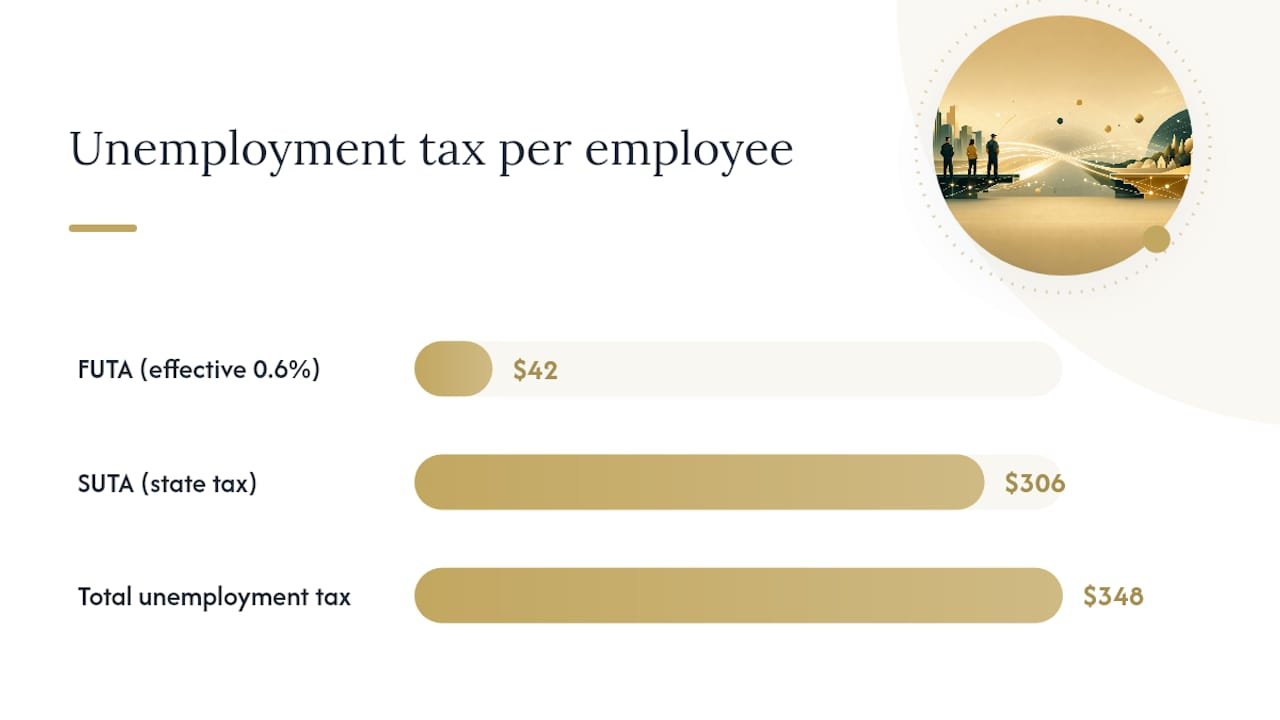
Here’s what that looks like for one employee earning $50,000 a year. FUTA applies only to the first $7,000, so at the effective 0.6% rate, you owe $42 in FUTA for that worker. That’s $306 in SUTA for the same employee. Total unemployment tax burden: $348, split between two governments with two very different rulebooks.
Multiply that by your headcount and you’ll see why a missed SUTA deadline is expensive. Lose the credit entirely and the effective FUTA tax can rise significantly, causing a much higher federal cost due to late payments.
Filing Form 940 and Meeting Deposit Deadlines
FUTA gets reported once a year on Form 940, due by January 31 for the prior calendar year. That single annual filing is deceptively simple looking, because the deposit rules underneath it trip up more employers than the form itself.
- Calculate your quarterly FUTA liability. Track it as you go rather than waiting until year end to add it up.
- Deposit electronically once your cumulative liability exceeds $500. The IRS requires electronic deposits through EFTPS once you cross that threshold, and you cannot mail a check instead.
- Pay with your return only if you stayed under $500 for the whole year. In that case, you can settle the balance when you file Form 940 rather than depositing quarterly.
- File by January 31, or by February 10 if you’ve deposited all your FUTA tax on time throughout the year.
Missing a deposit deadline triggers the failure to deposit penalty, which scales up the longer the payment stays outstanding. The most common mistake we see is employers treating the $500 threshold as optional guidance instead of a hard trigger. It isn’t. Cross it, and electronic deposit becomes mandatory for that quarter.
Why SUTA Rates Vary So Much by State
SUTA is where the real complexity lives, because wage bases and rates differ substantially from state to state. Some states set wage bases close to the federal $7,000 figure; others set them tens of thousands of dollars higher. Your actual rate within that range depends on something called experience rating.
Experience rating means your SUTA rate rises or falls based on how many former employees have filed unemployment claims against your account. A company with frequent layoffs pays a higher rate than one with a stable workforce, sometimes dramatically higher. New employers typically start at a flat new-employer rate set by the state, then get reassessed after a year or two once they’ve built up enough history to be rated individually.
For employers with workers in more than one state, the checklist gets longer:
- Determine which state has jurisdiction over each employee, which usually comes down to where the work is actually performed.
- Register separately with each state’s unemployment agency before running payroll there.
- Track each state’s wage base, rate, and filing calendar independently, since none of them line up automatically.
Pro Tip: If you’re running payroll in three or more states, build a single calendar with every state’s SUTA due date on it. States that miss federal loan repayments can trigger credit reduction status for every employer operating there, and you don’t want to be scrambling to check that list after the fact.
Our payroll compliance checklist walks through this state-by-state setup in more detail if you’re onboarding a new state for the first time.
Common Mistakes That Trigger Penalties and Audits
Most FUTA and SUTA problems trace back to a small handful of avoidable errors.
- Late SUTA payments don’t just cost you the state penalty; they also strip away your FUTA credit, multiplying the damage across two tax bills at once.
- Worker misclassification creates exposure on FUTA, SUTA, and payroll tax generally, since an employee mislabeled as a contractor was never covered by either system in the first place.
- Inconsistent multi-state tracking leads to missed registrations, late filings, and rate miscalculations that compound quietly until an audit surfaces them.
Pro Tip: Reconcile your FUTA and SUTA liability quarterly, not annually. Small discrepancies caught in March are corrections; the same discrepancies caught in December are often penalties.
Keep documentation on every classification decision, every SUTA payment confirmation, and every state registration. Auditors ask for paperwork, not explanations, and the businesses that struggle most in an audit are usually the ones that made a reasonable decision but never wrote down why. For a broader view of how these obligations fit into your overall payroll tax exposure, see our piece on payroll taxes for small businesses.
A Small-Business Accounting Partner’s Perspective
We see the same pattern constantly: small employers handle FUTA and SUTA correctly for years, then a single state expansion or a busy hiring quarter causes a missed deadline that costs far more than it should have. Outsourcing payroll makes the most sense once you’re managing more than one state, or once your own bandwidth for tracking quarterly deadlines starts slipping. Outsourcing payroll processing and annual tax form preparation is often where many small compliance gaps stop happening.
— Kelli
Let Kelliworks Handle the Payroll Math for You
Kelliworks is the alternative to hiring a full internal payroll department for small businesses that need FUTA and SUTA handled correctly without the overhead. Our payroll processing services track your state-by-state SUTA obligations, calculate your FUTA liability with the correct credit applied, and keep your deposit deadlines from sneaking up on you.

If tax season is the part of this that worries you most, our tax preparation and filing service also covers Form 940 preparation directly, so the annual filing lines up with everything paid throughout the year. Multi-state employers get the most value here, since keeping several states’ rates, wage bases, and due dates straight is exactly the kind of detail work that eats an HR team’s week. Reach out for a consultation and we’ll walk through what your current FUTA and SUTA setup actually costs you.
This article is general information, not a substitute for advice from a qualified financial advisor. Consult a qualified financial professional about your own circumstances before acting on anything here.
Sources
- Topic No. 759 Federal Unemployment Tax (FUTA)
- U.S. Department of Labor — Unemployment Insurance
- FUTA credit reduction (IRS)
FAQ
Are FUTA and SUTA the Same Tax?
No. FUTA is a federal tax employers pay on the first $7,000 of each employee’s wages, while SUTA is a state tax with its own separate rate and wage base. They work together, but they’re collected by different governments for different purposes.
What Percentage Is FUTA and SUTA?
FUTA’s gross rate is 6%, but most employers who pay SUTA on time receive a 5.4% credit, bringing the effective FUTA rate down to 0.6%. SUTA rates vary by state and by your individual experience rating, so there’s no single national percentage.
What Is FUTA Tax in the USA?
FUTA is the Federal Unemployment Tax Act tax that employers pay to fund the federal side of the unemployment insurance system. It applies to the first $7,000 of each employee’s annual wages at a gross rate of 6%, typically reduced to 0.6% through the SUTA credit.
Who Is Exempt From FUTA and SUTA?
Certain 501©(3) nonprofits are generally exempt from FUTA, and independent contractors are excluded from both taxes because they aren’t classified as employees. Exact exemptions for SUTA depend on your specific state’s rules, so check with your state unemployment agency directly.
Can Kelliworks Handle My FUTA and SUTA Filings?
Yes. Kelliworks offers payroll processing services that track state-specific SUTA obligations and prepare the annual Form 940 filing, so you don’t have to manage the calculations or deadlines on your own.