


A startup bookkeeping checklist has four parts: set up your system once, then repeat a short weekly routine, a monthly close, and a quarterly and yearly tax rhythm. Do these in order and your books stay current, your tax filings stay simple, and you always know how much cash and runway you have. Below is the full list, with the reasons behind each step and the points where a professional saves you time.
TL;DR
- Open a separate business bank account and card before you record a single transaction, then choose your accounting method and software.
- Spend 30 to 60 minutes a week reconciling accounts, categorizing expenses and chasing unpaid invoices.
- Close each month by reconciling every account, reviewing your profit and loss statement and updating your cash flow forecast.
- Keep invoices, receipts and statements organized by year. Employment tax records should be kept for at least four years.
- If you have employees or contractors, put payroll deadlines and worker classification on your calendar from day one.
Table of Contents
- Part 1: One-time setup checklist
- Part 2: Weekly bookkeeping checklist
- Part 3: Monthly close checklist
- Part 4: Quarterly and yearly tax checklist
- What records to keep, and for how long
- Common startup bookkeeping mistakes
- Perspective: why we treat bookkeeping as a growth tool
- When to bring in help
- Let us run this checklist for you
- FAQ
- Sources
Part 1: One-time setup checklist
Setup is the step most founders rush. A few hours here prevent weeks of cleanup later. Work through these items in order.
Separate business and personal money
Open a business checking account and, if you use one, a business credit card. The IRS notes that keeping separate business and personal bank accounts makes expense tracking and tax preparation simpler. Once personal spending lands in the business account, every transaction needs an explanation, and your reconciliation time grows with it.
If you formed an LLC or corporation, bank setup usually follows formation. Our business formation services cover incorporation, a registered agent and business banking setup, so these steps happen in one sequence.
Choose an accounting method
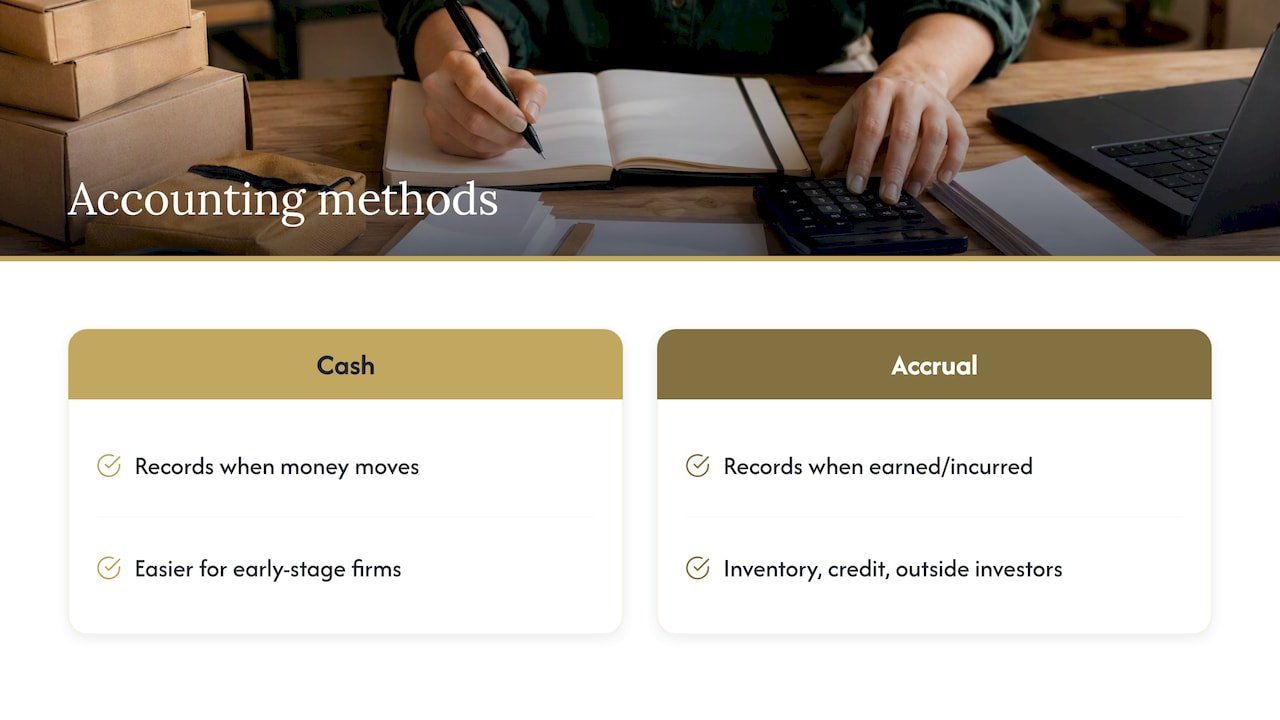
Businesses choose an accounting method when they file their first income tax return, according to IRS Publication 583. The two common choices are cash (record income and expenses when money moves) and accrual (record them when earned or incurred). Many early-stage companies start with cash because it is easier to follow. Companies that carry inventory, sell on credit or expect outside investors often need accrual. Ask a tax professional before you file, because changing later takes paperwork.
Pick software and build a chart of accounts
You need one system that holds your ledger. Record income and expenses there, categorize each one through a chart of accounts, and reconcile regularly against bank statements. Connect your bank feeds, then trim the default chart of accounts to the categories you actually use: revenue streams, cost of goods sold, software, contractors, payroll, marketing, travel and taxes.
If you are choosing QuickBooks, our guide to QuickBooks for startups walks through plans, setup and habits that keep the file clean.
Set up a filing system for documents
The IRS says supporting documents such as invoices, canceled checks and credit card statements should be kept in an orderly, safe place. A simple structure works: one cloud folder per year, with subfolders for income, expenses, payroll, tax filings, contracts and bank statements. Name files with the date and vendor so you can find them in seconds.
Decide how you will track mileage and special deductions
If you drive for the business, start a mileage log on day one. A reliable log records the date, destination, business purpose and miles driven for each trip. Our mileage tracking checklist covers the current rules.
Set up payroll before your first hire
If you will pay employees, choose a payroll process before the first paycheck, not after. Our guide to setting up small business payroll lays out the steps, and the quarterly section below explains the filings that follow.
Part 2: Weekly bookkeeping checklist
Plan on 30 to 60 minutes a week. Put it on your calendar at the same time each week, such as Friday morning, and treat it as a fixed appointment.
- Reconcile bank and credit card transactions. Match what your software shows to what the bank shows.
- Categorize new expenses. Assign each one to a category and attach the receipt.
- Review outstanding invoices. See who owes you money, and follow up on anything overdue.
- Send new invoices. Anything delivered but not yet billed is cash you are waiting on for no reason.
- Review bills due. Know what is payable in the next two weeks so cash does not surprise you.
- Flag unusual transactions. A duplicate charge, an unfamiliar vendor or a large round number deserves a look now, not at year-end.
The weekly routine also covers revenue that never reaches an invoice. Missed calls and unlogged inquiries become unbilled work, so some founders use an AI front desk for bookkeeping services to capture leads and follow-ups in one place, which makes it easier to see what should be invoiced.
Freelancers and solo founders can adapt this routine with our weekly bookkeeping workflow for freelancers.
Part 3: Monthly close checklist
The monthly close turns a pile of transactions into numbers you can use. Aim to finish within the first ten days of the following month.
- Reconcile every account. Bank accounts, credit cards, loan accounts and payment processors.
- Review accounts receivable and payable aging. Note what is overdue and what you will owe soon.
- Reconcile payroll. Confirm wages, withholding and employer taxes match your payroll reports and your ledger.
- Compare profit and loss to budget. Look for categories that moved more than you expected.
- Update your cash flow forecast and runway. Runway is cash on hand divided by your monthly net burn.
- Prepare a short financial package. Send it to co-founders, your board or advisors.
These steps follow the monthly routine described in Ramp’s startup accounting guide. For the budget comparison step, see our walkthrough of monthly budget vs actual reporting.
Which reports to review
The U.S. Chamber of Commerce recommends reviewing monthly profit and loss, balance sheet, cash flow, accounts payable and accounts receivable reports. Together they show profitability, liquidity, what you owe and what you are owed, and they inform pricing, spending, financing and expansion decisions.
| Report | What it answers | What to look for |
|---|---|---|
| Profit and loss | Did we make or lose money this month? | Margins, expense categories that jumped |
| Balance sheet | What do we own and owe? | Cash, debts, equity |
| Cash flow | Where did cash actually go? | Burn rate, timing gaps |
| AR aging | Who owes us? | Invoices past 30 and 60 days |
| AP aging | Whom do we owe? | Bills due soon, vendor terms |
Startups that raise money should also expect to produce a balance sheet, income statement and cash flow statement, and sometimes a statement of equity. Carta’s overview of financial reporting explains how internal reporting helps leadership manage burn rate, build budgets and forecast profits.
If you want a deeper look at which reports flag trouble early, read our guide to management reports for small businesses. For forecasting, use our cash flow forecasting guide.
Part 4: Quarterly and yearly tax checklist
Tax tasks are the ones that carry penalties, so give them their own calendar entries. Confirm exact dates each year on the IRS tax calendars in Publication 509, which list due dates for filing forms and paying taxes. Employers may need the Employer’s Tax Calendar from the same publication.
If you have employees
The IRS explains that employers report wages and employment taxes, generally on Form 941 each quarter. Employers with annual employment tax liability of $1,000 or less may file Form 944 annually if approved, and most employers also file Form 940 for federal unemployment tax. Deposits must be made on time by the required method and schedule.
Your quarterly checklist:
- Reconcile payroll reports to the ledger.
- File Form 941 (or Form 944 if the IRS notified you to).
- Confirm federal tax deposits were made electronically and on schedule.
- Check state and local payroll filings, especially if you hire in more than one state. See our guide to multi-state payroll rules.
Our payroll compliance checklist breaks down requirements by company stage.
At year-end
Form W-2, Form W-3, Form 940 and Form 1099-NEC are generally due January 31, and when that date falls on a weekend the deadline moves to the next business day. Before then:
- Reconcile every bank, card and loan account through December 31.
- Collect W-9 forms from contractors you paid.
- Confirm worker classification, employee or contractor, for everyone you paid.
- Review the full-year profit and loss and balance sheet for errors.
- Meet a tax professional before year-end, while you can still act on their advice.
Our payroll year-end checklist gives a quick W-2 check, and tax planning for early-stage companies shows what to decide before December.
Worker classification deserves human judgment. Even when AI tools handle categorization, founders should keep oversight of worker classification and estimated tax safe harbors to avoid IRS notices. A tax professional can confirm your situation.
What records to keep, and for how long
The IRS says you should keep income and expense records such as invoices, receipts and canceled checks, along with employment tax records. Retention depends on the record. The IRS advises that business owners keep employment tax records for at least four years. Other records follow different periods, so ask your tax professional before discarding anything.
A practical keep list:
- Sales invoices and payment confirmations
- Receipts and vendor bills
- Bank and credit card statements
- Payroll reports, W-4s and tax deposit confirmations
- Contractor agreements and W-9s
- Filed tax returns and supporting schedules
- Incorporation documents, contracts and loan agreements
- Mileage logs
Our guide to financial records for freelancers goes into more detail on what to keep and why, and it applies to solo founders as well.
Common startup bookkeeping mistakes
Most problems come from timing, not complexity.
- Mixing personal and business spending. It makes every reconciliation slower and weakens your records.
- Letting months pile up. A backlog is harder than a weekly habit. If you are behind, our catch-up bookkeeping guide lays out a plan.
- Skipping receipts. Without support, a deduction is hard to defend.
- Misclassifying workers. Decide employee or contractor deliberately, not by default.
- Ignoring cash flow. A profitable month can still leave you short of cash if customers pay late.
- Waiting until tax season. Books are most useful when they are current. Our list of small business tax mistakes shows what this costs.
Perspective: why we treat bookkeeping as a growth tool
We see the same pattern with new founders. The product is strong, customers are arriving, and the books are an afterthought until a tax deadline or an investor question forces the issue.
Our view is that bookkeeping works best as a steady, light routine rather than a yearly scramble. When the weekly and monthly steps are done, a founder can answer basic questions quickly: how much cash do we have, who owes us, what can we afford to hire.
That is why we offer both virtual and in-person support, tailored to each business. Some founders want us to run the whole process. Others want us to set it up, review it monthly and handle taxes. Either way, the goal is the same: accurate records, filings handled on time, and more of your attention on the business.
Kelli
When to bring in help
You can run the weekly routine yourself in the earliest months. Bring in a professional when any of these happen:
- You hire your first employee or contractor.
- You raise outside money or need investor-ready reports.
- You are more than a month or two behind on reconciliation.
- You operate in more than one state or are expanding into the U.S. from abroad.
- You are unsure which accounting method or entity structure fits.
Our guide on when to hire a bookkeeper helps you decide, and bookkeeping vs accounting explains who does what.
Let us run this checklist for you
KelliWorks is a virtual accounting department for small businesses, with in-person support available. We handle bookkeeping, payroll, tax preparation and filing, and financial consulting, customized to your stage. We do not publish prices, so reach out and we will scope the work with you.
Start with our accounting and bookkeeping services, or see tax preparation and filing if returns are your most urgent need.

For a wider look at ongoing habits, read our bookkeeping best practices and the founder’s financial playbook.
FAQ
How often should a startup do bookkeeping?
Weekly for transactions and invoices, monthly for a full close and reports, quarterly for payroll and tax filings if you have employees, and yearly for tax returns and records cleanup. A weekly session of 30 to 60 minutes is usually enough for an early-stage company. Doing a little often is easier than a large cleanup later.
What should I do first when setting up startup books?
Open a separate business bank account, then choose an accounting method and bookkeeping software. After that, set up your chart of accounts and a document filing system. If you plan to hire, set up payroll before the first paycheck.
Can I do my startup bookkeeping myself?
Many founders do the basics themselves in the first months. It becomes harder once you have payroll, contractors, several revenue streams or investors. At that point, a bookkeeper or virtual accounting team helps keep filings accurate and your time free for the business.
How long should I keep startup financial records?
The IRS advises keeping employment tax records for at least four years. Other records have different retention periods depending on the document and what it supports. Confirm with a tax professional, and keep records organized by year and type so they are easy to produce.
Sources
- IRS Publication 583, Starting a Business and Keeping Records
- IRS: What kind of records should I keep
- IRS: Common questions about recordkeeping for small businesses
- IRS: Employment tax due dates
- IRS Publication 509, Tax Calendars
- U.S. Chamber of Commerce: Monthly reports every small business should monitor
- Carta: Financial reporting
- Ramp: Startup accounting guide
- Beancount.io: Trust, but validate