


Most creatives do not need a professional corporation. A professional corporation (PC) is an entity only licensed professionals can form, and photographers, musicians, streamers, podcasters, writers and videographers generally are not licensed. For most of them the choice is a regular LLC, with or without an S corporation tax election. The exceptions are creatives whose work carries a state license, such as architects, landscape architects and, in some states, interior designers. For them the state decides which entities are allowed. We run the money side of creative businesses, so this guide covers both situations and shows how to tell which one is yours.
TL;DR
- A PC, or its LLC cousin the PLLC, exists for licensed professionals. If your work needs no state license, a standard LLC is the usual starting point.
- Neither a PC nor an LLC protects you from liability for your own professional mistakes. Both can protect your personal assets from business debts.
- Taxes are where the structures differ most. A PC is generally taxed as a corporation. An LLC is pass-through by default and can elect corporate treatment.
- Rules vary by state and by license type, and U.S. tax rules vary by state too. Check with your secretary of state and, if you hold a license, your licensing board.
- We can handle your tax work ourselves or work alongside your existing CPA, so the entity you choose is set up and kept running correctly.
Table of Contents
- What a professional corporation is, in plain terms
- Who is allowed to form a PC or PLLC
- Liability: what each entity does and does not protect
- Taxes: where the real difference shows up
- Ownership and day-to-day compliance
- Side-by-side comparison
- Which one fits you
- Costs and what to budget for
- Perspective
- How we help with entity setup and upkeep
- FAQ
- Next step
- Sources
What a professional corporation is, in plain terms
A professional corporation is a corporation formed by a licensed professional, such as a doctor, lawyer or architect. It limits your personal liability for business debts and for claims against the business. It does not protect you from liability for your own malpractice, though it can protect you from an associate’s malpractice, according to Nolo’s overview of professional corporations.
A PLLC, or professional limited liability company, is a variation of the LLC with the same licensing restriction. Where your state offers it, it brings LLC tax flexibility and looser management rules, but it likewise does not shield you from your own professional negligence.
The key word is “licensed.” The state creates these entities so that the people who own and run a professional practice are the people the licensing board oversees. That is why the rules are tied to specific professions.
Who is allowed to form a PC or PLLC
There is no single national list. Each state decides which professions must use a professional entity, which may choose one and which may use an ordinary LLC. A few examples show how much it differs.
- North Carolina. A business corporation or LLC must file under Chapter 55B as a professional entity if the owner holds a license from one of the listed boards. The list includes architects, attorneys, public accountants, engineers, landscape architects and many health professions.
- New York. Licensed professionals may form a professional service corporation (PC), a professional service LLC (PLLC) or a registered LLP. Architecture, landscape architecture, engineering, geology and land surveying may also form a design professional service corporation. Generally, a licensed professional may not use an ordinary business corporation to provide professional services.
- Illinois. Certain professions may incorporate only in designated ways. The state’s administrative code lists interior designers among the professions under the Professional Corporation Act, alongside architects and engineers under a different provision.
- Texas. The Secretary of State publishes a chart of permissible entity types by profession. Some professions can choose an LLC, PC or PLLC, while others have narrower options.
The practical lesson is not to copy what a colleague did. Even within one state, a different license type can bring a different entity rule, because the licensing board layers its own restriction on top of the state business-entity law. Check your state’s secretary of state entity division and your licensing board before you file anything.
If you are a photographer, a podcaster, a DJ, a writer, a YouTuber or an actor with no state license tied to your work, none of this applies to you, and you can move on to the LLC section below.
Liability: what each entity does and does not protect
This is the point that gets misunderstood most often, so here it is plainly.
Both entities can protect your personal assets from business debts. That means vendor invoices, a studio lease, a contractor’s unpaid bill or a claim against the business itself.
Neither protects you from your own professional mistakes. In North Carolina’s description of the two structures, licensees in both a PC and a professional LLC remain personally liable for their own malpractice. Another owner generally is not liable for it, unless the services were provided under that person’s supervision, direction or direct involvement.
A Maryland law firm reaches the same conclusion: on this key point a PC and an LLC protect owners the same way. The real differences lie in taxes, formalities and ownership transfer.
For a creative, the same logic applies in a simpler form. An LLC can separate your personal assets from the business’s contracts and debts. It will not cover your own negligence or wrongdoing, so insurance that fits your work still matters.
Keeping the protection intact
Liability protection can be lost if the entity is treated as a formality. Courts can disregard it, which is called piercing the corporate veil. A Maryland firm lists the habits that keep the protection in place: no mixing of business and personal accounts, contracts signed in the entity’s name, and adequate capitalization, including enough insurance.
In practice that means three things:
- Open a business bank account and pay business expenses only from it. Our guide on separating personal and business finances covers the routine.
- Sign contracts, brand deals and licensing agreements as the company, not as yourself.
- Keep the business funded well enough to meet its obligations. If a gap appears, business funding options are worth reviewing before the account runs thin, not after.
Taxes: where the real difference shows up
For most owners, the tax treatment decides the question. We can give the general picture here. Your own outcome depends on your income, your state and your records, so nothing below is a promise of a particular result.
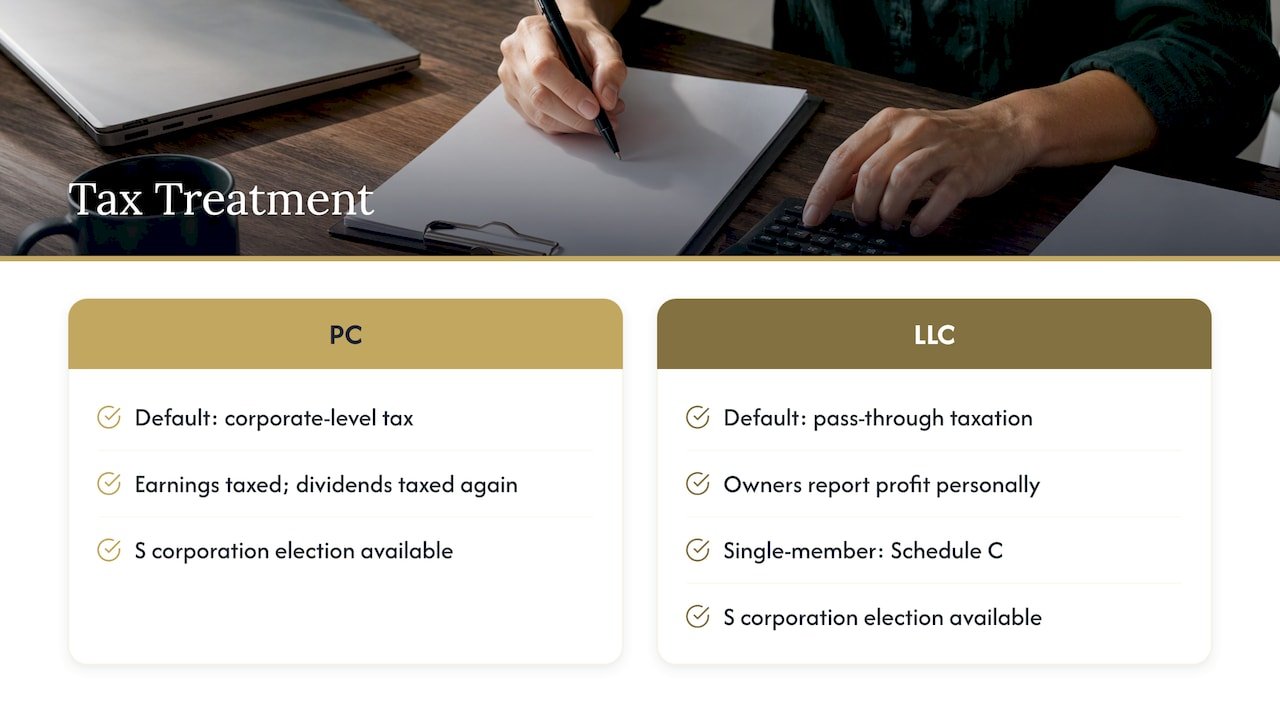
Professional corporation. A PC is taxed as a corporation by default. The company pays tax on its earnings and shareholders are taxed again on dividends. A PC can elect S corporation status, according to a Maryland guide to professional entities. Nolo notes that most PCs are classified as personal service corporations and pay a flat 21% federal rate unless they elect S status.
LLC or PLLC. An LLC is pass-through by default: profit is reported on the owner’s personal return. The same Maryland guide notes that LLC members report their share of profit personally. A single-member LLC usually reports on Schedule C. An LLC can also elect to be taxed as an S corporation. For a PLLC, North Carolina’s description is that it is not taxed at the entity level and members are taxed on its income.
State layers. Taxes differ by state. Some states tax LLCs beyond what the federal treatment implies. Forbes’ tax columnist has noted that some states charge LLCs extra corporate taxes even when they are federally treated as partnerships, which can raise the cost of being an LLC considerably. U.S. tax rules vary by state, so check yours before you decide.
The S corporation election
Many creatives with steady profit look at an S corporation election on top of an LLC. The election changes how owner pay is handled: you become an employee of your own company, which means payroll. Two of our guides explain what follows: how payroll setup for an LLC works and how to set payroll and draws so tax bills do not surprise you in April. The timing matters as well. Our Form 2553 deadline checklist walks through the filing window, and an S corporation also needs its own bookkeeping approach.
We can handle the tax side ourselves or work alongside the CPA you already have.
Ownership and day-to-day compliance
The structures also differ in how they are owned and run.
Ownership. A PC is typically limited to licensed professionals as shareholders, and the limit applies to employees, investors and family members alike. It is also limited to the services it was incorporated to provide. A law PC cannot offer design services, for example, as Forbes explains. Many states also require every PLLC member to be licensed in the same field, as the North Carolina Psychology Board describes it.
A standard LLC has no such restriction. You can bring in a business partner, a manager or a family member as an owner. That flexibility suits creative teams, such as a podcast with a co-host or a production company with a producer and an editor.
Management. In North Carolina, a PC’s shareholders own it and a board manages it, and a shareholder’s death or withdrawal does not affect it as long as licensing requirements are still met. A professional LLC is managed by its managers and may dissolve on a member’s death or withdrawal, depending on its articles or written agreement. Either way, a clear written agreement between owners is worth having.
Formalities. Corporations keep bylaws, a board, minutes and corporate records. LLCs carry fewer required formalities, a difference the Maryland firm above lists among the main practical ones.
Annual filings. Every state expects some recurring filing to keep an entity in good standing, such as an annual report or franchise fee. Missing it can put your protection at risk. See our overview of state annual report requirements for what to expect.
Side-by-side comparison
| Question | Professional corporation (PC) | Standard LLC | PLLC (where offered) |
|---|---|---|---|
| Who can form it | Licensed professionals only | Anyone | Licensed professionals only |
| Protection from business debts | Yes | Yes | Yes |
| Protection from your own malpractice | No | No | No |
| Default federal tax | Corporation | Pass-through | Pass-through |
| Tax elections | S election available | C or S election available | C or S election available |
| Who can own | Generally licensed professionals | Anyone, in most cases | Often licensed members only |
| Formalities | Bylaws, meetings, minutes | Fewer | Fewer |
| State rules | Set by state and licensing board | Set by state | Not offered in every state |
Which one fits you
Start from one question: does your state require a license for the work you do?
No license required. A standard LLC is the typical choice for creators, artists, musicians, producers, photographers, videographers, writers and talent managers. You get liability separation, pass-through taxation by default and the option to elect S corporation treatment once profit justifies it. If you are weighing it against a sole proprietorship with a trade name, our comparison of a DBA and an LLC goes through it.
License required, such as architecture, landscape architecture or interior design in some states. Your state and board decide whether you form a PC, a PLLC, an LLC with professional-entity filings or another structure. The state business-entity law and your board’s rule both apply, so start with both.
State examples differ sharply. California generally does not allow LLCs to provide licensed professional services, so licensed professionals there usually form a PC. The ABA’s guidance for lawyers notes that in California, sole practitioners have the professional corporation as their chief option. Other states permit PLLCs. Do not assume your state works like another.
Talent managers and agencies. If you manage creatives and carry no personal license for the services you provide, an LLC usually applies. If your state ties any part of your work to a license, confirm it with the state first.
Costs and what to budget for
Fees depend on the state. Filing costs, registered agent fees, any publication requirement and annual fees all vary. New York shows the spread: a recent comparison puts a PC filing at one level and a PLLC at a higher one, with a newspaper publication requirement for PLLCs and an annual fee based on New York-source income. Before you decide, look at your state’s filing fee schedule on the secretary of state’s site, including the annual cost of keeping the entity active.
When we quote our own work, it is a flat monthly fee agreed up front, never a percentage of your income.
Perspective
Creatives tend to arrive at this question from the wrong end. They ask which entity is best, when the better question is which entity their state allows and what will they do with it every month after it is formed.
The entity is only the container. The protection depends on how you run the business inside it: a separate bank account, contracts in the company’s name, bills paid on time, annual filings made and books kept current. Those habits are routine, and they are where most owners fall behind because the creative work comes first.
That is the part we take on. We pay the bills, keep the books and monthly reports, and keep the business in good standing. Whether you choose an LLC or a licensed-professional entity, we can handle your tax work or work alongside your CPA. Confidentiality is standard practice for us, and we are glad to sign an NDA before we start.
Kelli
How we help with entity setup and upkeep
We offer business formation and incorporation, including registered agent service, business banking setup and compliance and annual report filing. After formation, our accounting and bookkeeping and business management teams handle the monthly work that keeps the entity in good standing. Our tax preparation and filing covers the return, whichever entity you choose.

The monthly service is one flat fee agreed up front, so you know the cost before we start.
FAQ
Is a PLLC the same as a professional corporation?
No. A PC is a corporation formed by licensed professionals, while a PLLC is a form of LLC for the same group. Both limit liability for business debts and neither covers your own malpractice. They differ in default taxation, management and which states offer them.
Does my side hustle or creative business need an LLC?
Not legally in every case, since a sole proprietorship exists by default. An LLC separates your personal assets from the business’s debts and contracts, and it gives you tax options later. It does not protect you from your own negligence, and state rules and fees vary.
Can a creative without a license form a professional corporation?
Generally no. A PC or PLLC is limited to licensed professionals, and the profession must be one your state covers. If your work needs no license, a standard LLC is the usual route.
Is an LLC or a PC better for taxes?
It depends on your income, your state and your plans. A PC is taxed as a corporation by default, while an LLC passes profit through to your personal return and can elect corporate or S corporation treatment. We can work with you or alongside your CPA to look at your own numbers, and we promise no specific tax result.
Next step
If you are choosing an entity or already have one that needs proper bookkeeping, tax work and filings, we are happy to talk it through. Book a free consultation and we will look at your state, your work and what comes next.
Sources
- What Is a Professional Corporation? (Nolo)
- Professional: Do I Need To File (North Carolina Secretary of State)
- Choose a Business Structure: Professional Entities (North Carolina Secretary of State)
- PLLC/PC (North Carolina Psychology Board)
- How to file a Professional Service Entity (New York State Office of the Professions)
- Illinois Administrative Code, Section 150
- Guide for Determining Permissible Entity Types for Licensed Professionals (Texas Secretary of State)
- How to Form a Professional Entity in Maryland (Thienel Law)
- What Type of Entity Is Best for Maryland Professional and Family-Owned Businesses (Nguyen Roche)
- LLCs, S Corps & PCs: Choosing A Business Entity (Forbes)
- Business Formation and Tax Considerations for Solos and Small Firms (American Bar Association)
- Business funding options
Recommended
- DBA vs. LLC: Which One Does Your Business Need?
- Avoid an April Tax Shock: Set Payroll and Draws for Your U.S. LLC
- Business Formation
- Sales Tax for Services: What Creatives Need to Know
This article is general information, not tax, legal or financial advice. Talk to a professional about your situation.


