
Fixed asset tracking means keeping one dependable record of every piece of long-lived equipment your business owns: what you paid, when you bought it, how you use it, and what happened to it later. For a photographer, videographer, podcaster or studio owner, that record is what supports your depreciation deductions at tax time and gives you an accurate balance sheet all year. The simplest way to keep it is a register with a written capitalization policy behind it, reviewed on a schedule. At KelliWorks, we keep that register as part of the monthly books, so the gear you buy is recorded correctly from the first invoice.
TL;DR
- A fixed asset is equipment you own and use in the business for more than one year: cameras, lenses, computers, microphones, lighting, studio furniture, a business vehicle.
- Your register should show when and how you acquired each item, what it cost, how you use it, the deductions you took, and what happened when you sold or retired it.
- A capitalization threshold is the dollar line between “expense it now” and “track it as an asset.” The IRS de minimis safe harbor allows up to $2,500 per item or invoice for businesses without an audited financial statement.
- Write the policy down, sign it and keep it with your records. Tax rules for assets change, and U.S. tax rules vary by state, so your state return may treat the same purchase differently than your federal return.
- We can handle the tracking and the tax work ourselves, or work alongside your existing CPA.
Table of Contents
- What counts as a fixed asset in a creative business
- What a fixed asset register should include
- How a capitalization threshold works
- A fixed asset policy you can copy
- How the register ties to tax depreciation
- A tracking routine that holds up
- What we do with your assets
- Our view: the register is a planning tool
- FAQ
- Sources
What counts as a fixed asset in a creative business
A fixed asset is a physical item your business buys to use in its work, not to resell, and that will last more than a year. The IRS draws the same line when it explains depreciation: property you use in your business or to produce income, with a useful life that can be determined and is longer than one year, is generally depreciated over time rather than deducted all at once.
For creatives, that usually looks like this:
- Camera and video gear: camera bodies, lenses, gimbals, drones, tripods, lighting kits.
- Audio equipment: microphones, interfaces, mixers, monitors, instruments, DJ controllers.
- Computers and devices: editing workstations, laptops, tablets, external drives.
- Studio and office items: desks, acoustic treatment, backdrops, shelving.
- Vehicles: a van or car used for the business, which carries extra record rules covered below.
Things that are not fixed assets include a memory card replaced every season, cables, a bag of props or a software subscription paid monthly. Those are ordinary expenses. Merchandise you make to sell is inventory, which is also tracked differently.
The test is about how you use an item, not what it is. A camera you buy to shoot client work is a fixed asset. The same camera bought for resale is inventory.
What a fixed asset register should include
A fixed asset register is the list that holds every asset and its history. It can be a spreadsheet or a line in your accounting system. What matters is that each asset has its own line, a unique ID and a paper trail.
The IRS tells small businesses to keep records showing when and how you acquired each asset, the purchase price, the cost of any improvements, the Section 179 deduction taken, depreciation deductions taken, any casualty-loss deductions, how the asset was used, and when and how you disposed of it, including the selling price and selling expenses. Build your register around that list and add the fields that help you run the business.
| Field | Why it matters | Example |
|---|---|---|
| Asset ID | Lets you match the item to a tag or serial number | CAM-001 |
| Description and serial number | Identifies the item for insurance and resale | Mirrorless camera body, serial on invoice |
| Category | Drives the depreciation class | Camera equipment |
| Date placed in service | Starts the depreciation clock | March 3 |
| Cost, including setup | Your starting basis | Price plus shipping and sales tax |
| Vendor and invoice reference | Supports the purchase if questioned | Invoice saved in the shared folder |
| Business-use percentage | Only business use is deductible | 80% |
| Method and deductions taken | Prevents double counting | Section 179, bonus or MACRS |
| Location and custodian | Finds gear on a shoot or in a studio | Studio A, or with a contractor |
| Status and disposal details | Records sales, trade-ins, loss or theft | Sold, with date, price and fees |
Two fields deserve extra care.
Business-use percentage. The IRS requires records showing business, investment and personal use of property, and depreciation is allowed only for the business or investment portion. Publication 946 gives an example: an $11,000 asset used 80% for business has an $8,800 business cost for Section 179. If you edit on a laptop that your family also uses, record the split and keep a note of how you worked it out.
Vehicles and similar listed property. Cars and some other property fall into a category the IRS calls listed property, which has stricter records. If a vehicle is on your register, pair it with a mileage log. Our mileage tracking checklist walks through what that log should hold.
How a capitalization threshold works
A capitalization threshold is the minimum cost at which you treat a purchase as an asset instead of an expense. Under the threshold, you record the purchase as an expense in the year you buy it. At or above it, you add it to the register and depreciate it, or deduct it using a specific tax election.
There are two layers, and they are easy to confuse.
Your own policy. Accounting standards do not hand you a number. A threshold is a policy choice that businesses write down and apply consistently.
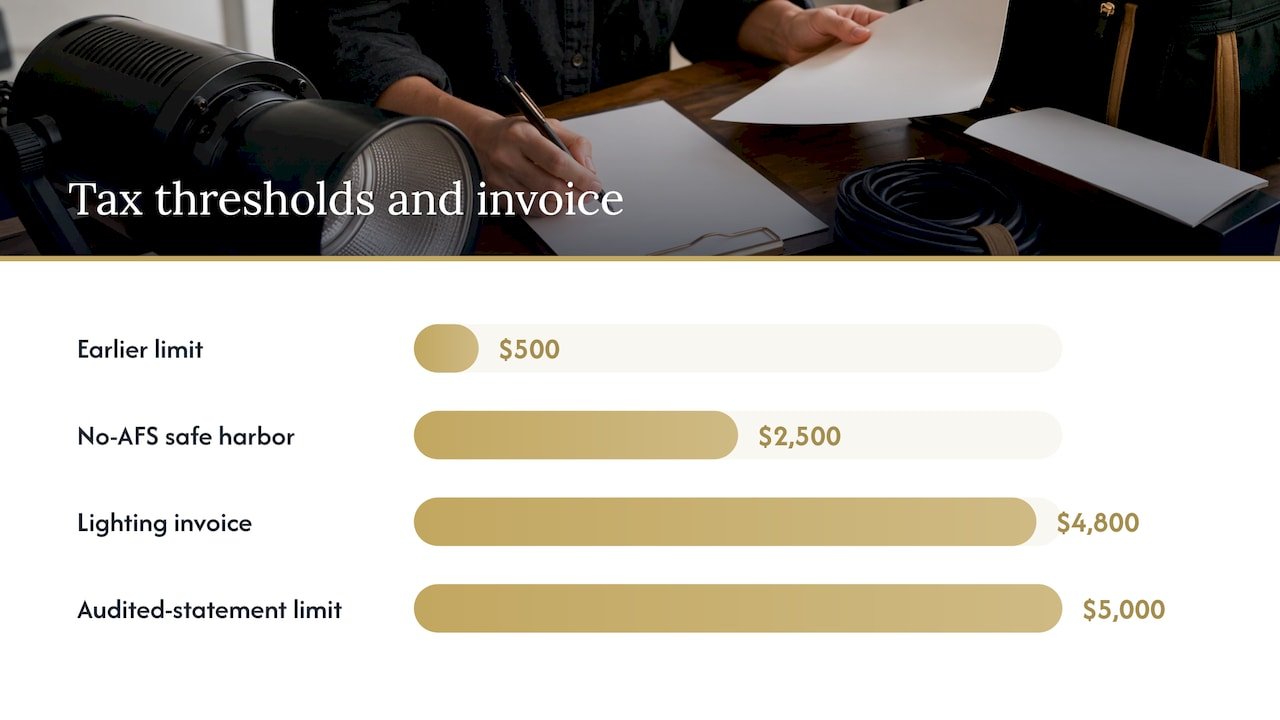
The federal tax safe harbor. The IRS gives a bright line for taxes. Under the de minimis safe harbor, a business without an applicable financial statement may expense up to $2,500 per item or per invoice, up from $500 for tax years beginning on or after January 1, 2016. A business with an audited financial statement can go up to $5,000. Most creative businesses and sole proprietors fall into the $2,500 group. The safe harbor is an election you make for the tax year, and once made it applies to every qualifying purchase that year. It excludes inventory and land, according to the IRS course material on the rule.
The safe harbor works by invoice or item, so a single invoice for a $4,800 lighting package is above the line even if each light costs $600. Read how the invoice is itemized before you decide.
Choosing a number
Pick a threshold that matches how you actually buy. If you replace $300 accessories all the time, tracking each one adds work and no value. If your gear tends to run $2,000 to $6,000, a threshold near $2,500 keeps the register to the pieces that matter. Many small businesses align the policy with the federal safe harbor so the books and the tax return agree. Your CPA may suggest a different number for your situation.
A fixed asset policy you can copy
A fixed asset policy is one or two pages that say how your business decides what is an asset and how it keeps the records. A state agency’s capitalization policy guide uses a clean structure that translates well to a small studio: write the policy, sign it (even as a sole proprietor, so you have a record of what you decided and when), and file paper and electronic copies.
Here is a sample you can adapt. It is an example, not tax advice.
Purpose. This policy sets how [Business Name] records and tracks equipment so that financial statements and tax returns are accurate and consistent.
Definition. A capital asset is tangible property that the business owns, uses in operations, and expects to last longer than one year, with a cost of $2,500 or more per item or invoice.
Cost. Recorded cost includes the purchase price, sales tax, shipping and setup costs needed to put the item to work. Routine repairs and maintenance are expensed.
Below the threshold. Purchases under $2,500 are expensed when incurred and are covered by the de minimis safe harbor election for the year.
Depreciation. Assets are depreciated by category. Tax depreciation follows IRS rules, including any Section 179 or bonus depreciation elected for the year.
Records. Each asset has a unique ID, an invoice copy, a placed-in-service date, a business-use percentage and a location. The register is reconciled to the books once a year, and disposals are recorded when they happen.
Approval. Signed by the owner, [date].
Strong policies also keep a few habits: keep invoices and contracts for at least as long as the asset is on your books, and for the period your tax advisor recommends after you dispose of it. The state guide above sets a four-year minimum for its own agency, which is a floor to build from, not a federal rule for you.
How the register ties to tax depreciation
The register is only useful if it connects to the return. For creatives, three tax tools matter most.
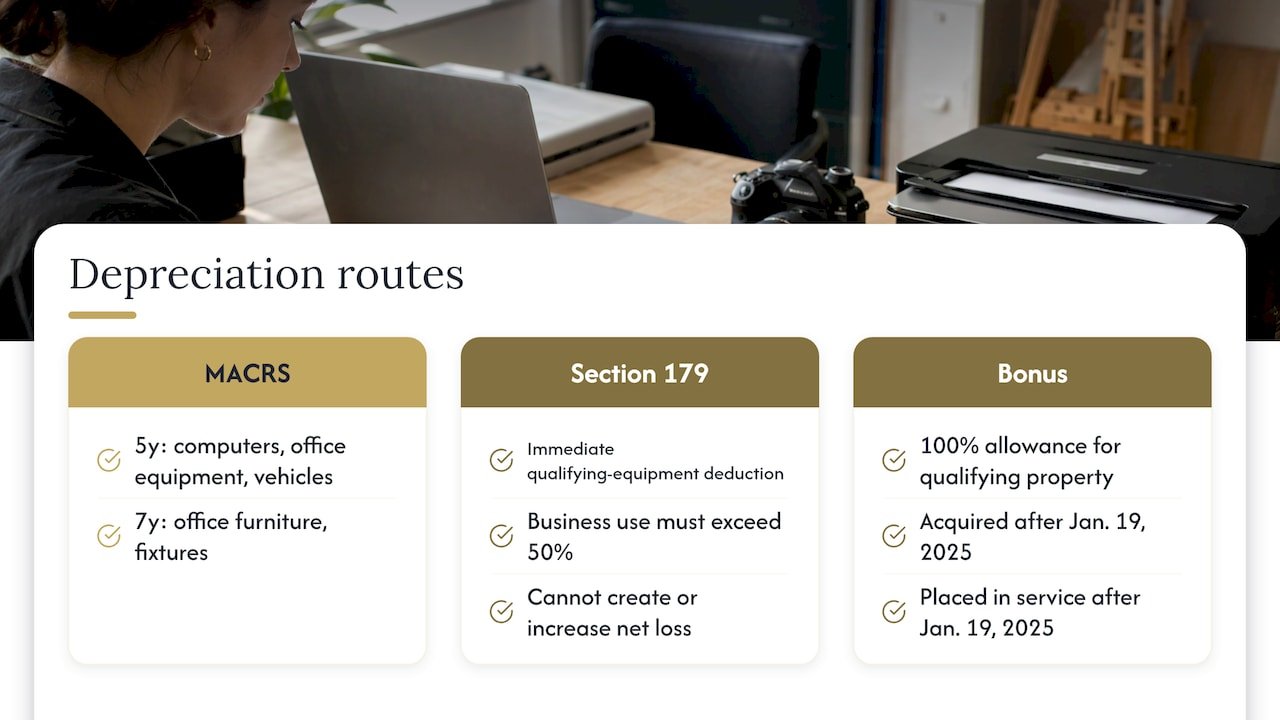
MACRS. The IRS depreciation system, MACRS, spreads an asset’s cost over a set recovery period. In Publication 946, computers, office equipment and vehicles generally fall in the 5-year class, and office furniture and fixtures in the 7-year class. Recording the right category in the register on day one saves you from correcting it later.
Section 179. This election lets you deduct the cost of qualifying equipment in the year you place it in service rather than over several years. For tax years beginning in 2026, the maximum Section 179 deduction is $2,560,000, reduced dollar for dollar once the property you place in service passes $4,090,000. Those limits are far above what a typical studio buys, but two rules matter at small scale. The property has to be used more than 50% for business, and the deduction cannot create or increase a net loss.
Bonus depreciation. The same IRS publication notes that P.L. 119-21 reinstated a 100% special depreciation allowance for certain qualified property acquired and placed in service after January 19, 2025. Whether you use Section 179, bonus depreciation or regular MACRS for a given purchase depends on your income, your state and your plans for the year. We never promise a specific tax outcome, and the right choice is a planning decision to make before you buy, not after. Our guide to deductions for U.S. owners in 2026 covers how these changes fit into the larger picture.
Remember that states often follow federal rules only partly. Some states cap or decouple from bonus depreciation or Section 179, so U.S. tax rules vary by state. Your register should be able to show both a federal and a state view of the same asset when the two differ.
Worked example: a video producer’s year
A freelance video producer buys the following in one year:
- A cinema camera body at $3,400 on one invoice.
- A laptop at $2,300 on one invoice.
- A lens set at $1,900 and a microphone kit at $850, both on one invoice, so $2,750 in total.
- A $15 memory card.
Under a $2,500 policy that matches the de minimis safe harbor, the laptop and the memory card are expensed. The camera body is above the line and goes on the register. The lens and microphone invoice totals $2,750, which is above the safe harbor line, so it also goes on the register as a single entry or as two lines under one invoice, depending on how the producer’s policy defines an item. That detail matters, and it is a reason to settle the wording in the policy before the purchases happen.
The producer then records the camera as a 5-year asset with a 90% business-use percentage because the camera also shoots family video. The tax treatment for the year depends on the elections made, which is a conversation with a tax professional before filing. The register captures everything that conversation needs.
A tracking routine that holds up
Most registers fail because they are built once and never maintained. This routine keeps the work small.
- Take a physical inventory. Walk through your studio, cases and storage. Match each item to an invoice and a serial number. Missing paperwork is common for older gear, so reconstruct what you can from bank and card statements.
- Assign IDs. Give each asset a unique ID and put a label or tag on it if the item travels.
- Record at purchase, not at tax time. Add the asset to the register the week it arrives. Save the invoice in a shared folder named for the asset ID.
- Set the depreciation parameters. Record the category, recovery period, placed-in-service date and business-use percentage.
- Reconcile monthly. Compare new equipment purchases in the books to the register. Items that look like equipment but were coded to an expense account are the most common error.
- Record disposals immediately. When you sell, trade in, donate or lose an item, record the date, proceeds and costs of sale. The IRS wants that information on file.
- Review once a year. Before year end, confirm that each item is still in use, still in the same location and still has the same business-use percentage.
A spreadsheet works while you have a small number of assets. Once you have a team, multiple locations or equipment shared across productions, a register inside your accounting system keeps the totals in step with the ledger. Our bookkeeping best practices and financial records guide for freelancers explain how the register fits with the rest of your records.
Where it goes wrong
- Capitalizing repairs. A new battery grip is probably an expense. A major upgrade that extends the life of an asset may be an improvement. The register should reflect the difference.
- Forgetting personal-use gear. If you move a personal laptop into the business, the starting basis is not simply what you paid. For converted property, the basis is generally the lesser of adjusted cost or fair market value on the conversion date, and Section 179 is not available because it was not purchased for business use. Ask us or your CPA before you start depreciating it.
- Losing the paper trail. Without the invoice, you cannot show the cost or date. Save digital copies on purchase.
- Never recording the sale. Selling old gear without recording it leaves depreciation running on an asset you no longer own.
What we do with your assets
Assets sit between bookkeeping and tax, which is why they get dropped. We run the money side of a creative career: bookkeeping and monthly reporting, tax planning and preparation, bill pay, collections, entity work, banking and compliance. Equipment gets recorded as part of that monthly work, and our tax preparation can use the register directly or sit alongside your existing CPA’s work. Our fee is one flat monthly amount agreed up front, never a percentage of your income. Confidentiality is standard practice for us, and we are glad to sign an NDA before we start.
If you want to see what is included, our accounting and bookkeeping services page explains it, and our tax preparation and filing page covers the return side. If you would rather talk through your equipment first, you can book a free consultation.
Our view: the register is a planning tool
Most creatives think of fixed assets as a year-end chore. We see them as the clearest record of how you have invested in your work.
When the register is accurate, the purchase decisions get easier. You know what you own, what is fully depreciated, what is due for replacement and what a new purchase will do to your books. You can plan a big gear year with your tax advisor ahead of time instead of reacting in March.
That is why we put asset tracking inside the monthly routine. We pay the bills, keep the books and keep the business in good standing, so the register stays current without you thinking about it. When tax season comes, the information is already there.
If your numbers are in a spreadsheet you have not opened since last spring, that is a normal place to start. We will help you sort it out.
Kelli
FAQ
What is the difference between a fixed asset register and fixed asset tracking?
The register is the list itself: each asset, its cost, its dates and its history. Tracking is the ongoing process of keeping that list accurate as you buy, use, move and dispose of equipment. A register you never update stops being useful quickly.
What capitalization threshold should a small creative business use?
Many small businesses use $2,500, which matches the federal de minimis safe harbor for businesses without an audited financial statement. Some choose a lower number for tighter control, and the right figure depends on how you buy and what your tax advisor recommends. Whatever you choose, write it into your policy and apply it the same way each year.
Do I need to track assets if I deduct everything under Section 179?
Yes. The IRS still expects records showing the cost, date, use and deduction taken, and you will need them if you later sell, trade in or stop using the item. Business-use percentage and disposal records are also needed to figure the result correctly when the asset leaves the business.
Can you work with my current CPA on fixed assets?
Yes. We can handle tax ourselves or work alongside your existing CPA, and we keep the register in step with the books either way. Our fee is a flat monthly amount agreed up front. To talk through your equipment and your records, book a free consultation at kelliworks.com/consultation.
Sources
- IRS: What kind of records should I keep
- IRS Publication 946 (2025), prior-year PDF
- IRS Publication 946, What’s New for 2026
- IRS Notice 2015-82: De minimis safe harbor limit
- IRS Link & Learn Taxes: de minimis safe harbor
- Capitalization policy guide (state agency)
Recommended
- QuickBooks Inventory Tracking Setup With Bookkeeping Controls for SMBs
- Paperless Accounting Setup: A Practical Guide for Small Business
- Financial Records for Freelancers: What to Keep and Why
- Streamline Small Business Finances in Hours, Not Weeks
This article is general information, not tax, legal or financial advice. Talk to a professional about your situation.


