


If you formed an LLC or corporation for your creative work, your state requires you to name a registered agent: a person or company with a physical street address in that state, available during business hours to receive legal papers and official notices on your behalf. You can usually serve as your own agent, but the address you list becomes public record. Many creators prefer to hand the role to a team that handles it alongside formation, annual reports and good standing. That is what we do at KelliWorks.
This guide explains who qualifies, which address counts, what the agent actually does, what happens when the role lapses, and how to decide who should hold it for your business.
TL;DR
- Every state requires LLCs and corporations to appoint and maintain a registered agent in the state where the entity is registered. Sole proprietorships and general partnerships are generally not required to have one.
- The agent must have a physical street address in the state (not a P.O. box) and be reachable during normal business hours. An individual must be an adult who lives in the state, or the agent can be a business entity authorized there.
- The agent receives lawsuits, subpoenas and state notices. Missing them can lead to default judgments or to your state ending your LLC.
- If you register in a second state, you generally need an agent there too.
- You can be your own agent, but your address goes on public filings. We offer registered agent service as part of business formation, for one flat monthly fee agreed up front.
Table of Contents
- What a registered agent is, in plain terms
- Which businesses need a registered agent
- Who can be your registered agent
- What the address has to be
- What a registered agent does
- Can you be your own registered agent?
- What happens if you do not keep a registered agent
- A short checklist before you appoint an agent
- A note on privacy and ownership filings
- What this means for your taxes
- Perspective
- How we can help
- FAQ
- Next step
- Sources
What a registered agent is, in plain terms
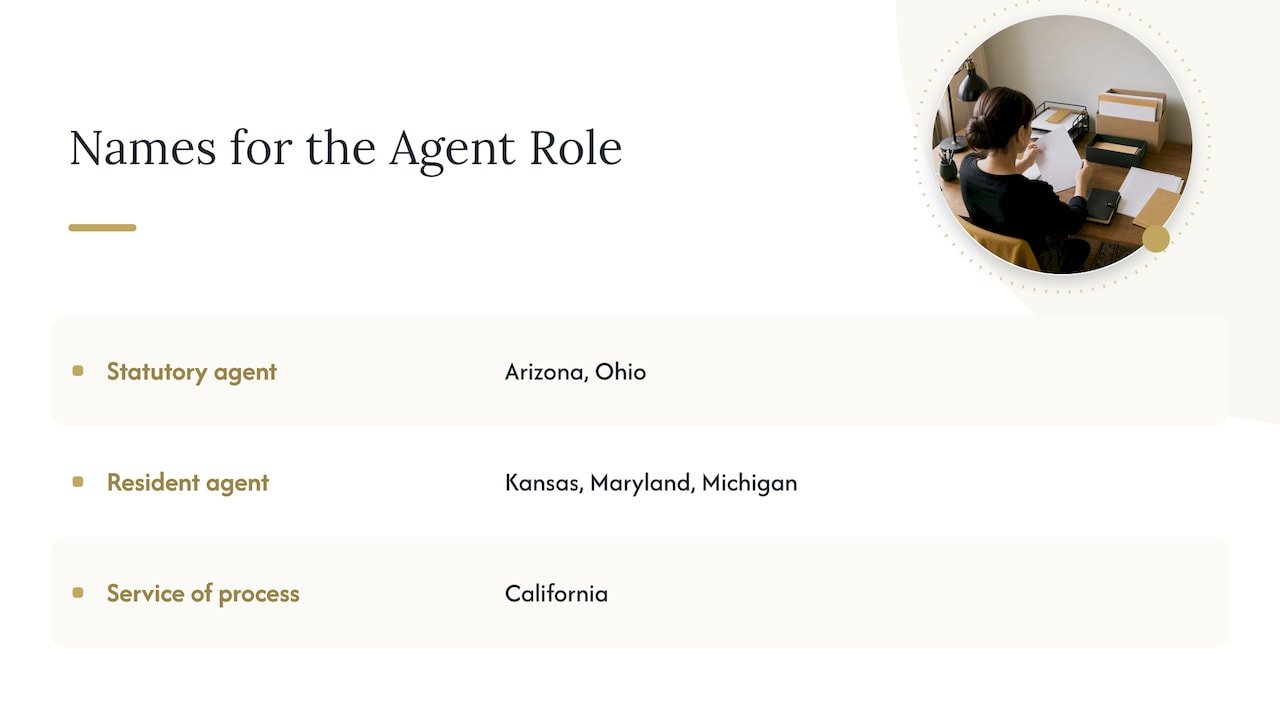
A registered agent (some states say statutory agent, resident agent or agent for service of process) is the contact point your state and the courts use to reach your business. When someone sues your LLC, a process server delivers the court papers to the agent. When the state sends an annual report reminder or a tax notice, it goes to the agent’s address on file.
States use different names for the same role. According to a 50-state survey, Arizona and Ohio say statutory agent, several states including Kansas, Maryland and Michigan say resident agent, and California says agent for service of process. The name changes, but the job is the same.
For a creative business, this matters more than it sounds. Your LLC may be a one-person company that licenses music, invoices brand sponsors, or books photography clients. You are often on the road, on set or in a studio, and legal papers cannot wait for your return.
Which businesses need a registered agent
The requirement follows the way the business was formed.
- LLCs, corporations, limited partnerships and LLPs: these entities are created by filing with a state, and every state requires them to appoint and keep a registered agent.
- Sole proprietorships and general partnerships: these are generally not required to have one, because nothing is filed with the state to create them. If you operate under a trade name, our guide on DBA vs. LLC explains how the two structures differ.
- Out-of-state registration: an LLC generally needs an agent in its home state and another in each additional state where it registers as a foreign LLC. A creator who forms in one state but works or hires in another should plan for this.
A few states work differently from the usual model. Washington requires domestic entities and registered foreign entities to designate and keep an in-state agent with a physical Washington address, according to the Washington Secretary of State. Utah’s updated statute, Utah Code § 16-1a-402, effective October 1, 2026, requires domestic filing entities, registered foreign entities and DBAs to designate and maintain a Utah registered agent. Some states, including Pennsylvania, ask for a registered office rather than a named agent, and New York treats its Secretary of State as the default agent for LLC service of process. The details vary by state, so check your state’s filing office for the exact wording.
Who can be your registered agent
The core qualifications are consistent across the country, even though every state words them a little differently.
- An individual who lives in the state. Most states require the person to be at least 18 and to live in the state.
- Or a business entity authorized in the state. This is a company, domestic or registered as a foreign entity there, that provides the service.
- A physical street address in the state. A P.O. box or a mail drop does not qualify as the agent’s address.
- Availability during normal business hours. Someone has to be there to accept papers.
- Consent. The agent must agree to serve.
Here is how two states put it.
Texas. The Texas Secretary of State’s Form 205 instructions say an LLC’s agent may be a domestic or Texas-registered foreign entity or a Texas-resident individual. The registered office must be a street address where the agent can be personally served during normal business hours, and the agent must consent. Texas expressly does not allow the LLC to serve as its own agent.
Wyoming. The Wyoming Secretary of State says domestic and foreign businesses must continuously maintain an agent. An individual must be at least 18, reside in Wyoming, and have a physical Wyoming address and a valid email address.
Colorado. Changes effective July 1, 2025 tightened eligibility. The Colorado Secretary of State says individual agents must verify Colorado residency, and entity agents must be registered with the state and in good standing.
Rules also change over time through legislation, as Colorado’s 2025 update shows. A state page you read two years ago may not match what your state requires today.
What the address has to be
This is where creators most often go wrong. The registered office address is not your mailing preference. It is the place where a process server can walk in and hand papers to a real person.
- It must be a street address in the state where the entity is registered.
- It cannot be a P.O. box.
- Someone must be there during regular business hours.
- If your studio, apartment or co-working desk is in another state, it does not count for your home-state filing.
The purpose is practical. A process server must be able to reach a real place and hand documents to a person. A home office that is empty from nine to five, or an address that changes every lease cycle, defeats that purpose.
What a registered agent does
The responsibilities are narrow but important.
- Accepts service of process. The agent is the formal point for personal service of lawsuits and subpoenas.
- Receives official state notices. Annual report reminders, tax notices and other government correspondence arrive at the agent’s address.
- Forwards documents promptly. The agent’s job is not just to receive papers but to get them to you in time to respond. Response deadlines on lawsuits can be short.
- Keeps the address current. If the agent or the registered office changes, the change should be filed with the state. Texas, for example, asks that a change of agent or registered office be filed with the Secretary of State.
The agent does not give legal advice, run your business or file your taxes. It is a receiving and forwarding role, and it works only if it is reliable every business day of the year.
Can you be your own registered agent?
In most states, yes, if you meet the individual requirements. In Wyoming, for example, you need to be at least 18, live in the state, have a physical Wyoming address and have a valid email address. Some states differ: Texas does not let the LLC itself serve as agent, though an eligible individual can.
Before you list yourself, weigh three practical points.
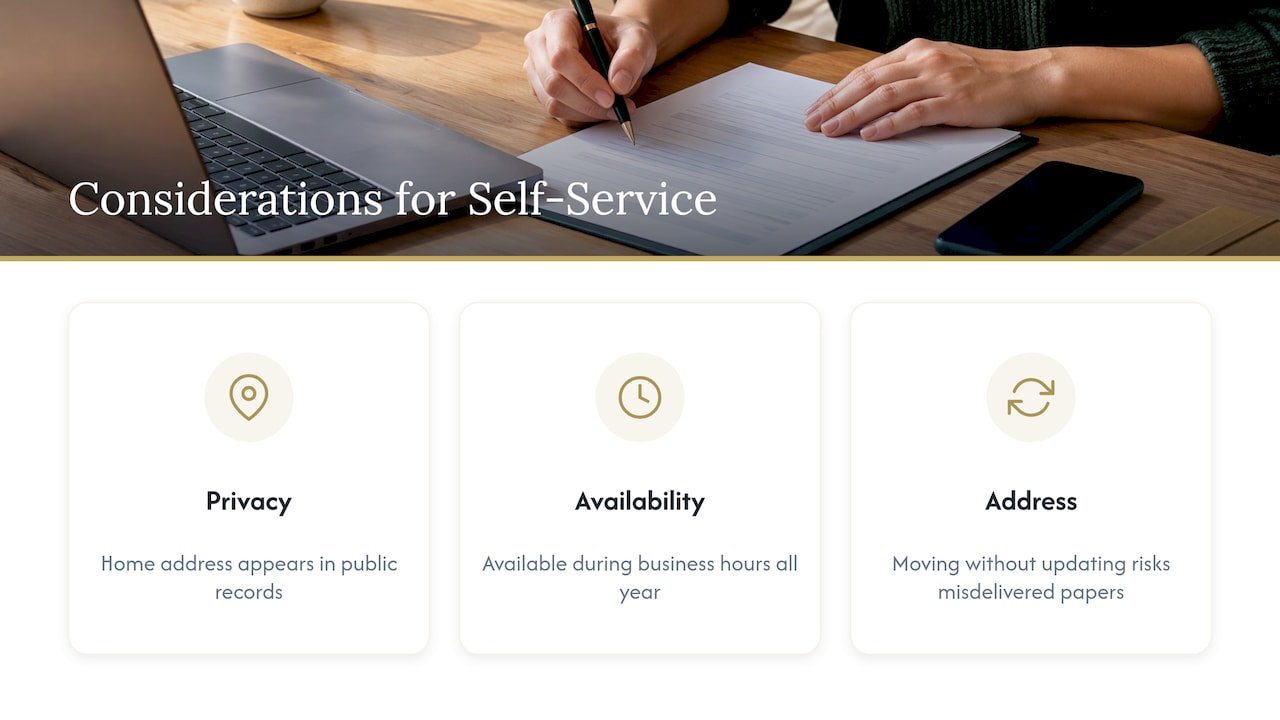
Your address becomes public. Nolo’s legal guide notes that using an individual agent can expose a home address in public records. For a creator with a public profile, such as an influencer, streamer or actor, a home address in a state database is a real privacy concern.
You must be available all year. The same guide points out that the person must stay available during business hours throughout the year. Tours, shoots, festivals and travel do not pause that obligation.
You must keep the address current. If you move your studio or home and forget to update the filing, important papers can be misdelivered. Lawsuit papers served at an old address can lead to a default judgment before you ever see them.
If you are not sure whether your situation is a good fit for being your own agent, that is a good question for our team during formation. We can also keep it discreet: confidentiality is standard practice for us, and we are glad to sign an NDA before we start.
What happens if you do not keep a registered agent
The consequences are real, and they come from the state.
- Missed legal papers. If no one can be served, a lawsuit can move forward without your knowledge.
- Loss of good standing. States can treat a missing agent as a compliance failure. In Texas, failing to maintain a registered agent and registered office may result in involuntary termination of the LLC, according to the Form 205 instructions.
- Administrative dissolution in other states. Other states have similar grounds for dissolving an entity that goes without an agent for a set period.
- Trouble with banks and contracts. A business that is not in good standing can run into problems opening accounts, signing label, brand or venue agreements, and raising money.
The common thread is that the failure is usually quiet. A notice is sent to an old address, nobody sees it, and the problem surfaces months later.
A short checklist before you appoint an agent
- Confirm your state’s rules. Look up the agent requirements on your Secretary of State’s website, because eligibility, terminology and address rules vary.
- List every state where you are registered. Home state plus any state where you registered as a foreign LLC.
- Decide who holds the role. Yourself, a trusted individual who lives in the state, or a company that provides the service.
- Check that the address is a street address that is staffed during business hours.
- Get the agent’s consent in writing if it is another person or company.
- Put a reminder on your calendar to review the agent each year when your annual report comes due.
- File a change promptly whenever the agent or address changes.
The annual report is the natural moment to review all of this. Our guide on state annual report requirements explains how those filings protect your good standing.
A note on privacy and ownership filings
Choosing a registered agent affects what is public about your business. The agent’s address appears on state filings, but your ownership information is a separate matter. If you want to understand which ownership details are reported and where, see our overview of beneficial ownership reporting changes. Keeping the two straight helps you decide how much of your personal information you are comfortable putting into filings.
What this means for your taxes
The registered agent role is a state compliance matter, not a tax filing. Still, state notices that reach the agent can include tax correspondence, and a lapse in good standing can complicate your filings. U.S. tax rules vary by state, so what applies to an LLC in one state may not apply in another. We can handle your tax planning and preparation ourselves, or work alongside your existing CPA. We do not promise any particular tax outcome, but we do make sure the right notices reach the right people on time.
Perspective
Most creators we meet did not choose a registered agent. They filled in a box on a formation form and moved on. Years later, a notice goes to an address nobody checks.
We think the role is best handled by the same team that already looks after your formation, annual reports and bank setup. When one team holds the whole compliance picture, an address change, a state notice or a deadline does not fall between two providers.
That is how we work. We run the money and compliance side of a creative business: bookkeeping, tax, bill pay, collections, entity and banking. For a creator who is on the road or in the studio most of the year, having a real team receive and route state papers is one less thing to carry. Confidentiality is standard practice for us, and we are glad to sign an NDA before we start.
Kelli
How we can help
Our business formation service covers business formation and incorporation, registered agent service, business banking setup, and compliance and annual report filing. That means the person who files your LLC can also be the one who receives your state notices and keeps the filings current.

If you need a professional business address as well, our virtual mailbox and business address service is another way to keep your home address out of day-to-day business paperwork. For pricing, we work on one flat monthly fee agreed up front, never a percentage of your income.
FAQ
Do I need a registered agent for my LLC?
Yes, in every state an LLC must appoint and maintain one in the state where it is registered. If you register in additional states as a foreign LLC, you generally need an agent in each of them. Sole proprietorships and general partnerships are generally not required to have one.
Can I use my home address?
If you act as your own agent, you can use a street address in your state where you are available during business hours, which can be your home. Keep in mind that the address becomes public record. If you want your home address off state filings, a business address or a professional agent is the usual answer.
Can my LLC be its own registered agent?
It depends on the state. Texas does not allow an LLC to serve as its own agent, according to the Secretary of State’s instructions. In most states, an individual who meets the residency and address rules, or an authorized entity, can serve. Check your state’s filing office before you appoint.
What are the registered agent’s responsibilities?
The agent receives lawsuits, subpoenas and official state notices at a physical in-state address during business hours, and forwards them to you promptly. The agent also needs to keep the address current with the state, and file a change when the agent or address changes.
What happens if my agent resigns or moves?
You need to name a new agent and file the change with your state. Until you do, your LLC is exposed to missed papers and, in some states, to administrative dissolution. Treat a change of agent as a filing that cannot wait.
Next step
If you want a team to hold your registered agent role and keep your filings, banking and books in line, we would be glad to talk. Book a free consultation and we will look at your state, your entity and what you need in place.
Sources
- Registered Agents, Washington Secretary of State
- Utah Code § 16-1a-402
- Form 205 Instructions, Texas Secretary of State
- Registered Agent FAQ, Wyoming Secretary of State
- Registered Agent Requirements Effective July 1, 2025, Colorado Secretary of State
- What is a Registered Agent and Who Can Be Your Company’s Agent, Nolo
Recommended
- Professional Corporation vs. LLC: Which Fits a Creative Business?
- Avoid an April Tax Shock: Set Payroll and Draws for Your U.S. LLC
- Protect Good Standing: State Annual Report Requirements for U.S. SMBs
- DBA vs. LLC: Which One Does Your Business Need?
This article is general information, not tax, legal or financial advice. Talk to a professional about your situation.


