


An inventory write-down lowers the value of stock on your books when it is worth less than you paid for it. You still own the items and may still sell them, but at a price that no longer covers their cost. If you sell merch, prints, gear, physical media or products, you will face this sooner or later, and how you record it affects your profit, your balance sheet and your tax return. We run the books for creatives and small business owners every day, and this is the walkthrough we would give you at the start of an engagement.
TL;DR
- A write-down reduces inventory to a lower value when some value remains. A write-off removes it entirely when it is worth nothing.
- Under U.S. GAAP, most small businesses measure inventory at the lower of cost or net realizable value (NRV): expected selling price minus the cost of selling it.
- The standard entry debits cost of goods sold (or a loss account) and credits inventory or an allowance account.
- Tax rules are not the same as book rules. The IRS has its own test for damaged or unsellable goods, and documentation decides whether the deduction holds.
- U.S. tax rules vary by state, so confirm how your state treats inventory losses.
Table of Contents
- Write-down, write-off and impairment: what each one means
- When you should write down inventory
- How U.S. GAAP measures the write-down
- How to record an inventory write-down, step by step
- Where a write-down goes wrong
- Book treatment versus tax treatment
- What this looks like for creatives
- How we handle it for you
- FAQ
- Ready to get your inventory books in order?
- Sources
Write-down, write-off and impairment: what each one means
These terms overlap, so it helps to separate them.
- Write-down: the stock is still there and still sellable, but its value has dropped below what you paid. You reduce the recorded amount to the lower figure. Investopedia’s explanation describes this as an adjustment where some residual value remains.
- Write-off: the stock has lost all value. It is spoiled, destroyed, stolen, lost or truly unsellable, and you remove the whole balance from your books.
- Impairment: the general word for a drop in an asset’s value. For inventory, it usually means the same thing as a write-down.
The mechanics are close to identical. What differs is how much comes off the books: part of the cost in a write-down, all of it in a write-off.
A quick example for a merch seller
Say you ordered 40 hoodies at $30 each, so your books carry them at $1,200. The design has gone out of style and you now expect to sell them for $18 each, with about $3 per hoodie in shipping supplies and fees.
- NRV per hoodie: $18 minus $3 = $15
- Cost per hoodie: $30
- Write-down per hoodie: $15
- Total write-down: 40 x $15 = $600
The hoodies now sit on your books at $600, and the $600 loss lands in the period where the drop in value happened. If a box of those hoodies later gets water damaged and cannot be sold at all, the remaining carrying value of that box is written off.
When you should write down inventory
The usual triggers are easy to recognize:
- Slow-moving or obsolete stock: last season’s merch, outdated gear, formats nobody buys anymore.
- Damage or wear: scuffed vinyl sleeves, creased prints, returned items that cannot be resold at full price.
- Price drops: you cut prices permanently or a supplier’s market price falls.
- Loss events: theft, spoilage, fire or flood, or stock that is simply missing after a count.
The standard rule is timing. The loss belongs in the period it happens, not in the period you eventually sell or throw the stock away. Waiting until disposal puts the expense in the wrong period and makes both years’ profit look off.
A practical rhythm is to review stock at least at year-end and ideally quarterly. Count what you have, compare it to your records, and flag anything aging, damaged or discounted below cost. If you track inventory in QuickBooks, our guide to QuickBooks inventory tracking with bookkeeping controls shows how to set up the item list so these reviews are quick.
How U.S. GAAP measures the write-down
The governing standard is FASB Topic 330 on inventory. Since ASU 2015-11, inventory measured by methods other than LIFO or the retail inventory method (FIFO and average cost are the common ones) is carried at the lower of cost and net realizable value. That ASU replaced the older lower-of-cost-or-market test for those methods and took effect for fiscal years beginning after December 15, 2016. LIFO and retail-method inventory still use the lower-of-cost-or-market rule.
In plain terms:
- Find your cost, which is what you paid plus freight in and similar costs to get the item ready to sell.
- Estimate NRV: the price you expect to get, minus costs to finish, sell and ship it.
- If NRV is below cost, the difference is your write-down.
When NRV is lower than cost, the FASB standard calls for recognizing the difference as a loss in earnings in the period it occurs. Causes it lists include damage, physical deterioration, obsolescence and changes in price levels.
Many small businesses do not issue GAAP statements and keep books for the tax return. Even then, applying this logic is the cleanest way to keep your inventory figure honest, and it is what lenders, investors or buyers will expect if you ever share financials.
How to record an inventory write-down, step by step
Step 1: Identify the items and the quantity
Use a count sheet or your inventory report to list the SKUs, quantities and unit costs affected. Counting is where most errors start: a wrong count produces a wrong write-down.
Step 2: Support the new value
For a write-down, you need evidence of what the goods can realistically sell for. That can be your current price list, recent sales at the reduced price, or a documented markdown. For a write-off, you need evidence the goods are gone or worthless.
Step 3: Calculate the amount
Use cost minus NRV, multiplied by quantity, as in the hoodie example above.
Step 4: Post the journal entry
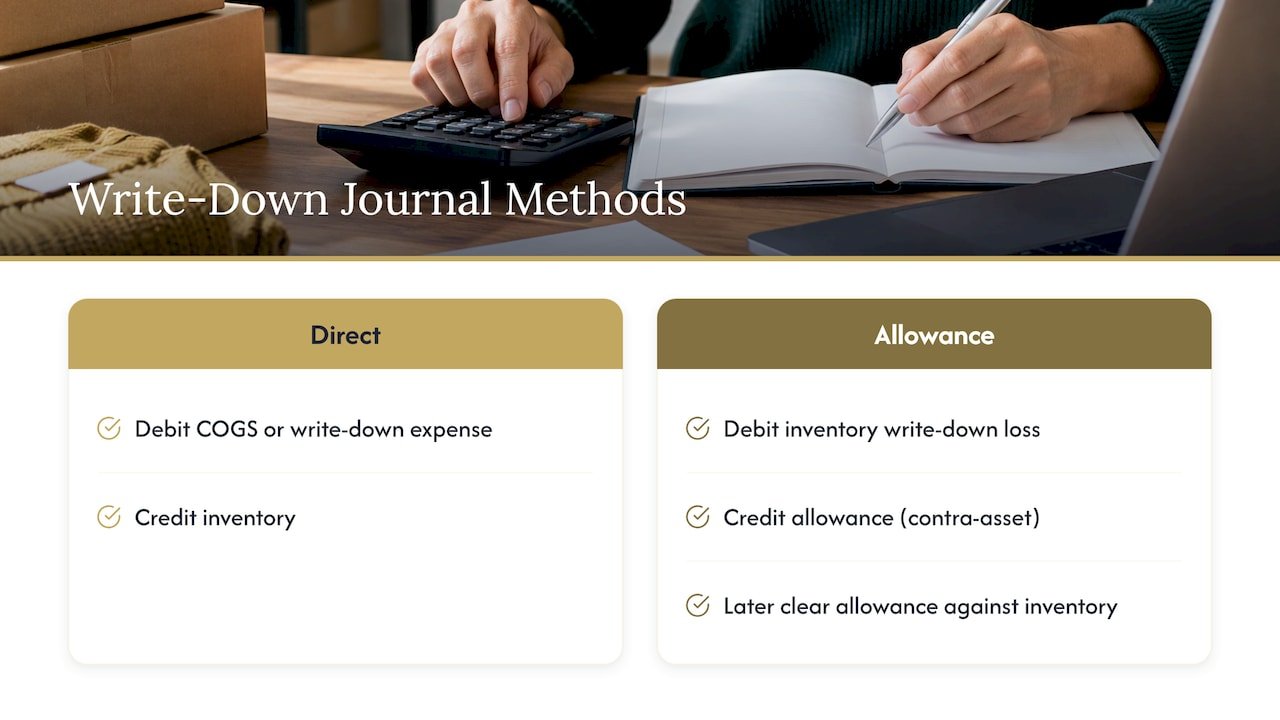
The standard entry has two forms.
Direct method. Debit cost of goods sold (or an inventory write-down expense account) and credit inventory. In the hoodie example, that is a $600 debit and a $600 credit.
Allowance method. Debit a loss on inventory write-down account and credit an allowance (a contra-asset account, which sits beside inventory and reduces it). When the units are later sold or scrapped, you clear the allowance against inventory so you do not book the loss twice. Investopedia’s write-off guide describes both the direct and allowance methods, including how the same approach applies to a full write-off.
A large or unusual write-down is better shown on its own line than buried in cost of goods sold. Otherwise it distorts your gross margin and hides what happened. FASB’s standard also calls for disclosing substantial and unusual losses in the financial statements.
Step 5: Document it
Keep a file for each adjustment: the date you found the problem, SKU and quantity, unit cost, the reason, photos or supplier and insurance records, how the stock was disposed of, and who approved it. This record is what protects you if a deduction is ever questioned.
Step 6: Remember that the new value sticks
Once you write inventory down under GAAP, the lower amount becomes your cost basis for that stock. As a general rule you do not write it back up if prices recover. Plan your estimates with that in mind.
Where a write-down goes wrong
The errors we see most often in inventory records are these:
- Recording the loss when the stock is thrown away, not when it lost its value.
- Using a vague reserve with no link to specific items or a price evidence.
- Posting the adjustment to the wrong account, such as general expenses, so gross margin looks better than it is.
- No count behind it, so shrinkage, theft and bookkeeping mistakes all get lumped together.
- Treating book and tax the same, which brings us to the next section.
Online sellers often find that these mistakes also hide their true margins. Our piece on ecommerce bookkeeping fixes that reveal true margins goes deeper on that.
Book treatment versus tax treatment
A write-down that is correct on your books may not be deductible on your return in the same year. The two sets of rules were built for different purposes.
For goods that cannot be sold at normal prices because of damage, imperfections, shop wear, style changes, odd or broken lots or similar causes, IRS Publication 538 says to value them at their bona fide selling price minus the direct cost of disposition. The regulation, 26 CFR 1.471-2, defines the standard and adds that a bona fide selling price means an actual offering of the goods. In practice that means you need to show you actually offered the goods at the lower price, and you carry the burden of proving it.
The regulation also does not accept a general reserve for estimated future decline in inventory value as a tax method. So an allowance you book for GAAP purposes may create a difference between book and tax until the specific items are sold, scrapped, donated or offered at the lower price.
Three practical takeaways:
- Keep the evidence of price changes: dated listings, price lists, sales records.
- Keep disposal records, such as receipts for donation, recycling or destruction.
- Do not assume the year you write down on the books is the year you deduct.
U.S. tax rules vary by state, so the state return can treat inventory losses differently from the federal one. We can handle the tax work for you, or work alongside your existing CPA so the book entries and the return agree. We cannot promise any specific tax outcome, since it depends on your facts, but clean records give your preparer the best starting point. Our guide to closing your books for taxes explains what should be settled before filing.
What this looks like for creatives
Inventory is not only for big retailers. Common cases we see in creative businesses include:
- Streamers and influencers with branded apparel, mugs or stickers.
- Musicians and DJs with vinyl, CDs, posters and tour merch that ages after a release cycle.
- Photographers and artists with prints, framed work and packaging stock.
- Designers and makers with materials and finished goods.
Events and seasons drive this. A tour ends, a campaign wraps or a design fades, and leftover stock is worth less than you paid. Recording that drop on time keeps your profit figure realistic and helps you decide what to reorder.
If you manage creatives, the same principle applies to each client’s merch line: each needs its own count, evidence and entries.
How we handle it for you
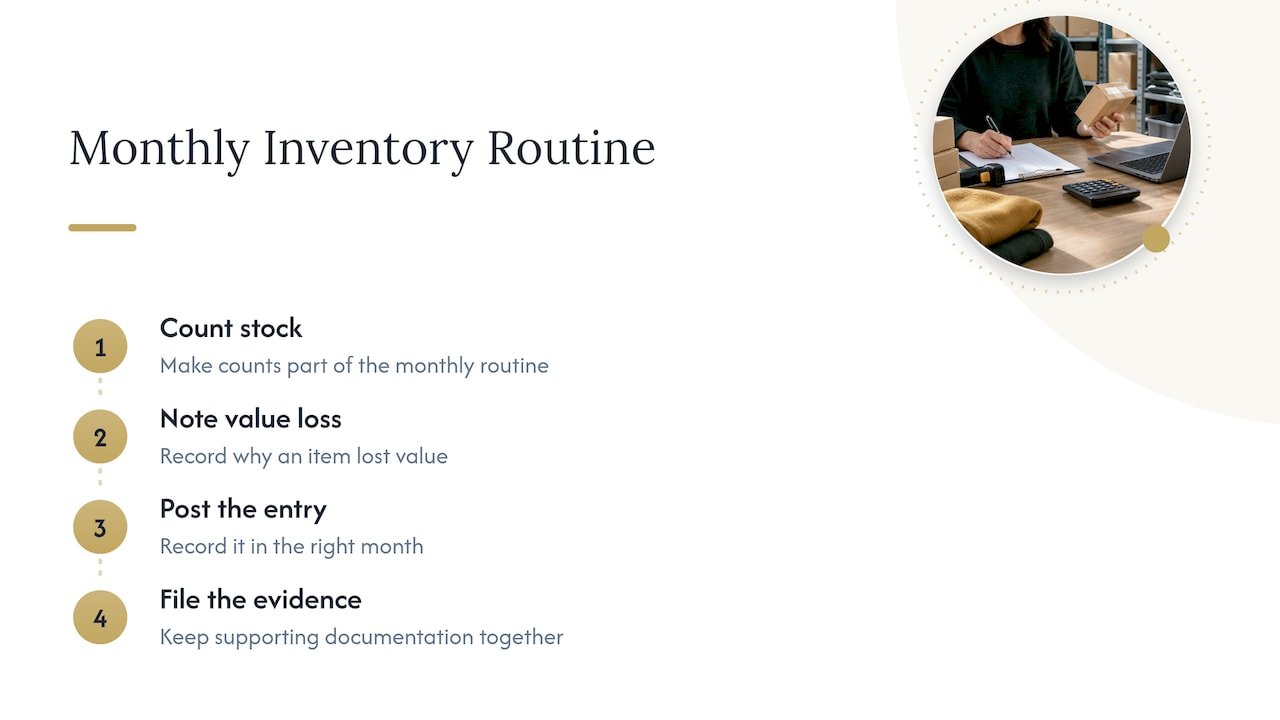
Inventory adjustments are the kind of task that gets pushed aside during a busy release or tour. We run bookkeeping and monthly reporting for creatives and small business owners, so counts, valuation entries and documentation are part of the monthly routine rather than a year-end scramble. We handle tax ourselves or work alongside your CPA, and confidentiality is standard practice, with an NDA available before we start.
Our accounting and bookkeeping services are priced as one flat monthly fee agreed up front, never a percentage of your income. If your return is the pressing question, our tax preparation and filing page explains how that works.

Our view
Most inventory problems are timing problems. The loss happened in March, the stock was counted in December and the entry went in the following April. By then nobody remembers why the number moved.
We think the fix is a routine, not a heroic cleanup: a regular count, a short note on why an item lost value, an entry in the right month and a file that holds the evidence. When that routine runs inside your monthly bookkeeping, your gross margin means something and your tax preparer is not reconstructing the year.
That is why we work as a real team rather than an app. We manage the books, pay the bills, chase what you are owed and keep your business in good standing, so you can stay focused on the work.
Kelli
FAQ
What is the journal entry for an inventory write-down?
Debit cost of goods sold or a loss on inventory write-down account, and credit inventory or an allowance account for the difference between cost and net realizable value. For example, $1,200 of stock with an NRV of $600 produces a $600 debit and a $600 credit.
Can I write off unsold inventory?
Unsold stock is not automatically a write-off. If it can still be sold, you generally write it down to net realizable value, and for tax you need to show an actual offering at the lower price. If it has no value at all and you dispose of it, you write off the remaining balance and keep the disposal records.
What is the difference between an inventory write-down and a write-off?
A write-down reduces the recorded value but leaves residual value on the books, because the items can still be sold. A write-off removes the full balance because the items are worthless. Both reduce inventory and increase expense in the period of the loss.
Can I reverse a write-down if prices recover?
Under U.S. GAAP, the written-down amount generally becomes the new cost basis, so you do not write it back up. Speak with us or your CPA about how any special situation, such as interim reporting, applies to you.
Does my state treat inventory write-downs differently?
It can. U.S. tax rules vary by state, so the state return may not follow the federal treatment line for line. We can review your state’s rules as part of your tax preparation.
Ready to get your inventory books in order?
If you would like help with counts, write-downs and the tax side, we are glad to talk it through. Book a free consultation and we will look at where your books stand.
Sources
- Inventory Write-Off: Definition, Journal Entry and Example
- FASB ASU 2015-11, Inventory (Topic 330)
- FASB Inventory (Topic 330)
- IRS Publication 538, Accounting Periods and Methods
- 26 CFR 1.471-2, Valuation of inventories
Recommended
- Bookkeeping Cleanup: A Step-by-Step Guide for Small Business Owners
- QuickBooks Inventory Tracking Setup With Bookkeeping Controls for SMBs
- Small Ecommerce Bookkeeping: Five Fixes That Reveal True Margins
This article is general information, not tax, legal or financial advice. Talk to a professional about your situation.


