


No, U.S. companies and U.S. persons no longer have to file beneficial ownership reports with FinCEN. FinCEN’s final rule, announced August 11, 2026 and effective August 14, 2026, permanently exempts domestic entities from Corporate Transparency Act filing duties. Foreign entities registered to do business in the United States still carry that obligation, and the old filings still exist somewhere in a federal database, so this isn’t quite the clean break it sounds like.
TL;DR:
- Domestic entities and U.S. persons are fully exempt from beneficial ownership reporting obligations as of August 14, 2026, reducing the estimated 32.6 million filings by the majority.
- Foreign entities registered to do business in the U.S. remain required to file beneficial ownership reports, with specific data on owners, beneficial owners, and registration details still necessary.
- FinCEN is actively deleting existing beneficial ownership records of U.S. persons and has simplified reporting for foreign pooled investment vehicles, aligning with ongoing privacy and compliance concerns.
- Banks will continue to ask for beneficial ownership information during onboarding under existing AML/CFT rules despite the federal exemption; internal compliance procedures should be updated accordingly.
- Business owners should retain copies of previous filings, update internal records, and consult professionals if uncertain about foreign or complex structures, as the statutory framework remains technically in place.
Table of Contents
- What the August 2026 Final Rule Actually Changes
- Who Still Has to File: Foreign Reporting Companies Explained
- FinCEN’s Plan to Delete U.S. Person Data
- Filing Deadlines: Then and Now
- Banks Still Want Beneficial Ownership Information
- What Business Owners Should Do Right Now
- Why “Permanent” Doesn’t Mean “Guaranteed Forever”
- What Beneficial Ownership Actually Means
- Why the Government Wanted This Information in the First Place
- Entities the Final Rule Still Reaches
- What Information a BOI Report Actually Collects
- Penalties for Getting This Wrong
- How FinCEN Protects the Ownership Data It Collects
- A Candid Take on This Rule Change
- Let Kelliworks Handle the Recordkeeping So You Don’t Have To
- Where This Information Comes From
- Sources
- FAQ
What the August 2026 Final Rule Actually Changes
For nearly two years, the Corporate Transparency Act (CTA) put millions of small business owners on the hook for a filing most had never heard of: a beneficial ownership information report, submitted directly to FinCEN, disclosing who owns and controls the company. That changed when the Treasury Department announced that FinCEN’s final rule permanently removes U.S. companies and U.S. persons from the reporting requirement altogether.
The rule amends 31 C.F.R. § 1010.380, the regulation that originally defined “reporting company” and laid out who had to file. Rather than tweak the edges, the final rule redefines the term itself, excluding domestic entities from it entirely. That’s a structural change, not a temporary pause. It relies on the Treasury Secretary’s exemptive authority under the CTA, the same authority Treasury used earlier in 2025 when it issued an interim final rule (IFR) narrowing reporting obligations ahead of a permanent fix.
If you’ve been tracking this since the CTA first took effect, the August 2026 rule will feel familiar. It formalizes and expands the March 26, 2025 interim final rule, which had already signaled Treasury’s direction by exempting domestic companies on a provisional basis. What was a stopgap is now permanent regulatory text, published in the Federal Register.
Here’s what shifted between the original 2024 framework and where things stand now:
- Before: Every domestic corporation, LLC, and similar entity created by filing with a secretary of state had to report beneficial ownership information, unless it fell under one of 23 narrow exemptions (banks, publicly traded companies, large operating companies, and similar categories).
- Now: Domestic entities are excluded from the definition of “reporting company” outright. No exemption category to check. No filing to make.
- Before and now, unchanged: Foreign entities registered to do business in any U.S. state or tribal jurisdiction remain “reporting companies” and must file.
The scale of who’s affected: FinCEN previously estimated that the original rule covered roughly 32.6 million domestic entities in its first year alone, compared to a foreign reporting company population in the tens of thousands. The final rule effectively removes the vast majority of that original filing population from any FinCEN reporting obligation whatsoever, while leaving the narrow foreign slice untouched.
For business owners who spent 2024 scrambling to understand beneficial ownership disclosure requirements, or who paid a service to file on their behalf, this is the regulatory equivalent of a fire drill being called off midway through. The compliance burden that once applied broadly to nearly every small LLC and corporation in the country now applies to almost none.
Who Still Has to File: Foreign Reporting Companies Explained
A “foreign reporting company” is any corporation, LLC, or similar entity formed under the law of a foreign country that has registered to do business in the United States by filing with a secretary of state or similar office. If your business was created abroad and then registered in a U.S. state to operate here, the exemption for domestic entities doesn’t reach you. You’re still required to file a BOI report.
That distinction, foreign versus domestic formation, is now the entire test. It replaces a much more complicated exemption checklist that used to require weighing entity size, revenue, employee count, and industry category. Foreign reporting companies still need to submit the following:
- Company information: legal name, any trade or “doing business as” names, jurisdiction of formation, and the U.S. address where the company conducts business.
- Beneficial owner information: full legal name, date of birth, current residential or business address, and a unique identifying number from a passport, driver’s license, or similar government-issued document, for every individual who owns 25% or more of the company or who exercises substantial control over it.
- Company applicant information: for entities registered on or after January 1, 2024, the individual who filed the registration document and, where applicable, the person primarily responsible for directing that filing.
One important nuance: the final rule limits reportable beneficial owners of foreign reporting companies to non-U.S. persons. If a foreign entity’s beneficial owner happens to be a U.S. citizen or resident, that individual’s information generally doesn’t need to appear on the report, consistent with the broader shift toward exempting U.S. persons from the system entirely.
Foreign pooled investment vehicles get their own carve-out. A pooled investment vehicle formed under foreign law that’s registered to do business in the U.S. and is managed by a U.S.-based investment adviser can typically report a single control person rather than tracing through every individual investor. That mirrors the treatment domestic pooled investment vehicles received under earlier rulemaking, extended now to their foreign counterparts operating in the U.S. market.
FinCEN identifiers still matter for the entities and individuals who remain in scope. A non-U.S. person who obtained a FinCEN ID to simplify reporting across multiple entities must still keep that information current. If a passport renews or an address changes, the update obligation stands. That’s the mirror image of what’s happening on the U.S. person side of the system, which brings us to the deletion question.
FinCEN’s Plan to Delete U.S. Person Data
FinCEN isn’t just suspending enforcement against U.S. persons. It’s actively deleting the beneficial ownership information those individuals and companies already submitted. If you filed a BOI report in 2024 or 2025 as a domestic entity, that record is slated for removal from FinCEN’s database rather than sitting there indefinitely as an orphaned filing.
FinCEN plans to identify U.S. person records using the identifying documents submitted with each filing, primarily passports and driver’s licenses tied to U.S. jurisdictions. That’s a reasonably reliable way to separate domestic filers from foreign ones, since a U.S. person almost always used a U.S.-issued identity document when they originally filed. The agency has described this as a single coordinated sweep rather than a rolling, ongoing purge, which means there isn’t a lingering window where you need to keep checking whether your record has been removed yet.
By the numbers: FinCEN estimates that roughly 760,000 U.S. persons previously obtained a FinCEN identifier, the unique number that let individuals report their information once and reference it across multiple company filings instead of resubmitting identical data. Every one of those 760,000 people is now relieved of the obligation to keep that FinCEN ID current. No more updating it when a license renews or an address changes.
FinCEN has also indicated it’s coordinating with the National Archives on records-retention requirements tied to federal recordkeeping law, since deleting government-collected data isn’t as simple as hitting a delete key. Federal agencies generally have to follow archival schedules even when a program winds down.
A few practical takeaways follow from this:
- If you filed a BOI report as a U.S. person or domestic entity, you don’t need to request removal yourself. FinCEN’s sweep is designed to catch these records automatically.
- If you hold a FinCEN ID as a U.S. person, you can stop tracking renewal dates and update obligations tied to that ID.
- Deletion doesn’t erase the fact that you once filed. Keep your own copy of what you submitted, for reasons covered later in this article.
Filing Deadlines: Then and Now
The original Reporting Rule, finalized in September 2022 and effective January 1, 2024, set up a tiered deadline structure that a lot of business owners never fully absorbed before the rules shifted underneath them. Understanding that history helps explain why some entities still face deadlines today while most don’t.
- Entities formed before January 1, 2024 had until January 1, 2025 to file their initial BOI report, a full year’s runway built into the original rule.
- Entities formed during 2024 had 90 days from formation or registration to file, a window FinCEN shortened from the originally proposed 30 days after pushback from small business groups.
- Entities formed on or after January 1, 2025 faced a 30-day filing deadline, the tightest window in the original schedule.
- Any reporting company had 30 days to file an updated report after a change to previously reported information, such as a new beneficial owner or an address change.
Those deadlines applied broadly to domestic and foreign entities alike under the original framework. The August 2026 final rule doesn’t erase that history. It simply removes domestic entities from having any ongoing deadline to track. Foreign reporting companies remain bound by the same categories of timing rules: an initial filing deadline tied to when they registered in the U.S., and a 30-day window to update the report whenever the underlying information changes.
If you’re a domestic business owner who already filed under the old deadlines, there’s no action required now. You don’t need to file a final report, request withdrawal, or notify FinCEN that you’re no longer covered. The exemption applies automatically based on your entity’s domestic status. If you never got around to filing before the exemption took effect, you’re simply no longer required to, retroactively relieved of a deadline that no longer applies to your entity type.
Banks Still Want Beneficial Ownership Information
Here’s where a lot of business owners get tripped up: FinCEN dropping the BOI reporting requirement doesn’t mean your bank stops asking who owns your company. Those are two separate legal frameworks, and only one of them changed in August 2026.
The Customer Due Diligence (CDD) Rule, a separate FinCEN regulation governing how banks and other financial institutions verify customer identity, was untouched by this final rule. Banks are still required to collect beneficial ownership information when you open a new business account, and in many cases when you materially change an existing one. That obligation exists because of anti-money-laundering and countering-the-financing-of-terrorism (AML/CFT) rules that predate the CTA by years and operate independently of it.
Practically, that means your bank’s onboarding process probably won’t look any different than it did before the exemption. Expect the same kinds of requests you’ve likely encountered before:
- Formation documents (articles of incorporation or organization) confirming the entity’s legal existence.
- Employer Identification Number (EIN) confirmation from the IRS.
- Identification for each individual who owns 25% or more of the company, or who has significant managerial control.
- A completed beneficial ownership certification form, often required at account opening regardless of whether FinCEN itself is collecting that data anymore.
Pro Tip: Don’t assume your bank’s paperwork will shrink just because FinCEN’s did. Ask your relationship manager directly whether their onboarding checklist has changed. Some institutions built compliance workflows entirely around the original CTA rule and haven’t updated their internal forms yet, which means you might still get asked for information that no longer serves a federal filing purpose but still satisfies the bank’s own CDD obligations.
What Business Owners Should Do Right Now
The exemption is good news, but “no more filing” isn’t the same as “no more thinking about this.” A handful of concrete steps will keep you protected without adding real work to your plate.
Archive what you already filed. If your business submitted a BOI report before the exemption, save a copy of that filing along with any FinCEN ID confirmation you received. FinCEN’s deletion sweep removes the record from its own database, not from your obligation to retain your own business records. A copy of your original beneficial ownership disclosure could matter later during a bank review, an audit, or a due diligence process tied to a sale or investment round.
Stop tracking update deadlines for U.S. persons, but don’t assume every entity in your structure is off the hook. If you own a domestic LLC that’s fully exempt, you can retire that compliance task. If your business structure includes a foreign subsidiary registered in the U.S., or if you’re a U.S. person who serves as a beneficial owner of a foreign entity, part of your compliance picture hasn’t changed.
Update your internal compliance documentation. If you built a BOI compliance checklist, an onboarding form for new hires with equity, or a standard operating procedure tied to ownership changes, revise it now to reflect the final rule. Leaving stale references to a defunct filing requirement creates confusion for whoever inherits that documentation next.
Revisit vendor and bank onboarding templates. If your business asks investors, partners, or new members to complete a beneficial ownership certification as part of your own internal process, decide whether that form still serves a purpose. It might, particularly if you use it to maintain accurate cap table records independent of any federal filing requirement.
Know when to call in help. A short list of situations still calls for a conversation with an accountant or attorney rather than a quick read of a FAQ page:
- Your company has a foreign subsidiary or affiliate registered to do business in the U.S.
- You’re uncertain whether your entity qualifies as “domestic” for CTA purposes, particularly if it was formed through a more complex cross-border structure.
- You serve as a beneficial owner of a foreign reporting company and need to determine your own disclosure status.
- You’re preparing for a sale, merger, or investment round where a buyer’s due diligence team may ask about historical BOI compliance.
Pro Tip: Treat your old BOI filing the way you’d treat a canceled insurance policy. You don’t need to think about it day to day, but you’d be glad to have the paperwork if someone ever asks whether you were covered. Reviewing your recordkeeping alongside a broader look at how you separate personal and business finances is a reasonable way to fold this into an existing compliance habit rather than treating it as a one-off task.
Why “Permanent” Doesn’t Mean “Guaranteed Forever”
Treasury calls this exemption permanent, and as a matter of current regulatory text, it is. But permanent regulations aren’t the same as permanent law, and the distinction matters more than most coverage of this rule has acknowledged.
The Corporate Transparency Act itself, the statute Congress passed in 2021, still exists and still authorizes beneficial ownership reporting. Legal commentary from the Harvard Law School Forum on Corporate Governance makes the point plainly: the final rule reflects an exercise of the Treasury Secretary’s exemptive authority under that statute, not a repeal of the statute itself. A future administration with different enforcement priorities could, in theory, revisit that exemptive authority and narrow it again.
Litigation adds another layer of uncertainty. The CTA has already faced multiple constitutional challenges since 2024, and while the exemption for domestic entities may moot some of that litigation, it doesn’t retire the underlying legal questions. A different case, a different circuit, or a change in judicial composition could shift the legal landscape again in ways that don’t map neatly onto the current rule.
The final rule leaves the Corporate Transparency Act’s statutory framework intact. What has changed is Treasury’s exercise of exemptive discretion, not the underlying authority Congress granted, and administrative discretion exercised one way can be exercised another way by a future administration.
None of this means you should treat the exemption as fragile or temporary in a practical sense. It means good governance habits should assume nothing is permanently settled just because a press release uses the word. A few reasonable steps:
- Keep every historical BOI filing and FinCEN ID record on file indefinitely, not just until you’re confident the rule has stuck.
- Set a calendar reminder to check the Federal Register or FinCEN’s BOI page once or twice a year, particularly around administration transitions.
- Maintain an internal ownership register even without a filing requirement forcing you to. It costs you almost nothing and protects you if the rule shifts again.
What Beneficial Ownership Actually Means
Beneficial ownership refers to the individuals who ultimately own or control a company, as distinct from the entity’s name on paper or the manager listed with a state’s business registry. Two tests generally define beneficial ownership under federal law: owning 25% or more of the entity’s equity, or exercising substantial control over its decisions, such as serving as a senior officer or having authority to appoint most of the board.
That distinction exists because ownership can hide behind layers of legal structure. A shell company registered in one state might be wholly controlled by an individual whose name never appears on any public document, using intermediary entities or nominee arrangements to obscure the actual decision maker. Beneficial ownership disclosure rules were built specifically to pierce through that kind of structure and identify the real person behind the entity.
The legal importance runs deeper than paperwork. Law enforcement, financial regulators, and banks all rely on accurate beneficial ownership information to detect money laundering, sanctions evasion, and shell company fraud. The Corporate Transparency Act was Congress’s response to years of findings that anonymous shell companies had become a preferred tool for hiding illicit financial activity, ranging from tax evasion to financing for organized crime.
Even with the domestic filing requirement gone, the concept of beneficial ownership hasn’t disappeared from U.S. law. It still governs how banks conduct due diligence, how foreign reporting companies disclose their structure, and how regulators define corporate transparency more broadly.
Why the Government Wanted This Information in the First Place
Congress designed beneficial ownership reporting closing a specific gap: the United States had become one of the easier places in the world to form an anonymous company. Unlike many other countries, most U.S. states ask for very little information when someone forms an LLC or corporation, sometimes nothing more than a name and a registered agent.
That gap had real consequences. Treasury and law enforcement agencies documented cases where anonymous U.S. shell companies were used to launder money, evade sanctions, and disguise the true parties behind real estate purchases and financial transactions. The stated purpose of ownership transparency requirements was to give law enforcement and financial institutions a reliable, centralized way to identify who actually stands behind a company, without requiring a subpoena or a multi-jurisdictional investigation just to find a name.
The objectives went beyond law enforcement alone. Supporters of the original CTA argued that transparent ownership records would also protect legitimate businesses from being undercut by shell-company competitors engaged in fraud, and would give banks a more reliable dataset to satisfy their own anti-money-laundering obligations under the Bank Secrecy Act.
The 2026 final rule doesn’t abandon those objectives. It narrows who has to help achieve them. Treasury’s own reasoning, reflected in both the interim final rule and the permanent version, concluded that domestic small businesses posed a comparatively low money-laundering risk relative to the compliance burden the original rule placed on them, while foreign entities operating through U.S. registration continued to warrant closer scrutiny.
Entities the Final Rule Still Reaches
Beyond the core distinction between domestic and foreign entities, a few specific categories deserve a closer look, since business owners sometimes assume they’re covered by the exemption when their actual structure says otherwise.
Foreign corporations, LLCs, and partnerships registered to transact business in any U.S. state remain reporting companies regardless of their size, revenue, or industry. There’s no small-business carve-out on the foreign side that mirrors the blanket domestic exemption.
Foreign pooled investment vehicles, including certain foreign hedge funds, private equity vehicles, and similar structures registered in the U.S. and managed by a U.S. investment adviser, remain in scope, though with the simplified single control-person reporting option described earlier.
Domestic entities that voluntarily choose to maintain internal beneficial ownership documentation aren’t “required” entities in any legal sense, but they occupy a middle category worth naming: businesses preparing for acquisition, seeking outside investment, or operating in regulated industries where a lender or partner independently demands ownership transparency. The federal filing requirement is gone for these businesses, but the practical demand for the same information often persists through private contractual channels.
Trusts and other non-entity ownership structures were never independently subject to CTA reporting, but when they hold a controlling interest in a reporting company, individuals connected to that trust, trustees, beneficiaries with certain rights, or grantors with revocation power, can still qualify as beneficial owners of the underlying entity if that entity remains a foreign reporting company.
What Information a BOI Report Actually Collects
For the foreign reporting companies still filing, understanding exactly what FinCEN wants helps avoid an incomplete or rejected submission. The report itself splits into distinct categories of information.
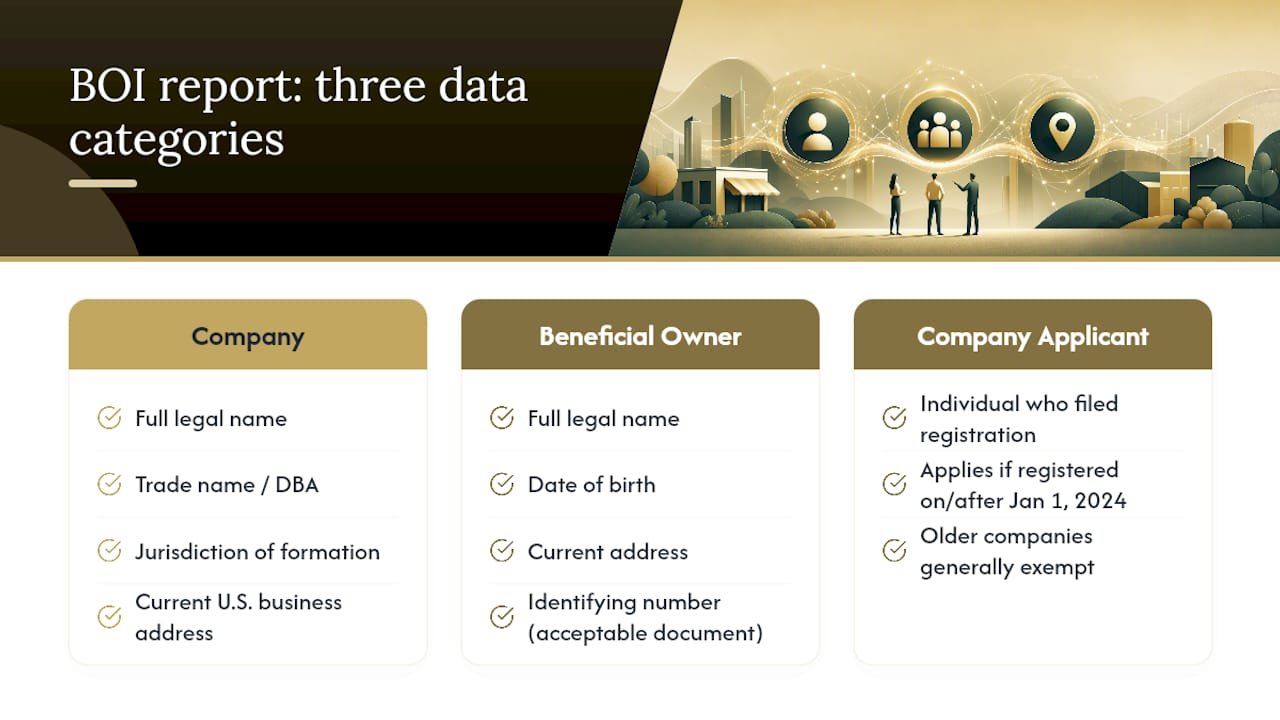
At the company level, filers submit the full legal name, any trade name or DBA, the jurisdiction where the entity was formed, and the current U.S. business address.
For each qualifying beneficial owner, the report requires full legal name, date of birth, current address, and an identifying number from an acceptable document, typically a passport, since the final rule limits reportable foreign beneficial owners to non-U.S. persons in most cases. Company applicant information, the individual who filed the entity’s registration, only applies to entities registered on or after January 1, 2024, sparing older foreign reporting companies from digging up historical filing records.
One threshold worth flagging: the 25% ownership test looks at total ownership interests, which can include more than simple stock ownership. Convertible instruments, profit interests, and certain option structures can count toward that threshold depending on how they’re structured, which is exactly the kind of judgment call worth running past a professional rather than guessing.
Penalties for Getting This Wrong
Even with the domestic exemption in place, the CTA’s penalty structure hasn’t been repealed, and it still applies with full force to anyone required to file, meaning foreign reporting companies and anyone who willfully provides false information.
Civil penalties can reach into the hundreds of dollars per day for continued noncompliance, and the statute also authorizes criminal penalties, including fines and potential imprisonment, for willful violations such as knowingly filing false beneficial ownership information or willfully failing to file a required report. The “willful” standard matters here. An honest mistake, corrected promptly, is treated very differently under the statute than a deliberate attempt to conceal ownership or falsify records.
For domestic businesses now outside the reporting requirement entirely, this section is largely academic, since there’s no filing obligation left to violate. But two groups should still take it seriously. Foreign reporting companies remain fully exposed to these penalties for late or inaccurate filings. And any business, domestic or foreign, that maintains internal beneficial ownership certifications for a bank or investor should treat the accuracy of that information with the same seriousness the CTA originally demanded, since providing false ownership information to a financial institution can trigger separate liability under banking and fraud statutes entirely apart from the CTA itself.
How FinCEN Protects the Ownership Data It Collects
Beneficial ownership information was never intended for public consumption. Unlike a state’s public business registry, the CTA’s reporting system was designed as a restricted-access database, available to law enforcement, certain regulators, and financial institutions conducting due diligence, but not searchable by the general public or the press.
That access model remains relevant even as the reporting population shrinks dramatically under the 2026 rule. Foreign reporting companies still filing will have their information protected under the same restricted-access framework that governed the system since its original rollout. Financial institutions accessing BOI data for CDD compliance purposes must do so under specific authorized-access provisions, not open lookup.
For the millions of U.S. persons and domestic entities whose records are being deleted, the practical privacy outcome is straightforward: that information won’t exist in FinCEN’s system at all going forward, which is a more complete form of protection than access restriction ever provided. The Treasury’s own announcement frames the deletion as directly responsive to privacy and burden concerns raised by small business advocates since the CTA’s original rollout.
A Candid Take on This Rule Change
This is genuinely good news for the small business owners we work with every day, and we don’t say that about every regulatory update that crosses our desk. The original BOI reporting requirement asked millions of tiny LLCs and sole proprietorships to navigate federal filing mechanics that had nothing to do with running their actual business, all to catch a comparatively small number of bad actors who probably weren’t filing honestly anyway.
That said, we’d push back gently on any narrative treating this as a permanent, closed chapter. The underlying statute is still there. Administrations change. Courts weigh in on things nobody expects them to touch. If you filed a BOI report before this exemption, keep that record somewhere safe, the same way you’d keep an old tax return you don’t expect to need again but wouldn’t want to have to reconstruct from memory.
If you’re not sure whether your entity structure still has any lingering obligation, particularly if you’ve got a foreign subsidiary or an ownership stake in a foreign entity, that’s worth a real conversation rather than a guess. We’d rather spend twenty minutes confirming you’re clear than have you find out the hard way during a bank review two years from now.
— Kelli
Let Kelliworks Handle the Recordkeeping So You Don’t Have To
An accounting partner can provide cohesive compliance advice instead of piecing it together from various sources. That matters here because the BOI exemption doesn’t eliminate the recordkeeping habits smart business owners still need, it just removes one filing deadline from a much longer list your business already carries.

Our full-service accounting and bookkeeping team can help you build the internal ownership documentation worth keeping even without a federal filing requirement forcing the issue, alongside the broader financial recordkeeping your business needs anyway. If your structure includes a foreign entity or you’re planning a U.S. registration, our business formation service walks you through what’s still required and what isn’t. And if your bank’s onboarding checklist doesn’t match what you expected after reading this, a short consultation with our team can sort out what’s actually still owed versus what’s outdated paperwork nobody’s updated yet. Book a consultation and bring your questions. We’ll tell you plainly what applies to your business and what doesn’t.
Where This Information Comes From
- Treasury Department press release announcing the final rule
- Federal Register final rule text, August 14, 2026
- FinCEN’s Beneficial Ownership Information FAQs
- FinCEN’s Beneficial Ownership Information program page
- Harvard Law School Forum on Corporate Governance legal analysis
Sources
- FinCEN Permanently Ends Beneficial Ownership Reporting Requirements for Millions of Small Business Owners
- Beneficial ownership information reporting requirement revision
- Frequently Asked Questions
- Beneficial Ownership Information Reporting
FAQ
Is beneficial ownership reporting still required?
For U.S. companies and U.S. persons, no. FinCEN’s August 2026 final rule permanently exempts domestic entities from filing. Foreign entities registered to do business in the U.S. still must file.
Is BOI reporting required in 2026?
Only for foreign reporting companies as of the final rule’s August 14, 2026 effective date. Domestic corporations, LLCs, and similar entities formed in the U.S. no longer have any BOI filing obligation, regardless of size or industry.
Who is exempt from beneficial ownership reporting?
Every domestic reporting company, meaning any entity formed by filing with a U.S. secretary of state or similar office, is now exempt. The exemption also covers U.S. persons who serve as beneficial owners, including the roughly 760,000 people who previously held FinCEN identifiers.
Did FinCEN remove beneficial ownership reporting requirements for U.S. companies?
Yes. FinCEN’s final rule, effective August 14, 2026, redefines “reporting company” to exclude domestic entities entirely, building on the March 2025 interim final rule that first signaled this shift. The agency is also deleting previously filed U.S. person data from its database.