


Yes, nonresident entrepreneurs can get a US EIN. Use the online EIN application only if your business has a legal residence or principal place of business in the United States and your responsible party already has an SSN or ITIN. Everyone else applies by phone, fax, or mail directly with the IRS. The EIN itself is free, but plan ahead for the compliance filings that often follow it, including Form 5472 or Form 1040-NR.
TL;DR:
- Nonresident entrepreneurs without U.S. stable residence or SSN/ITIN generally cannot use the online EIN application and must apply via phone, fax, or mail instead.
- When applying, accurately identify the responsible party; if no SSN or ITIN exists, enter “foreign” or “N/A” on line 7b to avoid delays or errors.
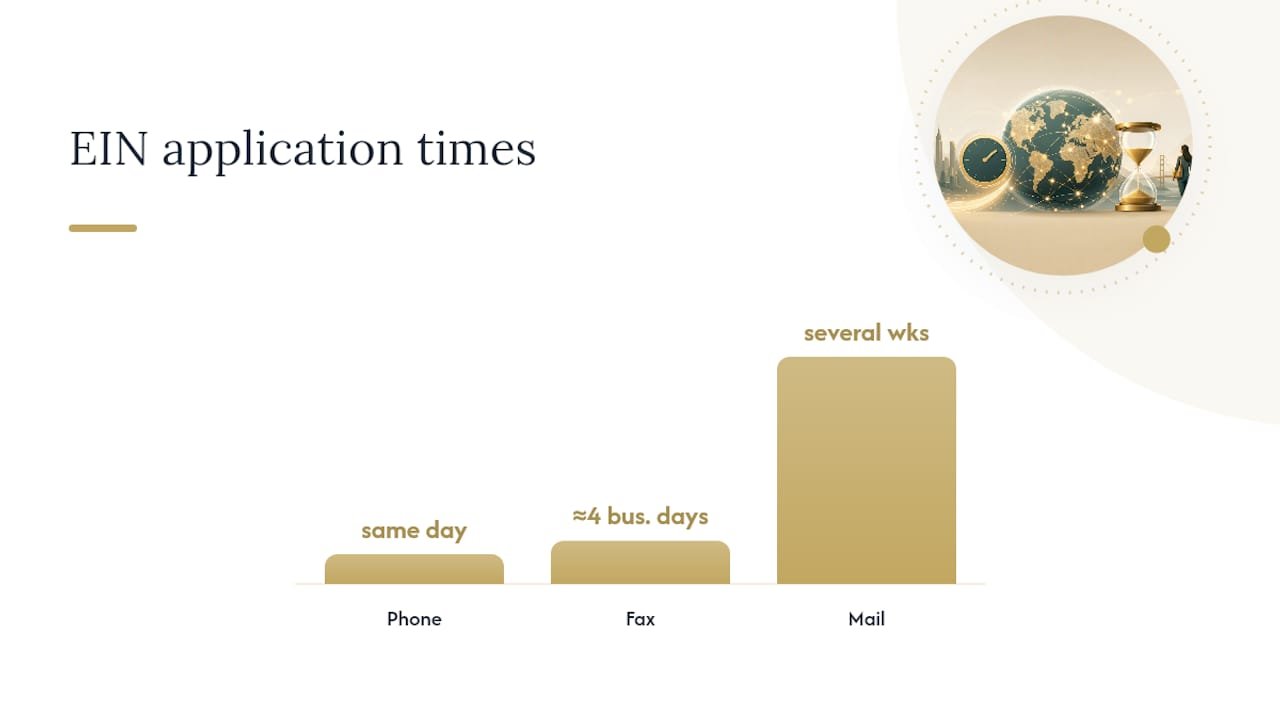
- Most nonresidents cannot use the online method, and should choose either phone (often same day), fax (about four days), or mail (four to five weeks), based on urgency.
- Incorrect responsible-party information is the most common issue that causes delays, so verifying details before submission saves weeks of correction time.
- After obtaining an EIN, nonresidents often need to file additional forms like Form 1040-NR or Form 5472, and should integrate the EIN into their broader U.S. compliance and banking setup.
Table of Contents
- What Does an EIN Actually Do for a Nonresident Business Owner?
- Who Qualifies as a Nonresident Applicant, and What Goes on Line 7b?
- How Do You Apply for an EIN as a Nonresident?
- Getting Form SS-4 Right the First Time
- What Goes Wrong Most Often, and How Long Should You Actually Wait?
- What Happens After You Get the EIN?
- A Practical Checklist to Keep With Your Formation Documents
- Why Getting the Responsible Party Right the First Time Saves You a Month
- How Kelliworks Helps International Founders Set Up Right
- Sources
- FAQ
What Does an EIN Actually Do for a Nonresident Business Owner?
An EIN is the federal tax identifier the IRS uses to track your business, not you personally. It functions the way an SSN does for an individual, but it belongs to the entity: your LLC, corporation, or partnership. Banks ask for it to open a business account, payroll providers need it to run wages, and vendors request it before sending you a Form W-9 or accepting your Form W-8BEN as a foreign entity.
We get this question constantly from international founders: does an EIN mean I’m now a US tax resident, or that I have work authorization? No. The IRS is explicit that an EIN doesn’t establish immigration status, doesn’t create tax residency, and doesn’t replace an individual’s SSN or ITIN for personal tax filing. It’s strictly a business identifier.
That distinction trips up a lot of founders. You can hold an EIN for a Delaware LLC while living in São Paulo or Lagos, filing no personal US tax return at all, provided your business activity doesn’t create effectively connected income. The EIN and your personal tax obligations are separate questions entirely.
Here’s when nonresidents typically need to apply:
- Opening a US business bank account, which almost every bank requires before it will even schedule a call.
- Hiring US-based employees or contractors, since payroll withholding and reporting run through the EIN.
- Acting as a withholding agent on payments to other foreign parties.
- Meeting a bank, payment processor, or state filing requirement that specifically asks for a federal tax ID.
- Filing information returns tied to a US disregarded entity or corporation, even when no US tax is actually owed.
If your business has no US bank account, no US employees, and no US-source income, you may not need one yet. But most founders forming a US LLC to sell into the American market end up needing an EIN within the first few weeks.
Who Qualifies as a Nonresident Applicant, and What Goes on Line 7b?
Any nonresident entrepreneur forming a US entity, or acting as a foreign responsible party for one, qualifies to apply for an EIN. The IRS doesn’t require citizenship, residency, or a Social Security Number to issue one. What it does require is a correctly identified responsible party, which is where a lot of applications go sideways.
The responsible party is the natural person who ultimately owns, controls, or has authority over the entity and its assets. It is not automatically your registered agent, your lawyer, or the person who filed your formation paperwork on a formation platform. If you’re the founder calling the shots, you’re the responsible party, regardless of where you live.
Here’s the part that confuses nearly every first-time applicant: what do you write on line 7b if you have no SSN and no ITIN, and aren’t eligible for either? Per the December 2025 Form SS-4 instructions, you enter “foreign” or “N/A.” That’s it. You don’t leave it blank, and you absolutely do not borrow a Social Security Number from a co-founder, a US relative, or your formation agent to push the application through faster.
That last mistake causes real headaches. If a formation service enters its own staff member as the responsible party just to get through the online form, the EIN record is now tied to the wrong controlling person. Fixing that later means filing IRS correspondence to correct the responsible party, and that can take weeks while your bank account or payroll setup sits on hold.
- Enter “foreign” or “N/A” on line 7b if you’re ineligible for an SSN or ITIN, per current SS-4 instructions.
- Never substitute another person’s SSN, even temporarily, to bypass the online system’s requirements.
- Confirm the responsible party is the actual controlling owner, not whoever handled your paperwork.
- Keep a copy of exactly what you entered, in case a bank or the IRS later asks you to confirm it.
Pro Tip: If you used a formation service to set up your LLC, double-check who they listed as the responsible party before you submit your SS-4. It’s a five-minute check that can save you a month of correction correspondence later.
How Do You Apply for an EIN as a Nonresident?
Most nonresident founders can’t use the online EIN application at all. That tool requires your business to have a legal residence, principal place of business, or principal office in the United States, and it requires the responsible party to already hold a valid SSN or ITIN. If either condition fails, the online system will reject you, and you’ll need one of three international channels instead: phone, fax, or mail.
Pick exactly one method and stick with it. The IRS explicitly recommends against submitting through multiple channels for the same entity, because parallel applications tend to generate duplicate EIN records and extra correspondence to untangle afterward.
1. Apply by phone
International applicants can call the IRS at 267-941-1099, Monday through Friday, 6:00 AM to 11:00 PM Eastern Time. This is usually the fastest route, and applicants who complete the call correctly often walk away with an EIN the same day.
Before you dial, have your completed SS-4 information ready: entity name, entity type, formation state and date, responsible party details, reason for applying, and principal business activity. The person on the phone will read through the form with you, so having it filled out in advance (even if you’re not faxing it) speeds the call considerably. This works well if you’re comfortable on an English-language phone call and need the EIN urgently for a closing deadline or bank appointment.
2. Apply by fax
Fax remains one of the most reliable international methods, largely because it leaves a paper trail. Send your completed and signed Form SS-4 to the IRS fax number designated for international applicants, and always include a return fax number.
Applications submitted this way generally receive an EIN by fax in about four business days when a return fax number is provided. Skip that return number and you may end up waiting for a mailed response instead, which defeats the purpose of faxing in the first place. Keep your fax transmission confirmation. It’s your proof of submission if the IRS response is delayed or if a bank asks when you applied.
3. Apply by mail
Mail is the slowest option and the one to avoid if you’re on any kind of deadline. International applicants mail Form SS-4 to the address the IRS designates for its EIN International Operation. Build in several weeks before you actually need the EIN in hand.
Mail makes sense mainly when there’s no urgency and you’d rather have a physical, signed paper trail without relying on a phone call. If you’re setting up a bank account soon, though, mail is the wrong choice.
How the three methods compare:
| Method | Typical turnaround | Best for |
|---|---|---|
| Phone (267-941-1099) | Often same day | Urgent deadlines, comfortable with a live call |
| Fax (with return number) | About 4 business days | Most nonresident applicants, reliable paper trail |
| About 4 to 5 weeks | No time pressure, prefer physical documentation |
Getting Form SS-4 Right the First Time
Form SS-4 asks for basic information, but nonresident applicants stumble on a handful of fields more than others. Get these right and your application moves cleanly through IRS processing.
You’ll need your entity’s exact legal name as it appears on your formation documents, both a mailing address and a physical address (they can differ), entity type, state and date of formation if you’ve already registered, the reason you’re applying (banking, hiring, compliance, and so on), your principal business activity, and the expected date of first wages paid, or “N/A” if you have no employees yet.
If someone else, an accountant, attorney, or authorized representative, will receive the EIN on your behalf, complete the third-party designee section. That requires the designee’s contact information and your signature authorizing them to speak with the IRS about the application. Skip this section if you plan to receive the EIN directly.
One sequencing note that catches people off guard: form your LLC or corporation at the state level before you apply for the EIN. Applying for an entity that technically doesn’t exist yet, because state formation hasn’t cleared, is one of the more common causes of processing delays and rejected applications.
- Confirm your legal entity name matches your state formation documents exactly, including punctuation.
- Complete the third-party designee section only if someone else will receive the EIN on your behalf.
- Form the entity at the state level first; don’t apply for an EIN on a pending formation.
- File your signed SS-4, submission proof, and the EIN assignment notice together with your formation and banking paperwork.
Pro Tip: Create a single digital folder the day you file your SS-4: signed form, fax confirmation or mailing receipt, and the EIN assignment letter once it arrives. Every bank and accountant you work with in the next few years will eventually ask for one of these three documents.
What Goes Wrong Most Often, and How Long Should You Actually Wait?
The most common mistake is an incomplete or incorrect responsible-party entry, usually because someone entered a formation agent’s information instead of the actual controlling owner. Close behind that: submitting the SS-4 through two channels at once (say, faxing it and then mailing it as a backup), using a placeholder or temporary entity name before formation is finalized, and simply not keeping proof of submission.
Realistic timelines, so you can plan your bank appointment or payroll start date around them:
- Phone: often same day when the call goes smoothly and your information is complete.
- Fax: about four business days with a return fax number included.
- Mail: roughly four to five weeks, so use it only when you have no urgent deadline.
If you fax your application, hold onto the transmission confirmation. That page is your evidence of a timely submission if the IRS response runs past the usual window. Mail applicants should use a mailing method with delivery confirmation for the same reason.
Escalate to a US tax professional when you’ve passed the expected turnaround window with no response, or when your situation involves entity classification questions (disregarded entity versus corporation) or withholding agent responsibilities. Those aren’t situations to guess your way through, since getting them wrong can ripple into your first tax filing.
What Happens After You Get the EIN?
An EIN letter is an administrative confirmation, not a compliance finish line. Depending on your entity structure and activity, a handful of filings often follow close behind it.
If you’re a nonresident alien with income effectively connected to a US trade or business, you’ll generally need to file Form 1040-NR. Getting the EIN doesn’t remove that obligation. It simply gives the IRS a way to track your business separately from your personal filing status.
For foreign-owned single-member LLCs treated as disregarded entities, Form 5472 reporting, filed with a pro forma Form 1120, is a frequent requirement. Whether you owe it depends heavily on how your entity is classified, which is why nailing down entity type before or right after EIN issuance matters more than most founders expect.
Beyond that, plan for the ordinary mechanics of running a US business: employer withholding if you hire staff, Form 1099-NEC for contractors you pay over the reporting threshold, and any state-level tax registration or banking steps your bank requires before releasing full account access.
- File Form 1040-NR if you have effectively connected US income as a nonresident alien.
- Check whether your entity structure triggers Form 5472 and pro forma Form 1120 reporting.
- Set up employer withholding and 1099-NEC processes before your first payment run.
- Treat your EIN letter as step one of a compliance file, not the final document.
A Practical Checklist to Keep With Your Formation Documents
Getting the EIN is a sequence, not a single event. Here’s the order that keeps nonresident founders out of trouble:
- Confirm your entity is formed at the state level and note the exact legal name.
- Identify the true responsible party, the person with real control, not a formation agent.
- Complete and sign Form SS-4, entering “foreign” or “N/A” on line 7b if applicable.
- Choose one submission channel, phone, fax, or mail, and don’t duplicate it.
- Retain your submission proof and file the EIN assignment notice once it arrives.
- Link the EIN to your bank account, payroll system, and tax records right away.
Keep the signed SS-4, your fax confirmation or postal receipt, the EIN assignment notice, formation documents, and banking paperwork together in one place. If your situation touches entity classification questions, potential Form 5472 reporting, or payroll withholding complexity, that’s the point to bring in a US tax advisor rather than guessing. Kelliworks works with international founders on exactly this kind of setup as a full-service virtual accounting department, built specifically for small business owners who’d rather not become part-time tax researchers.
Why Getting the Responsible Party Right the First Time Saves You a Month
The single biggest predictor of a smooth EIN process isn’t which method you choose. It’s whether your responsible-party information is accurate on the first submission. A quick fax turnaround means nothing if the IRS later has to process a correction because the wrong person was listed as controlling the entity.
Plan your EIN timing around your actual deadlines: a bank appointment, a payroll start date, a contract signing. Phone and fax can move fast, but fast only helps you if the underlying paperwork is right. A quick EIN with a wrong responsible-party entry just delays your real problem by a few weeks instead of solving it.
This is exactly the kind of detail a virtual accounting partner catches before it becomes a correction letter. Coordinating entity formation, the SS-4, and the compliance filings that follow isn’t complicated once someone has done it dozens of times, but it’s easy to get wrong once.
— Kelli
How Kelliworks Helps International Founders Set Up Right
Kelliworks gives international founders a coordinated path through entity formation, EIN submission, and the compliance filings that follow, instead of leaving you to piece together IRS instructions on your own between time zones.

A Kelliworks engagement typically starts with a document checklist tailored to your entity type, followed by hands-on handling of your SS-4 preparation and submission through the correct channel for your situation. From there, your EIN and supporting documents get placed directly into your ongoing compliance file, alongside bookkeeping and tax preparation support so filings like Form 5472 or your first Form 1040-NR don’t catch you off guard. If you haven’t formed your US entity yet, Kelliworks’ business formation and registered agent services can handle that step first, so your EIN application starts from solid ground rather than a pending filing. Once your entity and EIN are in place, Kelliworks’ accounting and bookkeeping services keep your records audit-ready as your US operations grow. Reach out for a consultation to map out your specific formation and EIN timeline before your next bank appointment.
This article is general information, not a substitute for advice from a qualified financial advisor. Consult a qualified financial professional about your own circumstances before acting on anything here.
FAQ
Can a Foreign Entity With No US Presence Get an EIN?
Yes. A foreign entity can obtain an EIN even without a US address or US employees, typically through the IRS international phone, fax, or mail process rather than the online application. Many foreign-owned entities apply for an EIN specifically to open a US bank account or meet a reporting requirement, not because they have US operations yet.
What Is Form W-8BEN, and Do I Still Need It If I Have an EIN?
Form W-8BEN certifies your foreign status to a US payer so they can apply the correct withholding or treaty rate on payments to you as an individual. It’s separate from your EIN, which identifies your business entity, so you may need both if you’re a foreign individual receiving payments through a US business you own.
Am I a Nonresident Alien Even If I Currently Live in the US?
Your tax residency depends on immigration status and the substantial presence test, not simply where you’re physically located when you apply for an EIN. Someone can live in the US on certain visas and still be classified as a nonresident alien for tax purposes, which affects whether Form 1040-NR applies to them.
Do Nonresident Aliens Have US Tax ID Numbers?
Nonresident aliens who need to file a US tax return but don’t qualify for an SSN typically use an ITIN instead. That’s a personal tax ID, separate from an EIN, which is issued to a business entity rather than an individual.
How Much Does It Cost to Get an EIN Directly From the IRS?
Getting an EIN directly from the IRS costs nothing, whether you apply by phone, fax, or mail. If you’d rather have someone handle the SS-4 preparation, submission, and compliance filing setup on your behalf, current pricing for that support is available on the Kelliworks accounting services page.