


Bookkeeping for a contractor means recording every dollar against the job it belongs to, so you can see which projects make money and which only keep you busy. That takes a separate business account, a weekly routine, job-level cost coding and a monthly review. We run this for small business owners as an outsourced team, so the books stay current while you are on site. This guide shows the routine, where it goes wrong, and what to hand off.
It is written for U.S. contractors and construction business owners. Project-based software and tools for design studios can help organize the work itself, but the financial side needs its own system, and that is what follows.
TL;DR
- Keep a business-only bank account and card, and enter every transaction against a job, not just a category.
- Job costing (assigning labor, materials, subcontractors and equipment to each project) is what separates contractor books from ordinary small business books.
- Plan for retainage and progress billing: profit on paper and cash in the bank can be months apart.
- Collect a W-9 from every subcontractor before the first payment and keep your payroll and 1099 records in order.
- U.S. tax rules vary by state. We can handle your tax work or work alongside your existing CPA.
Table of Contents
- Why contractor books are different
- Set up the foundation first
- Job costing: the heart of contractor bookkeeping
- A weekly and monthly routine that holds up
- Retainage, progress billing and cash flow
- Subcontractors, employees and the records the IRS expects
- Taxes: plan through the year
- What to hand off and what to keep
- Our perspective
- How we work with contractors
- FAQ
- Sources
Why contractor books are different
A salon or a consultant can get by with a profit and loss report for the whole business. A contractor cannot. You run several jobs at once, each with its own budget, crew, materials and payment schedule. A company-wide total can look healthy while one job loses money and another carries it.
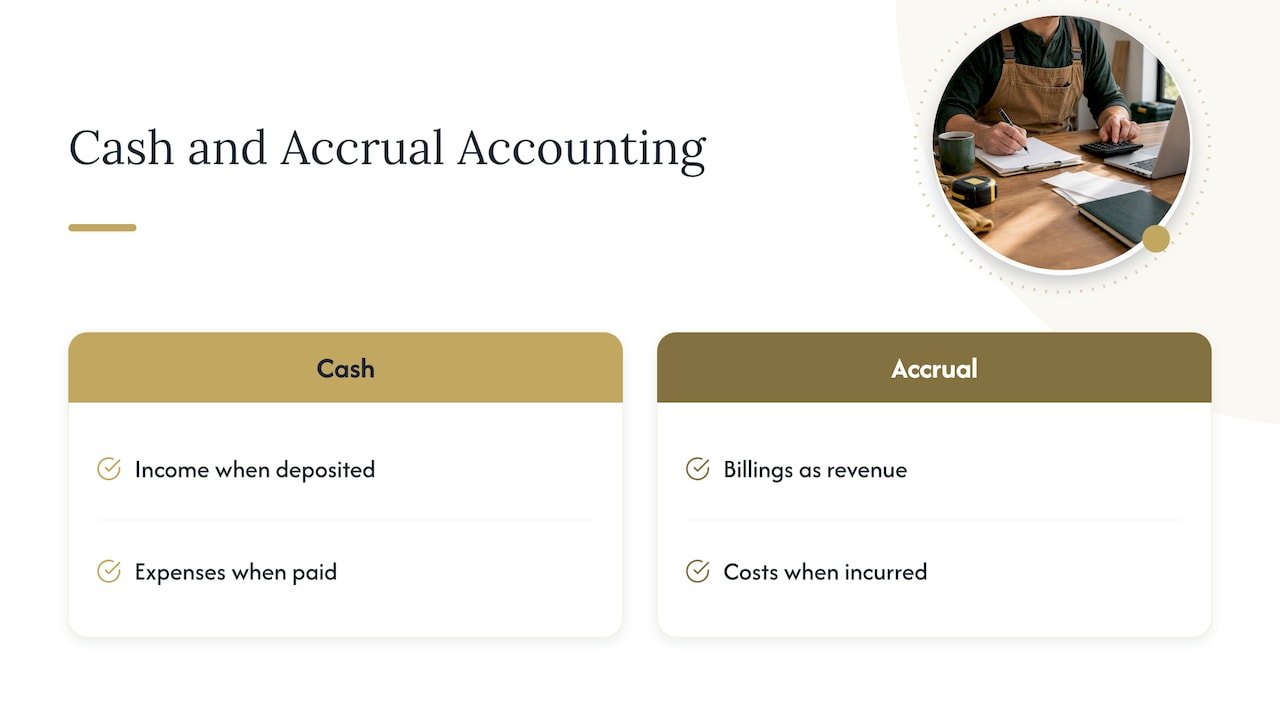
Construction accounting guidance from the Associated Builders and Contractors explains that the choice between cash and accrual accounting has a substantial effect on net income. Cash accounting records income when it is deposited and expenses when they are paid. Accrual accounting records billings as revenue and costs as expenses when they are incurred. For a contractor who bills in stages and pays suppliers on terms, those two methods can show very different months.
Crews and equipment also move between sites. An academic text on construction accounting and financial management notes that you have to track where people and machines are in order to charge costs to the correct job. If a day of labor lands on the wrong project, two jobs are misreported at once.
Set up the foundation first
The IRS says you may use any recordkeeping system that clearly shows your income and expenses. Your books must show gross income, plus the deductions and credits you claim. For most small businesses, the business checking account is the main source of entries. Supporting papers such as invoices, paid bills, receipts, deposit slips and canceled checks should be kept in an orderly place, organized by year and type of income or expense.
In practice, that means five things:
- A business-only bank account and card. Mixed personal and business spending is the most common reason books take days to clean up.
- A separate account for tax reserves. Move a set percentage of each customer payment into it when the payment arrives.
- A chart of accounts built for jobs. Separate income from direct job costs (labor, materials, subcontractors, equipment, permits) and from overhead such as insurance, office costs and vehicles.
- Accounting software connected to the bank. QuickBooks is the usual choice for contractors. Setup matters more than the product: the job list, the cost categories and the bank rules decide whether reports can be trusted later.
- A place for every receipt. Capture it the day you get it, tied to the job.
If the books are already behind, you can start from where you are. Our guide to catching up on bookkeeping covers how to rebuild months of records in a sensible order.
Job costing: the heart of contractor bookkeeping
Job costing gives each project its own costs so you can compare what you spent against what you estimated and see the profit. The ABC accounting guide says to track labor, materials, subcontractors, equipment, permits and other direct costs against the right job. It also says to keep direct and indirect job costs apart from general and administrative expenses.
What a job needs:
- A job number or name that appears on every invoice, bill, receipt and timesheet.
- Cost codes for the categories you estimate: demolition, framing, electrical, finishes, and so on. Use the same codes in your bids so actuals compare cleanly with estimates.
- Labor with its burden. Wages are only part of labor cost. Payroll taxes, workers’ compensation and benefits sit on top of them, and they belong in the job’s cost.
- Overhead assigned consistently. Pick a method for spreading shared costs across jobs and stick with it.
A worked example
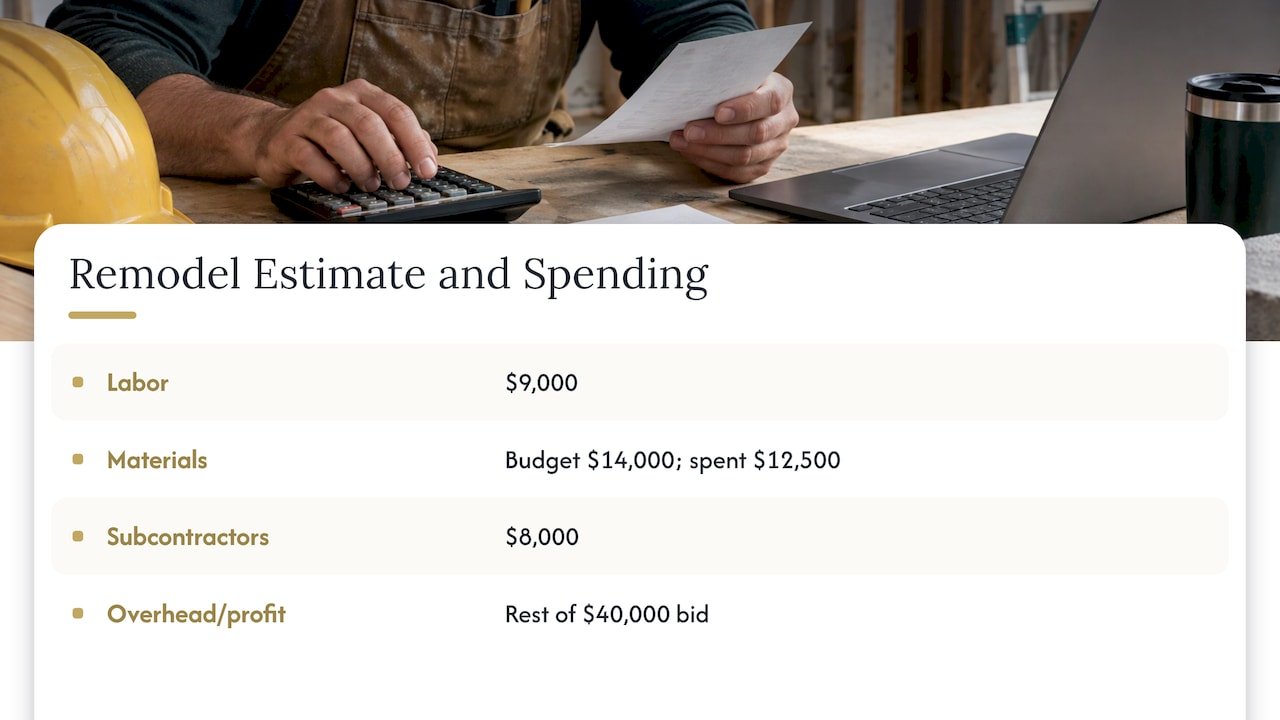
Suppose you bid a kitchen remodel at $40,000. Your estimate had $9,000 for labor, $14,000 for materials, $8,000 for subcontractors, and the rest for overhead and profit. Halfway through, the books show $12,500 in materials already spent against a $14,000 budget, with cabinets and countertops still to come. Without job-level coding, you would see only a busy month of purchases. With it, you see the overrun while you can still change a bid on the next phase or write a change order.
This is the point where most do-it-yourself books fail. The coding takes discipline on every transaction, every week. If a receipt gets no job tag in March, no report in April can recover it.
A weekly and monthly routine that holds up
A light routine, done on schedule, beats a big cleanup at tax time. Our weekly bookkeeping workflow is written for freelancers, but the logic carries over to contractors.
Weekly:
- Categorize new bank and card transactions and tag each to a job.
- Match receipts to transactions.
- Record customer payments and deposit them.
- Review overdue invoices and follow up.
- Enter supplier and subcontractor bills so you know what you owe.
Monthly:
- Reconcile every bank and card account. Any difference should be a timing item or an error you can name and fix.
- Review the profit and loss report, then job profitability for active and finished jobs.
- Update your work-in-progress (WIP) schedule.
- Move tax reserves to the separate account and save the month’s statements.
The AICPA describes a WIP schedule as listing the contract price, the estimated total cost, and the costs and billings to date. It is usually updated monthly and cross-checked against your other financial statements. Its example: $250,000 spent against a $1 million budget indicates 25% completion, so 25% of revenue and gross profit is recognized. A WIP schedule is how you spot a job that is billed ahead of its work, or behind it.
Retainage, progress billing and cash flow
Most larger jobs are paid in monthly progress payments, and many hold back a share of each as retainage until the work is complete. The construction accounting text notes that this defers part of your payment and creates unusual cash needs. You pay crews and suppliers now. A portion of what you earned arrives later.
In the books, that means:
- Retainage receivable is tracked as its own balance per job, so you know what is owed to you and when it releases.
- Retainage you hold back from subcontractors is tracked as a payable.
- Your cash forecast uses the date money will arrive, not the date you billed.
Payment and lien rights are set by state law. Florida, for example, has its own notice and deadline rules, summarized in this Florida construction lien law guide. Check your own state’s rules, because they differ, and keep dated records of what was delivered and billed.
This is where collections matter. Slow-paying customers are a bookkeeping problem before they are a legal one. Following up on aging invoices on a fixed schedule is part of the work we do for clients, along with paying bills on time.
Subcontractors, employees and the records the IRS expects
Subcontractors and Form 1099-NEC
The IRS explains that a subcontractor is not your employee. You report what you pay on a Form 1099, and the subcontractor keeps their own records and pays their own income and self-employment taxes. Whether someone is a subcontractor or an employee depends on your right to direct and control the work, judged on behavioral control, financial control and the relationship between the parties. Label a worker incorrectly and you can face payroll tax problems, so the question deserves care at the start of the relationship.
For reporting, IRS Publication 15 says Form 1099-NEC is required for payments of $600 or more made in 2025, and $2,000 or more for payments made in 2026, to people who are not employees. Wages paid to employees go on Form W-2. Thresholds can change, so confirm the figure for the year you are filing.
The habit that makes 1099 season easy: collect a Form W-9 from each subcontractor before the first payment, and record each payment against the right vendor and job all year.
Payroll records
The IRS says employers must keep employment tax records for at least four years after filing the fourth-quarter return for the year. These include your EIN, the amounts and dates of wage payments, employee names, addresses, Social Security numbers and occupations, W-4 forms, tax deposit dates, filed returns and fringe benefit records.
Work on federal public buildings adds more. Under 29 CFR 3.4, each contractor and subcontractor must preserve regular payroll records for three years after the prime contract work is complete. Those records include classification, hourly rates, daily and weekly hours, deductions and wages paid. Certified payrolls are due within seven days after the regular payment date. If you bid public work, build that schedule into your payroll routine.
Timesheets are where payroll and job costing meet. Hours entered by job feed both the paycheck and the job cost, so our guide on tying timesheets to payroll is worth reading before you set up the process. For setup from scratch, see small business payroll setup.
Taxes: plan through the year
Contractor taxes depend on how your business is structured and where you work. U.S. tax rules vary by state, and a contractor working in more than one state can face different filing and registration requirements. Clean job-level books make every one of those questions easier to answer, because income, deductions and payroll are already sorted.
We can prepare and file your taxes ourselves, or work alongside the CPA you already have. Either way, we do not promise specific tax outcomes; we make sure your records support the return. Our tax preparation and filing page explains how that works, and our note on small business tax mistakes lists the errors that cost owners the most time.
What to hand off and what to keep
Some owners do their own books for years. The moment to hand them off is usually when the weekly routine starts slipping, when jobs overlap, or when you hire your first crew. The signs are consistent:
- Receipts are stacking up in a truck, not in the system.
- You find out a job lost money after it closes.
- Bills get paid late, or customers pay late and nobody follows up.
- Tax time brings a scramble to find documents.
A bookkeeper who knows contractors keeps the job list and cost codes clean, reconciles monthly and gives you a report you can act on. That is different from a tax preparer who sees your numbers once a year. Our explainer on bookkeeping versus accounting shows where each fits.
Our perspective
Most contractors we talk to do not have a bookkeeping problem. They have a time problem. The work is on site, the evenings are for family, and the books get whatever is left over.
What we believe is that a report is only useful if somebody acts on it. That is why we run the money side as a team: bookkeeping and monthly reporting, bill pay, collections, and keeping the business in good standing. We manage, not just report. The fee is one flat monthly amount agreed up front, never a percentage of your income, so you know the cost before the work starts.
Discretion is standard practice for us, and we are glad to sign an NDA before we begin. If you already have a CPA, we work alongside them. If you do not, we can handle the tax side too.
Kelli
How we work with contractors
KelliWorks is a hands-on business manager and accounting department in one. For contractors and other small business owners, that means full-service accounting and bookkeeping, including QuickBooks setup, monthly reporting, payroll processing and cash flow management, for one flat monthly fee agreed up front.

If your business also needs formation, a registered agent or annual report filings, our business formation and compliance services keep the entity in good standing. For ongoing support with bill pay, workflows and payroll, see business management.
FAQ
What is job costing for contractors?
Job costing assigns each project its own labor, materials, subcontractor, equipment and permit costs. You then compare actual costs to your estimate to see profit while the job is still running. It works only when every transaction carries a job tag.
Do contractors use cash or accrual accounting?
Both are used. Cash accounting records income when deposited and expenses when paid, while accrual records billings and costs when they are incurred. Contractors with long jobs, progress billing and retainage often get a clearer picture from accrual reporting, but the right method depends on your size and your tax situation, so confirm it with your tax preparer. We can help you choose and set it up.
How often should a contractor reconcile the books?
Once a month at minimum, for every bank and credit card account, with transactions categorized and tagged to jobs weekly. A reconciliation should leave only timing differences or errors you can explain and correct. Monthly reconciliation also gives you a clean base for the WIP schedule and your job profit review.
When do I need to send a 1099 to a subcontractor?
IRS Publication 15 sets the Form 1099-NEC threshold at $2,000 for payments made in 2026, up from $600 for 2025 payments. Collect a W-9 before the first payment so the information is ready. If you would rather have someone keep that file current for you, we are happy to talk it through in a free consultation at kelliworks.com/consultation.
Sources
- The Basics of Construction Accounting & Financial Management, Associated Builders and Contractors
- What kind of records should I keep, IRS
- Construction Accounting and Financial Management, Steven J. Peterson
- WIP schedules: Blueprints for solid construction accounting, AICPA & CIMA
- Subcontractors, IRS
- 2026 Publication 15, IRS
- Employment tax recordkeeping, IRS
- 29 CFR 3.4, eCFR
- Construction Lien Law Florida guide
- Interior design studio project management software
Recommended
- Financial Records for Freelancers: What to Keep and Why
- 30–60 Minute Weekly Bookkeeping for Freelancers, IRS Ready Workflow
- Manage Cash Flow with Bookkeeping: A Small Business Guide
- Bookkeeping Best Practices for Small Business Owners
This article is general information, not tax, legal or financial advice. Talk to a professional about your situation.