


An outsourced accounting department is an outside team that runs the money side of your work on a regular schedule: bookkeeping, monthly reports, bill pay, collections, tax planning and compliance. For a creative professional, that means you get the function of a finance department without hiring one. You keep making the work, and a team keeps the books current, the bills paid and the filings on time. At KelliWorks, we built our service around that idea: a real team that manages your finances, not just an app that reports on them.
TL;DR
- An outsourced accounting department takes over recurring finance work (bookkeeping, reporting, bill pay, collections, tax and compliance) for a set fee instead of a salaried hire.
- Creative income is irregular and comes from many places, so clean monthly books matter more than they do for a business with one steady revenue stream.
- The service can handle your taxes directly or work alongside the CPA you already have. U.S. tax rules vary by state, so your state matters.
- Look for a flat monthly fee agreed up front, a clear scope, and confidentiality handled as standard practice.
- You can start small and add services as your career and your income grow.
Table of Contents
- What an outsourced accounting department actually is
- Why creative careers are a special case
- What the department handles for you
- Outsourced department or in-house hire?
- How an outsourced team works with you and your advisers
- Outsourced finance leadership: where a controller or CFO fits
- What to look for when you choose a provider
- How pricing works
- Perspective
- Work with a team that runs the money side
- FAQ
- Sources
What an outsourced accounting department actually is
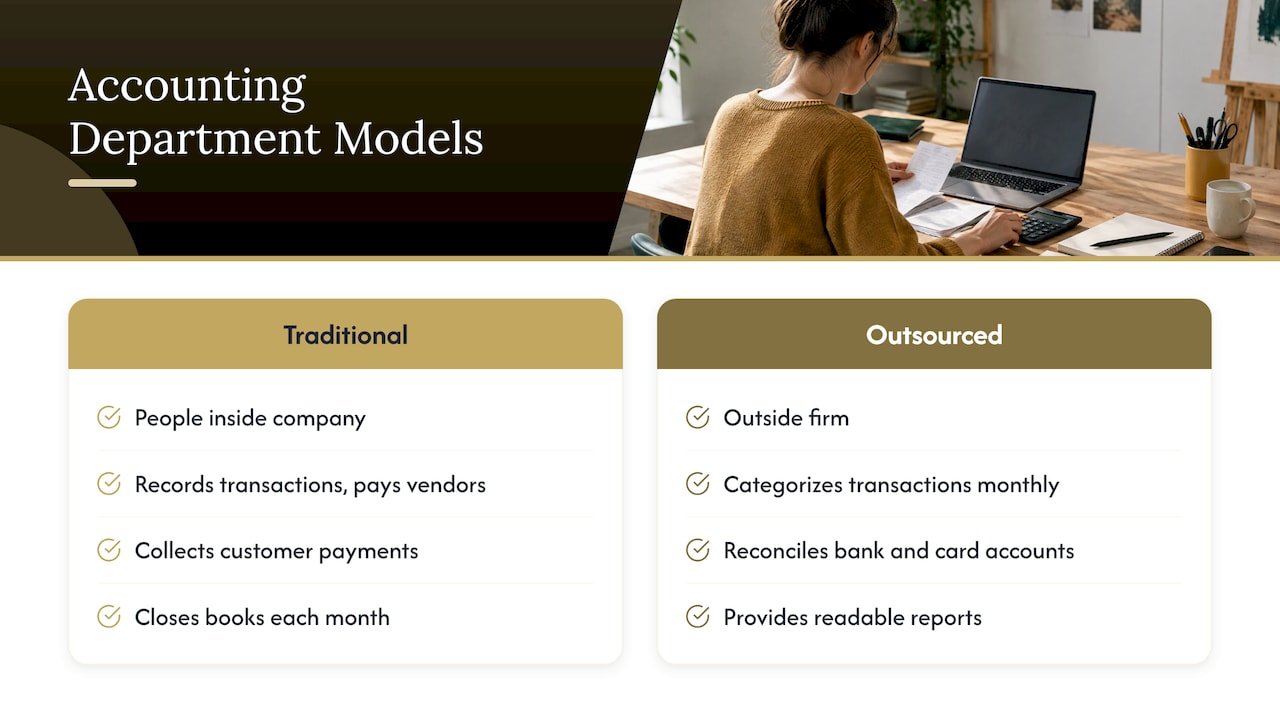
The phrase sounds corporate, but the idea is simple. A traditional accounting department is a group of people inside a company who record transactions, pay vendors, collect from customers, close the books each month and prepare for tax. A one-person creative business or a small studio rarely has the volume to justify that group. It still has the same work.
Outsourcing means an outside firm does that work for you as an ongoing engagement. You are not buying a single tax return or a one-off cleanup. You are buying a routine: every month the transactions are categorized, the accounts are reconciled (matched against your bank and card statements), and you receive reports you can read.
You will also see the same idea described as an outsourced accounting team or an outsourced finance department. The wording changes, but the scope is what matters. Ask what the team does each month, who does it, and what you will receive.
Bookkeeping, accounting and finance: where the lines fall
Three layers are often blurred together:
- Bookkeeping records what happened: income, expenses, bank and card activity.
- Accounting turns those records into reports, supports tax preparation and checks that the numbers make sense.
- Finance and management looks forward: cash flow, budgets, forecasts and decisions about what you can afford to do next.
A full department covers all three. We explain the difference in more detail in our guide to bookkeeping versus accounting, and our overview of full-service accounting for small businesses shows what the complete package looks like.
Why creative careers are a special case
A salaried employee gets one pay stub and one W-2. A creative professional often gets a dozen forms of income, and each one has its own paperwork.
Consider a few typical patterns:
- A streamer or podcaster may receive platform payouts, sponsorship payments, affiliate commissions and merchandise sales, all on different schedules.
- A musician or DJ may combine performance fees, royalties, session work and teaching, with travel and equipment costs spread across the year.
- An actor, writer, photographer or videographer may be paid by several clients, some through payroll and some as an independent contractor.
- A talent manager handles commissions, client expenses and sometimes pass-through payments on behalf of the artists they represent.
The IRS explains that people who work for themselves generally must pay tax throughout the year through estimated tax payments, because no employer is withholding for them. Clients who pay you as a contractor typically report those payments to the IRS on Form 1099-NEC. If your records are scattered across platforms and inboxes, matching what you were paid to what was reported becomes a scramble each spring.
A monthly routine fixes that. When income and expenses are categorized as they happen, you can see what you have earned, what you owe and what you can safely spend.
What the department handles for you
Here is what an outsourced team typically takes off your plate, and what we do in each area.
Bookkeeping and monthly reporting
This is the foundation. Every deposit and expense is recorded, accounts are reconciled and you get a monthly report. Good books are what make everything else faster and less expensive, including tax preparation. Our piece on outsourced bookkeeping and year-round IRS readiness walks through why a steady monthly routine beats a yearly cleanup.
Bill pay and collections
Many creatives lose time and money here. Invoices go out late, payments from brands or production companies arrive weeks after they are due, and nobody follows up. We pay the bills and chase what clients owe you, so cash does not stall while you are on set, on tour or on deadline. If you want a closer look at the receivables side, see accounts receivable outsourcing. The routine behind paying vendors is covered in our bill pay workflow guide.
Tax planning and preparation
We can handle tax ourselves, or we can work alongside the CPA you already have. If you like your current CPA, nothing about outsourcing the day-to-day accounting requires you to change that relationship. The books we keep give your CPA clean records to work from.
One point to keep in mind: U.S. tax rules vary by state. Where you live, where you perform and where your income is sourced can all affect what you file. We do not promise any particular tax result, because the outcome depends on your facts and the rules that apply. What we can do is keep your records organized so planning conversations are based on real numbers. For ideas on planning, see our tax savings strategy guide, and for the pitfalls to avoid, small business tax mistakes.
Entity, banking and compliance
Many creatives start as sole proprietors and later form an LLC or corporation as income grows. The department can help with business formation, a registered agent, business banking setup and annual report filings, so the business stays in good standing. Our business formation page lists what we cover.
Cash flow, budgets and forecasting
With irregular income, the question is rarely “how much did I make?” It is “how much can I count on over the next three months?” Cash flow management, budgets and forecasts answer it. Our guides on cash flow forecasting and managing cash flow with bookkeeping show the method. We do not give investing advice, so our focus stays on the operating side of your business: what comes in, what goes out and when.
Payroll, if you have a team
Once you hire an editor, an assistant or a crew, payroll and its deadlines come with them. We offer payroll processing and HR solutions, and our payroll setup guide explains the steps.
Outsourced department or in-house hire?
The usual alternative is to hire an in-house bookkeeper or accountant. The U.S. Bureau of Labor Statistics publishes wage data for these roles: a May 2025 median wage of $83,680 a year for accountants and auditors, before benefits, payroll taxes, software and office costs. A single hire also covers only one person’s hours and one person’s skills. When that person is out sick or leaves, the work stops.
An outsourced team gives you a group of people with different strengths for one agreed fee. For most creative businesses and small studios, that is a better fit than a full-time salary. Larger operations with heavy volume may eventually build an internal team, and the transition is smoother when the books are already in order.
How an outsourced team works with you and your advisers
A good engagement has a rhythm. Here is what ours looks like in practice.
- Onboarding. We learn how you earn money, which accounts and platforms you use and what is outstanding. If you have backlogged months, we bring them up to date first.
- Monthly routine. Transactions are recorded, accounts reconciled, bills paid and receivables followed up.
- Reporting. You receive monthly reports so you can see where you stand without learning accounting jargon.
- Tax coordination. We prepare taxes ourselves or send organized records to your CPA, depending on your preference.
- Planning. We use the numbers for budgets, forecasts and conversations about what is coming.
If you have a business manager, agent or attorney, we work around them rather than over them. Our role is the accounting and operations layer.
Confidentiality
Creative careers involve sensitive deals: unreleased projects, contract terms, private fees. Discretion is standard practice for us, and we are glad to sign an NDA before we start.
Outsourced finance leadership: where a controller or CFO fits
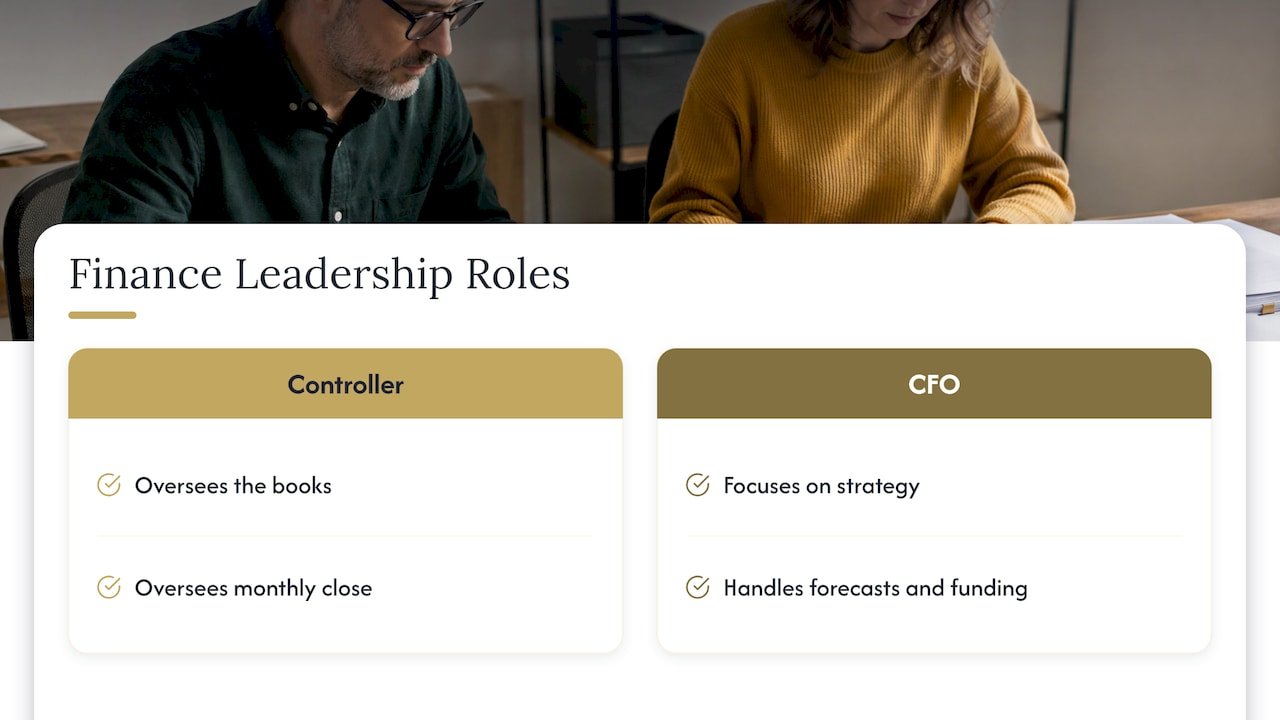
Some businesses need more than accounting. A fractional controller oversees the books and the monthly close. A fractional or outsourced CFO focuses on strategy, forecasts and funding. These are part-time versions of roles that larger companies hire full time. If you are curious about the first, we wrote about what a fractional controller does and when to hire one.
For a deeper look at how the senior finance role shapes decisions, read about the CFO’s role in strategy. Fortune has reported on a small design studio that turned to an outsourced CFO firm even though it already had an in-house accountant, which shows that outside finance leadership is not only for large companies.
For most creatives, the practical path is to build the foundation first: clean books, reliable reports, then planning. Our Business Management service combines financial management, compliance and operational support under one team.
What to look for when you choose a provider
Use these questions to compare any outsourced accounting department.
- Scope. Is it bookkeeping only, or does it include bill pay, collections, tax and compliance? Ask for a written list.
- Pricing structure. A flat monthly fee agreed up front is easy to budget for. A fee that is a percentage of your income grows with your success and is harder to predict. Ours is one flat monthly fee, never a percentage of income.
- Tax approach. Can the team prepare taxes and also work with your CPA?
- People. Will you work with a real team that knows your account?
- Reporting. Will you get monthly reports you can understand?
- Confidentiality. Is discretion standard, with an NDA available?
- Fit with your career. Does the team understand creative income, such as royalties, brand deals, platform payouts and project-based pay?
A practical tip is to start at the level of service your obligations require, then add more only when it earns its place. If a lender or investor may someday want more formal statements, mention it at the start so the engagement is set up with that in mind.
How pricing works
Price depends mainly on how many transactions you have, how many entities or income streams are involved, whether there is backlog to catch up and how much tax and management work is included. Our fee is a flat monthly amount agreed before we begin, so you know the cost every month. We do not publish a dollar figure because the scope is customized to your business. For a fuller explanation, see our guide to accounting service pricing for small business owners, and for an angle on cost, why manual accounting costs more.
Perspective
Creative people rarely get into the work because they love reconciling bank statements. Yet the business side decides how long a career can last. We have built KelliWorks around a simple belief: the money side should be run by people, on a routine, with someone accountable for it.
That is why we manage and do not only report. A dashboard can tell you an invoice is overdue. A team can call the client. A report can show a tax bill is coming. A team can plan for it with you, and work with your CPA when you want that.
We charge one flat monthly fee agreed up front, so a good year does not mean a bigger bill. And we treat your information with the discretion it deserves, as standard practice.
Kelli
Work with a team that runs the money side
If you are ready to hand off bookkeeping, bill pay, collections, tax and compliance, our accounting services bring them together under one flat monthly fee. For tax alone, see tax preparation and filing. Either way, we can take on the tax work or coordinate with your existing CPA.

The easiest way to see what it would look like for your career is a conversation. Visit kelliworks.com/consultation to book a free consultation.
FAQ
What does it mean to outsource an accounting department?
It means an outside team performs the recurring work an internal accounting group would do: bookkeeping, reconciliations, reporting, bill pay, collections and tax support. You work with the team on a regular schedule instead of managing employees. The result is the same function with less overhead.
Is an outsourced accounting team the same as my CPA?
Not necessarily. A CPA focuses on tax and attest work, while an outsourced team handles the ongoing monthly accounting. We can prepare your taxes ourselves or work alongside your existing CPA, so you can keep the relationship you already have.
Can I outsource if my income is irregular?
Yes, and irregular income is a strong reason to do it. Monthly books show how each income stream performs, and forecasts help you plan for slow months. Because tax rules vary by state, we also keep your records organized for the state or states that apply to you.
How is the service priced?
We charge one flat monthly fee agreed up front, never a percentage of income. The fee reflects the scope of work for your business, so we discuss it on a consultation.
Is my financial information kept confidential?
Discretion is standard practice for us, and we are glad to sign an NDA before we start. Many of our clients work on projects and deals that are not public, and we treat that information accordingly.
Sources
- IRS: Estimated taxes
- IRS: About Form 1099-NEC
- Wage data for accountants and auditors, May 2025 (Bureau of Labor Statistics figures)
- Fortune: How far can you go with an outsourced CFO?
- The CFO’s role in strategy
Recommended
- Outsourced Bookkeeping Keeps Small Businesses IRS Ready All Year
- Virtual Accounting Department Explained for Small Business
- Financial Records for Freelancers: What to Keep and Why
- Freelance Bookkeeping Basics Explained for Small Business
This article is general information, not tax, legal or financial advice. Talk to a professional about your situation.