


The general ledger is defined as the master financial record that captures every transaction a small business makes, organized by account type and date. Every sale, expense, loan payment, and payroll entry lives here. The role of general ledger in small business accounting is not just recordkeeping. It is the foundation that makes reliable financial reporting, tax compliance, and sound decision-making possible. Tools like QuickBooks, Xero, and Sage all center their accounting systems around this single record.
How does the general ledger support financial reporting and decision-making?
A well-maintained general ledger is foundational for producing reliable financial statements like the balance sheet and income statement. Ledger account balances flow directly into these reports. An error in the ledger produces an error in the report. That chain reaction is why accuracy at the source matters so much.
The general ledger organizes accounts into five core categories:
- Assets: Cash, accounts receivable, equipment, and inventory
- Liabilities: Accounts payable, loans, and credit card balances
- Equity: Owner contributions and retained earnings
- Revenue: Sales income and service fees
- Expenses: Rent, payroll, utilities, and supplies
Each category feeds a specific section of your financial statements. Revenue and expense accounts build your income statement. Asset, liability, and equity accounts build your balance sheet. When these accounts are accurate, you can track profits, monitor cash flow, and spot problems before they grow.
GL reports condense vast transaction data into readable formats that support reconciliation, budgeting, anomaly detection, and audit preparation. That means you can filter by account, date range, or transaction type to answer specific questions fast. Did your supply costs spike in march? The ledger tells you exactly when and by how much.

Pro Tip: Run a general ledger report by expense category at the end of each month. Comparing month-over-month totals takes less than ten minutes and often reveals spending patterns you would otherwise miss.
The true value of the general ledger lies less in data entry and more in how its structure enables decision-making, accountability, and reliable financial reporting. Owners who read their ledger regularly make faster, more confident decisions about hiring, pricing, and investment.
What practices keep your general ledger reliable and audit-ready?
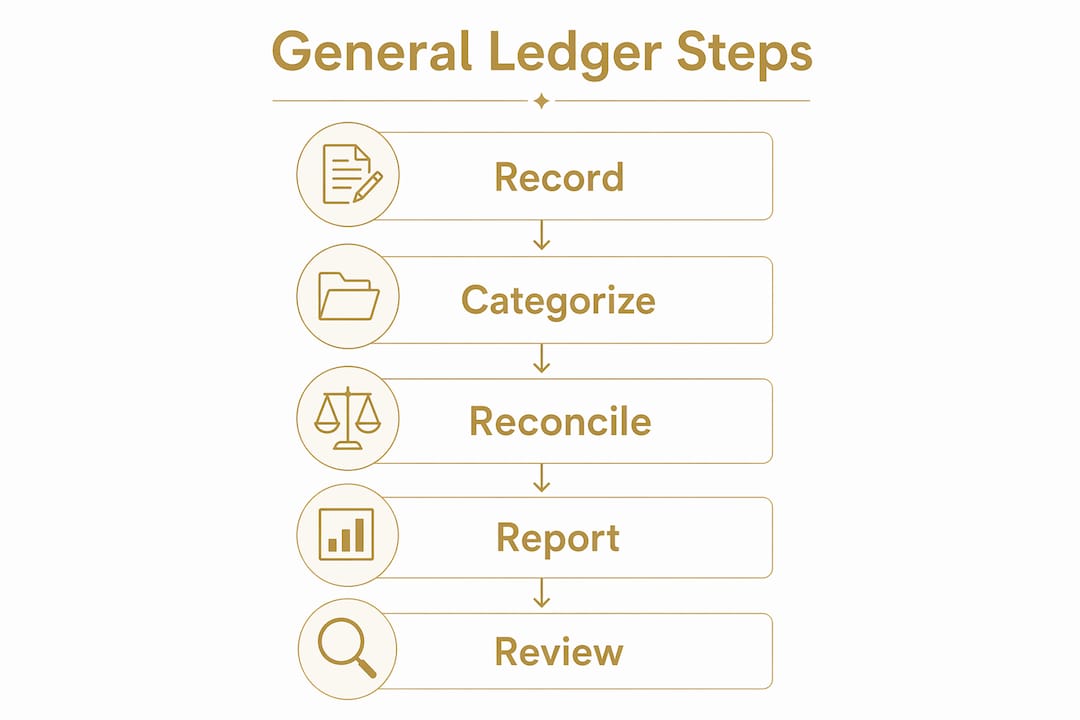
Ledger accuracy does not happen automatically. It requires consistent habits and basic internal controls, even in a one or two-person operation.
-
Attach source documents to every entry. Every journal entry needs a receipt, invoice, or approval attached. Journal entries must be balanced and supported by evidence such as invoices, approvals, and descriptions to be defensible. Balancing debits and credits alone is not enough. Auditors examine the rationale and documentation behind each entry.
-
Use subsidiary ledgers for detail. Subsidiary ledgers like accounts receivable and accounts payable keep individual customer and vendor balances organized without overloading the general ledger with line-by-line detail. The GL holds the summarized control account. The subsidiary ledger holds the specifics.
-
Reconcile accounts monthly. Many small business accounting failures happen between recording transactions and reconciling balances. Monthly trial balances prevent errors from accumulating undetected. A post-closing trial balance confirms that account balances carry forward correctly into the next period.
-
Separate duties where possible. Separation of duties in ledger management improves accuracy and helps detect errors or fraud, even in small businesses. Having one person enter transactions and another handle reconciliations creates an independent check. Partial separation is far better than none.
-
Review your chart of accounts regularly. A bloated or poorly organized chart of accounts leads to misposted entries. Review it at least once a year and remove accounts you no longer use.
Pro Tip: Set a recurring calendar reminder for the 5th of each month to close the prior month’s books. Consistent timing builds a habit and prevents the backlog that makes reconciliation painful.
Good bookkeeping techniques tied to your ledger also protect your cash flow. When your accounts are current and reconciled, you always know what you owe and what you are owed.
How does the general ledger support tax compliance and IRS documentation?
The IRS requires businesses to keep records sufficient to determine correct tax liabilities. The general ledger is the core of that requirement. It connects every income and expense figure on your tax return to a specific transaction, date, and account.
Here is what the ledger does for your tax position:
- Substantiates income. Every revenue entry in the ledger ties back to a sale or invoice. That chain of evidence supports the gross income figure on your return.
- Documents deductions. Expense accounts in the ledger show exactly what you spent, when, and on what category. The IRS expects this level of detail for deductions like home office, vehicle use, and business meals.
- Creates an audit trail. A defensible audit trail requires every ledger posting to be traceable back to original journal entries and supporting documentation. Balanced entries alone do not satisfy an auditor. The documentation behind each posting must exist and be accessible.
- Speeds up tax preparation. A clean, current ledger means your accountant or tax preparer spends less time reconstructing records and more time finding legitimate deductions. That directly reduces your tax prep costs.
US federal law requires businesses to keep records sufficient to determine correct tax liabilities, which means organized and traceable transactional records are not optional. They are a legal requirement. A general ledger maintained throughout the year is your best defense if the IRS ever questions your return.
For small business owners who want to understand how accurate ledgers support tax preparation, the connection is direct. Clean books produce accurate returns. Accurate returns reduce audit risk.
What are the benefits of accounting software for managing your general ledger?
Accounting software removes most of the manual work from ledger maintenance. QuickBooks, Xero, and Sage each automate posting, balancing, and report generation. That automation saves hours each week and reduces the risk of arithmetic errors.
Here is how three widely used platforms compare for small business general ledger management:
| Feature | QuickBooks Online | Xero | Sage 50 |
|---|---|---|---|
| Automated journal posting | Yes | Yes | Yes |
| Subsidiary ledger support | Yes | Yes | Yes |
| Bank reconciliation tools | Yes | Yes | Yes |
| Custom chart of accounts | Yes | Yes | Yes |
| Real-time GL reports | Yes | Yes | Yes |
| Best fit | Broad small business use | Growing businesses | Accounting-heavy operations |
Modern accounting software automates posting, balancing, and report generation but cannot prevent posting errors without proper configuration and oversight. Software posts to whatever account you tell it to. If your chart of accounts is set up incorrectly, the automation locks in the mistake at scale.
Understanding ledger structure and reconciling discrepancies remains critical for accuracy and audit defensibility, even when software handles the routine work. Automation handles volume. Human review handles judgment. You need both.
For owners weighing their options, a guide on financial consulting vs. bookkeeping can clarify which type of support best fits your current stage and budget.
Key takeaways
A well-maintained general ledger is the single most important financial record a small business can keep, directly supporting accurate reporting, tax compliance, and sound decision-making.
| Point | Details |
|---|---|
| Ledger feeds financial statements | Errors in the general ledger flow directly into your balance sheet and income statement. |
| Monthly reconciliation prevents errors | Running a trial balance each month stops small mistakes from compounding over time. |
| Source documents are non-negotiable | Every ledger entry needs an invoice, receipt, or approval to be audit-defensible. |
| Software automates but does not replace judgment | QuickBooks, Xero, and Sage reduce manual work but require correct setup and human review. |
| The ledger is your IRS defense | A traceable, well-organized ledger substantiates every income and deduction figure on your tax return. |
What I have learned from watching small businesses manage their ledgers
Most small business owners I work with underestimate the general ledger until something goes wrong. A loan application gets rejected because the financials look inconsistent. A tax return gets questioned because deductions cannot be traced. A partner dispute erupts because no one can agree on what the business actually earned. Every one of those situations traces back to a ledger that was not maintained properly.
The most common mistake I see is treating the ledger as a year-end task. Owners let transactions pile up, then scramble in january or february to reconstruct months of activity. That approach produces errors, misses deductions, and creates stress that is entirely avoidable. Keeping the ledger current is a weekly habit, not an annual project.
The second mistake is over-relying on software without understanding what it is doing. QuickBooks and Xero are excellent tools. But if your chart of accounts is wrong, or if bank feeds are pulling transactions into the wrong categories, the software will confidently produce inaccurate reports. Automation amplifies whatever you put into the system.
My honest advice: learn the five account categories, reconcile monthly, and attach documentation to every entry. You do not need to be an accountant. You need to understand the structure well enough to catch problems and ask the right questions. That knowledge protects your business and makes every conversation with your accountant more productive.
— Kelli
How Kelliworks supports your general ledger and financial health
Running a small business is demanding enough without worrying whether your books are accurate and your records are audit-ready.
Kelliworks operates as a full-service virtual accounting department built specifically for small business owners. Our team handles expert bookkeeping and accounting that keeps your general ledger current, reconciled, and organized throughout the year. We also provide tax preparation and financial consulting so your ledger data translates directly into accurate filings and real savings. If you want to understand your cost-saving accounting options before committing, we offer a free consultation to walk through your current setup and identify where we can help most.
FAQ
What is the general ledger in accounting?
The general ledger is the master record of all financial transactions in a business, organized by account type such as assets, liabilities, revenue, and expenses. Every financial statement a business produces draws its figures directly from the general ledger.
Why is the general ledger important for small businesses?
The general ledger gives small business owners a single, accurate source of financial truth that supports reporting, tax compliance, and daily decision-making. Without it, financial statements are unreliable and tax returns become difficult to defend.
How often should a small business reconcile its general ledger?
A small business should reconcile its general ledger at least once a month. Monthly reconciliation prevents errors from accumulating and ensures that account balances carry forward correctly into the next period.
Does accounting software replace the need to understand the general ledger?
No. Software like QuickBooks, Xero, and Sage automates posting and reporting but cannot correct errors caused by a misconfigured chart of accounts or wrong account assignments. Owners still need to review and reconcile their ledger regularly.
What records should support general ledger entries for IRS purposes?
Every ledger entry should be supported by a source document such as an invoice, receipt, bank statement, or signed approval. The IRS requires businesses to keep records sufficient to determine correct tax liabilities, and a traceable ledger is the foundation of that requirement.
Recommended
- Financial Consulting vs Bookkeeping: A Small Business Guide
- Manage Cash Flow with Bookkeeping: A Small Business Guide – Kelliworks Accounting FIrm
- Cost-Saving Accounting Strategies for Small Business – Kelliworks Accounting FIrm
- What Is a Scalable Accounting Service for Small Businesses – Kelliworks Accounting FIrm




One Response