


Tax planning is a proactive financial strategy that determines how much capital your startup keeps from its first day of operation. The role of tax planning in the early stage goes far beyond filing annual returns. Founders who build tax strategy into their first decisions on entity structure, expense timing, and credit eligibility consistently preserve more cash and face fewer surprises. The IRS tax code creates real opportunities for early-stage companies, but those opportunities close fast if you miss deadlines or choose the wrong structure. This guide covers what you need to know to make tax planning work for your startup from day one.
How early tax planning shapes business structure and entity choice
Entity selection is the single most consequential tax decision a founder makes. The structure you choose determines your tax rate, your personal liability, and your ability to raise outside capital. Getting it wrong early costs far more to fix later than it would have cost to get right from the start.
C-Corporations are the standard for venture-backed startups. They are taxed at a flat 21% federal rate, which is predictable and favorable for reinvesting profits. The trade-off is double taxation: the company pays tax on profits, and shareholders pay tax again on dividends. LLCs, by contrast, pass income directly to owners, avoiding that second layer of tax. That flexibility makes LLCs attractive for service businesses and solo founders who expect to take distributions early.

S-Corporations sit between those two options. They avoid double taxation like an LLC but carry restrictions on the number and type of shareholders. That matters if you plan to bring in institutional investors, since most venture capital funds cannot hold S-Corp shares.
Converting entity types mid-stream triggers taxable events that founders rarely anticipate. A founder who starts as an LLC and converts to a C-Corp during a funding round may face unexpected tax bills on appreciated assets. Planning your entity choice around your three-year fundraising roadmap avoids that problem entirely.
| Entity type | Federal tax treatment | Best fit |
|---|---|---|
| C-Corporation | Flat 21% corporate rate; double taxation on dividends | VC-backed startups |
| LLC | Pass-through; taxed at owner’s personal rate | Solo founders, service businesses |
| S-Corporation | Pass-through; restrictions on shareholder type | Small teams without institutional investors |
Pro Tip: Choose your entity before you sign your first client contract or accept your first dollar. Retroactive restructuring is expensive and sometimes impossible without triggering taxes.
Common pitfalls in entity selection include:
- Choosing an LLC because it sounds simpler, without modeling the tax difference at your projected income level
- Ignoring investor term sheets that require a C-Corp before they will wire funds
- Assuming you can convert later without cost
What deductions and credits can startups actually claim?
Startups can reduce their tax liability through deductions and credits, and the difference between the two matters. A deduction reduces the income you are taxed on. A credit reduces the actual tax you owe, dollar for dollar. Credits are more valuable, and R&D tax credits are the most overlooked savings tool available to early-stage companies.
The Research and Development tax credit applies to wages, supplies, and contractor costs tied to developing or improving a product or process. You do not need a lab coat to qualify. Software development, product testing, and process design all count. Many founders assume the credit only applies after they have revenue. That assumption is wrong. Tax credits apply even before revenue if the company incurs qualifying expenses, making them a real cash management tool from the earliest months.
Payroll tax credits are equally powerful. Qualifying startups can apply the R&D credit against payroll taxes rather than income taxes, which means the benefit arrives even when the company shows no profit. That directly affects hiring decisions. Evaluating tax credits in the broader capital planning context changes whether you hire a full-time engineer or bring in a contractor, and whether you launch a benefits program this quarter or next.
Key deductions and credits for early-stage startups:
- Operating costs: Rent, software subscriptions, professional services, and marketing expenses are fully deductible in the year incurred
- Section 179 expensing: Allows immediate deduction of qualifying equipment and software purchases rather than depreciating them over years
- R&D tax credit: Covers wages, supplies, and contractor costs for qualifying development activities
- Payroll tax offset: Startups with under $5 million in gross receipts can apply R&D credits against payroll taxes
- Startup costs: The IRS allows deduction of up to $5,000 in startup costs in the first year of business
Pro Tip: Track every expense from the day you register your business. Receipts and memos that document the business purpose of each cost are what make deductions defensible in an audit.
Kelliworks works with founders to identify which credits apply to their specific operations, including those that apply before the first dollar of revenue arrives. You can learn more about personalized financial strategies that connect credit planning to your broader capital goals.
How does income and expense timing affect your tax bill?
Timing is one of the most underused tools in early-stage tax planning. The year you recognize income and the year you deduct expenses directly determines your taxable income for that period. A startup with volatile cash flow can smooth its tax burden significantly by making deliberate timing decisions.
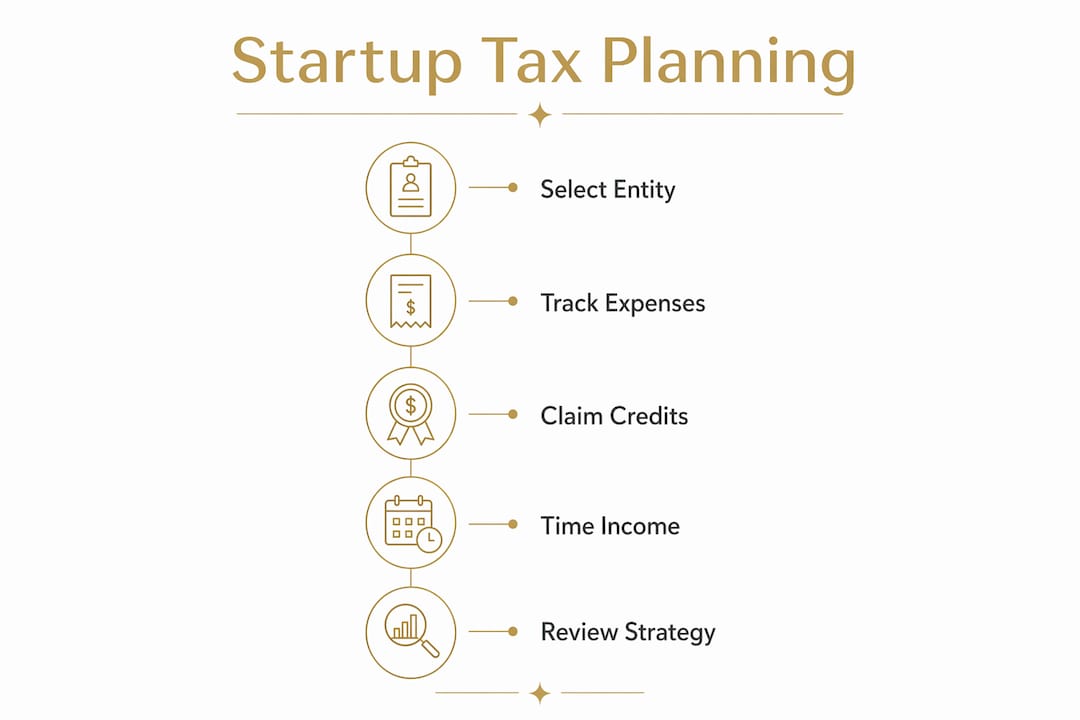
Accelerating deductions into a high-income year reduces taxable income when the tax rate impact is greatest. Deferring income into a lower-income year has the same effect in reverse. Early insight into tax decisions strengthens alignment between your tax strategy and your long-term financial plan. That coordination is what separates reactive tax filing from proactive tax management.
Choosing to expense or depreciate fixed assets affects both taxes and financial reporting. Section 179 lets you deduct the full cost of qualifying equipment in the year of purchase instead of spreading it across five or seven years. Bonus depreciation offers a similar benefit for certain asset classes. The right choice depends on whether you need the deduction now or in a future year when income is higher.
| Timing decision | Effect on current year taxes | Best use case |
|---|---|---|
| Accelerate deductions (Section 179) | Reduces taxable income now | High-revenue year; need cash now |
| Defer income to next year | Reduces current year taxable income | Near year-end with pending invoices |
| Capitalize assets over time | Spreads deductions across multiple years | Low-income year; expect higher income later |
| Pay Q4 expenses in December | Locks in current-year deduction | Predictable expense with flexible timing |
Quarterly estimated tax payments are where timing errors show up most painfully. Founders who underestimate quarterly payments face underpayment penalties on top of the tax bill itself. Reviewing your income trajectory each quarter and adjusting estimated payments accordingly keeps cash flow predictable and avoids penalties.
Common early-stage tax planning mistakes to avoid
Most early-stage tax mistakes are not the result of bad intentions. They come from not knowing what you did not know until the bill arrives. These are the errors that cost founders the most:
- Missing the 83(b) election deadline. The 83(b) election must be filed within 30 days of receiving restricted stock. Missing that window means you pay taxes on the full value of the stock as it vests, not at the lower value when you received it. For a founder whose company grows quickly, that difference can be enormous.
- Treating tax credits as a bonus rather than a planning input. Integrating tax credits into capital planning changes operational decisions. Founders who only think about credits at year-end miss the chance to use them as a real-time financial tool.
- Relying on general-purpose tax software without specialized advice. DIY tax software handles straightforward returns well. It does not flag R&D credit eligibility, entity conversion consequences, or timing strategies specific to your situation.
- Skipping quarterly tax strategy reviews. Many founders neglect quarterly reviews as the business evolves, which leads to missed opportunities and tax inefficiencies. A business that hires its first employee, closes a funding round, or launches a new product line has a materially different tax picture than it did 90 days earlier.
- Assuming entity conversion is simple. Changing from an LLC to a C-Corp mid-growth triggers taxable events. Plan your structure around where you are going, not just where you are today.
Getting professional tax preparation support early prevents most of these mistakes before they become expensive problems.
Key Takeaways
Early tax planning is the most cost-effective way for startups to preserve capital, reduce liability, and build a financial structure that supports long-term growth.
| Point | Details |
|---|---|
| Entity choice drives everything | Select your business structure before your first transaction, based on your fundraising roadmap. |
| Credits beat deductions | R&D and payroll tax credits reduce actual taxes owed, not just taxable income, and apply before revenue. |
| Timing controls your tax bill | Accelerating deductions and deferring income in the right years smooths cash flow and reduces liability. |
| The 83(b) deadline is non-negotiable | File within 30 days of receiving restricted stock or face a potentially massive future tax bill. |
| Quarterly reviews prevent surprises | Revisit your tax plan every quarter as your business milestones change. |
Why I think most founders wait too long to take tax planning seriously
The founders I work with most often come to us after their first painful tax season. They filed on time, paid what they owed, and still felt blindsided. The bill was legal and correct. It was also largely avoidable.
The misunderstanding I see most often is treating tax planning as a compliance task rather than a capital management tool. Tax strategy is a core growth driver that helps founders increase available capital without raising additional debt or equity. That framing changes everything. When you see a tax credit as internal funding, you make different decisions about hiring, equipment purchases, and timing of expenses.
The 83(b) election is the clearest example of how time-sensitive this work is. A founder who misses that 30-day window cannot go back. No advisor can fix it retroactively. The same logic applies to entity selection. The cost of getting it right at formation is a fraction of the cost of fixing it during a Series A.
My honest advice is this: engage a tax advisor before you register your business, not after your first year-end. The questions you answer in that first conversation, about entity type, equity grants, and expected revenue timing, shape every tax outcome that follows. Waiting until april to think about taxes means you have already lost most of your options for that year.
Founders who treat tax planning as a quarterly discipline rather than an annual chore consistently have more cash, fewer surprises, and better conversations with investors. That is not a coincidence.
— Kelli
How Kelliworks supports startups with tax planning from day one
Early-stage founders need more than a tax preparer. They need a financial partner who understands how entity structure, credit eligibility, and expense timing connect to real business decisions.
Kelliworks provides full-service virtual accounting built specifically for small business owners and early-stage startups. Our accounting services cover tax preparation, bookkeeping, and financial consulting, all coordinated to give you a complete picture of your tax position at every stage of growth. We help founders identify R&D credits, plan entity structures, and set up quarterly reviews that keep your tax strategy current as your business evolves. Schedule a free consultation to see how Kelliworks can reduce your tax burden and extend your runway from the start.
FAQ
What is the role of tax planning in the early stage of a startup?
Tax planning in the early stage defines how much capital a startup keeps by optimizing entity structure, deductions, credits, and income timing. Founders who plan proactively reduce unexpected liabilities and extend their financial runway.
When should a startup start tax planning?
Tax planning should begin before the business is formally registered. Entity selection, equity grant decisions, and the 83(b) election all have deadlines or consequences that cannot be reversed after the fact.
What tax credits are available to early-stage startups?
The R&D tax credit is the most valuable credit for early-stage companies, covering wages, supplies, and contractor costs for qualifying development work. Startups can apply this credit against payroll taxes even before they have revenue.
What happens if you miss the 83(b) election?
Missing the 83(b) election means you pay income tax on the full value of restricted stock as it vests rather than at the lower value when you received it. For fast-growing companies, that difference can result in a very large and unexpected personal tax bill.
How often should a startup review its tax strategy?
A startup should review its tax strategy every quarter. Business milestones like new hires, funding rounds, or product launches change the tax picture significantly, and waiting until year-end means missing most of the available planning options.



3 Responses