


An accountant’s role in startup growth is to deliver financial clarity, compliance, and strategic insight that lets founders scale with confidence. Most founders treat accounting as a back-office task. That misunderstanding costs real money. The industry term for what a startup accountant does is financial management, and it covers far more than bookkeeping. It includes cash flow forecasting, GAAP compliance, investor reporting, and tax planning. Founders who build this infrastructure early grow faster and raise capital more easily than those who bolt it on later.
What is the role of an accountant in startup growth?
An accountant is the financial architect behind every major decision a startup makes. They translate raw numbers into signals that tell you whether to hire, cut spending, or raise your next round. Without that translation, founders make expensive guesses.

The scope of the role goes well beyond recording transactions. A startup accountant manages compliance with Generally Accepted Accounting Principles (GAAP), prepares financial statements for investors and boards, and builds the forecasting models that show how long your runway actually lasts. Accounting functions extend to board reporting, revenue forecasting, debt covenant compliance, and acquisition due diligence as the company grows. Each of those outputs directly shapes leadership decisions.
Founders who skip this infrastructure pay for it later. The cost is not just financial. Missed compliance deadlines, inaccurate cap tables, and unrecorded stock compensation create legal exposure that slows fundraising and damages investor trust. Getting the financial foundation right from day one is the single highest-leverage move an early-stage founder can make.
How do accounting needs evolve through startup stages?
Accounting requirements grow at every funding milestone, and the gap between stages is larger than most founders expect.
Pre-seed: basic accrual and SAFE accounting
At the pre-seed stage, your accounting needs are relatively simple. You need basic accrual accounting and proper recording of Simple Agreements for Future Equity (SAFEs). Tools like QuickBooks or Xero handle this well. The goal is clean books that give you an accurate picture of spending and cash position.
Seed stage: equity accounting and investor reporting
The seed stage introduces complexity. Accounting requirements at seed add 409A valuations, equity accounting, and formal investor reporting. A 409A valuation sets the fair market value of your common stock, which determines the exercise price of employee stock options. Getting this wrong creates tax problems for employees and legal problems for the company.
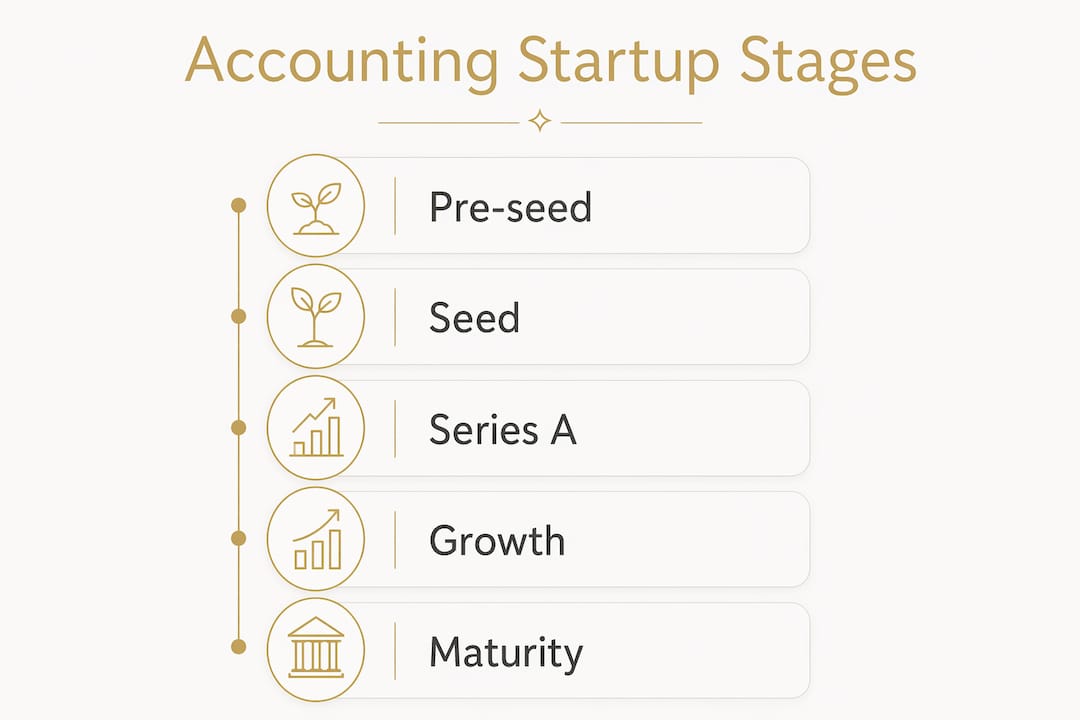
Series A: GAAP compliance and audit readiness
Series A is where accounting infrastructure gets tested hard. Investors expect GAAP-compliant audited financials and a finance function capable of producing detailed FP&A (financial planning and analysis) reports. QuickBooks and Xero typically show their limits here. Enterprise resource planning (ERP) platforms like NetSuite accommodate the audit complexity that Series A demands.
Founders who delay building this infrastructure face a painful reckoning. Cleanup costs between $55,000 and $145,000 are common when restating financials, reclassifying equity instruments, and recording omitted stock-based compensation under ASC 718. That is money spent fixing the past instead of funding the future.
Pro Tip: Treat each funding round as an accounting upgrade trigger. Before you close a round, confirm your books meet the standards investors at the next stage will require.
The right staffing model also shifts with stage. Fractional or outsourced accounting delivers institutional-quality expertise at startup-appropriate prices from pre-seed through Series A. A full-time in-house hire typically becomes cost-effective only after Series A closes and complexity justifies the salary.
- Pre-seed: Use basic accounting software and a part-time bookkeeper.
- Seed: Engage a fractional CFO or outsourced accounting firm for equity and investor reporting.
- Series A: Evaluate ERP platforms and consider your first in-house finance hire.
- Post-Series A: Build an internal finance team with dedicated FP&A capability.
What accounting functions drive startup growth?
Specific accounting activities directly support scaling, and founders who understand them use them as growth tools rather than compliance chores.
- Cash flow forecasting. Knowing your runway to the week lets you make hiring and spending decisions without guessing. A 13-week rolling cash flow model is the standard tool for this. Accurate financial reports support cash flow management that is critical for startup survival and scaling.
- Investor and board reporting. Monthly or quarterly financial packages build investor confidence. They show revenue trends, burn rate, and key performance indicators (KPIs) in a format that supports fast decisions.
- Tax planning. Proactive tax planning integrated early extends runway by reducing the cash you send to the IRS unnecessarily. R&D tax credits, for example, are available to many startups but claimed by very few because founders do not know they qualify.
- KPI monitoring. Gross margin, customer acquisition cost (CAC), and lifetime value (LTV) are accounting outputs. Tracking them monthly lets you catch problems before they become crises.
- Compliance and risk management. Sales tax obligations, payroll tax filings, and equity plan administration all carry penalties for errors. An accountant manages these so you do not face surprise liabilities.
Pro Tip: Set up a financial KPI dashboard in your accounting software from day one. Reviewing five key metrics weekly takes 20 minutes and replaces hours of reactive number-hunting later.
The financial consulting checklist for startups published by Kelliworks outlines how aligning accounting goals with business milestones avoids costly retroactive fixes and improves operational confidence. That alignment is what separates founders who scale smoothly from those who scramble.
In-house, fractional, or outsourced: which accounting model fits your startup?
The right accounting model depends on your startup’s complexity and stage, not your revenue number. Founders who hire based on revenue thresholds consistently over-spend early and under-invest late.
| Model | Best fit | Cost profile | Key limitation |
|---|---|---|---|
| In-house accountant | Post-Series A, high complexity | High fixed cost | Expensive before scale justifies it |
| Fractional CFO/accountant | Seed to Series A | Moderate, flexible | Limited hours per engagement |
| Outsourced accounting firm | Pre-seed to seed | Low to moderate | Less embedded in daily operations |
Fractional and outsourced models give early-stage startups access to senior expertise they could not afford to hire full-time. A fractional CFO working 10 hours per month costs a fraction of a full-time salary while delivering the investor-ready reporting and financial controls that seed investors expect.
The decision to hire or outsource should rest primarily on startup complexity and stage. A SaaS startup with multiple revenue streams, equity compensation, and international contractors needs more sophisticated accounting than a single-product company with domestic sales. Match the model to the complexity, and upgrade the model as complexity grows.
Scalable accounting services are specifically designed to grow with your business, so you pay for what you need at each stage without over-building infrastructure before you need it.
How to integrate accounting into your startup growth strategy
Embedding accounting into your growth strategy means treating financial data as an input to decisions, not a report card after the fact.
- Choose the right tools for your stage. QuickBooks or Xero work well at pre-seed. Plan your migration to an ERP platform before Series A, not during it.
- Set up bookkeeping controls from day one. Separate business and personal accounts immediately. Reconcile accounts monthly. Document every equity transaction at the time it occurs.
- Align accounting goals with business milestones. Selecting the right mix of services aligned with your stage avoids expensive retroactive fixes and keeps you fundraising-ready.
- Use accounting data for fundraising. Investors read your financials before they read your pitch deck. Clean, GAAP-compliant books with clear revenue recognition and accurate cap tables accelerate due diligence and build trust.
- Review financial statements monthly. Monthly reviews catch errors early, reveal trends, and give you the data to make confident decisions about hiring, pricing, and growth investment.
Business financial planning connects your accounting outputs directly to your growth targets, so every financial decision moves you toward a defined goal rather than away from a problem.
Key Takeaways
The role of an accountant in startup growth is to build the financial infrastructure that makes every other growth decision faster, cheaper, and more confident.
| Point | Details |
|---|---|
| Accounting evolves with funding stage | Pre-seed needs basic accrual; Series A demands GAAP-compliant, audit-ready financials. |
| Deferred accounting is expensive | Cleanup costs of $55,000–$145,000 are common when founders delay financial infrastructure. |
| Fractional models work early | Outsourced or fractional accounting delivers senior expertise at startup-appropriate cost before Series A. |
| Tax planning extends runway | Proactive tax strategy reduces unnecessary cash outflows and supports longer runway. |
| Financial data drives decisions | Monthly KPI reviews and accurate reporting turn accounting into a growth tool, not just compliance. |
What I’ve learned from watching founders delay their accounting
Founders consistently underestimate how fast accounting complexity compounds. I have worked with startups that had clean books at pre-seed and then raised a seed round without upgrading their financial infrastructure. By the time Series A conversations started, their cap table had errors, stock compensation was unrecorded, and revenue recognition did not meet GAAP standards. The cleanup took months and cost more than a year of proper accounting would have.
The uncomfortable truth is that accounting feels optional until it suddenly is not. Investors do not wait for you to get your books in order. They move to the next deal. Founders who treat accounting as a growth function rather than a compliance burden close rounds faster, negotiate from a position of strength, and make better decisions between rounds.
My strongest advice: hire or outsource accounting one stage earlier than you think you need to. The cost is always lower than the cleanup. And the confidence that comes from knowing your numbers accurately is worth more than most founders realize until they have it.
— Kelli
How Kelliworks supports startup accounting at every stage
Kelliworks operates as a full-service virtual accounting department built specifically for small businesses and startups. Whether you are at pre-seed with basic bookkeeping needs or approaching Series A with complex equity and reporting requirements, Kelliworks provides the expertise your stage demands.
Our services cover tax preparation and planning, bookkeeping, and financial consulting, all tailored to where your business is now and where it is headed. Founders who work with Kelliworks get virtual accounting support that scales with their growth, without the overhead of a full-time hire before they need one. If you are ready to build the financial foundation your startup deserves, Kelliworks is the partner that grows with you.
FAQ
What does an accountant do for a startup?
An accountant manages bookkeeping, GAAP compliance, tax planning, cash flow forecasting, and investor reporting. These functions give founders the financial clarity needed to make confident growth decisions.
When should a startup hire an accountant?
Founders should engage accounting support at the pre-seed stage, starting with outsourced or fractional services. Full-time in-house hires typically become cost-effective after Series A closes.
How much does poor accounting cost a startup at Series A?
Founders who delay proper accounting infrastructure often face cleanup costs of $55,000 to $145,000 at Series A, covering restated financials, reclassified equity, and missing compliance records.
What accounting standards do startups need to follow?
Most venture-backed startups must follow GAAP (Generally Accepted Accounting Principles). Series A investors require GAAP-compliant, audit-ready financial statements before closing a round.
What is the difference between fractional and outsourced accounting?
A fractional accountant or CFO works part-time as an embedded member of your team. An outsourced accounting firm handles specific functions remotely. Both models deliver senior expertise at lower cost than a full-time hire.



One Response