


Accounting is the process of identifying, analyzing, and managing business costs to achieve measurable cost savings and stronger financial outcomes. The role of accounting in cost savings goes far beyond tax filing or bookkeeping. It gives you a clear picture of where money is going, which expenses are necessary, and which ones are quietly draining your profits. For small business owners and entrepreneurs, this visibility is the foundation of every smart financial decision. Methods like Activity-Based Costing and management accounting turn raw numbers into a plan that protects your cash flow and improves your margins.
How does cost accounting help identify and reduce business expenses?
Cost accounting is a branch of accounting that tracks, records, and analyzes all costs associated with running a business. The standard industry term for this practice is “cost accounting,” and it covers everything from direct materials and labor to overhead and administrative expenses. Most business owners think of accounting as a record-keeping task. Cost accounting is actually a diagnostic tool.

The most widely used technique within cost accounting is Activity-Based Costing, or ABC. ABC assigns overhead costs to specific products, services, or departments based on actual resource consumption rather than broad averages. 44% of companies using Activity-Based Costing report significant waste reduction and overhead savings because ABC reveals which activities actually drive costs. That means you stop subsidizing low-margin products with profits from your best sellers.
Beyond ABC, cost accounting uses two other powerful tools:
- Cost variance analysis: Compares your budgeted costs against actual spending. A consistent variance in a specific category, such as shipping or utilities, signals a problem worth investigating.
- Margin analysis: Tracks profitability by product, service, or client. Regular margin analysis alerts you to profitability shifts early, before a slow quarter becomes a cash flow crisis.
- Expense categorization: Groups spending into fixed, variable, and semi-variable costs. This separation makes it easier to identify which costs you can cut without affecting operations.
- Direct vs. indirect cost tracking: Separates costs tied directly to production from overhead. Many businesses discover their indirect costs are far higher than expected once they track them properly.
Pro Tip: Run a cost variance report every month, not just at year-end. Monthly reviews catch spending drift early and give you time to correct it before it compounds.
What accounting strategies support effective cost control and budgeting?
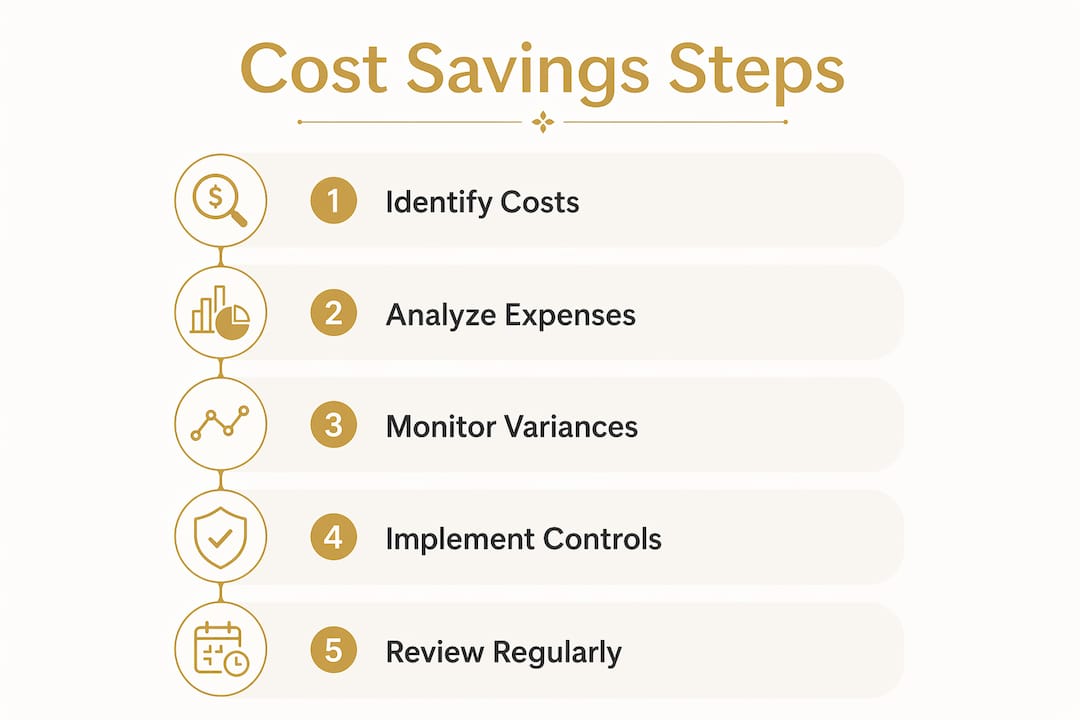
Cost accounting and management accounting work together, and understanding the difference between them matters. Cost accounting uncovers where money leaks. Management accounting frames the strategic response. Together, they form a complete cost control system.
Here is how that works in practice for a small business:
- Build a zero-based budget. Instead of adjusting last year’s numbers, justify every expense from scratch each budget cycle. This forces you to question costs that have become automatic, like software subscriptions or vendor contracts that no longer deliver value.
- Set spending thresholds by category. Use your accounting data to assign monthly limits to expense categories such as marketing, supplies, and travel. When a category approaches its limit, your accounting system flags it before you overspend.
- Conduct quarterly variance reviews. Compare budgeted figures against actual results every quarter. Identify the top three categories where spending exceeded the budget and trace the cause. A pattern of overruns in one area usually points to a pricing or process problem.
- Integrate accounting data into operational planning. When you plan a new hire, a product launch, or a facility change, pull your cost data first. Decisions made without accounting input routinely cost more than expected because indirect costs get overlooked.
- Use rolling forecasts. A static annual budget becomes outdated fast. Rolling 12-month forecasts, updated monthly with real accounting data, keep your financial plan aligned with what is actually happening in your business.
Cost accounting provides detailed cost data that management accounting uses to make strategic budgeting and planning decisions. The two disciplines are inseparable for any business owner serious about growth. One tells you what happened. The other tells you what to do next.
What are common cost reduction strategies enabled by accounting practices?
Accounting data does not just explain the past. It drives the specific actions that reduce costs going forward. The most effective cost reduction strategies are grounded in real financial data, not guesswork.
- Supplier consolidation: 52% of CFOs prioritize cost reduction by consolidating suppliers and eliminating unauthorized spending. Fewer suppliers mean better contract terms, volume discounts, and more predictable payment schedules. Your accounting records show exactly which vendors you use and how much you spend with each, making consolidation decisions straightforward.
- Eliminating maverick spending: Maverick spending refers to purchases made outside approved channels or budgets. Accounting systems with approval workflows catch this spending before it posts, not after. This single change can recover a meaningful portion of your operating budget.
- Automation of accounting processes: Automation reduces labor costs and errors through technologies like OCR and AI-powered expense reconciliation. Automated approval workflows also prevent overspending by requiring sign-off before a purchase is completed.
- Subscription and expense management: Accounting systems with expense categorization let you manage recurring expenses and set early renewal alerts. Many businesses discover they are paying for software or services that no one actively uses once they categorize and review subscriptions quarterly.
- Real-time financial visibility: When your books are current, you can see cash flow problems forming before they arrive. Real-time data lets you pause discretionary spending at the right moment rather than reacting after the damage is done.
Connecting your bookkeeping to cash flow management is one of the most direct ways to put these strategies into action. Clean, current books are the prerequisite for every cost reduction decision on this list.
How can effective accounting prevent hidden costs and improve pricing decisions?
Hidden costs are the expenses that do not show up on a simple profit and loss statement but quietly erode your margins. Overhead costs like rent, insurance, software licenses, and administrative time all attach to every product or service you sell. If your pricing does not account for them, you may be selling at a loss without knowing it.
Knowing exact costs helps business owners avoid selling at a loss due to hidden overhead. Accurate cost accounting prevents underpricing and improves cash flow sustainability. This is one of the most common and costly mistakes small business owners make, especially when launching new products or services.
The table below shows how accounting-informed pricing differs from pricing based on direct costs alone.
| Pricing approach | What it includes | Risk |
|---|---|---|
| Direct cost only | Materials and labor | Ignores overhead; likely underpriced |
| Full cost accounting | Direct costs plus allocated overhead | Accurate margin; protects profitability |
| Activity-Based Costing | Costs tied to specific activities | Most precise; reveals true cost per unit |
Pro Tip: Before setting a price, calculate your fully loaded cost per unit or service hour. Include a proportional share of rent, utilities, software, and administrative time. If the price does not cover that number plus your target margin, the price is too low.
Strong accounting directly informs pricing decisions, preventing businesses from underpricing products due to hidden overhead. For service businesses especially, where time is the primary cost, this discipline separates profitable firms from ones that stay busy but never build cash reserves. Reviewing your cost-saving accounting strategies regularly keeps your pricing aligned with your actual cost structure as the business grows.
Key Takeaways
Accounting drives cost savings by giving business owners accurate, category-level data that reveals inefficiencies, prevents underpricing, and supports budget decisions that protect cash flow.
| Point | Details |
|---|---|
| Cost accounting as a diagnostic tool | Activity-Based Costing and variance analysis reveal where overhead is wasted and margins are shrinking. |
| Budgeting prevents overspending | Zero-based budgets and quarterly variance reviews stop cost drift before it becomes a cash flow problem. |
| Supplier consolidation saves money | Accounting data identifies vendor overlap, enabling consolidation for better terms and volume discounts. |
| Hidden costs damage pricing | Full cost accounting, including overhead allocation, prevents underpricing and protects profitability. |
| Automation reduces errors and labor | Automated expense workflows cut labor costs and catch unauthorized spending in real time. |
What I have learned about accounting and sustainable cost savings
Most business owners treat accounting as a compliance task. They get their books done, file their taxes, and move on. That approach leaves real money on the table every single year.
What I have seen working with small business owners is that the ones who grow consistently treat their accounting data as a management tool, not a report card. They review their numbers monthly. They ask why a category is over budget. They use that information to make a decision the same week, not six months later at year-end.
The insight from KPMG’s cost management research resonates with what I see in practice: targeted cost cutting based on detailed analysis is more effective than across-the-board cuts. Blanket cuts hurt good programs along with bad ones. Data-driven cuts go exactly where the waste is.
The other thing I would push back on is the idea that cost management is a finance department problem. Sustainable cost savings require collaboration between finance and operational teams with clear ownership of each initiative. If your operations team does not understand the cost data, they cannot act on it. Sharing your accounting insights with the people who control day-to-day spending is what turns a report into a result.
For business owners who want to build this kind of financial discipline, the starting point is clean, current books and a monthly review habit. Everything else follows from that. You can also explore cash flow forecasting for growth as a natural next step once your cost data is reliable.
— Kelli
How Kelliworks helps small businesses cut costs through better accounting
Small business owners rarely have the time to run detailed cost analyses, build zero-based budgets, and track expense variances every month. That is exactly the gap Kelliworks fills.
Kelliworks operates as a full-service virtual accounting department, giving you the financial management benefits of an in-house team without the overhead. From bookkeeping and tax preparation to financial consulting, every service is built around helping you find and keep more of your money. If you are ready to see what a virtual accountant can do for your bottom line, Kelliworks offers personalized solutions designed specifically for small business owners who want real results, not just compliance.
FAQ
What is the role of accounting in cost savings?
Accounting identifies, tracks, and analyzes all business costs, giving owners the data they need to cut waste, control spending, and price products profitably. Without accurate accounting, cost reduction decisions are based on guesses rather than facts.
How does Activity-Based Costing reduce overhead?
Activity-Based Costing assigns overhead to specific activities rather than spreading it evenly, revealing which products or services consume the most resources. Companies using ABC report significant waste reduction because it exposes inefficiencies that average-cost methods hide.
What is the difference between cost accounting and management accounting?
Cost accounting tracks and records actual costs, while management accounting uses that data to make budgeting and strategic planning decisions. Together, they form a complete system for cost control and financial management.
How does accounting help with pricing decisions?
Accurate cost accounting calculates the true cost of a product or service, including overhead and indirect expenses, so you can set prices that cover all costs and deliver a target margin. Businesses that price without this data frequently sell at a loss without realizing it.
Can small businesses benefit from accounting automation?
Automation reduces labor costs and errors by handling expense reconciliation, approval workflows, and subscription tracking automatically. Small businesses gain real-time spend visibility without adding administrative headcount.