


Full-service accounting is defined as an integrated financial management system that combines transaction processing, compliance reporting, internal controls, and strategic advisory under one coordinated service. The industry also calls this model “outsourced accounting” or a “virtual accounting department.” For small business owners, it means replacing a patchwork of disconnected tools and part-time help with a single, expert-led financial operation. Kelliworks was built specifically around this model, giving small businesses access to the kind of financial depth that was once reserved for large corporations. Understanding what full-service accounting includes, and how it differs from basic bookkeeping, is the first step toward making a real decision about your financial future.
What does full-service accounting include?
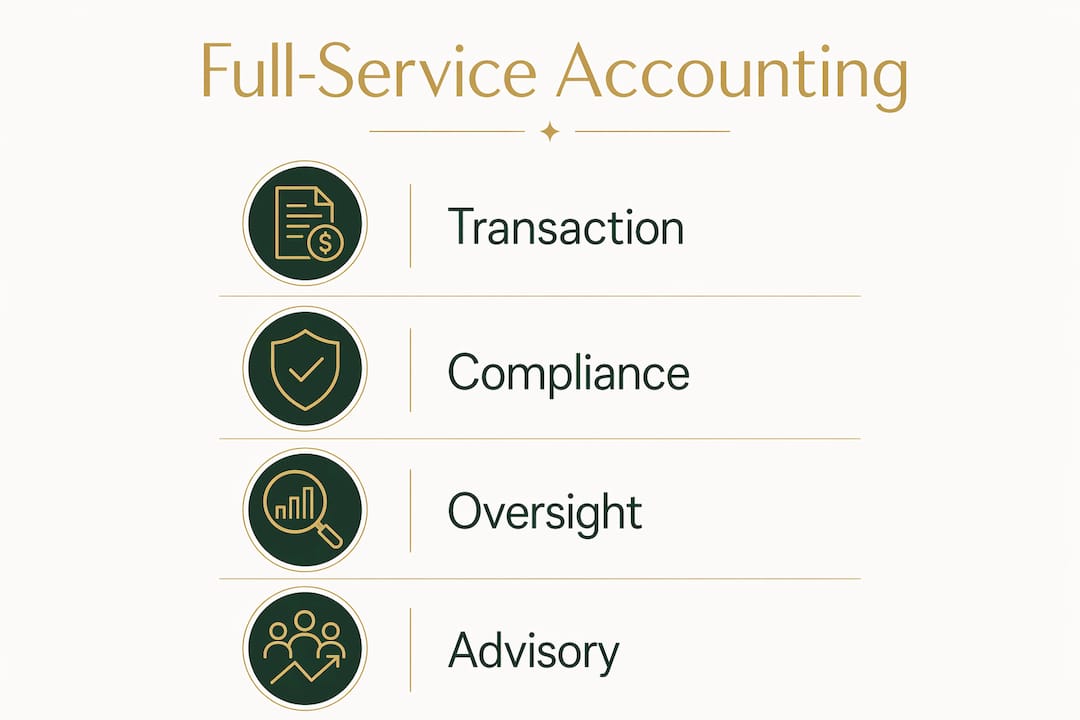
Full-service accounting integrates four pillars: transaction management, compliance and reporting, financial oversight, and strategic advisory. Each pillar covers a distinct layer of your business finances, and together they create a complete picture.
Transaction management
This is the foundation. It covers accounts receivable, accounts payable, payroll processing, and expense tracking. Every dollar that moves in or out of your business gets recorded accurately and on time. Without this layer working correctly, everything built on top of it is unreliable.

Compliance and reporting
This pillar handles month-end close, financial statement preparation, tax filings, and regulatory reporting. Automated invoicing and reconciliations run continuously, reducing the manual workload on you and your team. You get clean, audit-ready records without spending your weekends chasing receipts.
Financial oversight
Internal controls and fraud prevention sit here. A critical control is segregation of duties: no single person should control both cash disbursement and bank reconciliation. This applies even when you outsource. A well-structured full-service provider builds these controls into their workflow from day one.
Strategic advisory
This is where full-service accounting separates itself from everything else. Cash flow forecasting, budgeting, and CFO-level guidance give you the data to make confident decisions about hiring, expansion, or cutting costs. Most small business owners never had access to this layer before.
Pro Tip: Ask any prospective accounting provider which of the four pillars they cover. If they skip strategic advisory, you are getting bookkeeping with a fancier label.
How does full-service accounting differ from traditional bookkeeping?
Traditional bookkeeping records what already happened. Full-service accounting tells you what is happening now and what is likely to happen next. That distinction changes how you run your business.
| Feature | Traditional bookkeeping | Full-service accounting |
|---|---|---|
| Focus | Historical transaction recording | Forward-looking financial management |
| Scope | Data entry and basic reports | Tax, payroll, compliance, advisory, CFO guidance |
| Expertise | Single bookkeeper | Team: staff accountants, controller, fractional CFO |
| Insights | Reactive | Proactive, data-backed |
| Technology | Manual or basic software | Cloud-based automation and real-time access |
| Outcome | Accurate records | Better decisions and financial confidence |
The full-service model uses specialists: staff accountants handle daily work, controllers maintain data accuracy and internal controls, and fractional CFOs provide strategic guidance. That team depth is simply not available from a single bookkeeper.
Full-service accounting transforms bookkeeping from a reactive, historical record into a forward-looking financial engine. That shift gives you real-time cash flow visibility and the confidence to act on what you see. For a deeper look at how these two approaches compare, the guide on financial consulting vs. bookkeeping breaks down the differences in practical terms.
What are the key benefits of full-service accounting for small businesses?
The benefits of full-service accounting go well beyond cleaner books. They show up in your decisions, your compliance posture, and your bottom line.
- Cost consolidation. A complete accounting service costs far less than hiring separate in-house roles for bookkeeping, payroll, tax, and financial planning. You get more capability for less total spend.
- Access to CFO-level thinking. Most small businesses cannot afford a full-time CFO. Full-service accounting gives you fractional CFO support, including budgeting, forecasting, and growth planning, without the full-time salary.
- Real-time financial visibility. Cloud-based systems give you continuous access to your financial data. You can check your cash position, outstanding invoices, or payroll liabilities at any time, not just at year-end.
- Compliance confidence. Full-service accounting firms provide a secure audit trail accessible at any time. That reduces risk and removes the anxiety of a surprise audit.
- Fraud risk reduction. Built-in internal controls, including proper segregation of duties, protect your business from both external fraud and internal errors.
- Scalability. As your business grows, your accounting needs grow with it. A full-service provider scales its support without you needing to hire, train, or manage additional staff.
Financial advisory experts recommend viewing full-service accounting as a strategic investment to drive growth rather than treating it as an overhead cost. That reframe matters. When you see accounting as a growth tool, you use it differently.
Understanding how to manage cash flow effectively is one of the clearest advantages small business owners gain when they move to a full-service model.
How do small business owners implement full-service accounting?
Switching to a full-service model is a process, not a single event. These steps make the transition predictable and low-risk.
- Audit your current setup. List every financial task your business handles: invoicing, payroll, tax prep, reporting. Identify gaps, delays, and recurring errors. This audit tells you exactly what you need from a provider.
- Evaluate providers on all four pillars. Ask specifically about transaction management, compliance, internal controls, and strategic advisory. A provider strong in bookkeeping but weak in advisory is not a full-service firm.
- Confirm internal controls are built in. Before signing, ask how the provider handles segregation of duties. No single person at the provider should control both payment authorization and reconciliation for your account.
- Plan the onboarding carefully. Data migration, role definition, and communication protocols all need to be agreed upon before work begins. A clear onboarding plan prevents the first 90 days from becoming chaotic.
- Set measurable KPIs. Track cash flow accuracy, reporting turnaround time, error rates, and tax filing deadlines. These metrics tell you whether the service is delivering real value.
- Use the technology. Cloud-based platforms give you real-time access to your financial data. Log in regularly. The visibility is only useful if you actually look at it.
Pro Tip: Optimizing your financial services workflow before onboarding a full-service provider cuts the transition time significantly. Clean data in means clean reports out.
What pitfalls should small businesses watch for with full-service accounting?
Full-service accounting delivers strong results when implemented correctly. These are the most common mistakes that prevent that from happening.
- Skipping segregation of duties. Even with an outsourced provider, overlapping responsibilities create fraud risk. Confirm that no single person controls both authorization and reconciliation for any financial process.
- Choosing a provider without strategic advisory. Many firms label themselves “full-service” but only offer bookkeeping and tax prep. If there is no fractional CFO or cash flow forecasting capability, you are not getting the full model.
- Undervaluing proactive insights. The shift from reactive bookkeeping to proactive strategic accounting is the biggest value driver in this model. Business owners who ignore the advisory layer miss most of the benefit.
- Poor communication with your provider. A full-service relationship requires regular check-ins, not just year-end tax calls. Set a monthly review cadence from the start.
- Treating accounting as a cost center. When you view accounting purely as an expense, you under-invest in it and over-restrict it. The businesses that grow fastest treat financial management as a core operational function.
Key Takeaways
Full-service accounting is the most complete financial management approach available to small businesses, combining transaction processing, compliance, internal controls, and strategic advisory in one integrated service.
| Point | Details |
|---|---|
| Four-pillar model | Full-service accounting covers transaction management, compliance, oversight, and strategic advisory. |
| Beyond bookkeeping | It provides forward-looking insights and CFO-level guidance, not just historical records. |
| Cost-effective structure | One integrated service replaces multiple in-house roles at a lower total cost. |
| Internal controls matter | Segregation of duties must be built into any full-service arrangement to prevent fraud. |
| Treat it as an investment | Businesses that view accounting as a growth tool make better decisions and scale more confidently. |
Why I think most small businesses are still underserved by their accountants
Working with small business owners over the years, I have seen the same pattern repeat itself. A business owner hires a bookkeeper, maybe adds a tax preparer at year-end, and calls it done. Then they wonder why their cash flow feels unpredictable or why they are always surprised by their tax bill.
The honest truth is that basic bookkeeping was never designed to answer the questions that actually keep business owners up at night. Questions like: Can I afford to hire someone next quarter? Should I take that loan? Where is my money actually going? Those answers require the strategic advisory layer that most small accounting arrangements simply do not include.
What I have found is that business owners who move to a genuinely integrated model, one that includes a controller and fractional CFO alongside their bookkeeper, report a noticeable shift in confidence. They stop reacting to financial surprises and start planning around real data. That is not a luxury. That is what good financial management looks like.
The misconception I push back on most often is that full-service accounting is only for larger businesses. The cost structure of a well-run outsourced model makes it accessible to businesses with just a handful of employees. If you are spending more time worrying about your finances than running your business, that is the clearest sign you need more than a bookkeeper. You can read more about cost-saving accounting strategies that make this transition practical for businesses at any stage.
— Kelli
How Kelliworks supports small businesses with full-service accounting
Kelliworks operates as a full-service virtual accounting department built specifically for small business owners. The team covers every pillar: bookkeeping, payroll, tax preparation, financial reporting, and strategic consulting, all coordinated by professionals who understand the pressures you face as a business owner.
Small business owners who work with Kelliworks get more than accurate books. They get a financial partner who monitors their numbers, flags issues early, and helps them plan for growth. If you have been relying on a single bookkeeper or managing finances yourself, learning why a virtual accountant makes sense for your business is a practical next step. You can also explore Kelliworks’ full range of accounting services to see exactly what an integrated approach looks like in practice.
FAQ
What is the full-service accounting definition?
Full-service accounting is an integrated financial management system covering transaction processing, compliance reporting, internal controls, and strategic advisory. It goes beyond bookkeeping to include payroll, tax prep, and CFO-level guidance.
Is full-service accounting worth it for a small business?
A complete accounting service costs far less than hiring multiple in-house roles while delivering more capabilities, including bookkeeping, payroll, tax compliance, and fractional CFO support. For most small businesses, the value exceeds the cost.
What questions should I ask a full-service accounting firm?
Ask whether they cover all four pillars: transaction management, compliance, financial oversight, and strategic advisory. Also confirm how they handle segregation of duties to protect against fraud.
How does full-service accounting work on a day-to-day basis?
The provider manages invoicing, reconciliations, payroll, and reporting on a continuous basis using cloud-based systems. You get real-time access to your financial data and regular advisory check-ins to support your decisions.
What is the difference between full-service accounting and traditional bookkeeping?
Traditional bookkeeping records past transactions. Full-service accounting adds forward-looking analysis, compliance management, internal controls, and strategic financial guidance to give you a complete financial operation.