


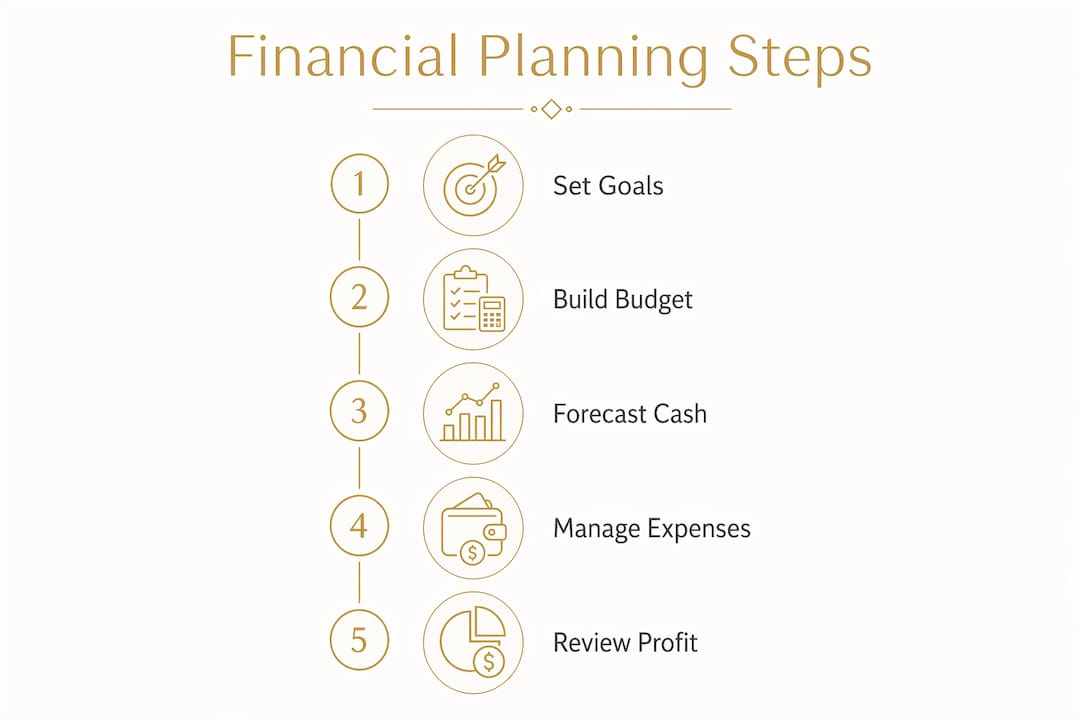
Business financial planning is defined as the process of setting financial goals, building budgets, and creating forecasts that connect your company’s daily decisions to long-term wealth and growth. Most small business owners treat it as an accounting task. It is actually a management tool. Done well, it tells you where your money is going, where it needs to go, and what stands between you and the business you want to build. This guide breaks down the core components, practical steps, and integrated strategies that make financial planning work for small businesses in 2026.
What is business financial planning explained as a process?
Business financial planning, known in professional circles as corporate financial planning, is the structured process of translating business objectives into measurable financial targets. Sound financial planning converts uncertainty into informed decisions by turning objectives into trackable goals with cash flow visibility. That means you stop reacting to problems and start anticipating them.
The process covers four core areas: revenue planning, expense management, cash flow forecasting, and profit analysis. Each area feeds the others. A revenue target without an expense budget is just a wish. A cash flow forecast without a profit target gives you no direction. Effective financial planning for businesses ties all four together into one working picture.

Effective financial planning relies on four key financial statements: the profit and loss statement, the balance sheet, the cash flow statement, and the budget variance report. Each document answers a different question about your business health. Together, they give you the full picture.
The core components every plan needs
A complete financial plan for a small business includes these elements:
- Revenue targets: Set specific monthly and annual revenue goals based on historical data and market conditions.
- Profit margin benchmarks: Service-based businesses should target net profit margins between 15–25%, while product-based e-commerce businesses typically see margins of 5–15%. Knowing your benchmark tells you whether your pricing model is working.
- Cash reserves: Define a minimum cash buffer, usually three to six months of operating expenses, before making growth investments.
- Budget vs. actuals tracking: Compare what you planned to spend against what you actually spent, every month without exception.
- Forecasting: Project revenue and expenses three to twelve months forward using your current data.
Pro Tip: Build your first financial plan over a focused weekend. Research shows initial plan creation takes about a weekend, then requires roughly one hour of monthly review to stay useful. That is a small time investment for the clarity it delivers.
Regular review is not optional. A financial plan that sits in a drawer is not a plan. It is a document. The value comes from updating it monthly as your actual numbers come in.
How does integrating business and personal financial planning benefit small business owners?
Most small business owners keep their business and personal finances in completely separate mental boxes. That separation feels organized, but it creates a blind spot. Integrated planning ensures the business functions as a driver of long-term personal financial independence and exit planning, not just a source of monthly income.
The risk of treating them as unrelated is real. When most of your personal wealth sits inside your business, you carry concentrated risk. Separating personal and business wealth reduces that concentrated risk and helps preserve long-term financial plans. A single bad year, a lawsuit, or an economic downturn can wipe out both your business and your personal savings if they are not properly separated.
“Many business owners miss the full potential of wealth growth by treating business and personal financial planning as separate exercises. Integrated planning aligns both effectively.” — Life Moves Wealth
Practical integration means asking these questions together, not separately:
- How much salary do you need from the business to cover personal expenses and savings goals?
- What is your exit strategy, and does your business valuation support it?
- Are you reinvesting profits at the right rate, or are you underpaying yourself while the business holds excess cash?
- Does your personal retirement plan account for the eventual sale or transfer of the business?
Kelliworks works with small business owners on personalized financial strategies that address exactly this integration. Getting the two plans aligned is one of the highest-value moves an owner can make.
What are practical strategies to manage cash flow, taxes, and working capital in 2026?
Cash flow is the number one operational challenge for small businesses. Financial managers monitor cash inflows and outflows continuously to make sure funds are available when needed. That discipline separates businesses that survive slow periods from those that do not.
In 2026, three priorities stand out for small business owners managing their finances:
- Excess cash management: Holding too much cash in a low-yield business account is a hidden cost. Identify your minimum operating reserve, then put surplus cash to work through short-term investments or debt reduction.
- Tax allowance planning: Key 2026 priorities include using tax allowances effectively for company-funded contributions and beginning succession planning early. Tax planning is not a year-end activity. It is a year-round discipline.
- Working capital optimization: Review your accounts receivable cycle. If customers pay you in 45 days but you pay suppliers in 15, you carry a cash gap every month. Tightening that gap improves liquidity without increasing revenue.
Pro Tip: Use your bookkeeping data to build a 13-week rolling cash flow forecast. Update it every week. This gives you early warning of cash shortfalls before they become emergencies.
Financial managers also balance profit opportunities against risk by weighing market demand, interest rates, and economic conditions. That same discipline applies to small business decisions about equipment purchases, hiring, and expansion. Every investment decision is a risk-return trade-off, and your financial plan is where you make that trade-off explicit.
Understanding the difference between financial consulting and bookkeeping matters here. Bookkeeping records what happened. Financial consulting helps you decide what to do next. Both are necessary for effective cash flow and tax management.
How can scenario planning and regular financial reviews increase resilience?
Scenario planning is the practice of modeling multiple versions of your financial future before any of them happen. Most owners think of it as a defensive tool for bad times. Scenario planning actually builds resilience and confidence for volatile conditions by preparing you for best-case, worst-case, and most-likely outcomes. That confidence changes how you make decisions under pressure.
A practical scenario planning process follows four steps:
- Define your baseline: Use your current financial plan as the expected outcome. This is your “most likely” scenario.
- Build a downside case: Reduce revenue by 20–30% and hold expenses flat. Ask whether the business survives and for how long.
- Build an upside case: Increase revenue by 20–30% and model the staffing, inventory, or capacity investments that growth would require.
- Set trigger points: Decide in advance what metric will prompt you to shift from one scenario to another. For example, if monthly revenue drops below a set threshold for two consecutive months, you activate your downside plan.
Pro Tip: Schedule a quarterly financial review on your calendar the same way you schedule client meetings. Proactive planning builds resilience by translating strategy into measurable targets rather than reacting to crises after they arrive.
Regular reviews do more than catch problems early. They build your financial literacy over time. Owners who review their numbers monthly make faster, more confident decisions than those who check in only at tax time. The plan becomes a management habit, not a one-time document.
Key takeaways
Effective business financial planning connects your company’s daily cash decisions to personal wealth goals and long-term growth, and it requires consistent monthly review to stay relevant.
| Point | Details |
|---|---|
| Define clear financial goals | Set specific revenue targets, profit margin benchmarks, and cash reserve minimums before building any budget. |
| Use four core financial statements | Track your P&L, balance sheet, cash flow, and budget variance reports every month without exception. |
| Integrate business and personal planning | Align your salary, reinvestment rate, and exit strategy to avoid concentrated personal wealth risk. |
| Prioritize cash flow visibility | Build a rolling cash flow forecast and update it weekly to catch shortfalls before they become crises. |
| Practice scenario planning | Model best-case, worst-case, and likely outcomes quarterly so you can act fast when conditions shift. |
Why I think most small business owners are planning too late
After working with small business owners for years, the pattern I see most often is this: owners build a financial plan after something goes wrong. A slow quarter, a surprise tax bill, a cash crunch. The plan becomes a reaction, not a tool.
The owners who build real financial stability do the opposite. They plan before they need to. They know their profit margins, their cash runway, and their personal financial needs before any crisis forces the question. They also treat their business and personal finances as one connected system, not two separate problems.
The other thing I have noticed is that owners consistently underestimate how little time good planning actually takes. A focused weekend to build the initial plan, then one hour a month to update it. That is it. The return on that time investment is enormous compared to the cost of flying blind.
The shift from reactive to proactive is not complicated. It starts with deciding that your financial plan is a management tool you use every month, not a document you file and forget. If you make that shift, everything else in your business gets clearer.
— Kelli
How Kelliworks supports your financial planning process
Running a small business means wearing every hat at once. Financial planning often gets pushed aside because it feels complex or time-consuming.

Kelliworks functions as your full-service virtual accounting department, handling the bookkeeping, tax preparation, and financial consulting that make a real financial plan possible. We build personalized strategies around your specific revenue goals, cash flow patterns, and tax situation. Whether you need help setting up your first budget or want a complete review of your 2026 financial position, we are ready to work alongside you. Book a free consultation and find out what a clear financial plan can do for your business.
FAQ
What is business financial planning?
Business financial planning is the process of setting financial goals, building budgets, and forecasting cash flow to connect daily business decisions to long-term growth and personal wealth objectives.
How long does it take to build a financial plan?
Building an initial business financial plan takes roughly a weekend of focused effort. Maintaining it requires about one hour of monthly review to keep it accurate and useful.
What financial statements does a small business need?
A small business needs four core financial statements: the profit and loss statement, the balance sheet, the cash flow statement, and the budget variance report. Each one answers a different question about your financial health.
Why should I integrate business and personal financial planning?
Treating them separately creates concentrated personal wealth risk. Integrating both plans aligns your salary, reinvestment decisions, and exit strategy so your business actively builds your long-term financial independence.
What is scenario planning in business finance?
Scenario planning is the practice of modeling best-case, worst-case, and most-likely financial outcomes before they occur. It helps business owners make faster, more confident decisions when conditions change unexpectedly.



3 Responses