


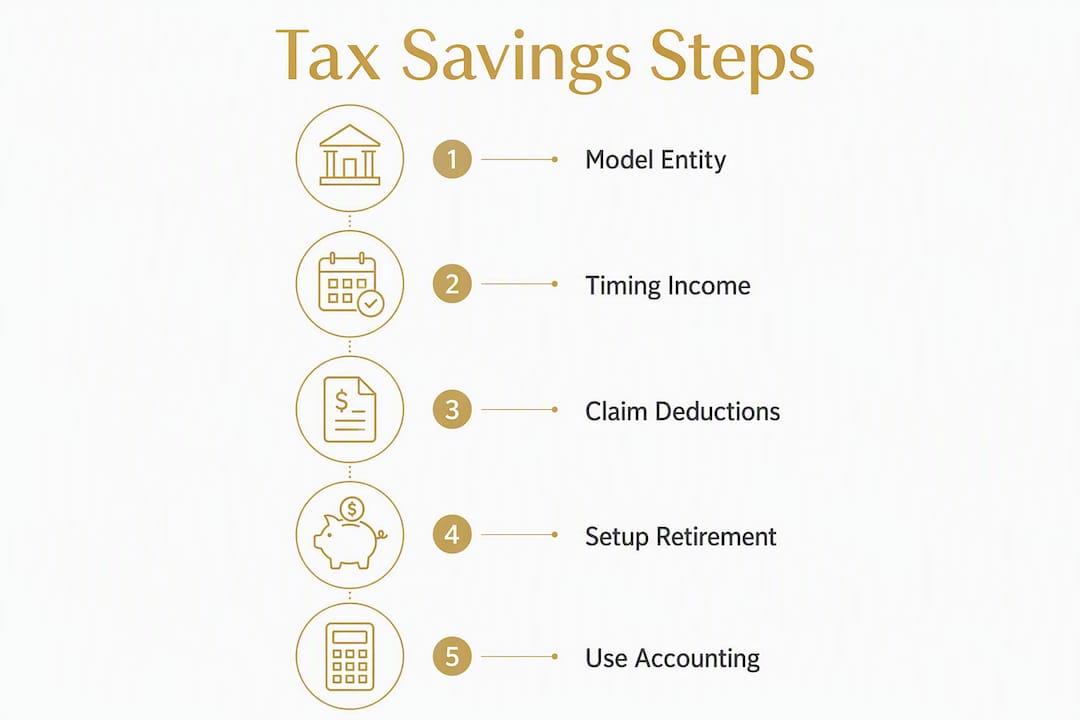
A business tax savings strategy is a coordinated set of entity, timing, deduction, payroll, retirement, and accounting choices designed to lower your effective tax burden while keeping you fully compliant. The IRS Taxpayer Advocate Service is clear: tax planning is a year-round responsibility, and you remain legally accountable for your return even when a professional prepares it. The top levers to know are:
- Entity choice and elections — S-corp election can reduce self-employment tax when net profit clears the compliance cost threshold.
- Income and expense timing — Accelerating deductions or deferring income shifts taxable dollars across years.
- Business deductions and credits — R&D credit, Work Opportunity Tax Credit (WOTC), and ordinary business expenses directly cut your tax bill.
- Depreciation and cost recovery — Section 179 and bonus depreciation can eliminate taxable income in a single year.
- Retirement plan design — Solo 401(k) and cash-balance contributions reduce current taxable income while building wealth.
- Accounting method choices — Cash vs. accrual determines which timing levers you can legally use.
Start by running a multi-year model with a trusted accountant before committing to any structural change.
Table of Contents
- What are the primary levers of a small-business tax savings strategy?
- How do entity choice and the QBI deduction interact?
- When should you act? A year-round planning calendar
- Which deductions, credits, and depreciation choices matter most?
- How do retirement plans and payroll choices generate tax savings?
- How does your accounting method affect your tax options?
- Why do tax strategies stop working as your business grows?
- How does an outsourced accounting partner implement your tax strategy?
- Key Takeaways
- Why proactive planning is the only kind that works
- Kelliworks gives you a full accounting department, not just a tax return
- Useful sources and further reading
What are the primary levers of a small-business tax savings strategy?
Each lever below works independently, but the real savings come from combining them deliberately.
Entity choice is often the highest-impact decision. A single-member LLC pays self-employment tax on 100% of net profit. An S-corp owner pays FICA only on a reasonable W-2 salary, with remaining profit taken as distributions not subject to self-employment tax. That split is where the savings live, though it adds payroll filing costs.
Timing of income and expenses is the most flexible lever. Cash-basis businesses can prepay deductible expenses before December 31 or delay invoicing to push revenue into the next year. Neither move requires a structural change, just disciplined bookkeeping.

Depreciation rewards capital investment. Bonus depreciation lets you deduct a large percentage of qualifying asset costs in the year of purchase rather than over the asset’s useful life. For real estate owners, cost segregation studies reclassify building components into shorter depreciation schedules, accelerating deductions significantly.
Retirement plans do double duty: they reduce taxable income now and build long-term wealth. A solo 401(k) allows both employee and employer contributions, making it the highest-ceiling option for self-employed owners.
Pro Tip: Never evaluate a single-year rule of thumb in isolation. A strategy that saves $8,000 in year one can cost more than that in year three if profit grows and the structure no longer fits. Model at least three years before committing.
How do entity choice and the QBI deduction interact?
This is where most small-business owners need professional help, because the math pulls in two directions at once.
An LLC taxed as a sole proprietor pays self-employment tax on all net profit. An S-corp owner pays FICA on a W-2 salary and takes remaining profit as distributions, which are not subject to self-employment tax. The savings are real, but they come with payroll administration costs, state fees, and a reasonable compensation requirement the IRS enforces.
The Qualified Business Income (QBI) deduction adds a layer of complexity. QBI allows eligible pass-through owners to deduct up to 20% of qualified business income, but the deduction phases out for specified service trades or businesses (SSTBs) above certain income thresholds. Here is the tension: owner salary reduces the QBI base while also satisfying the wage-based limitation that unlocks a larger deduction at higher income levels. Setting salary too low saves payroll tax but shrinks the wage limitation. Setting it too high defeats the payroll-tax savings.
Practical breakeven guidance: the S-corp election tends to produce net savings above roughly $75,000–$150,000 of net profit, depending on your state’s fees and your reasonable compensation floor. Below that range, compliance costs often erase the benefit.
Inputs to model before making an entity election:
- Net profit (current year and projected)
- Household income and filing status
- SSTB classification
- State income tax rate and state-level S-corp fees
- Reasonable compensation floor for your role
- State pass-through entity tax (PTET) availability
Pro Tip: Form 2553 (S-corp election) must generally be filed within 75 days of the tax year start or by March 15 for a calendar-year entity. Missing that window costs you a full year of potential savings.
State rules frequently determine whether the election is worthwhile at all. State PTET elections and fees can flip the math entirely, particularly in high-tax states where PTET elections bypass the federal SALT cap. Model state friction before assuming federal savings translate dollar-for-dollar.
When should you act? A year-round planning calendar
Planning is not a December activity. The TAS recommends keeping a tax calendar and making timely estimated payments to avoid penalties. Here is a practical quarterly structure:
Q1 (January–March): File prior-year return or extension. Confirm entity election deadlines. Set up retirement plans if not already in place. Adjust estimated tax payments based on prior-year results.
Q2 (April–June): Review year-to-date profit against projections. Assess whether payroll or distribution mix needs adjustment. Confirm Q1 estimated payment was made.
Q3 (July–September): Run a mid-year tax projection. This is the best window to model structural changes for the following year. Evaluate bonus depreciation purchases before year-end.
Q4 (October–December): Execute year-end moves: prepay expenses, fund retirement accounts, finalize payroll adjustments, and confirm Q3 estimated payment. Engage your accountant for a year-end review by November at the latest.
Critical deadlines to track:
- March 15: S-corp and partnership returns due (or extension); S-corp election deadline for calendar-year entities.
- April 15: Individual and C-corp returns due; Q1 estimated tax payment.
- September 15: Q3 estimated tax payment.
- December 31: Last day for most year-end deductions, retirement contributions (employer side for some plans), and asset purchases qualifying for bonus depreciation.
Which deductions, credits, and depreciation choices matter most?
Common deductions for small businesses include ordinary and necessary business expenses, home-office deductions (calculated under the simplified or regular method for qualifying service businesses), vehicle use, professional fees, and software subscriptions. Each requires documentation to survive scrutiny.
Credits worth evaluating:
- R&D Credit (Section 41): Available to businesses developing or improving products, processes, or software. Startups can apply it against payroll taxes, not just income tax, making it accessible even before profitability.
- Work Opportunity Tax Credit (WOTC): A credit for hiring from targeted groups (veterans, long-term unemployed, others). The credit amount varies by category and hours worked.
Depreciation options:
| Method | What it does | Best for |
|---|---|---|
| Section 179 | Immediate expensing up to the annual limit | Equipment, vehicles, off-the-shelf software |
| Bonus depreciation | First-year deduction on qualifying property | Larger asset purchases; note the phase-down schedule |
| Cost segregation | Reclassifies real property into shorter-life assets | Commercial real estate owners |
| Standard MACRS | Spreads deductions over asset life | When current-year income is already low |
Accounting method choices and timing levers are among the highest-ROI planning moves available, particularly as your business scales.
Pro Tip: When claiming the R&D credit or aggressive depreciation, document everything at the time of the activity, not retroactively. Contemporaneous records are the difference between a clean audit and a disallowed deduction.
How do retirement plans and payroll choices generate tax savings?
Retirement plans reduce current taxable income and build long-term wealth simultaneously. The right plan depends on your profit level, employee headcount, and how much administrative complexity you can manage.
| Plan | Contribution limit | Setup complexity | Best for |
|---|---|---|---|
| Solo 401(k) | Up to 25% of compensation total | Moderate | Self-employed with no full-time employees |
| SEP IRA | Up to 25% of compensation, max limit | Low | Sole proprietors wanting simplicity |
| SIMPLE IRA | employee deferral limit | Low | Small employers with staff |
| Cash-balance plan | Varies by age; often substantial | High | High-income owners wanting larger deductions |
Payroll strategy ties directly into retirement capacity. A higher W-2 salary increases the employer contribution ceiling for a solo 401(k) but also raises FICA costs. That trade-off requires the same multi-variable modeling as the QBI salary decision.
Key setup deadlines: solo 401(k) plans must be established by December 31 of the plan year. SEP IRA contributions can be made up to the tax return due date, including extensions, giving you more flexibility.
How does your accounting method affect your tax options?
Your accounting method and bookkeeping quality directly determine which timing strategies you can use and how defensible they are under audit. This is not an administrative detail; it is a structural tax decision.
Cash method recognizes income when received and expenses when paid. It gives you direct control over timing. Most small service businesses qualify and benefit from it.
Accrual method recognizes income when earned and expenses when incurred, regardless of cash flow. It is required for businesses with inventory above certain thresholds and for C-corps above the gross receipts limit. IRS Publication 538 outlines the rules for each method and when a change requires IRS approval.
Recordkeeping checklist for audit readiness:
- Maintain separate business bank accounts and credit cards (never comingle personal and business funds, per IRS Publication 583)
- Keep transaction-level support (receipts, invoices, contracts) for every deduction
- Retain records for at least three years from the return due date; six years if income was underreported by more than 25%
- Document business purpose for meals, travel, and home-office use at the time of the expense
- Reconcile books monthly so year-end projections are based on clean data
Pro Tip: An outsourced accounting partner who reconciles your books monthly gives you audit-ready records and accurate mid-year projections. Both are prerequisites for executing timing strategies with confidence. Kelliworks’s bookkeeping best practices framework is built around exactly this.
Why do tax strategies stop working as your business grows?
Tax optimizations are dynamic. A structure that saves taxes at one profit level can become costly as income, state rules, or business goals change. Multi-year modeling is the standard practitioners recommend precisely because single-year rules of thumb fail when profit grows or an exit becomes relevant.
Common triggers to re-run your model:
- Net profit crosses a new threshold (particularly the $75,000–$150,000 S-corp breakeven range)
- You hire employees, which changes payroll costs and retirement plan options
- You move to a different state, altering the state-fee and PTET calculus
- You plan a capital investment that changes depreciation and cash flow
- A business sale or exit becomes a realistic near-term goal (QSBS and C-corp considerations enter the picture)
Three-step re-evaluation checklist:
- Update your profit projection for the next three years using actual year-to-date figures.
- Re-run entity, salary, and retirement scenarios with current state fees and PTET rules.
- Schedule a review with your accountant in Q3 so structural changes can be implemented before year-end deadlines.
Pro Tip: Run sensitivity analysis across a profit range of plus or minus 20% from your base projection. Cliff effects in the QBI phaseout and S-corp breakeven zone can produce large swings in net tax from small income changes.
How does an outsourced accounting partner implement your tax strategy?
An outsourced partner operationalizes the strategy by maintaining your books, running scenario models, coordinating elections and filings, and monitoring QBI, payroll, and state friction throughout the year. The planning work only produces savings when someone executes it accurately and on time.
Concrete deliverables a virtual accounting partner handles:
- Quarterly bookkeeping reconciliation and mid-year tax projection
- Form 2553 preparation and filing support for S-corp elections
- Payroll setup and W-2/distribution ratio monitoring
- Retirement plan setup coordination and contribution tracking
- Estimated tax payment scheduling and safe-harbor calculations
- Year-end depreciation and expense timing review
- K-1 and K-2 review for pass-through entities
- State PTET election evaluation and filing support
Clients who move from reactive tax preparation to proactive planning with a virtual accounting partner consistently report better tax predictability and reduced surprises at filing. The net savings after fees depend on your profit level and the strategies implemented, but the structural changes alone (entity election, retirement plan, accounting method) often produce savings that dwarf the cost of the service.
Kelliworks functions as a full virtual accounting department for small businesses, handling the implementation tasks above so you can focus on running your business rather than managing compliance calendars.
Key Takeaways
A business tax savings strategy works when entity choice, timing, deductions, retirement plans, and accounting methods are modeled together and executed before year-end deadlines.
| Point | Details |
|---|---|
| Model entity choice first | S-corp savings typically materialize above a moderate net profit level where state fees and PTET rules shift the math. |
| Plan year-round, not in December | Q3 is the last practical window to implement structural changes before year-end deadlines close. |
| Retirement plans do double duty | Solo 401(k) contributions reduce current taxable income and build long-term wealth. |
| Bookkeeping quality is a tax asset | Clean monthly records unlock timing strategies and make deductions defensible under audit. |
| Kelliworks operationalizes the strategy | As a virtual accounting department, Kelliworks handles elections, payroll, bookkeeping, and quarterly modeling so savings are captured, not just planned. |
Why proactive planning is the only kind that works
Most small business owners I work with come to us after a painful tax season, not before one. They did the right things in their business and were blindsided by a tax bill that a few structural decisions, made earlier, would have reduced substantially. The strategies in this article are not complicated in concept. What makes them hard is the timing: entity elections have filing windows, retirement plans have setup deadlines, and depreciation decisions have to be made before December 31. Waiting until spring to think about last year’s taxes means every one of those windows has already closed.
The owners who consistently pay less in taxes are not the ones with the most aggressive strategies. They are the ones who run the numbers in Q3, make decisions with full information, and have someone maintaining their books accurately enough to execute the plan. That combination of early modeling and disciplined recordkeeping is what we build for every client at Kelliworks.
Kelliworks gives you a full accounting department, not just a tax return
Most small business owners need more than a preparer who shows up in April. They need someone who monitors their books monthly, models their entity and salary decisions before deadlines close, and coordinates the filings that make the strategy real.
Kelliworks delivers exactly that as a virtual accounting department built for small businesses, freelancers, and entrepreneurs. Our services cover tax preparation and planning, bookkeeping, payroll coordination, retirement plan setup, and financial consulting, all under one roof. You get the expertise of a full finance team without the overhead of hiring one. Records stay audit-ready. Quarterly projections stay current. And you walk into every tax season knowing what to expect.
Book a discovery call with Kelliworks to run your numbers and see which strategies apply to your business.
Useful sources and further reading
The following authoritative sources informed this article and are worth consulting directly for current rules and thresholds:
- IRS Publication 334: Tax Guide for Small Business — comprehensive overview of federal tax rules for self-employed individuals and small business owners.
- IRS Publication 538: Accounting Periods and Methods — official guidance on cash vs. accrual accounting, inventory rules, and method changes.
- IRS Publication 583: Starting a Business and Keeping Records — recordkeeping requirements, electronic storage, and bookkeeping basics.
- Taxpayer Advocate Service: Small Business Tax Highlights — year-round planning guidance and taxpayer responsibility reminders from the TAS.
- Accounting Today: 12 Tax-Planning Moves for Business Owner Clients — practitioner-level analysis of accounting method changes, PTET elections, and timing levers.
“Tax planning is a year-round responsibility. Business owners are responsible for the information on their returns even when a paid preparer files on their behalf.” — Taxpayer Advocate Service
This article provides general information about U.S. business tax planning and is not legal, tax, or financial advice. Confirm current rules, thresholds, and deadlines with a qualified tax professional or the IRS directly before making decisions.