


Exemption certificate management is the process of collecting a valid exemption or resale certificate from a customer, reviewing it in good faith, linking it to the sale it supports, tracking renewals, and keeping it for as long as your state requires. Done well, it protects you in a sales tax audit and keeps customers from being charged tax they do not owe. This guide walks through each step and shows how a small business can run it without a dedicated tax department.
TL;DR
- Collect the certificate before or at the first exempt sale, and review it for completeness and for whether it fits what the customer is buying.
- Link every certificate to the customer, the ship-to location and the invoices it covers, so you can find it in minutes during an audit.
- Expiration and retention rules differ by state. Texas, for example, requires you to keep resale certificates for four years.
- A permit number alone is not a substitute for a properly completed certificate in states such as Texas.
- Assign one owner, one repository and a recurring review. We can build that routine with you.
Table of Contents
- What exemption certificate management covers
- Why careless certificate handling gets expensive
- Step 1: Collect the certificate at the right time
- Step 2: Validate what you receive
- Step 3: Link each certificate to the transactions it covers
- Step 4: Know your state’s expiration and retention rules
- Step 5: Track renewals before they lapse
- Step 6: Get audit-ready before the audit
- Choosing where to store certificates
- Common mistakes to avoid
- Our perspective
- Let us handle the paperwork side
- FAQ
- Sources
What exemption certificate management covers
When you sell to a customer who does not owe sales tax, you usually do not collect it. The customer might be reselling the goods, using them in manufacturing, or be a government or nonprofit buyer. In every case, the state expects you to hold paperwork showing why you did not charge tax. That paperwork is the exemption certificate, or a resale certificate when the buyer is a reseller.
A certificate is proof that a buyer qualifies for tax-exempt purchases, for reasons such as resale, manufacturing or government status. Managing those certificates means handling the full life cycle:
- Collect the certificate from the customer.
- Validate it: is it complete, signed, and plausible for this customer?
- Link it to the customer account, ship-to address and invoices.
- Track expiration or re-verification dates.
- Retain it for the period your state requires.
- Retrieve it quickly when an auditor asks.
If the certificate is missing, incomplete or invalid when the state reviews your sales, the tax you did not collect can become your liability. That is the whole reason this process matters.
Why careless certificate handling gets expensive
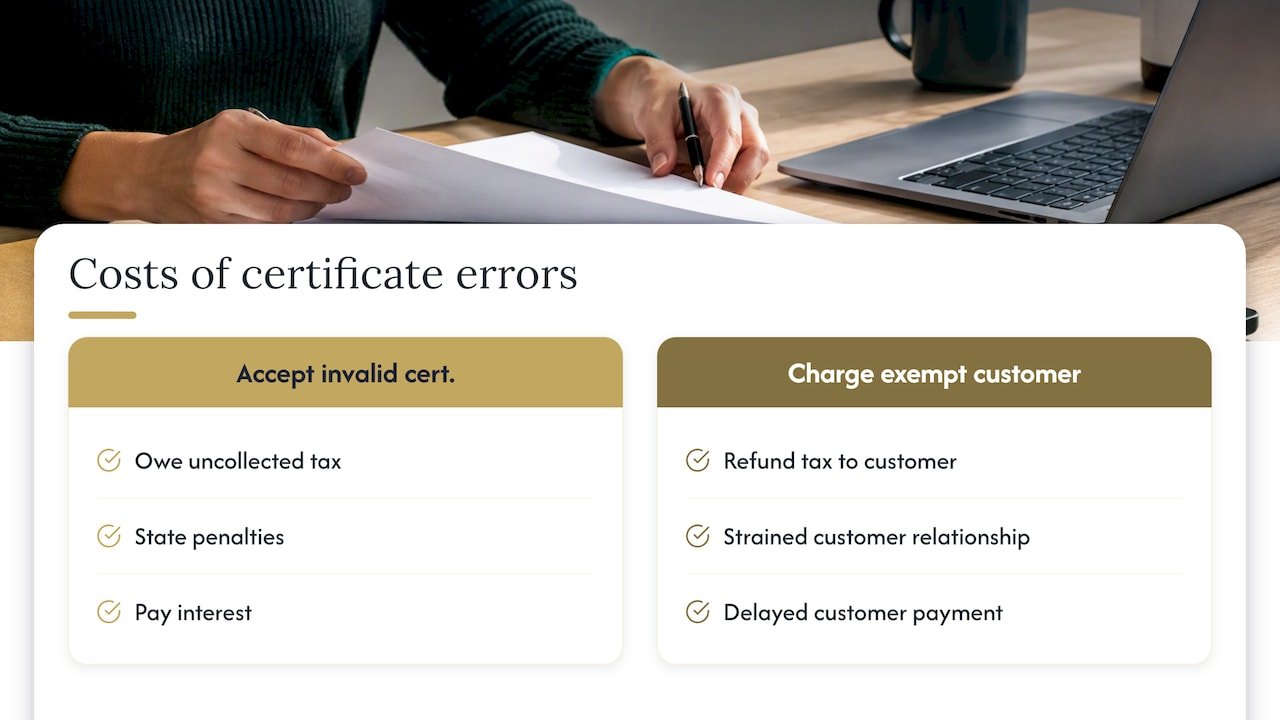
There are two ways to get this wrong, and both cost money.
The first is accepting a certificate without checking it. If the state later finds the certificate was incomplete or did not fit the sale, you may owe the uncollected tax, plus any penalties and interest your state applies. The Sales Tax Institute notes that inaccurate, invalid or missing certificates are a key source of negative audit findings.
The second is the opposite: charging tax to a customer who is exempt and then refunding it once the certificate turns up. That back-and-forth can harm the customer relationship and stretch out days sales outstanding, because the customer may hold payment until the tax is corrected. For a small business watching cash closely, that delay is a real cost. Our guide to managing cash flow with bookkeeping explains why slow-paying invoices hurt so much.
A third, quieter risk is volume. A business that sells in several states can end up with certificates in different formats, with different rules, saved in email inboxes and shared folders. That is exactly the situation where something goes missing. If you are growing into new states, it helps to understand where you have sales tax nexus first, because nexus decides where you need to collect, and therefore where you need certificates.
Step 1: Collect the certificate at the right time
The best moment to ask for a certificate is before or at the time of the first exempt transaction. Building it into onboarding is easier than chasing it after the invoice has gone out. The Sales Tax Institute’s guidance points the same way: collect certificates at the point of sale and validate them immediately.
Practical ways to make this routine:
- Add a certificate request to your new-customer form or quote acceptance.
- Mark the account “taxable” by default until a validated certificate is on file.
- Tell customers which form you accept. Many states accept their own form, and some resale buyers use the Uniform Sales & Use Tax Resale Certificate published by the Multistate Tax Commission. The MTC notes that listed states accept it, subject to state-specific instructions and limitations, so check the instructions for the state where the sale is sourced.
- Keep a single contact at your company who owns incoming certificates.
Step 2: Validate what you receive
Receiving a document is not the same as accepting it. Validation has two layers.
Check that the certificate is complete
Requirements differ by state, but the core fields are consistent. Minnesota, for instance, requires the purchaser’s name and address, a tax ID or qualifying alternative identification, the type of business, the reason for exemption, and a signature. Most other states ask for similar details. A good internal checklist covers:
- Buyer’s legal name and address
- Seller’s name
- Tax ID, permit number or other identification the state accepts
- Type of business
- Reason for exemption, with the correct box checked
- Description of the items being purchased, where the form asks for it
- Signature and date
Blank fields are the most common problem. Virginia’s guidance says both parties must use reasonable care to make sure the certificate is complete and correct at the time of the original transaction. Reasonable care starts with not accepting a form that has gaps.
Check that it makes sense for the sale
A complete form can still be the wrong form. The Texas Comptroller advises sellers to note the general character of the purchaser’s business and to question a resale certificate when the items do not fit that business. A landscaping company buying office furniture “for resale” is the kind of mismatch that deserves a follow-up question before you skip the tax.
A simple review note on the file helps: who reviewed it, when, and what they confirmed. If an auditor later asks why you accepted it, that note is your answer.
Step 3: Link each certificate to the transactions it covers
A certificate stored in a folder called “Exemptions” is hard to defend. A certificate tied to a customer account, a ship-to location and the invoices it supports is easy to defend. That is where many small businesses fall short, because the accounting system and the certificate files live in different places.
A workable approach:
- Name files consistently, for example customer name, state, certificate type and date received.
- Record the certificate’s state and, if it has one, its expiration date in the customer record in your accounting software.
- Flag exempt invoices with the reason code so a report can pull every exempt sale and the certificate behind each.
- Keep reviewer notes and any verification evidence in the same record.
This is bookkeeping discipline as much as tax compliance. If your books are already tidy, this step is mostly a matter of adding two or three fields. Our bookkeeping best practices cover the habits that make this kind of record-keeping stick.
Step 4: Know your state’s expiration and retention rules
This is the part that surprises people. There is no single national rule. Some certificates carry a stated validity period. Others stay usable only as long as the facts behind them stay true, such as the buyer continuing to resell the goods. Retention periods vary as well.
A few examples from official sources show how different the rules can be:
| State | What the official source says |
|---|---|
| Texas | Sellers must keep accepted resale certificates for four years, and a customer’s permit number or a copy of the permit does not replace the completed certificate. |
| North Carolina | A seller gets liability relief when it obtains the required certificate or information within 90 days of the sale. If the Secretary requests substantiation because documentation is incomplete, the seller has 120 days to obtain a completed certificate in good faith or other information showing the sale was not taxable. |
| Minnesota | The exemption certificate must include identification of the purchaser, the exemption reason and a signature. |
| Virginia | Both buyer and seller must exercise reasonable care so the certificate is complete and correct when the sale occurs. |
Two takeaways. First, the same customer can need different handling in different states. Second, the safest default is to keep certificates at least as long as the longest period that applies to you, and to confirm the current rule on the state’s revenue department website before you set a policy. Rules change, so treat any table, including this one, as a starting point and not a substitute for the state’s current guidance.
If you register in more than one state, the workload multiplies quickly. Our article on when to outsource sales tax filing covers how filing frequency and state count change what a small team can reasonably handle.
Step 5: Track renewals before they lapse
An expired or outdated certificate can leave you exposed on every sale made after the lapse. Build a renewal routine rather than relying on memory:
- Record an expiration or re-verification date on each certificate, wherever the state sets one.
- Run a monthly or quarterly report of certificates expiring in the next 60 to 90 days.
- Send customers a request with the correct form attached, not a vague reminder.
- Set a cut-off: if a renewal is not received by a stated date, new invoices are taxed until it arrives.
- Log the new certificate and keep the old one for the full retention period.
For certificates that do not expire, a periodic check is still wise. A customer’s business may change, and a certificate that fit two years ago may no longer match what they buy.
Step 6: Get audit-ready before the audit
Auditors do not usually review every transaction. Avalara’s Gail Cole points out that auditors often sample, so every exempt sale needs organized support, not just the big ones.
A useful self-audit, done once or twice a year, looks like this:
- Pull a report of all exempt sales for the period.
- Pick a sample, for example ten transactions across different customers and states.
- For each, find the certificate within a few minutes. If you cannot, note why.
- Check completeness, signature, date and fit with the purchase.
- Fix gaps now by requesting corrected certificates from customers.
Review your records the way an auditor would, and the weak spots show up while there is still time to repair them. Where the state allows a window to obtain a missing certificate, as North Carolina does, act quickly and keep proof that you asked.
Choosing where to store certificates
Small businesses often start with a shared drive and a spreadsheet. That can work for a handful of customers. It starts to fail when certificates multiply, when several people handle them, or when you need to find one under time pressure. Whatever you use, look for a repository that is:
- Centralized, so there is one place to look
- Secure, since certificates contain tax IDs
- Searchable by customer, state, type and expiration date
- Linked to invoices or at least to customer records
- Backed up, with clear access permissions
Digital tools can also automate collection and send renewal alerts. Pick the option that matches the number of customers and states you handle, then document how it works so the process survives staff changes.
Common mistakes to avoid
- Accepting a permit number in place of a certificate where the state requires the certificate itself.
- Leaving fields blank and planning to fix it later.
- Never reviewing the reason for exemption against what the customer buys.
- Storing certificates in email with no link to invoices.
- Ignoring state differences and applying one retention period everywhere.
- Forgetting renewals until an audit surfaces them.
These overlap with the broader errors we see in small business tax work. Our list of small business tax mistakes and how to avoid them puts certificate gaps in context. If you have just started selling and are still learning the basics, the step-by-step sales tax guide for new business owners is a good place to begin.
Our perspective
Most of the certificate problems we see are not tax-law problems. They are organization problems. The customer was exempt, the paperwork existed somewhere, and nobody could find it, or nobody checked it when it arrived.
We think certificate management belongs inside your bookkeeping, not beside it. When the customer record, the invoice and the certificate sit together, a missing document shows up in a monthly review instead of an audit letter. That is why we treat it as part of financial management and compliance for the small businesses we work with, and why we like to set up the workflow once, clearly, so your team can follow it.
You should not have to become a multistate tax specialist to run a good process. Give us the customers, the states and the current paperwork, and we will help you build a checklist, a review routine and a record structure that fits how you already work. Business owners tell us the relief comes from knowing where everything is.
Kelli
Let us handle the paperwork side
If certificates are scattered across inboxes and you are not sure which ones are complete, we can help. Our team provides bookkeeping, tax preparation, compliance support and workflow design for small businesses, available virtually or on site. We can help you organize your records, set up a repeatable review process and keep your books ready for questions from a state.

See how our full-service accounting and bookkeeping fits your business, or book a free consultation to talk through your situation.
FAQ
What is the difference between an exemption certificate and a resale certificate?
A resale certificate is one type of exemption certificate. A buyer uses it to purchase goods tax-free that they plan to resell. Other exemption certificates cover reasons such as manufacturing or purchases by government and nonprofit buyers. The form you need depends on the state and the reason for exemption.
How long do I need to keep exemption certificates?
It depends on the state. Texas, for example, requires sellers to keep accepted resale certificates for four years. Check the revenue department of each state where you sell, and keep records at least as long as the longest rule that applies to you.
Can I accept a certificate after the sale?
Sometimes, within limits. North Carolina, for instance, gives relief when the seller obtains the required certificate or information within 90 days of the sale. Other states set different windows or none. Collecting the certificate up front is simpler and safer.
Is a customer’s sales tax permit number enough?
Not always. In Texas, a customer’s permit number or a copy of the permit does not substitute for a properly completed resale certificate. Ask for the full certificate and confirm the form your state requires.
Do I need software to manage certificates?
No. A small business with few exempt customers can run a clean process with consistent file names, customer record fields and a calendar of renewals. As customers and states grow, a centralized digital repository with renewal alerts saves time and reduces errors.
Sources
- Understanding exemption certificate management
- Sales Tax Institute: 6 Best Practices for Exemption Certificates
- Avalara: Growth in B2B ecommerce exposes businesses to compliance risks
- Multistate Tax Commission: Uniform Sales & Use Tax Resale Certificate
- Minnesota Department of Revenue: Nontaxable Sales
- Virginia Tax: Ruling 25-81
- Texas Comptroller: Sales and Use Tax FAQ on resale certificates
- North Carolina G.S. 105-164.28
- Avalara: Effective strategies for sales tax exemption certificate management