


Bookkeeping is defined as the systematic recording of every financial transaction your business makes, from purchases and sales to receipts and payments. Financial consulting, by contrast, takes that recorded data and turns it into forward-looking strategy. Understanding the difference between financial consulting vs bookkeeping is not just academic. It determines which professional you hire, when you hire them, and what results you can realistically expect. Both services are necessary for a healthy business, but they solve entirely different problems.
How does financial consulting vs bookkeeping differ in roles?
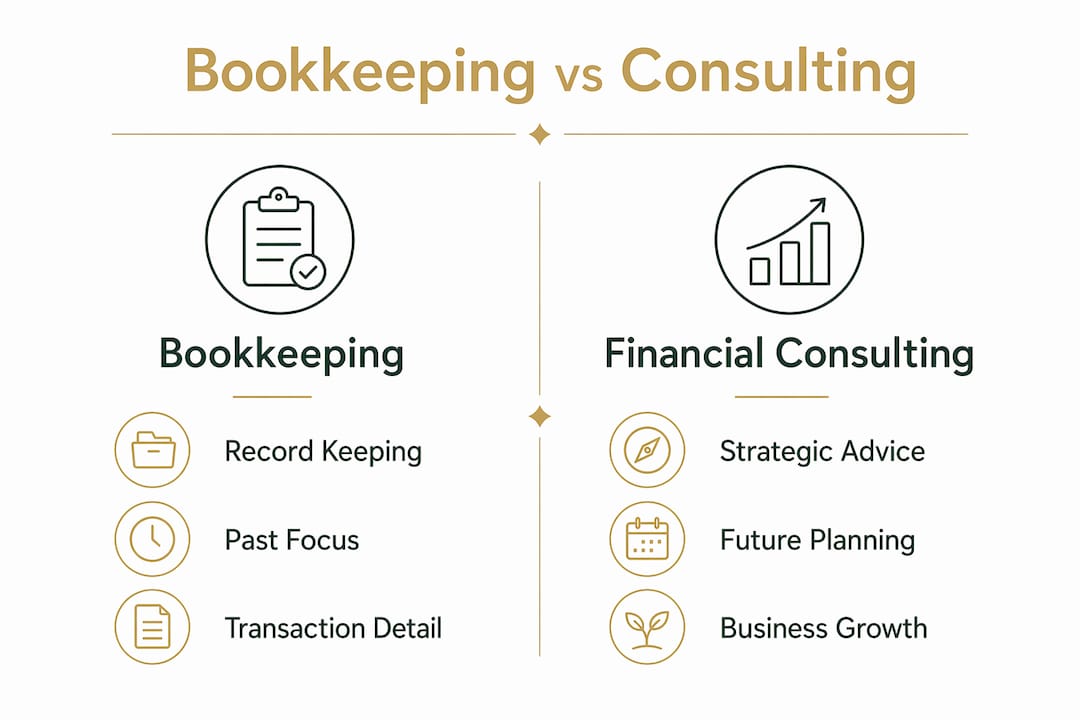
Bookkeeping records financial transactions using single-entry or double-entry systems, producing ledgers, source documents, and the clean data that every other financial function depends on. A bookkeeper documents what happened. A financial consultant interprets what it means and advises on what to do next.
The clearest way to understand this distinction is through a simple framework: bookkeepers explain the past, accountants validate the present, and financial consultants guide the future. Each role builds on the one before it. Without accurate bookkeeping, neither accounting nor consulting can function reliably.
Here is a direct comparison of the two roles:
| Function | Bookkeeping | Financial consulting |
|---|---|---|
| Primary focus | Recording transactions accurately | Interpreting data for decisions |
| Key tasks | Bank reconciliation, ledger maintenance | Forecasting, cash flow modeling, margin analysis |
| Time orientation | Backward-looking (historical) | Forward-looking (projections) |
| Tools used | QuickBooks, Xero, spreadsheets | Driver-based models, rolling forecasts |
| Output | Financial statements, reports | Strategic recommendations, variance narratives |

Bookkeepers and accountants are not interchangeable, and the same applies to bookkeepers and financial consultants. A bookkeeper gives you raw data. A financial consultant gives you a diagnosis and a plan.
Financial consulting also uses a fundamentally different methodology. Consulting relies on driver-based models built around variables like headcount, pricing, and growth rates, paired with rolling forecasts that update as assumptions change. This is a different discipline from the monthly close process that defines bookkeeping work.
Why is bookkeeping foundational to effective financial consulting?
Clean, reconciled financial data is the non-negotiable starting point for any consulting engagement. Consulting engagements often begin with evaluating and cleaning up bookkeeping data because unreliable records make forecasting impossible. A consultant building a cash flow model on inaccurate books is building on sand.
Inconsistent reconciliation timing creates volatility in financial forecasts). When bank statements and internal records are only matched quarterly, errors compound and projections lose accuracy. Monthly reconciliation, at minimum, gives consultants stable inputs to work with.
Common problems that poor bookkeeping creates for consulting include:
- Misclassified expenses that distort margin analysis
- Missing transactions that skew cash flow projections
- Unreconciled accounts that make balance sheets unreliable
- Outdated records that delay the start of any consulting project
Pro Tip: Before you engage a financial consultant, ask them to review three months of your books. If they identify significant errors or gaps, invest in a bookkeeping cleanup first. You will get far more value from consulting once your data is solid.
The right level of financial support starts with bookkeeping accuracy. Skipping that step and jumping straight to strategic consulting is one of the most common and costly mistakes small business owners make.
How do small business owners decide between bookkeeping and consulting?
The decision depends on your business stage, complexity, and the specific problem you are trying to solve. Most small businesses need bookkeeping from day one. Consulting becomes relevant once you have enough financial history and complexity to warrant strategic interpretation.
Use this framework to identify what you need:
- You need bookkeeping if your primary concern is keeping accurate records, staying organized for tax season, and maintaining clean financial statements.
- You need an accountant if you face tax complexity, compliance requirements, or need someone to review and validate your financial reports.
- You need financial consulting if you are planning to grow, struggling with cash flow, evaluating a major investment, or need a forecast to support a loan application.
- You need all three if your business is scaling and financial decisions are becoming more frequent and higher-stakes.
Most scaling companies benefit from all three roles working together. The layered model, bookkeeper handling daily accuracy, accountant managing compliance, and consultant driving strategy, gives you complete financial coverage without overpaying for any single role.
A practical way to think about it: if your biggest financial question is “Did we record everything correctly?”, you need a bookkeeper. If your question is “Can we afford to hire two more people next quarter?”, you need a financial consultant. The questions you are asking reveal the service you need.
Pro Tip: Many small business owners skip directly to consulting when they feel financially stressed, only to discover their books are too disorganized for a consultant to work with. Audit your bookkeeping health before making any advisory hire.
For a deeper look at how bookkeeping supports cash flow, Kelliworks has published a practical guide specifically for small business owners.
What are the real benefits of financial consulting beyond bookkeeping?
Financial consulting, often delivered as Client Accounting and Advisory Services (CAAS), extends beyond bookkeeping by adding budgeting, forecasting, cash flow modeling, and profitability analysis. These are the outputs that actually drive business decisions.
Here is what financial consulting delivers that bookkeeping alone cannot:
- Budgeting and variance analysis: A consultant builds your annual budget and then explains, each month, why actual results differ from the plan.
- Cash flow forecasting: You see, weeks in advance, when your account balance will drop below a safe threshold, giving you time to act.
- Margin improvement: A consultant identifies which products or services are most profitable and which are quietly draining resources.
- Hiring and investment decisions: When you want to add staff or buy equipment, a consultant models the financial impact before you commit.
- Scaling support: A consultant helps you understand whether your current revenue can support your growth plans.
Bookkeeping tells you that revenue was $180,000 last quarter. Financial consulting tells you whether that number is healthy, what drove it, and what needs to change to hit $220,000 next quarter. The difference is interpretation and direction.
Bookkeeping focuses on recording, not interpretation. Financial consulting adds value by diagnosing problems, building systems, and improving financial operations. These are two distinct skill sets, and expecting one to do the job of the other leads to frustration and missed opportunities.
For small business owners who want to understand what scalable accounting services look like in practice, the layered model of bookkeeping plus consulting is the most cost-effective structure available.
Key Takeaways
Bookkeeping provides the accurate financial data that makes financial consulting possible. Without clean records, strategic advice is unreliable.
| Point | Details |
|---|---|
| Bookkeeping records the past | Bookkeepers document transactions, reconcile accounts, and produce financial statements. |
| Consulting guides the future | Financial consultants use your data to forecast, plan, and support growth decisions. |
| Clean data comes first | Consulting engagements often start with a bookkeeping cleanup to ensure reliable inputs. |
| Layered support works best | Bookkeeper, accountant, and consultant each serve a distinct role in a growing business. |
| Match the service to the question | If you need accuracy, hire a bookkeeper. If you need strategy, engage a financial consultant. |
What I have learned from watching small businesses get this wrong
After working with small business owners across a wide range of industries, the most consistent mistake I see is expecting bookkeeping to answer strategic questions. A business owner will look at their profit and loss statement and wonder why they feel broke despite showing a profit. That is not a bookkeeping problem. That is a cash flow management problem, and it requires consulting to solve.
The second mistake is the reverse: hiring a financial consultant before the books are in order. I have seen consulting engagements stall for weeks because the underlying records were so disorganized that no reliable analysis was possible. The consultant ends up doing cleanup work they were not hired for, at consulting rates.
My honest recommendation is to build in sequence. Get your bookkeeping right first. Then, when your business reaches a point where financial decisions are frequent and consequential, add consulting support. The right financial advisory services are not a luxury for large companies. They are a practical tool for any business owner who wants to grow with confidence rather than guesswork.
The businesses I see thrive are the ones that treat bookkeeping and consulting as a system, not as competing options. They are not either/or. They are sequential, and together they give you a complete picture of where you are and where you are going.
— Kelli
Kelliworks offers bookkeeping and consulting built for small businesses
Kelliworks operates as a full-service virtual accounting department, giving small business owners access to bookkeeping, financial consulting, and tax preparation under one roof. You do not have to piece together separate providers or explain your books to a new person every time a financial question comes up.

Kelliworks tailors every engagement to your business stage. Whether you need clean, reliable bookkeeping to get organized or strategic financial consulting to plan your next move, the team brings the expertise to support both. Clients consistently report greater financial confidence and more time to focus on running their business. Explore Kelliworks’ accounting and advisory services to find the right level of support for where your business is today.
FAQ
What is the main difference between bookkeeping and financial consulting?
Bookkeeping records and organizes financial transactions, while financial consulting interprets that data to provide forecasts, budgets, and strategic recommendations. They serve different purposes and require different skill sets.
Do I need both a bookkeeper and a financial consultant?
Most growing businesses benefit from both. A bookkeeper maintains accurate records, and a financial consultant uses those records to guide decisions on cash flow, hiring, and scaling.
Can a bookkeeper give me financial advice?
A bookkeeper provides accurate financial records but is not trained to deliver strategic advice or forecasting. For decisions about growth, investment, or cash flow planning, a financial consultant or fractional CFO is the appropriate resource.
When should a small business hire a financial consultant?
Hire a financial consultant when you face cash flow problems, are planning significant growth, need a forecast for a loan, or find that financial decisions are becoming more frequent and complex.
What is CAAS in financial services?
CAAS stands for Client Accounting and Advisory Services. It extends beyond standard bookkeeping to include budgeting, forecasting, cash flow modeling, and profitability analysis, addressing what happens next rather than just what happened.



2 Responses