


Most U.S. businesses that pay a contractor who lives and works abroad do not have to withhold U.S. tax. The reason is that the income is generally foreign-source. The picture changes if any of the work is done inside the United States, if the payee is a U.S. person, or if the worker is really an employee. In those cases withholding, reporting forms and penalties can come into play. This guide walks through the decisions in the order you face them.
TL;DR
- Where the work happens decides the tax. Services performed outside the U.S. by a nonresident alien are generally foreign-source and carry no U.S. withholding. U.S.-performed services can face 30% withholding.
- Collect the right form before the first payment. U.S. persons give you a Form W-9. Foreign contractors give you a Form W-8 series form or Form 8233 when they claim a treaty benefit.
- Reporting follows withholding. U.S.-source payments to nonresident aliens go on Form 1042-S, with Form 1042 filed alongside.
- Classification still matters. A contractor label does not protect you if the relationship looks like employment.
- Keep proof. Contracts, invoices and payment records are what support your deduction.
Table of Contents
- Start with where the work is performed
- U.S. contractors versus foreign contractors
- When withholding and Form 1042-S apply
- Contractor or employee? Get it right before you pay
- Foreign company payroll in the USA
- Rules in the contractor’s country still count
- Payment practicalities and cost
- Records that protect your deduction
- Our perspective
- How we help
- FAQ
- Sources
Start with where the work is performed
The IRS looks at where services are performed to decide the source of income. Payer residence, where the contract was signed and where you send the money do not change that. Source of income rules for personal services state this plainly, and they add that work split between the U.S. and abroad is generally allocated on a time basis.
That gives you three common situations:
| Situation | Generally U.S.-source? | What it means for you |
|---|---|---|
| Contractor lives abroad and does all work abroad | No | No U.S. withholding; keep records |
| Contractor does all work physically in the U.S. | Yes | 30% withholding unless a treaty or law lowers it |
| Contractor splits time between the U.S. and abroad | Partly | Only the U.S. portion is U.S.-source, allocated by time |
A graphic designer in Lisbon, a developer in Manila or a bookkeeper in Nairobi who never sets foot in the U.S. while working for you is in the first row. IRS guidance on persons employed abroad says that pay earned by nonresident aliens for services performed outside the U.S. is generally foreign-source and not subject to U.S. federal income tax reporting or withholding.
The short-visit exception
There is a narrow carve-out for brief U.S. stints. An IRS publication on income from sources within the U.S. describes an exclusion where the individual is in the U.S. for no more than 90 days, earns no more than $3,000, and works for a qualifying foreign employer or the foreign office of a U.S. employer. Because the conditions are tight, do not assume a contractor qualifies. Ask us or your tax adviser first.
Why invoices should split the work
If a contractor does some work in the U.S. and does not show on the invoice which part is U.S.-source and which is foreign, you may have to withhold on the whole payment. A university manual on nonresident taxation notes this when a payer knows some income is U.S.-source. A simple line on the invoice stating where the work was done, and for how many days, avoids the problem.
U.S. contractors versus foreign contractors
The first question for every contractor is whether they are a U.S. person. The answer sets the paperwork.
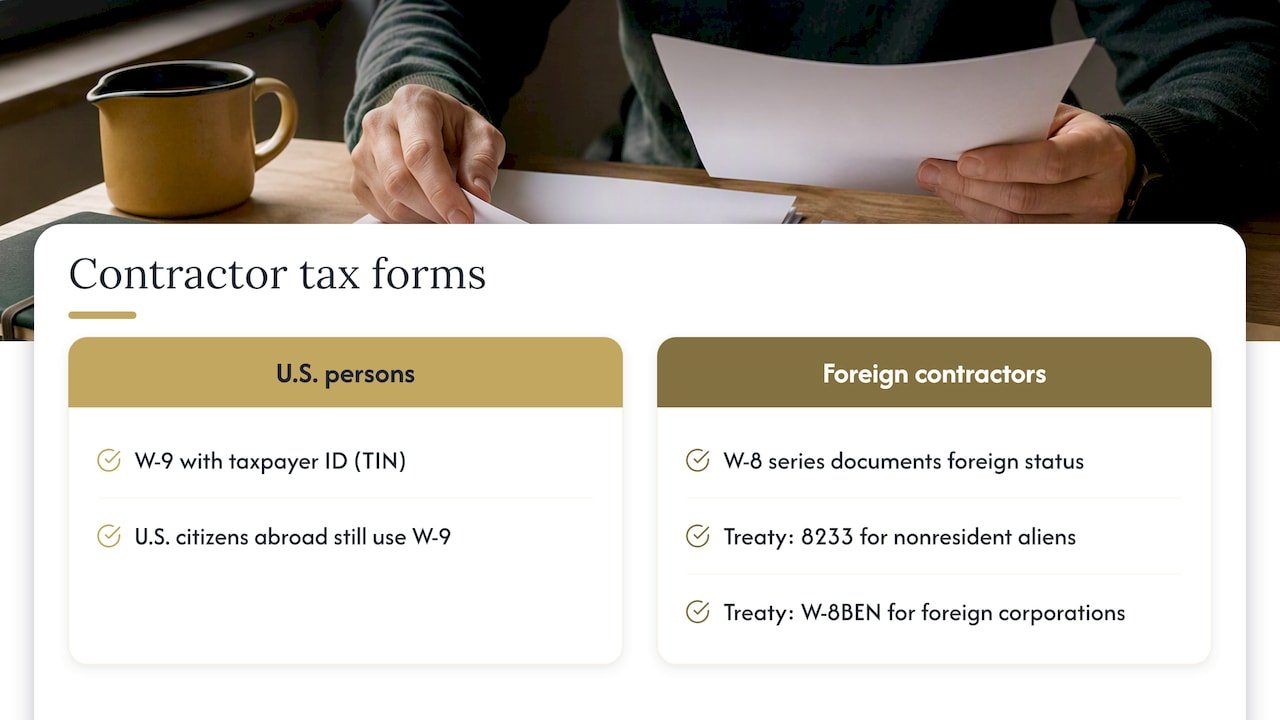
U.S. citizens and residents should give you a Form W-9 with their taxpayer identification number (TIN). Without it, the IRS says you may need to apply 24% backup withholding, which also applies if the IRS tells you the TIN is incorrect and the payee does not fix it. Our guide to stopping backup withholding with the right W-9 steps covers the process. Americans living abroad are still U.S. persons, so a U.S. citizen contractor in Berlin gets a W-9, not a foreign-status form.
Foreign individuals and companies give you a Form W-8 series form that documents their foreign status. If a contractor wants a treaty exemption from withholding on U.S.-source pay, the form depends on who they are. An IRS memorandum says that a nonresident alien individual claims the exemption with Form 8233, while a foreign corporation uses Form W-8BEN. Get the form before you pay, not after a question arrives.
For domestic contractors, our 1099 filing requirements guide explains the separate Form 1099 rules. Foreign contractors are generally handled differently, as the next sections show.
When withholding and Form 1042-S apply
When a payment to a nonresident alien is U.S.-source, the IRS says independent personal services may be subject to 30% withholding unless a lower rate applies under a treaty or law. In that case you act as the withholding agent. You deduct the tax, send it to the IRS and report it.
The reporting works like this:
- Nonemployee compensation paid to nonresident aliens is reported on Form 1042-S, and Form 1042 must be filed whenever a 1042-S is required.
- You furnish a copy of Form 1042-S to the recipient.
- You file Form 1042 for the calendar year. The deadline falls in mid-March; the IRS tax calendar set it at March 17 for the 2026 filing season because of the weekend.
- File electronically if you submit 10 or more information returns in total, counting 1099s, 1042-Ss and W-2s, according to the IRS.
If all of your overseas contractors do all their work abroad, none of this normally applies. That is why the work location should be written into every contract and invoice.
Contractor or employee? Get it right before you pay
Sending money abroad does not make someone a contractor. The IRS common-law test weighs behavioral control, financial control and the relationship of the parties. Publication 1779 explains that no single factor decides it, and that instructions about how, when or where to work, plus training you provide, point toward employment. A business can also file Form SS-8 to ask the IRS for a determination.
The label in the contract does not control the outcome either. An IRS letter ruling reiterates that a contractor designation is immaterial if the common-law employer-employee relationship exists.
Practical checks before you sign:
- Does the person set their own hours and methods?
- Do they use their own equipment and serve other clients?
- Are they paid per project or deliverable, rather than a salary?
- Could they send a substitute?
If most of your answers look like employment, read our 1099 vs W-2 classification steps. Misclassifying a worker who does U.S. work can pull you into payroll tax obligations.
Foreign company payroll in the USA
The other half of the search is the reverse case: a foreign company with people working in the United States. That is a different set of rules from contractor payments. Nonresident alien employees who perform services in the U.S. are generally subject to graduated withholding, with exceptions, just as other employees are. Employment also triggers state registration, unemployment insurance and payroll tax deposits.
If you are a foreign business that wants a U.S. team, you will typically need a U.S. entity, an EIN, a payroll process and a registered agent. Our guides to hiring employees in the U.S., multi-state payroll rules and payroll taxes for small businesses cover the mechanics. For the reverse direction, a U.S. company paying a genuine employee abroad also needs to consider that country’s rules, as discussed below.
Rules in the contractor’s country still count
U.S. tax is only half the compliance picture. The country where the contractor works may impose its own requirements: local tax registration, VAT or GST invoicing, or its own test of whether the person is really an employee. Those rules vary widely, so confirm them with a local adviser before you scale up a team in one country.
Social insurance is one area where the U.S. has coordination agreements. The IRS notes that Totalization Agreements with 25 countries help eliminate dual Social Security and Medicare taxation. Under those agreements, a worker temporarily sent by the same employer to another country stays covered only by the home country. They matter mainly for employees posted abroad, not for independent contractors, who generally handle their own social contributions.
There is also a route for American citizens and residents working for a foreign affiliate. U.S. employers may use a Section 3121(l) agreement to provide U.S. Social Security coverage for them.
Payment practicalities and cost
Tax is not the only cost of working with people abroad. Currency conversion, bank fees, time zones and management hours all add up. A sensible approach is to agree the invoice currency in the contract, decide who bears transfer fees, and pay on a fixed schedule against invoices. If you are weighing how much of your work to send offshore, this piece on reducing outsourcing costs is worth reading alongside your tax checklist.
Whatever payment method you choose, make sure each payment can be tied to an invoice, a contract and a deliverable. That is what your records need to show.
Records that protect your deduction
Federal law does not require a specific bookkeeping system, but you must keep documents that clearly show income and expenses. IRS Publication 583 adds that supporting documents for an expense should show the payee, the amount, proof of payment, the date incurred and a description of the service, so the business purpose is clear.
For each foreign contractor, keep one file with:
- The signed contract, with a clause on where the work will be performed
- The contractor’s W-8 form, W-9 or treaty form
- Every invoice, stating the work location and, if relevant, U.S. days
- Proof of each payment, including exchange rate and fees
- Any Form 1042-S and 1042 copies, if withholding applied
We also suggest a short written note on why you treated the person as a contractor. If the IRS asks, you will have an answer ready. Our bookkeeping best practices show how to keep these files tidy through the year.
Our perspective
The most common mistake we see is not a missed treaty claim. It is a missing form. A business starts paying someone overseas on a handshake, and a year later nobody can say where the work was done, whether the person was ever documented, or why no return was filed.
We treat every new foreign contractor as a small onboarding project. First, confirm whether the person is a U.S. person. Second, collect the right form. Third, write the work location into the contract and the invoice template. Fourth, code the payment properly in your books. It takes less than an hour per contractor and removes most of the risk.
We also encourage owners not to guess when the facts are mixed: a contractor who visits the U.S. for a client event, or one who looks more like staff than a vendor. Those are the cases where a quick conversation saves a large penalty. You are running a business, not a tax department, and you should not have to become one.
— Kelli
How we help
KelliWorks is a virtual accounting department for small businesses, with in-person support too. We can set up the contractor onboarding process, keep your books so every foreign payment is documented, and prepare the returns that follow. If you also need a U.S. entity for a growing team, we assist with business formation and incorporation. To discuss your contractors, see our tax preparation and filing services or ask for a free consultation.

FAQ
Do I need to send a 1099 to a contractor who lives abroad?
Generally no. Form 1099 is for U.S. persons. A nonresident alien contractor with U.S.-source income is reported on Form 1042-S instead, and a contractor who does all work abroad usually has no U.S.-source income to report. A U.S. citizen living overseas is still a U.S. person and gets a W-9 and a 1099 when thresholds are met.
Can I deduct payments to foreign contractors?
Generally yes, if the payments are ordinary and necessary business expenses and you can document them. Keep the contract, invoice, proof of payment and a description of the service. Where withholding was required and you skipped it, you may face penalties, so get that part right.
What if my contractor does some work while visiting the U.S.?
The portion performed in the U.S. may be U.S.-source income, usually allocated by time, and could face 30% withholding unless a treaty or an exception applies. Ask the contractor to show U.S. days and foreign work separately on the invoice. Speak with a tax professional before the visit, not after payment.
Is paying a foreign contractor the same as running foreign company payroll in the U.S.?
No. Contractor payments depend on income source and withholding. Payroll for employees working in the U.S. involves graduated withholding, payroll tax deposits, state registrations and unemployment insurance. A foreign company with U.S. staff usually needs a U.S. entity and a payroll setup.
When is Form 1042 due?
The deadline falls in mid-March for the previous calendar year. For 2026 the IRS listed March 17. Check the IRS tax calendar each year for the current date, and remember that filers of 10 or more information returns must file electronically.
Sources
- Forms and associated taxes for independent contractors, IRS
- Source of income: personal service income, IRS
- Persons employed abroad by a U.S. person, IRS
- Income from sources within the U.S. and ECI, IRS
- Nonresident alien tax manual, UNLV
- IRS memorandum on treaty withholding exemption
- Reporting payments to independent contractors, IRS
- First quarter tax calendar, IRS
- Publication 1779, IRS
- IRS letter ruling on worker designation
- Aliens employed in the U.S., IRS
- Totalization Agreements, IRS
- Section 3121(l) agreements, IRS practice unit
- Publication 583, IRS