


A payroll journal entry records one pay run in your books. You debit the expense for gross wages and employer payroll taxes. You credit the liabilities for what you owe other parties, plus cash or a payable for net pay. Total debits must equal total credits. If wages are earned in one month and paid in the next, you add an accrual entry so the expense lands in the right period.
This guide is for U.S. small business owners who run payroll and want to understand what goes into the books. It has worked examples with the arithmetic shown, the accrual entry, and the checks that catch mistakes early.
TL;DR
- A payroll entry debits wage expense and employer payroll tax expense, and credits liabilities (withholdings, taxes owed) plus cash or net pay payable.
- Employee withholdings are liabilities you hold for others. Employer payroll taxes are a cost to your business.
- Paying employees and remitting taxes are separate entries that clear liabilities. They never record expense a second time.
- When work is earned before payday, such as at month end, record an accrual and reverse it when the full payroll is booked.
- Gross wages must equal total withholdings plus net pay. If they do not, find the missing line before you post.
Table of Contents
- What a payroll journal entry actually records
- The accounts you will use
- Current federal rates to know
- Example 1: the standard payroll entry
- Example 2: the employer payroll tax entry
- Paying employees and remitting taxes
- The payroll accrual entry
- Checks before you post
- Common mistakes and how to avoid them
- Our view: payroll entries are a routine, not a one-off task
- Hand payroll bookkeeping to a team
- FAQ
- Sources
What a payroll journal entry actually records
Payroll touches several accounts at once, which is why one pay run is never a single line. The U.S. Chamber of Commerce describes three common approaches: an initial payroll entry, an entry for accrued wages earned before processing or payday, and a manual entry for irregular payments. The same guide notes that payroll accounting can also capture items such as health premiums, retirement contributions, employer matching, workers’ compensation and garnishments.
You can enter payroll as one summary entry for the whole team rather than one entry per employee. Your payroll report shows the totals, and the journal entry mirrors them.
Three ideas carry most of the weight:
- Gross wages are the full amount earned before anything is taken out. This is your expense.
- Withholdings and deductions are amounts taken from employee pay: income tax, the employee share of Social Security and Medicare, and benefit contributions. You owe them to someone else, so they sit as liabilities until you pay them over.
- Employer payroll taxes are costs on top of wages, such as your matching share of Social Security and Medicare and unemployment taxes. These are expenses to you.
Keeping withholdings and employer taxes apart is the most common stumbling block. A short read on separating liabilities from expenses in bookkeeping shows the same distinction in a different kind of business.
The accounts you will use
Most small business charts of accounts need these:
| Account | Type | Normal side | What it holds |
|---|---|---|---|
| Wages Expense (or Salaries Expense) | Expense | Debit | Gross pay earned |
| Payroll Tax Expense | Expense | Debit | Employer share of payroll taxes |
| Federal Income Tax Payable | Liability | Credit | Income tax withheld from employees |
| State Income Tax Payable | Liability | Credit | State tax withheld, where your state has one |
| FICA Payable | Liability | Credit | Employee and employer Social Security and Medicare |
| Benefits Payable | Liability | Credit | Employee share of health or retirement deductions |
| Unemployment Tax Payable | Liability | Credit | Federal and state unemployment taxes |
| Wages Payable or Accrued Payroll | Liability | Credit | Net pay or earned wages not yet paid |
| Cash | Asset | Debit or credit | Money leaving your bank account |
If you use accounting software, check that these exist before your first pay run. Missing liability accounts are why many entries end up out of balance or lumped into one catch-all line.
Current federal rates to know
Federal payroll tax rules are set out in the IRS’s Publication 15, the primary federal guide for employers. For tax year 2026, the California Employment Development Department lists Social Security at 6.2% for the employee and 6.2% for the employer, with a $184,500 wage limit, and Medicare at 1.45% each with no wage limit. These figures are published for 2026 and are reset by the government, so confirm them on the IRS and your state agency pages before you set up a new year.
U.S. tax rules vary by state. State income tax withholding, state unemployment rates and local taxes differ, so the state lines in your entry depend on where your employees work.
Example 1: the standard payroll entry
This example is illustrative. The federal and state withholding amounts are made up, but the Social Security and Medicare math uses the 2026 rates above.
Suppose you run a small studio and pay one salaried employee $5,000 for the month.
Step 1: Work out the employee side.
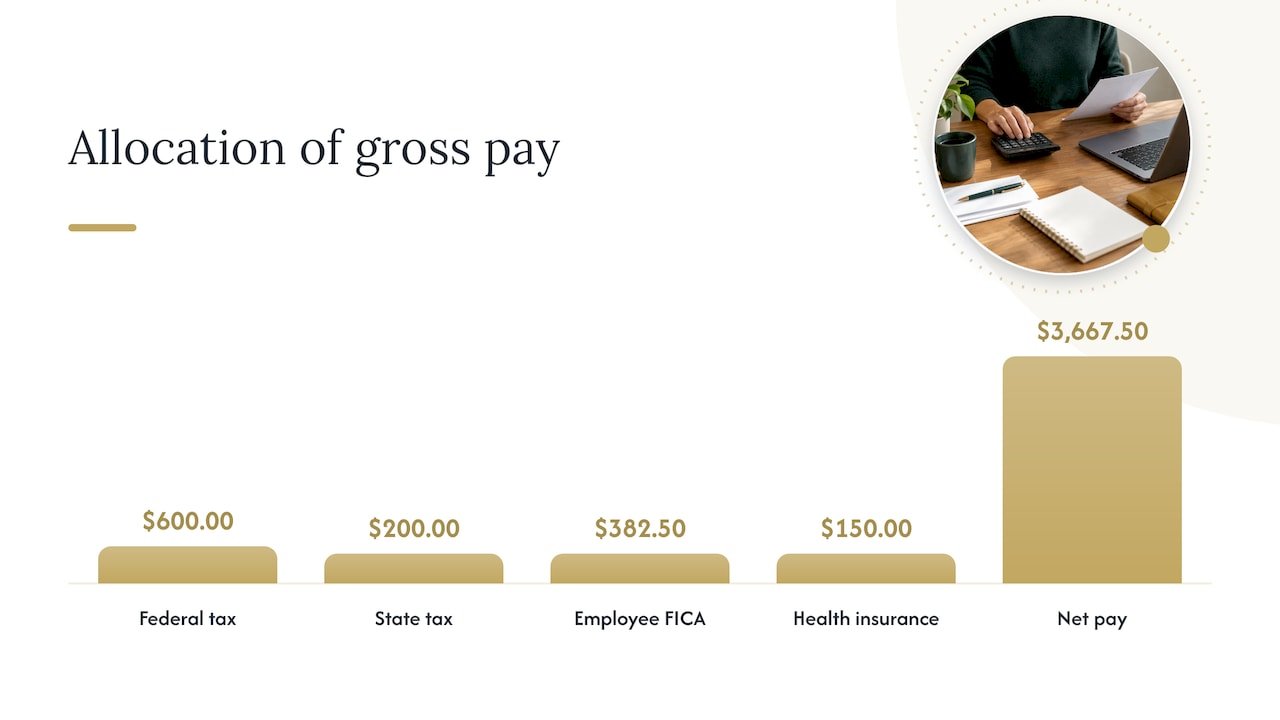
- Social Security: 6.2% of $5,000 = $310.00
- Medicare: 1.45% of $5,000 = $72.50
- Federal income tax withheld (from the employee’s W-4 and the IRS tables): $600.00
- State income tax withheld: $200.00
- Employee health insurance share: $150.00
- Net pay: $5,000 less $310 less $72.50 less $600 less $200 less $150 = $3,667.50
Step 2: Record the entry.
| Account | Debit | Credit |
|---|---|---|
| Wages Expense | $5,000.00 | |
| Federal Income Tax Payable | $600.00 | |
| State Income Tax Payable | $200.00 | |
| FICA Payable (employee share) | $382.50 | |
| Benefits Payable | $150.00 | |
| Wages Payable (net pay) | $3,667.50 | |
| Totals | $5,000.00 | $5,000.00 |
The credits add up: 600 + 200 + 382.50 + 150 + 3,667.50 = 5,000. Debits equal credits.
A textbook example follows the same pattern. In OpenStax’s accounting text, an employee earning a $2,000 monthly salary has gross pay debited to Salaries Expense, each deduction credited to its own liability, and the remaining $1,370 credited to Salaries Payable.
Example 2: the employer payroll tax entry
The employer’s share is a separate cost. Using the same $5,000 payroll:
- Employer Social Security: 6.2% of $5,000 = $310.00
- Employer Medicare: 1.45% of $5,000 = $72.50
- Employer FICA total: $382.50
| Account | Debit | Credit |
|---|---|---|
| Payroll Tax Expense | $382.50 | |
| FICA Payable (employer share) | $382.50 | |
| Totals | $382.50 | $382.50 |
Federal and state unemployment taxes are also employer costs. Their rates and wage bases differ by state and by your experience with unemployment claims, so take them from your state agency notice and add them to this entry as Payroll Tax Expense debits with Unemployment Tax Payable credits.
The FICA Payable account now holds $765.00: $382.50 withheld from the employee and $382.50 matched by you. That is the figure you will deposit with the IRS for FICA, along with the federal income tax withheld, on your deposit schedule. Our guide to payroll taxes for small businesses explains how deposit schedules work and what happens when they slip.
Paying employees and remitting taxes
The two entries above recognize cost and obligations. Cash moves later, and each cash movement has its own entry.
When you pay net pay:
| Account | Debit | Credit |
|---|---|---|
| Wages Payable | $3,667.50 | |
| Cash | $3,667.50 |
When you deposit the federal taxes (income tax withheld plus both FICA shares):
| Account | Debit | Credit |
|---|---|---|
| Federal Income Tax Payable | $600.00 | |
| FICA Payable | $765.00 | |
| Cash | $1,365.00 |
Notice what is missing: no expense account. The expense was recorded when payroll was processed. Remittances only reduce liabilities. If you debit Wages Expense or Payroll Tax Expense again when you pay the IRS, you double count your labor cost, which is a common reason profit looks too low.
Many payroll providers pay employees and taxes directly from your bank account. In that case you still record the cash entries, usually by matching the bank feed lines to the payable accounts rather than to expense.
The payroll accrual entry
An accrual entry records wages that employees have earned but you have not yet paid at the end of a reporting period. The U.S. Chamber’s guide says this method records the expense when employees earn it, rather than on the processing date, which gives more precise financial statements for accrual-basis reporting.
If you keep your books on a cash basis, you generally record payroll when it is paid and skip accruals. If you use accrual accounting, or your lender or investors expect monthly statements on that basis, you need one.
Worked accrual example
Your pay period ends on November 5, and payday is November 8. The workdays from October 27 to October 31 belong to October, and they total $3,000 in gross wages. Employer FICA on that amount is 7.65%, or $229.50.
On October 31, record the accrual:
| Account | Debit | Credit |
|---|---|---|
| Wages Expense | $3,000.00 | |
| Payroll Tax Expense | $229.50 | |
| Accrued Payroll (Wages Payable) | $3,000.00 | |
| Accrued Payroll Taxes | $229.50 | |
| Totals | $3,229.50 | $3,229.50 |
October now carries the cost of the work done in October.
On November 1, reverse it:
| Account | Debit | Credit |
|---|---|---|
| Accrued Payroll (Wages Payable) | $3,000.00 | |
| Accrued Payroll Taxes | $229.50 | |
| Wages Expense | $3,000.00 | |
| Payroll Tax Expense | $229.50 |
The reversal clears the accrual so you can record the full November 8 payroll in the normal way, without splitting it by hand. After both entries, October holds its share of the expense and November holds only what belongs to November.
Reversing is a convenience, not a requirement. You can also leave the accrual in place and, on payday, debit the accrued liability for the part already expensed and debit expense only for the remainder. Pick one method and use it every month, because switching causes double counting.
Checks before you post
A few quick checks catch most errors:
- Debits equal credits. If the software will not post, compare your entry to the payroll register. A missing withholding line or a typo is the usual cause.
- Gross equals withholdings plus net pay. In Example 1, $5,000 equals $1,332.50 in withholdings and deductions plus $3,667.50 in net pay.
- Employee FICA matches employer FICA. Both are 7.65% of taxable wages up to the Social Security wage limit, so the two shares should mirror each other for every employee below it.
- Liability accounts clear. After deposits are made, payable balances should drop to what is genuinely due. A balance that keeps growing means a remittance was missed or posted to the wrong account.
- Quarterly reconciliation. Add up a quarter of payroll entries and compare gross wages and tax totals with the figures on your quarterly federal payroll return. Differences point to entries that were skipped or coded wrongly.
At year end, your totals should also agree with the W-2s you issue. Our payroll year-end checklist walks through that comparison.
Common mistakes and how to avoid them
- Booking net pay as the wage expense. Wage expense is always the gross amount. Recording only the amount that hit the bank hides taxes and deductions.
- Treating employer taxes as withholdings. The employer share is an expense, not something taken from the employee.
- Recording owner pay as payroll without checking the entity. How owners are paid depends on the business structure, and the accounts and taxes differ. Confirm this with your tax professional before setting up the entry.
- Posting remittances to expense. Use the payable accounts, as shown above.
- Forgetting benefits and garnishments. Health premiums, retirement contributions and court-ordered garnishments each need a liability line until they are paid out.
- Ignoring state differences. State withholding, unemployment and local taxes differ, so a template from another state can leave out lines you owe.
For a wider view of the setup, our small business payroll setup guide and payroll compliance checklist cover the registrations and routines that sit around these entries. An overview of how a professional services business records a payroll run in the general ledger gives another look at the same flow.
Our view: payroll entries are a routine, not a one-off task
Payroll is one of the few areas where a small error repeats every pay period. A wrong account mapping on the first run is copied into every run after it, and it usually surfaces at quarter end or when a W-2 does not match.
That is why we treat payroll entries as part of a monthly close. Someone should post them, someone should reconcile liabilities to the tax deposits, and someone should compare the totals with the filings. When one person does all of that while also running a business, steps get skipped.
We run the books for small business owners as a real team. We handle bookkeeping and monthly reporting, bill pay and compliance, so the entries are posted and checked each month. For tax, we can handle it ourselves or work alongside your existing CPA. Everything is covered by one flat monthly fee agreed up front, never a percentage of income. Confidentiality is standard practice for us, and we are glad to sign an NDA before we start.
Q: A good test of your own process is simple. Can you explain, today, where every payroll liability balance comes from and when it will clear? If not, that is the place to start.
Kelli
Hand payroll bookkeeping to a team
If you would rather not post entries, reconcile liabilities and chase deposit mismatches yourself, our accounting team can take it on. Our accounting and bookkeeping services include payroll processing, cash flow management, tax planning and preparation, and monthly reporting, under one flat monthly fee.

If you already have a CPA, we work alongside them. If you do not, we can handle tax preparation too. You can read more about outsourced bookkeeping for small businesses, or book a free consultation at kelliworks.com/consultation to talk through your setup.
FAQ
What is the basic journal entry for payroll?
Debit Wages Expense for gross pay and Payroll Tax Expense for the employer’s taxes. Credit the liability accounts for withheld taxes, employer taxes and deductions, and credit Cash or Wages Payable for net pay. Total debits must equal total credits.
How do I record a payroll accrual entry?
At the end of the period, debit Wages Expense and Payroll Tax Expense for the amounts employees earned but have not been paid. Credit Accrued Payroll and Accrued Payroll Taxes. On the first day of the next period you can reverse it, then record the full payroll as usual.
Are employer payroll taxes part of the same entry as wages?
They can be posted in one entry or in two, as long as the accounts are right. Many owners keep them separate, as in the examples above, because the employee side and the employer side have different accounting roles: withholdings are liabilities and employer taxes are expenses.
How do I record payroll when employees are paid later?
Credit Wages Payable for net pay when you process payroll. When you pay employees, debit Wages Payable and credit Cash. If you pay at the same time you process payroll, credit Cash directly instead.
Do I need to do this if I use a payroll provider?
Yes, the books still need the entries, though many providers send a summary you can post or sync. Someone still has to check that the mapping is right and that the liabilities clear. We can do that review as part of monthly bookkeeping, and for tax we can handle it or work with your CPA.
Sources
- Payroll Accounting Best Practices for Small Businesses, U.S. Chamber of Commerce
- 2026 Federal and State Payroll Taxes (DE 202), California EDD
- 12.5 Record Transactions Incurred in Preparing Payroll, OpenStax
Recommended
- How to Tie Timesheets to Payroll Without Errors
- Avoid a One Time Tax Bill: Cash vs Accrual for Small Businesses
- Payroll Compliance Checklist for 2026: A Stage-by-Stage Guide
- Avoid the $100,000 Trap: Payroll Taxes for U.S. Small Businesses
This article is general information, not tax, legal or financial advice. Talk to a professional about your situation.


