


If you paid an independent contractor, freelancer, or vendor an amount that meets or exceeds the IRS threshold for services in 2026, you almost certainly owe the IRS a Form 1099-NEC. If you processed payments through a card or app, Form 1099-K may apply at a different threshold. And a December 2026 update to the IRS instructions raises the general reporting threshold for many other information returns to a higher amount, up from the long-standing threshold used for tax years beginning after 2025.
That single change affects how you track rent, prizes, royalties, and other miscellaneous payments this filing season. Here’s what to do right now, before you touch a single form:
- Pull every vendor and contractor payment record from your books and sort by total paid.
- Collect a signed Form W-9 from anyone you haven’t already documented.
- Run those Taxpayer Identification Numbers through the IRS TIN Matching program before you file, not after.
- Confirm whether you’ll cross the 10-return threshold that makes electronic filing mandatory.
We’ll walk through every form, deadline, and compliance step below, but those four actions are the ones that keep you off the IRS penalty list.
Key Takeaways
Meeting 1099 filing requirements comes down to knowing which form applies, tracking the correct threshold, and collecting vendor documentation before you pay, not after.
| Point | Details |
|---|---|
| Know your thresholds | The federal reporting threshold for many information returns rises to $2,000 for tax years beginning after 2025, while 1099-NEC keeps its $600 trigger. |
| Track three separate deadlines | Recipient copies, IRS paper filing, and IRS e-filing each carry different dates, with 1099-NEC due January 31 across the board. |
| Plan e-filing early | Filing 10 or more aggregate information returns requires e-filing, and a TCC application can take up to 45 days to process. |
| Collect W-9s before payment | Running TIN Matching at onboarding, not year-end, prevents most B-notices and penalty exposure. |
| Consider outsourcing the workflow | Kelliworks builds W-9 collection, TIN Matching, and e-filing support into ongoing bookkeeping so 1099 compliance stops being a January scramble. |
This article is general information, not a substitute for advice from a qualified financial advisor. Consult a qualified financial professional about your own circumstances before acting on anything here.
Table of Contents
- Understanding 1099 Filing Requirements for Small Businesses
- What Are the Current Federal Reporting Thresholds?
- When Are the 1099 Deadlines in 2026?
- How Do You E-File 1099 Forms With the IRS?
- Onboarding Vendors: W-9 Collection and TIN Matching
- What Penalties Apply for Late or Incorrect 1099 Filings?
- Are You Filing 1099s for Employees You Should Have Classified Differently?
- How KelliWorks Operationalizes 1099 Compliance for Small Businesses
- What Small Businesses Get Wrong About 1099 Compliance
- Ready to Hand Off Your 1099 Workflow?
- Sources
Understanding 1099 Filing Requirements for Small Businesses
The core rule hasn’t changed even though the dollar thresholds have: if your business made reportable payments to a non-employee in the course of trade or business, you have a filing obligation. What counts as “reportable” depends on which form applies, and getting that wrong is the single most common mistake we see among small business owners handling payroll and accounts payable for the first time.
1099-NEC: the contractor form
Form 1099-NEC reports nonemployee compensation, meaning any payment that meets or exceeds the IRS threshold you made to a freelancer, contractor, or consultant for services performed for your business. If you hired a bookkeeper on a project basis, paid a web developer to redesign your site, or brought in a marketing consultant for a quarter, this is your form. The IRS clarifies that the trade-or-business test applies: personal payments, like paying a neighbor’s kid to mow your lawn, don’t trigger a filing requirement because that payment isn’t connected to your business operations.
1099-MISC: everything else
Form 1099-MISC now catches the payments 1099-NEC doesn’t: rent, royalties, prizes and awards, and certain medical and health care payments. Under the new instructions, most of these categories move to a higher reporting threshold, though a few specific boxes still follow different rules, so check the current instructions for the category you’re reporting.
1099-K: the payment processor’s job, not always yours
If your customers pay you through a third-party settlement network like a payment app or card processor, that processor issues the 1099-K, not you. You typically don’t need to file this form yourself unless you’re the one operating a marketplace or payment platform. The nuance that trips people up: money that shows up on a 1099-K you receive might overlap with income you’d otherwise report elsewhere, so reconcile carefully rather than double-counting.
Forms you’ll see less often but still need to recognize
A few other forms show up occasionally in a small business context:
- 1099-INT reports interest income, relevant if your business paid interest to someone (rare, but it happens with seller financing).
- 1099-R covers distributions from pensions, annuities, or retirement plans, relevant mainly if you run a small business retirement plan.
- 1099-S reports proceeds from real estate transactions, relevant if your business sold property.
Pro Tip: Payments to corporations are generally exempt from 1099-NEC and 1099-MISC reporting, with two notable exceptions: attorney fees (always reportable, even to a law firm structured as a corporation) and certain medical and health care payments. When in doubt, the signed W-9 you collected should already tell you the payee’s entity type.
What Are the Current Federal Reporting Thresholds?
The headline number for 2026 is $2,000. The December 2026 revision of the Instructions for Forms 1099-MISC and 1099-NEC raises the minimum reporting threshold for several categories of information returns to $2,000 for tax years beginning after 2025, with further inflation adjustments scheduled to begin in 2027. For years, the standard trigger sat at $600, so this is the most consequential change to hit small business 1099 compliance in recent memory.
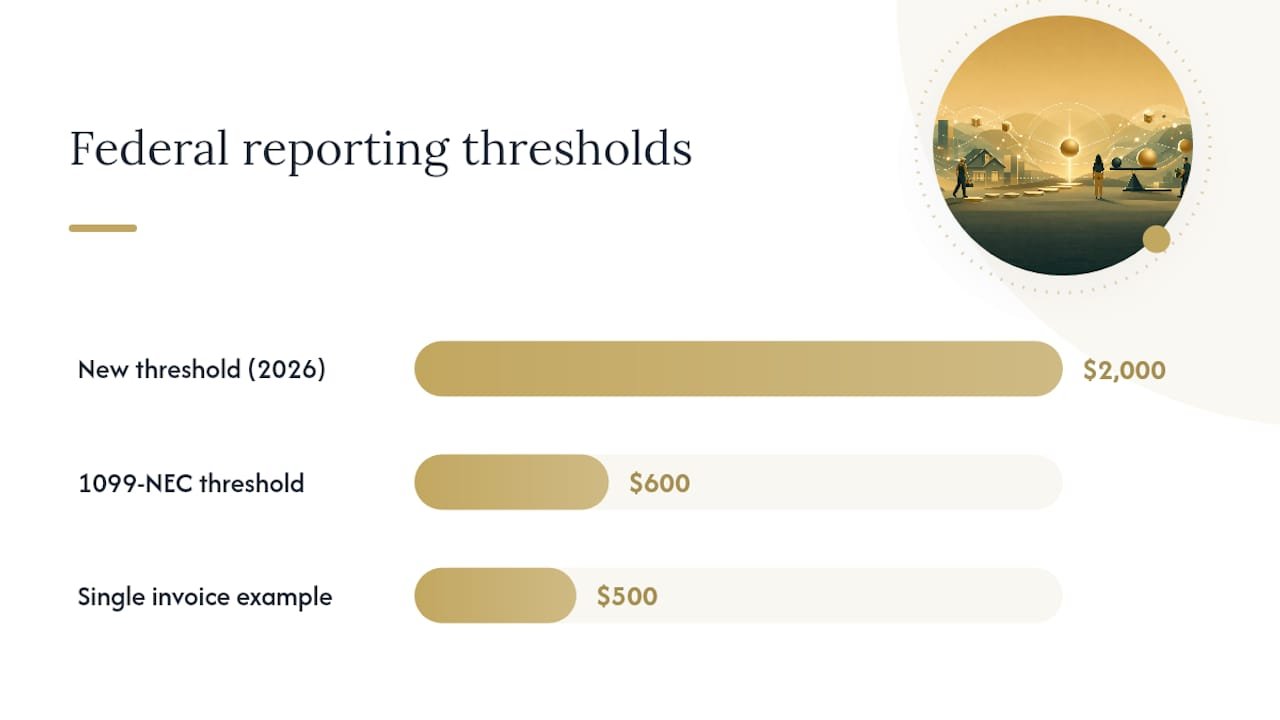
The catch: this threshold increase doesn’t apply uniformly across every 1099 variant. Form 1099-NEC’s $600 threshold for nonemployee compensation remains a separate figure in current guidance, so don’t assume every payment category shifted at once. Treat the $2,000 mark as applying specifically to the categories named in the December 2026 instructions, and verify the figure against the current-year instructions for any form you’re less familiar with.
Two rules determine whether a payment counts toward any threshold at all:
- The trade-or-business test. The payment must relate to your business activity, not a personal transaction. A landlord operating rental property as a business reports rent payments made to a contractor; a homeowner paying a handyman personally does not.
- The aggregate rule. You add up all payments to a single payee across the year, not per invoice. Four separate $500 invoices to the same contractor total $2,000, which meets the threshold even though no single payment did.
To audit your own books before filing season, run this quick process:
- Export your accounts payable ledger for the full calendar year.
- Group payments by payee, not by transaction.
- Flag any payee whose annual total meets or exceeds the applicable threshold for the form category involved.
- Cross-check flagged payees against your W-9 file to confirm you have a valid TIN on record.
If a payee’s total sits close to the line, don’t guess. The current-year instructions spell out category-specific rules, and a five-minute check beats an amended filing in April.
When Are the 1099 Deadlines in 2026?
Three separate deadlines govern your filing calendar, and confusing them is what causes most late-filing penalties. Recipient copies, IRS paper filings, and IRS e-filings don’t all share the same date, and Form 1099-NEC runs on a tighter schedule than most other 1099 variants.
| Filing task | Typical deadline | Notes |
|---|---|---|
| Furnish 1099-NEC to recipient | January 31 | Same date applies whether you file on paper or electronically. |
| File 1099-NEC with IRS | January 31 | No extended window for e-filers on this form. |
| Furnish 1099-MISC to recipient | January 31 (most boxes) | Some boxes with substitute payments allow until mid-February. |
| File 1099-MISC with IRS (paper) | Late February | Falls on the last business day of February in most years. |
| File 1099-MISC with IRS (e-file) | March 31 | E-filers get roughly a month longer than paper filers. |
| State filing deadlines | Early February to late March | Varies significantly; check your specific state’s requirements. |
When any deadline lands on a weekend or federal holiday, it shifts to the next business day. That’s a small mercy, not a planning strategy: build your internal deadline a few business days ahead of the federal one so a printer jam or software glitch doesn’t turn into a late filing.
If you need more time, Form 8809 requests an automatic 30-day extension for most information returns, though 1099-NEC extensions are automatic only in limited circumstances and require a stronger justification. Extensions push back your IRS filing deadline, not your obligation to furnish recipient copies on time in most cases, so don’t assume filing Form 8809 buys you breathing room on the contractor-facing side.
State filing requirements add another layer entirely. Many states participate in the Combined Federal/State Filing Program, which forwards your federal data automatically, but a meaningful number require a separate state-level submission with its own deadline and portal. Typical state windows fall between early February and late March, and a handful of states have no filing requirement at all. Check your state department of revenue directly rather than assuming your neighbor state’s rules apply to you.
A practical year-end timeline looks like this:
- November through December: finalize your vendor list, chase any outstanding W-9s, and run TIN Matching on new payees.
- Early January: reconcile your accounts payable ledger against your W-9 file and confirm every reportable payee is accounted for.
- By January 31: furnish recipient copies and file 1099-NEC with the IRS.
- February through March: file remaining 1099-MISC and other forms, watching paper versus e-file deadlines separately.
How Do You E-File 1099 Forms With the IRS?
If you file a certain number of information returns of any type combined, aggregated across every 1099 variant and other information returns like W-2s, the IRS requires electronic filing. The aggregate count applies across return types, meaning a business filing six 1099-NECs and five 1099-MISCs crosses the threshold even though neither form alone hits 10.
Getting set up to e-file takes real lead time, which is the part most first-time filers underestimate.
- Apply for a Transmitter Control Code (TCC) through the IRS system well before filing season opens; processing can take up to 45 days.
- Use the IRIS portal, the IRS’s free Information Returns Intake System, for direct submission if you’re filing a manageable volume yourself.
- Consider an Application-to-Application (A2A) transmitter or a third-party e-file service if your volume is high or your internal systems already export in a compatible format.
- Request an e-file waiver only if you can demonstrate genuine hardship, such as a lack of internet access; waivers are granted sparingly and require advance application.
Pro Tip: Don’t wait until January to request your TCC. IRIS onboarding and TCC approval both move slower during peak season, and a business that applies in November has a filing system ready to go before the January 31 deadline hits.
Onboarding Vendors: W-9 Collection and TIN Matching
The cleanest 1099 season starts months earlier, with the vendor onboarding process itself. Collect Form W-9 before you issue the first payment, not after, and you eliminate the scramble that defines late January for most small businesses.
- Require a signed W-9 as a condition of payment. Build it into your vendor setup checklist alongside banking details, so accounts payable can’t process a first invoice without it on file.
- Run the TIN through IRS TIN Matching as part of onboarding, not at year-end. This free program flags mismatched names and numbers before they become B-notices.
- Store W-9s in a centralized digital repository with version control, so a vendor’s updated address or entity change doesn’t leave you filing against stale data.
- Set a revalidation schedule, roughly every two to three years for long-term vendors, since entity structures and addresses change more often than people expect.
- Flag reportable payments automatically in your accounts payable workflow, tagging any vendor coded as a 1099 recipient the moment a payment posts.
That last step matters more than it sounds. A business that manually reviews vendor payments in December is reconstructing a year of transactions from memory and invoices; a business that flags reportable payments as they happen is just exporting a report. Tools built for vendor onboarding automation can handle steps one through three without adding headcount, which matters if your accounts payable team is one person doing three jobs.
Pro Tip: A W-9 collected verbally or by email attachment without a real signature is a weak record if the IRS ever asks. Use a system that captures a genuine signature and timestamp, even a simple e-signature tool, so you have a defensible paper trail.
What Penalties Apply for Late or Incorrect 1099 Filings?
Penalties scale with how late you are and whether the IRS believes the failure was accidental or willful, and the numbers add up faster than most small business owners expect. The general instructions for information returns lay out a tiered structure: smaller penalties for returns corrected quickly, larger penalties for returns filed significantly late, and the steepest tier reserved for intentional disregard of the filing requirement.
- Filing within roughly 30 days late carries the lowest per-return penalty tier.
- Filing after 30 days but before August 1 moves to a mid-tier penalty.
- Filing after August 1, or not filing at all, triggers the highest standard tier.
- Intentional disregard removes the penalty cap entirely and applies per return, with no ceiling protecting a business that knowingly ignored the requirement.
Reasonable-cause relief exists, and the IRS does grant it in genuine cases, such as a documented system failure or a death in the family during filing season. It rarely covers “we didn’t know” or “we always file late,” so don’t count on it as a backup plan.
Backup withholding is the other lever most small businesses don’t think about until it hits them. If a payee fails to provide a valid TIN, or if the IRS notifies you that a TIN doesn’t match its records, you’re required to withhold a flat percentage of future payments to that vendor and report it on Form 945. This isn’t optional once triggered, and failing to withhold when required shifts liability onto your business.
If you catch an error after filing, correcting it is straightforward but time-sensitive: file a corrected return using the same method (paper or e-file) as the original, checking the “corrected” box, and furnish a corrected copy to the recipient. The sooner you catch it, the lower the penalty tier you land in, so a quick internal review each February before deadlines close catches most errors while they’re still cheap to fix.
Are You Filing 1099s for Employees You Should Have Classified Differently?
The IRS doesn’t decide whether someone is an employee or an independent contractor based on the form you issued. It looks at the actual working relationship, specifically the degree of control your business exercises over how, when, and where the work gets done. Issuing a 1099 to someone who legally functions as an employee doesn’t protect you if an audit determines the classification was wrong; it just adds a second problem on top of the first.
Common audit triggers include a “contractor” who works exclusively for your business, uses equipment you provide, follows a schedule you set, and has worked in that arrangement for years without a defined project scope. None of those facts are automatically disqualifying on their own, but stacked together they paint a picture that looks like employment with extra steps.
A few operational habits genuinely reduce your risk:
- Use a written contract that defines a specific scope of work and project timeline, not an open-ended arrangement.
- Let the contractor control their own hours, tools, and methods wherever the work allows it.
- Avoid providing employee-style benefits, office space, or equipment unless the engagement genuinely requires it.
- Allow the contractor to work for other clients; exclusivity clauses undercut the independent-contractor argument.
Pro Tip: If you’re genuinely unsure how a worker should be classified, file Form SS-8 with the IRS to request an official determination, or talk to an accountant before the relationship starts rather than after you’ve issued three years of 1099s to someone who should have been on payroll.
How KelliWorks Operationalizes 1099 Compliance for Small Businesses
Most small business owners don’t have a spare 20 hours in January to chase down missing W-9s and reconcile a year of vendor payments. That’s the exact gap KelliWorks fills as a virtual accounting department built around the workflows small businesses actually need.
- W-9 collection and centralized storage, built into vendor onboarding from the first payment rather than bolted on at year-end.
- TIN Matching run proactively, catching mismatches before they become IRS notices.
- E-filing assistance through IRS-compliant systems, including guidance on TCC applications for businesses crossing the 10-return threshold.
- Year-end reconciliation that cross-checks your accounts payable ledger against your 1099 obligations before deadlines close in.
A business that builds 1099 compliance into its monthly bookkeeping rhythm, instead of treating it as a January fire drill, spends less time correcting errors and more time running the business.
Clients who move their 1099 workflow to a managed process typically report the same two outcomes: fewer scrambling weeks in January and measurably lower exposure to penalty notices, because vendor documentation is complete months before the deadline rather than assembled in a rush. If you’re ready for a closer look at how a managed engagement works, KelliWorks’ tax preparation services outline what a full compliance handoff looks like for a small business.
What Small Businesses Get Wrong About 1099 Compliance
The conventional advice on this topic treats 1099 filing as a January task: gather your forms, hit the deadline, move on. That framing is backwards, and it’s why so many small businesses end up filing corrected returns or fielding IRS notices in the spring.
The businesses that stay clean don’t have better January routines. They have better July, September, and November routines. Every W-9 collected at onboarding instead of chased down in December, every TIN matched the week a vendor is set up instead of the week before filing, removes a point of failure before it exists. The $2,000 threshold change makes this more urgent, not less, because it pulls more payment categories into scope even as it exempts smaller ones.
What gets overrated: worrying about which exact form applies to a borderline payment. What gets underrated: the vendor file itself. A messy, incomplete W-9 repository causes more penalty exposure than a genuine form-selection error ever will. If you take one thing from this piece, make it a standing habit of collecting documentation before you pay, not after.
— Kelli
Ready to Hand Off Your 1099 Workflow?
Running 1099 compliance yourself means owning every step: chasing W-9s, matching TINs, tracking three separate deadline types, and hoping you crossed every threshold correctly. Kelliworks operates as your virtual accounting department instead, building W-9 collection, TIN Matching, and e-filing into your regular bookkeeping cycle so nothing gets reconstructed in a January panic.

That means fewer surprises at filing season and a lower chance of a penalty notice landing in your mailbox come spring. A typical engagement starts with a review of your current vendor files and payment history, moves into setting up ongoing W-9 and TIN Matching workflows, and ends with your 1099s filed on time, every category checked against the current thresholds. If your business paid contractors, vendors, or landlords this year and you’d rather not own the deadline calendar yourself, explore what a virtual accounting department actually handles for a business your size, and get a clear picture of what compliance support looks like before the next deadline arrives.