


File Form 7004 to get an automatic extension of time to file most business tax returns, including Forms 1120, 1120-S, 1065, and 1041. That is the whole answer to which form you need. But the rule that trips up more business owners than any other part of this process is this: an extension to file is never an extension to pay. Whatever tax your business owes is still due on the original deadline, and interest starts running the day after that date even if the IRS approves your extension.
For calendar-year filers, the shifts look like this:
- S-corporations and partnerships: March 15 moves to September 15
- C-corporations: April 15 moves to October 15
Pro Tip: Save your e-file confirmation the moment you submit Form 7004. The IRS no longer sends a separate approval notice — it only contacts you if the request is rejected, so your confirmation receipt is your only proof the extension was filed on time.
Key Takeaways
Filing Form 7004 grants your business more time to submit its return, but any tax owed is still due on the original deadline, with penalties and interest starting immediately on unpaid balances.
| Point | Details |
|---|---|
| File Form 7004 by the original deadline | Submit before March 15 (S-corps, partnerships) or April 15 (C-corps) to secure the automatic extension. |
| Pay what you owe regardless of the extension | Any balance due is still owed by the original date; unpaid tax accrues a 0.5% monthly failure-to-pay penalty. |
| Check your state’s separate rules | Federal extensions don’t automatically cover state deadlines, so confirm each state’s requirements individually. |
| Keep proof of filing and payment | Save e-file confirmations and EFTPS receipts since the IRS no longer sends approval notices. |
| Get professional support for the estimate | Kelliworks prepares Form 7004, calculates tentative tax, and manages EFTPS payments for small business clients. |
Table of Contents
- What Is Form 7004 and Which Returns Does It Cover?
- When Are the New Deadlines for Each Entity Type?
- How Do You File and Pay for a Business Tax Extension?
- Does a Federal Extension Cover Your State Return Too?
- What Happens After You File the Extension?
- How Do You Estimate a Tentative Tax Payment for Form 7004?
- What Are the Most Common Form 7004 Mistakes?
- Let Kelliworks Handle Your Business Tax Extension Filing
- Where to Verify Extension Rules and Forms
- Sources
What Is Form 7004 and Which Returns Does It Cover?
Form 7004 is the mechanism the IRS uses to grant an automatic extension for most business income tax, information, and other returns. You can find the current instructions on IRS.gov, and the form itself lists every return it applies to along with a corresponding code you enter in Part I.
The form covers a wide range of business filings, and the return code you select determines both the deadline and the maximum extension period. Common examples include:
- Form 1120 (C-corporations) — six-month extension for most tax years
- Form 1120-S (S-corporations) — six-month extension
- Form 1065 (partnerships and multi-member LLCs taxed as partnerships) — six-month extension
- Form 1041 (trusts and estates) — five-and-a-half-month extension for most trusts
- Form 1120-POL and Form 1120-RIC — six-month extension, same general rules
Not every business owner should file this form. Individuals, sole proprietors, and single-member LLCs that are disregarded entities reporting income on Schedule C of their personal Form 1040 do not use Form 7004 at all. That group files Form 4868 instead, since their business income is really personal income for tax purposes. Mixing these two up is one of the more common filing mistakes among first-time business owners, and it can mean your extension gets rejected simply because you used the wrong form for your entity type.
One rule worth repeating because so many preparers miss it: you must file a separate Form 7004 for each return your business needs to extend. If you own two entities, an S-corp and a partnership, you file two separate forms, each with its own return code entered in Part I, line 1. There is no combined or bundled extension request, even if both entities share an EIN structure or a preparer.
To be granted, Form 7004 has to be filled out completely, include a reasonable estimate of any tax owed where applicable, and reach the IRS by your original due date. Missing any one of those three requirements can mean the extension is invalid, which puts you right back where you started: filing late with no protection.
When Are the New Deadlines for Each Entity Type?
Filing Form 7004 on time moves your due date forward by a set number of months, and the exact number depends on which return you’re extending. Here’s how the most common entity types line up for the 2026 filing season.
| Entity Type / Form | Original Due Date (Calendar Year) | Extended Due Date |
|---|---|---|
| S-corporation (Form 1120-S) | March 15 | September 15 |
| Partnership (Form 1065) | March 15 | September 15 |
| C-corporation (Form 1120) | April 15 | October 15 |
| Trust/Estate (Form 1041) | April 15 | September 30 |
| C-corp with June 30 year-end (tax years beginning before 2026) | September 15 | April 15 |
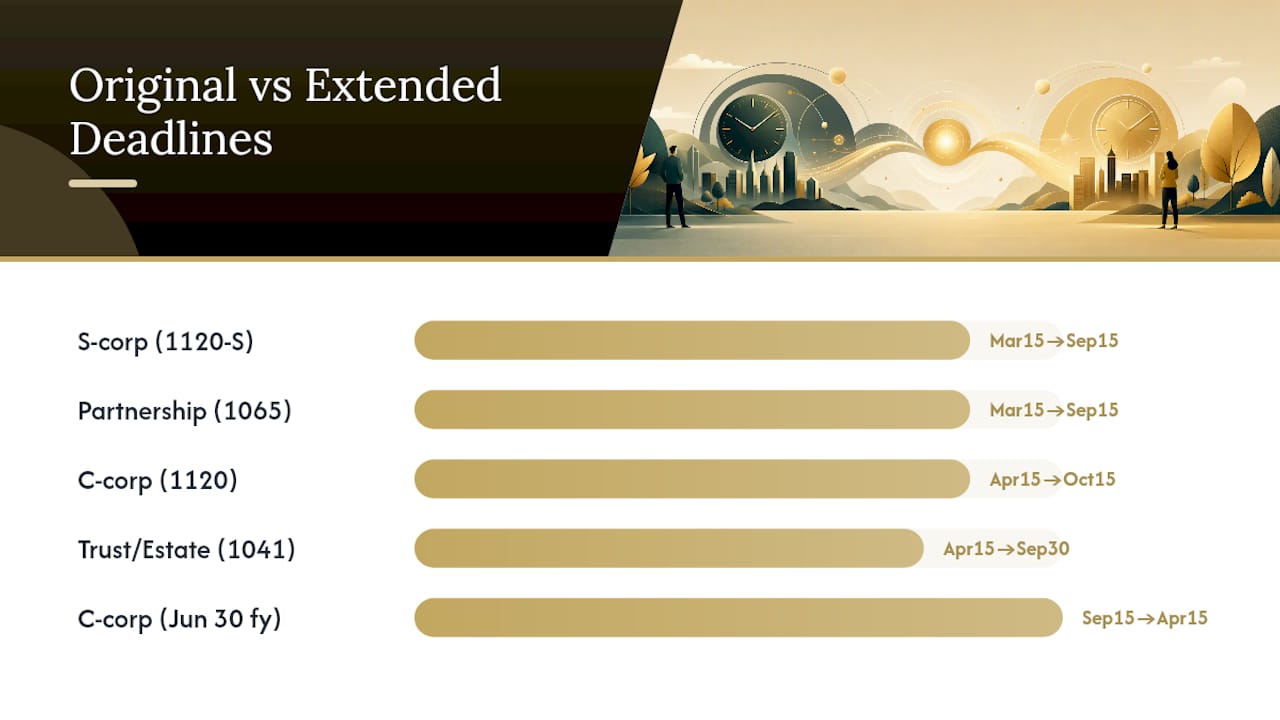
That last row is the exception worth memorizing. Most C-corporations get a standard six-month extension, but corporations with a June 30 fiscal year-end that began before January 1, 2026, are eligible for an extension longer than the usual period, according to the instructions on Form 7004. For tax years beginning in 2026 and after, that special seven-month rule goes away and the standard six-month period applies across the board, so fiscal-year C-corps need to check which side of that transition their tax year falls on.
Fiscal-year filers in general should not assume the calendar-year dates above apply to them. If your business’s tax year ends on a date other than December 31, your original due date is the 15th day of the third or fourth month after your fiscal year closes (the third month for S-corps and partnerships, the fourth for C-corps), and your extended due date is calculated the same number of months out from there. A partnership with a June 30 fiscal year-end, for instance, has an original due date of September 15 and an extended due date of March 15 the following year.
One more scheduling detail: if any of these dates fall on a Saturday, Sunday, or federal holiday, the deadline automatically shifts to the next business day. This is a standard IRS rule, not something specific to extensions, but it catches people off guard almost every year when a due date lands on a weekend.
How Do You File and Pay for a Business Tax Extension?
Filing Form 7004 correctly comes down to five steps you need to finish before your original due date, not after. Here’s the order that works:
- Identify your return and enter the correct form code. Part I of Form 7004 has a numbered list of return types. Match your business’s return to the right code and enter it precisely; an incorrect code is one of the most common reasons extensions get flagged.
- Confirm your tax year dates. If you’re a fiscal-year filer, this box needs to reflect your actual fiscal year, not a default calendar year. A mismatch here can cause processing delays.
- Calculate your tentative total tax and any balance due. This requires a reasonable estimate of your full-year tax liability, even though your books may not be finalized. Use your best available numbers from year-to-date financials, prior-year returns, or projected income.
- Choose your filing method. You can e-file Form 7004 through an IRS-approved e-file provider, which typically returns an acceptance confirmation within minutes, or you can mail a paper form to the appropriate IRS service center. E-filing is faster and gives you a digital timestamp that’s easier to produce later if a question comes up.
- Submit your payment for any balance due, using an approved method, by the original due date.
That last step is where most of the real financial risk sits. Form 7004 does not extend your time to pay. The IRS is explicit that any balance due is generally required by the original due date of your return, regardless of whether your extension is approved.
For payment, most businesses are required to use electronic funds transfer, and the Electronic Federal Tax Payment System, EFTPS, is the standard channel the IRS expects larger and mid-sized businesses to use for federal tax deposits. If you’d rather not manage EFTPS enrollment directly, you can:
- Use Electronic Funds Withdrawal when you e-file, which lets you authorize a direct debit as part of the filing process
- Pay through the IRS payments page, which lists Direct Pay, same-day wire, and other electronic options
- Arrange for a trusted third party, such as a payroll provider or accounting firm, to submit deposits on your behalf
That third option matters more than it might seem. A PEO or payroll partner can handle recurring federal tax deposits so you’re not manually logging into EFTPS every quarter, which is especially useful if your business already outsources payroll.
Once you’ve filed and paid, keep your records. That means your e-file confirmation, your EFTPS payment confirmation number, and your bank statement showing the transaction posted. Retain these for at least three years, longer if your return involves more complex issues like net operating losses or foreign income, since that’s the general window the IRS can look back for an audit.
Pro Tip: The two fields that cause the most rejected or delayed Form 7004 filings are the EIN and the tax year end date. Double-check that your EIN matches IRS records exactly (no transposed digits) and that your tax year end date matches what’s on file from your prior return, not just what’s on your calendar.
Does a Federal Extension Cover Your State Return Too?
No, in most cases it doesn’t. A federal Form 7004 extension does not automatically extend your state filing or payment deadline. Every state sets its own rules, and treating the federal extension as a blanket pass is one of the more expensive assumptions a business owner can make.
States generally fall into a few patterns:
- States that automatically honor the federal extension, as long as you attach a copy of Form 7004 to your eventual state return
- States that require their own separate extension form, filed by the state’s own deadline, regardless of what you did federally
- States that grant a filing extension but still require estimated payment by the original date, mirroring the federal “extension to file, not to pay” structure
Because these rules shift from year to year and state to state, the only reliable move is to check your specific state’s department of revenue website before assuming anything. If your business operates in more than one state, you’re managing multiple deadlines and multiple payment requirements simultaneously, and a missed one can mean penalties in a state you didn’t even think to check.
This is exactly the kind of detail that becomes a headache during a busy filing season, particularly for businesses managing multi-state sales tax obligations alongside income tax deadlines. A simple state-by-state calendar entry, noted the moment you file your federal extension, prevents this from becoming a last-minute scramble.
What Happens After You File the Extension?
Filing Form 7004 buys you time to complete your return, not time to pay what you owe. If you have an unpaid balance after your original due date, penalties and interest start accruing immediately, extension or no extension.
The main one to know is the failure-to-pay penalty, which runs at 0.5% of your unpaid tax for each month or partial month the balance stays unpaid, up to a cap of 25% of the total amount due. Interest accrues separately and compounds daily, on top of that penalty.
Here’s what that looks like in practice. Say a calendar-year C-corporation owes $20,000 and pays nothing by its April 15 original due date, filing its extension but not its payment. By the time it finally pays in full six months later at the October 15 extended filing deadline, it has accumulated six months of failure-to-pay penalty, roughly 3% of the balance, or about $600, on top of separately accruing interest. That’s money that had nothing to do with being late on the actual return. It’s the cost of treating “extension” as “delay everything,” when only the paperwork deadline moved.
A few practical ways to limit that exposure include paying as much of your estimated liability as possible by the original due date, considering an installment agreement if you cannot cover the full balance, and documenting reasonable cause such as a natural disaster or serious illness if penalty relief might apply.

Pro Tip: If your business relies on estimated tax payments throughout the year, it is important to adjust your numbers rather than simply recycle last year’s figures. C-corporations should carefully document the assumptions behind their estimates, because underpayment penalties are calculated separately from failure-to-pay penalties and can apply even if your extension was filed properly.
How Do You Estimate a Tentative Tax Payment for Form 7004?
Here’s a worked example: a small calendar-year C-corporation projecting $150,000 in taxable income would owe roughly $31,500 in federal tax at the flat 21% corporate rate, and that estimated amount is what needs to accompany Form 7004 if the company hasn’t already prepaid it through estimated quarterly payments.
Walking through the math step by step:
- Estimate full-year taxable income. Using year-to-date books plus a reasonable projection for the remaining months, the company projects $150,000 in taxable income for the year.
- Apply the corporate tax rate. C-corporations pay a flat 21% federal rate, so $150,000 × 0.21 = $31,500 in tentative total tax.
- Subtract any credits. Say the company qualifies for a $2,000 general business credit. That brings the tentative tax down to $29,500.
- Subtract estimated tax payments already made during the year. If the company made four quarterly estimated payments totaling $20,000, that leaves a projected balance due of $9,500.
- Remit that balance through EFTPS or Electronic Funds Withdrawal by the original due date, and enter the figures on Form 7004, Part II.
You can build your own version of this with a simple fill-in table:
This example uses a flat corporate rate and simple assumptions to show the mechanics, not a prediction of your actual liability. Real numbers get more complicated fast, especially once you factor in multi-state apportionment, depreciation timing, or pass-through income for an S-corp or partnership. If your situation involves any of that, it’s worth having a tax preparer build the estimate rather than guessing, since an inaccurate estimate can itself trigger an underpayment penalty even with a validly filed extension.
What Are the Most Common Form 7004 Mistakes?
The mistakes that cause extension requests to get rejected or delayed are almost always small, avoidable ones:
- Entering the wrong return code in Part I, which tells the IRS you’re extending a different return than you intended
- Transposing digits in the EIN, which can cause the system to fail to match your extension to your account
- Filing Form 7004 when you actually needed Form 4868 (common among single-member LLC owners)
- Submitting the form without a payment when a balance is clearly owed, which doesn’t invalidate the extension itself but does start the penalty clock immediately
- Listing an inconsistent tax year end date that doesn’t match what the IRS has on file from a prior return
Red flags that tend to draw IRS attention or slow processing include incomplete line items on Part II, a tax year that doesn’t align with your entity’s established fiscal calendar, or an extension filed with no payment despite an obvious tax liability from a prior-year return.
Before you submit, run through a short final checklist: verify your EIN character by character, confirm the return code matches the form you’re extending, confirm you’ve remitted any balance due (or made your best documented estimate), and save your confirmation the moment it comes through.
Pro Tip: Name your saved e-file confirmations by entity and tax year, something like “SmithLLC_1120S_2025_7004_confirmation.pdf.” It sounds minor, but when three years of extensions pile up across multiple entities, a clear naming convention is the difference between finding proof in ten seconds and digging through an inbox during an audit.
How Kelliworks Handles Extension Filings for Clients
We treat extension season as a full workflow, not a single form. That means reviewing your books before the deadline, calculating a defensible tentative tax estimate, filing Form 7004 with the correct codes, and submitting your payment through EFTPS with a confirmation saved to your file. We’ve walked small business owners through this exact process across S-corps, partnerships, and C-corps, and the pattern is always the same: the businesses that avoid penalties are the ones who had someone checking the payment math before the deadline, not after.
If you’re staring at a March or April deadline and unsure whether your estimate is close enough, reach out to Kelliworks before you file, not after.
Let Kelliworks Handle Your Business Tax Extension Filing
Between tracking form codes, calculating a tentative payment, and confirming your state’s separate rules, filing an extension correctly takes more coordination than most business owners have time for during a busy season. Kelliworks acts as your virtual accounting department for exactly this kind of deadline pressure, handling the calculation and the filing so nothing falls through a gap in your calendar.

Our team prepares Form 7004 with the correct return codes for your entity type, builds a tentative tax estimate based on your actual books rather than a rough guess, and submits your payment through EFTPS with a saved confirmation you can pull up anytime, whether that’s for your own records or an eventual state filing. That combination matters most in the weeks right before a deadline, when a wrong form code or a missed payment turns into a penalty that a second set of eyes would have caught.
If your business is approaching March 15 or April 15 and you want a professional to confirm your numbers before anything gets submitted, visit our tax preparation services page to see how we support extension filings, estimated payments, and the recordkeeping that goes with both.
Where to Verify Extension Rules and Forms
For the most current details, go straight to the source rather than relying on secondhand summaries:
- Form 7004 instructions for filing rules, return codes, and deadline exceptions
- Form 7004 itself for the return code list and Part I/Part II layout
- IRS payments page for EFTPS enrollment and other electronic payment options
- Form 4868 if you’re an individual, sole proprietor, or single-member LLC filing on Form 1040 instead of a business return
This article is general information, not a substitute for advice from a qualified financial advisor. Consult a qualified financial professional about your own circumstances before acting on anything here.
Sources
- Instructions for Form 7004 (12/2025) | Internal Revenue Service
- Form 7004 (Rev. December 2025) | Internal Revenue Service
- Payments | Internal Revenue Service
- Form 4868 (Rev. December 2025) | Internal Revenue Service



4 Responses