


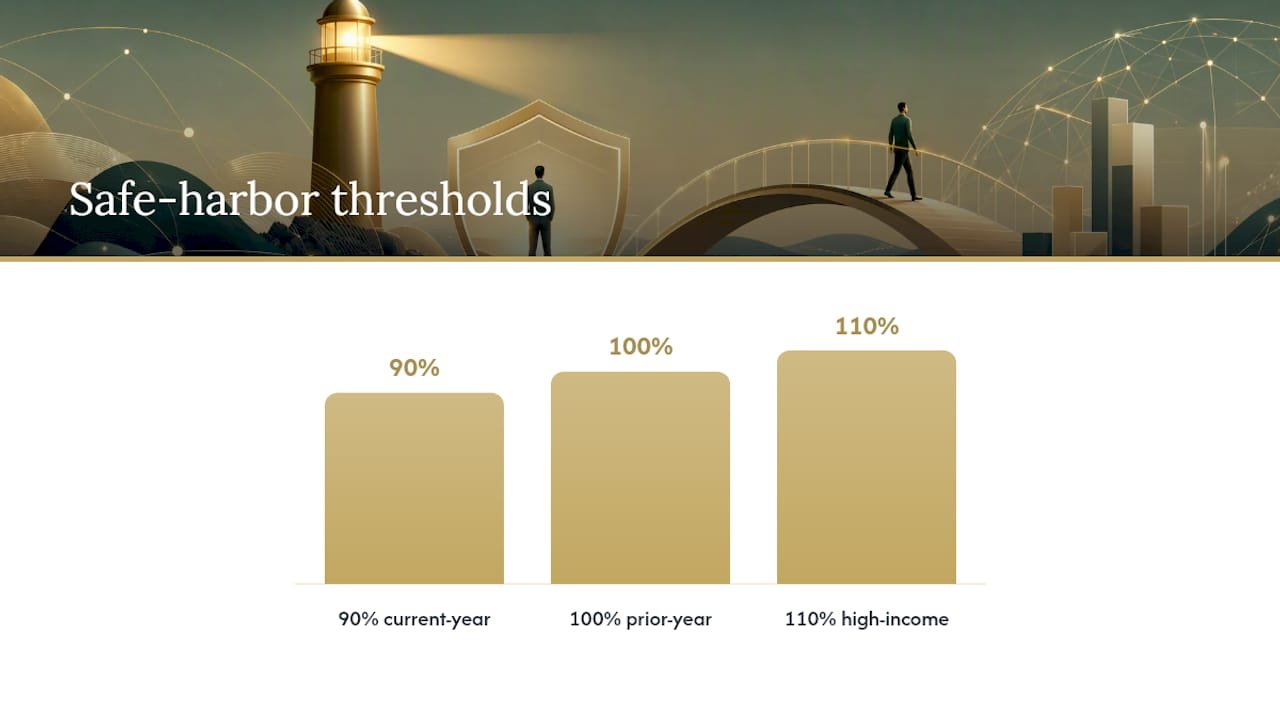
You generally avoid an underpayment penalty if you pay at least 90% of your 2026 tax bill or 100% of your 2025 tax bill, whichever is smaller. If your 2025 adjusted gross income topped $150,000, that prior-year test rises to 110%. Withholding and estimated payments both count toward these numbers, and if you owe less than a threshold amount below which the penalty does not apply after withholding, penalty rules may not apply.
TL;DR:
- Paying at least 90% of this year’s estimated tax or 100% of last year’s tax (110% if high income) generally prevents penalties, but thresholds increase with income.
- Most self-employed taxpayers must use the annualized income method to avoid penalties from uneven income, unlike wage earners who rely on withholding.
- Payments are due quarterly with specific dates in April, June, September, and January, with options to pay via bank transfer, check, or by adjusting withholding.
- Large capital gains late in the year or seasonal income can trigger penalties unless Schedule AI is used to match payments to actual income receipt.
- A professional tax service can help track actual income against safe harbor thresholds and reduce the risk of penalties through careful planning.
Table of Contents
- What Is the Estimated Tax Safe Harbor and Why Does It Matter
- Safe Harbor Rules and Exceptions in Detail
- Payment Due Dates and How to Pay Your Estimated Tax
- Annualized Income Installment Method: When It Helps and How to Use It
- Penalties, Waivers, and Responding to an IRS Notice
- Practical Compliance Steps to Avoid a Surprise Penalty
- The Kelliworks Perspective on Preventing Underpayment Penalties
- How Safe Harbor Rules Differ for the Self-Employed vs. Wage Earners
- Does the Alternative Minimum Tax Change Your Safe Harbor Math
- Real Examples of the Safe Harbor Rule Preventing a Penalty
- A Balanced Approach to Safe Harbor Planning
- Let Kelliworks Handle Your Estimated Tax Planning
- Where to Verify These Rules Directly
- Sources
- FAQ
What Is the Estimated Tax Safe Harbor and Why Does It Matter
The estimated tax safe harbor is the IRS rule that protects you from an underpayment penalty even if your final tax bill comes in higher than expected. It works like an insurance policy for your cash flow. Pay enough during the year to satisfy one of the two thresholds, and the IRS leaves you alone even if you end up owing a large balance on April 15.
This matters most for people whose income doesn’t arrive in neat, predictable paychecks. Freelancers, sole proprietors, landlords, and anyone with a big capital gain or bonus year face a real risk of guessing wrong on their tax liability. Without a safe harbor to lean on, you’d have to predict your exact tax bill months before the year even ends, an impossible task for most self-employed people.
The IRS’s estimated tax guidance treats withholding and quarterly payments the same way for safe harbor purposes. That flexibility is the whole point. You don’t need to nail your numbers precisely. You just need to hit one of two thresholds, and the system gives you room to be wrong about the rest.
Safe Harbor Rules and Exceptions in Detail
The math behind the estimated tax safe harbor comes down to a “smaller of” comparison. You’re protected from a penalty if you pay in at least the lesser of these two amounts:
- 90% of the tax you’ll owe for the current year (2026)
- 100% of the tax you owed for the prior year (2025), or 110% if your 2025 AGI exceeded a high income threshold for filing separately
Here’s why that matters in practice. Say your prior-year tax liability was a certain amount and your income jumped significantly in 2026. Paying in that prior-year amount through withholding and estimated payments this year protects you completely if your AGI was below the high-income threshold, regardless of what you actually owe when you file.
Most tax professionals lean toward the prior-year test specifically because it removes the guesswork. You already know last year’s number.
Two narrower exceptions round out the rules. Farmers and fishermen who earn a large portion of their gross income from those activities only need to pay a reduced percentage of their current-year tax, with special filing options detailed in Form 1040-ES. And if you owe less than a threshold amount below which the penalty does not apply after subtracting withholding and credits, the entire safe harbor question is moot. No penalty applies regardless of your payment pattern.
Payment Due Dates and How to Pay Your Estimated Tax
The IRS splits estimated tax into four payments tied to specific income periods rather than even calendar quarters. For 2026, the due dates are:
- mid-April 2026 — covers income earned January through March
- June 15, 2026 — covers income earned April and May
- September 15, 2026 — covers income earned June through August
- January 15, 2027 — covers income earned September through December
You have several ways to send a payment. IRS Direct Pay and the Electronic Federal Tax Payment System (EFTPS) both let you pay straight from a bank account at no cost, while debit or credit card payments go through a third-party processor that charges a fee. If you’d rather mail a check, Form 1040-ES includes payment vouchers for that purpose.
Fiscal-year filers shift these dates to match their own tax year, and farmers or fishermen who qualify for the 66 2/3% rule can skip straight to a single payment by January 15 instead of paying quarterly.
Annualized Income Installment Method: When It Helps and How to Use It
If your income arrives in lumps rather than a steady stream, paying equal quarterly installments can leave you penalized even when your total payments were adequate for the year. That’s the exact problem the annualized income installment method solves. Filed as Schedule AI on Form 2210, it lets you match each required payment to when you actually earned the income, rather than assuming a flat one-fourth of your annual liability every quarter.
This approach helps in a few specific situations:
- Seasonal businesses that earn most of their revenue in a few months
- A large capital gain or bonus that lands late in the year
- Freelancers with wildly uneven month-to-month billing
Without annualizing, that owner would face a penalty for underpaying the April installment, even though total payments for the year were sufficient. Schedule AI recalculates each period’s requirement based on income actually received, erasing that mismatch.
Pro Tip: Run the annualized calculation even if you’re not sure it will help. It only ever reduces or eliminates a penalty, never increases one, so there’s no downside to checking.
Filing Form 2210 is mandatory if you use Schedule AI or request a penalty waiver. Skip it, and the IRS will simply calculate the penalty using the standard even-quarterly assumption.
Penalties, Waivers, and Responding to an IRS Notice
The IRS calculates the underpayment penalty using a rate tied to the federal short-term interest rate, applied separately to each installment period you fell short. In most cases, you don’t need to compute this yourself: the IRS runs the numbers when you file and sends a bill if a penalty applies.
You can still avoid or reduce that penalty through a waiver in several situations:
- Casualty, disaster, or other unusual circumstances beyond your control
- Retirement after age 62 or disability, if the underpayment resulted from reasonable cause and wasn’t willful neglect
- Federally declared disaster areas, where the IRS often applies relief automatically without a separate request
File Form 2210 when you want the IRS to compute the penalty using the annualized method, or when you’re requesting a waiver, and attach a written explanation with supporting documentation. If a notice arrives before you’ve taken any of these steps, you have three real options: pay the amount billed, request penalty abatement with reasonable-cause evidence, or file an amended Form 2210 if you believe the IRS miscalculated.
Practical Compliance Steps to Avoid a Surprise Penalty
Meeting the estimated tax safe harbor isn’t about a single smart move in December. It’s about a handful of habits that keep you from getting blindsided.
- Reconcile your books monthly. A running total of income and expenses lets you project your tax liability with real numbers instead of a year-end guess.
- Increase your paycheck withholding. If you or a spouse has a W-2 job, adjusting Form W-4 is often the simplest safe harbor strategy available, since withholding counts as if paid evenly across the year even if you only adjust it in November.
- Pace your payments to match your income. A late-year windfall can be handled by boosting the next quarterly payment, increasing withholding for the rest of the year, or filing Schedule AI if the income truly arrived unevenly.
- Document everything. If you ever need to claim reasonable cause for a waiver, dated records of the disaster, illness, or unusual event will matter far more than a verbal explanation.
Pro Tip: Treat your quarterly estimate like a bill you can’t skip, not a suggestion. The taxpayers who get hit hardest are usually the ones who felt “on track” without ever running the actual numbers.
If your return involves multiple income streams, a high AGI, or a large one-time gain, the math above stops being a quick mental check and starts being a real planning exercise. That’s when tax preparation support earns its cost many times over.
The Kelliworks Perspective on Preventing Underpayment Penalties
We work with small business owners who are usually managing five priorities at once, and estimated tax planning rarely makes the top three until a penalty notice forces the issue. Our approach centers on catching the problem months before it becomes one.
Through monthly bookkeeping and rolling tax projections, we track your actual numbers against the safe harbor thresholds throughout the year rather than reconstructing everything in March.
Handling this yourself makes sense if your income is stable and your prior-year numbers are a reliable guide. It stops making sense once you’re juggling irregular freelance income, a business with seasonal swings, or a year with a major capital gain. At that point, the hours spent second-guessing your own math usually cost more than having a bookkeeping team handle the projections for you.
How Safe Harbor Rules Differ for the Self-Employed vs. Wage Earners
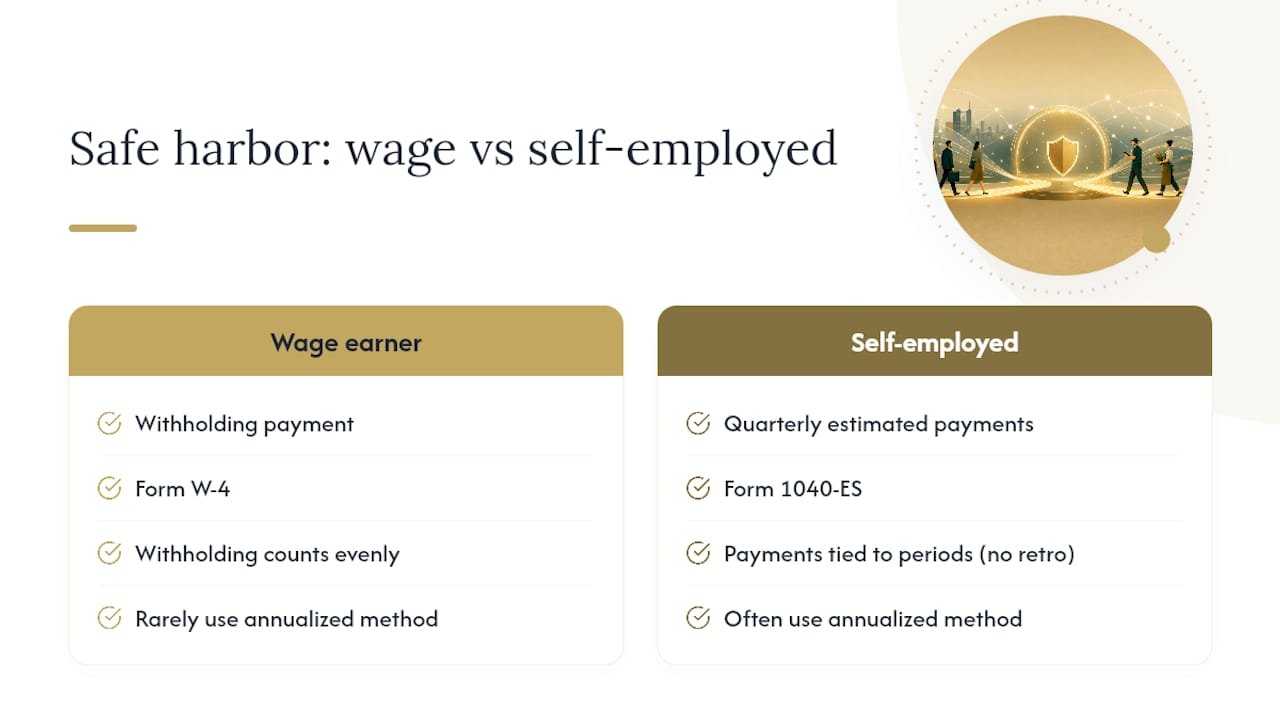
Wage earners have a built-in advantage: withholding. Every paycheck automatically sends money to the IRS, and that withholding counts as if it were paid evenly throughout the year no matter when it was actually withheld. A W-2 employee who realizes in November that they’re under withheld can adjust Form W-4 for the last few paychecks of the year and retroactively cover the whole year’s safe harbor requirement.
Self-employed taxpayers don’t have that luxury. Without an employer withholding on your behalf, you’re responsible for sending in your own quarterly payments through Form 1040-ES, and a payment made in November does not retroactively cover an April shortfall the way withholding does. Miss the June installment because a big invoice hadn’t cleared yet, and you can owe a penalty for that period even if your total payments for the year are more than adequate.
This is precisely why the annualized income installment method exists, and why self-employed people use it far more often than salaried workers. It’s also why many freelancers keep a part-time W-2 spouse’s withholding dialed up as a backstop. Since withholding from either spouse on a joint return counts toward the household’s total safe harbor requirement, a spouse’s paycheck can quietly absorb a freelancer’s uneven income swings.
The self-employed also face a second complication wage earners rarely see: self-employment tax.
Does the Alternative Minimum Tax Change Your Safe Harbor Math
The alternative minimum tax (AMT) doesn’t create a separate safe harbor system.
Here’s where it trips people up. If you exercised incentive stock options, claimed large state and local tax deductions, or had significant miscellaneous deductions in a prior year, your prior-year tax liability may include an AMT component you didn’t expect.
The bigger risk runs the other direction. Someone who exercises a large batch of incentive stock options mid-year can trigger AMT liability that dramatically exceeds their regular tax, and that AMT hit typically doesn’t show up in ordinary withholding calculations at all.
If you’ve had stock option activity, large itemized deductions, or other AMT triggers in either the current or prior year, run your safe harbor calculation using your total tax liability, including any AMT, rather than just your regular tax. This is one of the more common blind spots in Schedule AI planning too, since annualizing income without annualizing the AMT calculation alongside it can understate what you actually owe for a given period.
Real Examples of the Safe Harbor Rule Preventing a Penalty
A freelance graphic designer with $20,000 in prior-year tax liability lands a major rebranding contract that doubles her income in 2026. Her actual tax liability jumps to $34,000.
She falls $4,500 short and owes a penalty on that gap, despite believing she’d covered herself completely. This is one of the most common errors among higher earners who haven’t updated their safe harbor math in a raise year.
A seasonal retail business owner earns almost nothing in the first quarter and the bulk of her income between October and December. Paying flat quarterly installments based on one-fourth of her prior-year liability would create an apparent underpayment in the early quarters. By filing Schedule AI, she matches each installment to when the income actually arrived, and the penalty on those early “underpaid” quarters disappears entirely.
Each of these examples turns on the same principle: the safe harbor doesn’t ask you to predict the future accurately. It asks you to hit a specific, calculable number, and the taxpayers who avoid penalties are the ones who know which number applies to them.
A Balanced Approach to Safe Harbor Planning
I lean toward the prior-year safe harbor whenever a client’s income is reasonably stable. Known numbers beat forecasts every time, and forecasting current-year income is where most underpayment penalties actually originate. For anyone with lumpy or growing income, though, I’d rather see them annualize or raise withholding than gamble on a flat quarterly guess. One more thing worth checking: your state may set its own safe harbor thresholds that don’t mirror the federal rules, so confirm both before you assume you’re covered.
— Kelli
Let Kelliworks Handle Your Estimated Tax Planning
A professional accounting service can be an alternative to guessing at your quarterly numbers alone: instead of reconstructing your tax picture from memory every April, tracking it monthly and flagging safe harbor risk while there’s still time to fix it can be beneficial.

If you’re a small business owner or self-employed professional who has ever been surprised by a penalty notice, that’s exactly the gap our services close. A few starting points:
- Tax preparation for filing, projections, and safe harbor calculations tailored to your income pattern
- Monthly accounting and bookkeeping to keep your numbers current instead of reconstructed at year-end
- Business financial planning to build a payment schedule around irregular income
This is a paid engagement, not a free calculator. What you get for it is a real projection built from your actual books and a payment plan designed around how your income actually arrives. If a penalty notice or a stressful April is what you’re trying to avoid next year, book time with our tax team now, while there are still enough quarters left to make a difference.
Where to Verify These Rules Directly
Every threshold and form referenced here comes straight from IRS primary sources, and it’s worth bookmarking them:
- Form 1040-ES — worksheets and vouchers for calculating and paying estimated tax
- Form 2210 — penalty computation, waiver requests, and Schedule AI
- Publication 505 — detailed rules on withholding, estimated tax, and penalty waivers
- The IRS Tax Withholding Estimator helps you check whether your current withholding is on pace to meet the safe harbor.
This article is general information, not a substitute for advice from a qualified financial advisor. Consult a qualified financial professional about your own circumstances before acting on anything here.
Sources
FAQ
Does withholding count toward the safe harbor, or only quarterly payments?
Withholding counts fully toward the safe harbor and is treated as if paid evenly throughout the year, which makes it one of the simplest ways to meet the threshold without tracking quarterly deadlines.
How does Form 2210 work if I think I owe a penalty?
Form 2210 calculates whether you owe an underpayment penalty, lets you request a waiver for reasonable cause, and is required if you use the annualized income installment method through Schedule AI.
Do state estimated tax safe harbor rules match the federal rules?
Not necessarily.


