


Calculate your fully loaded break-even cost first, then set prices using a value-informed model wrapped in clear packages, and test before you commit. Most service businesses do best with hourly, retainer, or value-based billing depending on how predictable the work is. The workflow below walks through the math, the model choice, the packaging, and the review cadence so you can price with confidence instead of guesswork.
TL;DR:
- Well-structured pricing models align with the nature of the work, such as retainer for ongoing projects or project-based pricing for defined deliverables.
- Calculating fully loaded break-even costs, including direct labor, overhead, and nonbillable time, is essential to set sustainable rates and avoid underpricing.
- Using tiered packages with clear scope controls helps clients understand options and protects margins by preventing scope creep.
- Regularly testing prices, reviewing margins, and tracking key metrics enables adaptive pricing that reflects costs, market changes, and business growth.
- Applying psychological techniques like anchoring and bundling can influence client perception, but transparency and clear scope maintain trust and profitability.
Table of Contents
- Overview: pricing strategy families and service billing models
- Calculate costs and break-even for services (formulas + example)
- How to choose a pricing strategy and model for your service business
- Packaging, tiering, and scope control to make offers shoppable and profitable
- Value-based pricing for services: capture outcome value without overpromising
- Test, measure, and govern pricing: metrics and lightweight experiments
- Common pitfalls and an anti-underpricing checklist
- Practitioner note from Kelli (KelliWorks): accounting and forecasting that make pricing reliable
- Strategies for handling discounts, promotions, and negotiation in service pricing
- Psychological pricing techniques and their application to service pricing
- Adapting pricing strategies over time to reflect market changes and business growth
- Author perspective: pricing as a recurring capability
- How KelliWorks supports pricing built on real numbers
- Sources
- FAQ
Overview: pricing strategy families and service billing models
Pricing strategy and pricing model are two different decisions. Strategy is the philosophy behind the number, cost-plus, competitive, value-based, penetration, or price-skimming. Model is how you collect that number: hourly, project, retainer, subscription, or usage.
Cost-plus adds a margin on top of your costs and works best when costs are stable and easy to track, like routine bookkeeping. Competitive pricing anchors to what similar providers charge in your market and suits commoditized work where clients compare quotes side by side. Value-based pricing sets fees according to the outcome you deliver rather than the hours it takes, and it fits consulting, tax strategy, or any service where the result is worth far more than the labor behind it. Penetration pricing means entering a market low to build a client base quickly, a common move for new practices that need case studies and referrals. Price-skimming does the opposite, charging a premium early while demand and reputation are still building, then adjusting as competitors catch up.
Billing models translate strategy into an invoice:
- Hourly: best for unpredictable scope, like ad hoc IT support or legal research, but it punishes efficiency because faster work earns less.
- Project or flat fee: works when deliverables are well defined, such as a website build or a tax return, and it rewards speed.
- Retainer: suits ongoing relationships, like monthly bookkeeping or fractional consulting, and creates predictable revenue for both sides.
- Subscription: fits standardized, recurring services, such as software-adjacent support or compliance monitoring, and scales well once the delivery process is repeatable.
- Usage-based: charges according to volume, like transactions processed or tickets closed, and aligns cost with actual consumption.
- Hybrid: combines a base retainer with usage or project add-ons, common in accounting firms that charge a monthly fee plus a per-payroll-run rate.
A management consultant advising on a merger will usually price by value, because the financial stakes dwarf the hours worked. A plumber quoting a bathroom remodel will price by project, because the client wants one number, not a running clock. A bookkeeper managing monthly reconciliations will price by retainer, because the work repeats every month at a similar volume. Matching the model to the nature of the work, not just copying what a competitor does, is what keeps margins healthy. Salesforce research on pricing-model taxonomy notes that fit between model and customer expectation matters as much as the price itself.
Calculate costs and break-even for services (formulas + example)
Before you set a single rate, you need to know what an hour, a client, or a project actually costs you to deliver. Skipping this step is the single biggest reason service businesses underprice.
Start by listing every cost tied to delivery, not just the obvious ones:
- Direct labor, including your own salary equivalent, not just staff wages.
- Nonbillable time, such as proposal writing, client meetings that don’t get billed, and internal training.
- Overhead, covering software subscriptions, insurance, rent, and administrative support.
- Contractor or subcontractor fees for any outsourced portion of delivery.
- Payment processing and collection costs, including card fees and the time spent chasing late invoices.
Once you have those figures, the U.S. Small Business Administration’s break-even guidance lays out two formulas. Break-even units equal fixed costs divided by the sales price per unit minus the variable cost per unit. Break-even sales dollars equal fixed costs divided by your contribution margin, which is the percentage of each sale left over after variable costs. For a service business, the “unit” is whatever you bill against: a billable hour, a client-month, or a completed project.
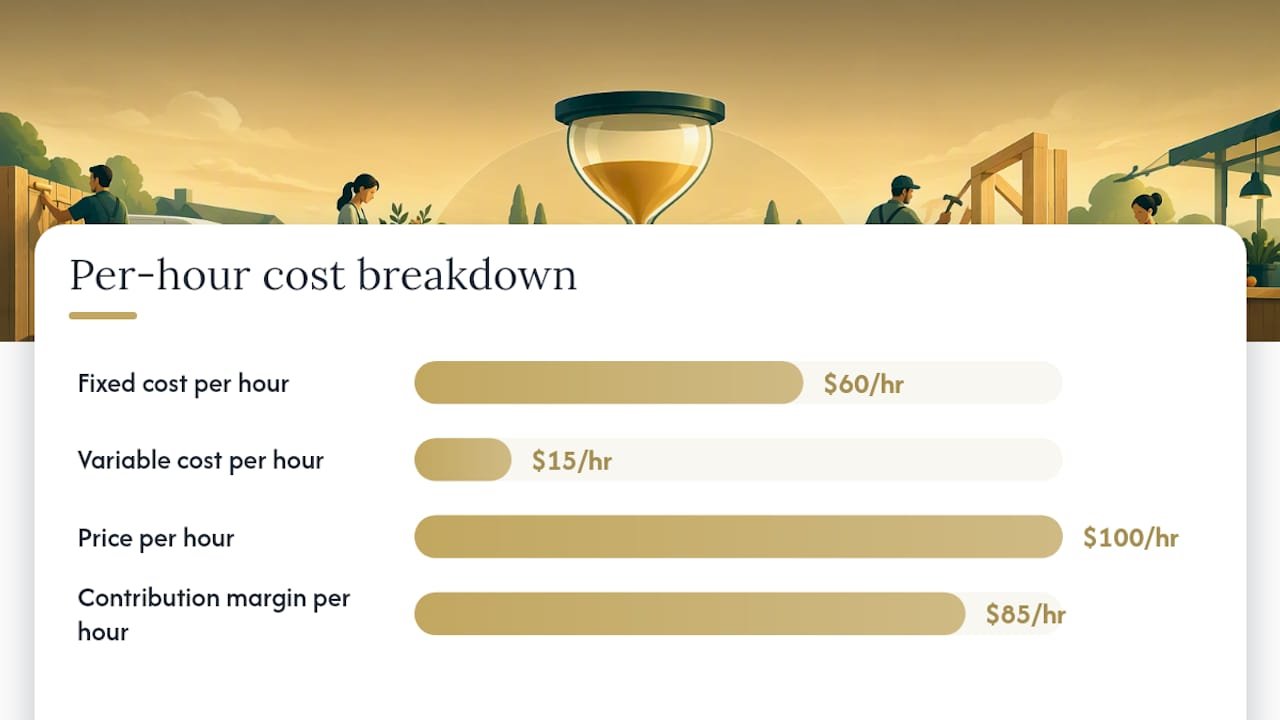
Worked example: say a solo consultant has $60,000 in annual fixed costs (software, insurance, marketing, a share of rent) and expects to bill 1,000 hours a year after accounting for nonbillable time. The fixed cost per billable hour is $60. If variable costs, mainly a subcontractor rate for overflow work, run $15 per hour, the contribution margin per hour is the price minus $15. To break even at a $100 hourly rate, contribution margin is $85, so break-even units equal $60,000 divided by $85, or about 706 billable hours. Anything billed beyond that point contributes to profit. Run the same math for a flat project fee by treating the whole project as one unit and estimating the hours it will actually consume, including revisions.
Reproducible break-even math is the floor, not the price. A published framework for calculating break-even units and break-even sales dollars gives you the minimum you must charge to avoid losing money, before you layer on profit margin and value pricing.
Spreadsheet templates make this easier to maintain month over month, and a profit analysis tool built for entrepreneurs can help you track break-even alongside realized margin once you’re billing clients.
How to choose a pricing strategy and model for your service business
Choosing a strategy starts with four questions, often called the 4 Cs: cost, customer value, competition, and company objectives. Cost sets your floor. Customer value sets your ceiling, based on what the outcome is worth to the client. Competition tells you what buyers currently expect to pay for similar work, and the SBA’s guidance on planning your business recommends identifying competitors by service line and researching what customers already pay for alternatives before you settle on a number. Company objectives, whether you’re chasing growth, stability, or premium positioning, determine which end of the value range you aim for.
A practical workflow ties these together:
- Define your ideal client and the outcome they want, not just the task you’ll perform.
- Segment clients by moment of need, since a business in crisis will pay more urgently than one planning ahead.
- Map one or two models to that segment, choosing retainer for steady relationships or project pricing for one-off work.
- Set a primary model with ancillary options, like a base retainer plus hourly overflow for scope that exceeds the plan.
Segmenting by moment of need is echoed in L.E.K. Consulting’s services-pricing research, which found that productizing common use cases into shoppable packages reduces friction and improves conversion.
For most small service businesses, a hybrid default works well: a retainer or subscription base for predictable work, with hourly or project rates for anything outside scope. This protects cash flow while leaving room to charge properly for exceptions.
Pro Tip: Before you finalize a model, ask three recent clients what almost stopped them from hiring you, price objections often reveal which model would have felt easier to say yes to.
Packaging, tiering, and scope control to make offers shoppable and profitable
Turning a service into a menu of clear packages does two things: it removes the friction of custom quoting, and it nudges buyers toward the option that protects your margin best. A good/better/best structure typically works better than a single price, because it gives clients a frame of reference and a reason to upgrade.
Build three tiers around deliverables, not just price points. The entry tier covers the core outcome with minimal customization. The middle tier, usually the one most clients choose, adds faster turnaround or an extra deliverable. The top tier bundles premium access, like direct calls or priority scheduling, at a meaningfully higher price.
Example structures across service types:
- Consulting: a diagnostic session alone, a diagnostic plus a written action plan, or a diagnostic plus plan plus a 90-day implementation retainer.
- Bookkeeping: monthly reconciliation only, reconciliation plus monthly reporting, or reconciliation plus reporting plus quarterly tax planning check-ins.
- Trade services: a basic repair call, repair plus a parts warranty, or repair plus warranty plus a maintenance plan for the year ahead.
Scope creep is what turns a profitable package into a loss leader, so every tier needs a scope-control checklist attached to the quote:
- List deliverables explicitly, naming what’s included rather than assuming it’s understood.
- State assumptions, such as expected response times from the client or the condition of existing records.
- Name exclusions, so clients know what triggers an additional charge.
- Define a change-order process, with a clear rate for work outside the original scope.
- Attach a service-level agreement where relevant, covering turnaround time and communication expectations.
Bundling related services, like pairing bookkeeping with tax preparation and filing, also raises average revenue per client without requiring new customer acquisition. A comparison of accounting service pricing structures walks through how small firms typically build these tiers for financial services specifically.
Value-based pricing for services: capture outcome value without overpromising
Value-based pricing sets your fee according to what the client gains, not how many hours the work took. It works best when the outcome is measurable: revenue generated, time saved, or risk avoided. A tax strategy that saves a client $40,000 a year justifies a fee well above what the hours alone would suggest, because the client is paying for the result, not the labor.
Hinge Marketing’s research on professional services found that value-based pricing depends on clearly explaining the business outcome to the client, and that scope control is the operational safeguard that keeps the model profitable rather than exposing you to unlimited effort for a fixed fee.
A few quoting formats make this practical:
- Range-based quotes, presenting a low and high fee tied to the complexity of the client’s situation.
- Fixed fee plus success fee, where a base covers your time and a bonus rewards a defined outcome.
- Shared-savings arrangements, where your fee is a percentage of quantifiable savings, common in cost-reduction consulting.
To pilot a value-based price without inviting disputes, agree on the KPIs before work begins and set a measurement window, thirty, sixty, or ninety days, so both sides know exactly how success will be judged. Vague promises about “growth” or “efficiency” invite arguments later. A specific, written metric, tied to a specific date, protects both the client relationship and your invoice.
Test, measure, and govern pricing: metrics and lightweight experiments
Pricing isn’t a decision you make once and forget. Bank of America’s small-business guidance recommends testing prices and reviewing realized margin and customer feedback regularly rather than setting a rate and walking away from it.
Track a short list of metrics consistently:
- Realized margin by service line, comparing quoted price to actual delivery cost.
- Average fee per client or project, watched over time for drift.
- Close rate, the share of quotes that convert to signed work.
- Delivery hours versus estimate, flagging services that consistently run over.
- Price objections, logged by service so you know where resistance concentrates.
- Retention, since a price that’s too aggressive often shows up later as churn rather than an immediate objection.
Run small experiments rather than overhauling pricing all at once. Try presenting two price points on different landing pages to see which converts better, or offer a limited-time pilot price to a handful of new clients before rolling a change out broadly. Testing whether clients notice or choose the middle tier when it’s made more visually prominent is another low-risk way to learn what actually drives selection.
Governance matters as much as the testing itself. Assign one person, often the owner in a small business, to own the pricing cadence and review results quarterly. Document the rules you land on: which services use which model, when discounts are permitted, and who approves exceptions. Rafi Mohammed’s research on pricing argues that businesses leave revenue on the table by treating pricing as a one-time choice, and that a recurring review process is what turns pricing into a real management capability rather than a guess made once and never revisited.
Retention deserves particular attention here, since a growth marketing guide on customer retention points out that small shifts in how pricing feels to a client can move retention more than the price itself.
Common pitfalls and an anti-underpricing checklist
Most underpricing comes from a handful of repeat mistakes. Ignoring nonbillable time is the most common: if you only count hours spent directly on client work, you’ll set a rate too low to cover proposal writing, admin, and training. Fuzzy scope is a close second, since vague deliverables invite endless small requests that never get billed. A habit of discounting to win deals trains clients to expect a lower number every time, and misreading competitor pricing, often based on outdated or incomplete information, can anchor your rates below what the market will actually bear.
Run this checklist before sending any quote:
- Confirm the scope is written down, not just discussed verbally.
- Check the quote against your break-even calculation for that service.
- Compare the fee to your last three similar engagements for consistency.
- Identify exclusions and the change-order rate before the client asks.
- Decide your walk-away price before the conversation starts, not during it.
When a client pushes back on price, a short script helps you hold the line without sounding defensive: “This fee reflects the scope we outlined, if we need to adjust the price, we’d need to adjust what’s included.” That reframes the conversation around scope rather than turning it into a negotiation over your worth.
Pro Tip: Never discount the listed price, instead remove a deliverable, a discount trains the client to wait for one next time, while a smaller scope preserves your rate.
Practitioner note from Kelli (KelliWorks): accounting and forecasting that make pricing reliable
Pricing decisions are only as good as the numbers behind them, and that’s where consistent bookkeeping earns its keep. A clean profit and loss statement broken out by service line shows you which offerings actually carry your margin and which ones quietly drain it. Utilization reports reveal your real billable capacity, not the optimistic number you assumed when you set your rates. Cash-flow runway tells you how much room you have to test a lower introductory price without risking the business, and realized margin, tracked monthly, shows whether your quotes are holding up against what delivery actually costs.
Bookkeeping and consulting engagements can produce these reports, so pricing decisions rest on current numbers rather than a spreadsheet built once and forgotten. Every pricing exercise benefits from four outputs before it’s trustworthy: profit and loss by service, a utilization report, a cash-flow runway estimate, and realized margin by client or project. If you’re preparing for a conversation about your numbers, our guide to preparing for a financial consulting meeting walks through what to gather beforehand.
— Kelli
Strategies for handling discounts, promotions, and negotiation in service pricing
Discounts should be the exception, not the default response to hesitation. When a client asks for a lower rate, the better move is trading scope for price rather than cutting the number outright, offering fewer deliverables at the discounted rate instead of the full package at a reduced fee.
Promotions work best when they’re time-bound and tied to a specific reason, like a launch period for a new service line or a limited number of pilot spots. Open-ended promotions tend to become the expected price rather than a special one.
Negotiation goes more smoothly when you’ve already decided your floor before the conversation starts. If a prospect compares you to a cheaper competitor, resist matching the number and instead ask what’s driving the comparison, often it’s scope, not just price, and that opens room to adjust the package rather than the rate. Reserve real discounts for genuine volume commitments, like a multi-month retainer paid upfront, where the trade-off benefits your cash flow enough to justify the lower rate. Document every negotiated exception so you can review, at your regular pricing check-in, whether exceptions are becoming the rule.
Psychological pricing techniques and their application to service pricing
Psychological pricing shapes how a price feels, not just what it costs. Charm pricing, ending a fee at $997 instead of $1,000, remains common in service marketing, though its effect is stronger for lower-cost, self-service offerings than for high-trust professional engagements, where a round number can actually read as more confident.
Anchoring is one of the more useful techniques for service businesses: presenting your highest tier first makes the middle option look reasonable by comparison, which is part of why good/better/best structures convert better than a single quoted price. Framing a fee as a monthly retainer rather than a large annual lump sum can also make the same total cost feel more manageable, even though the client pays the same amount over a year.
Bundling leans on a similar principle, since a package priced as one number feels simpler to evaluate than a list of itemized charges, even when the itemized total would be the same. For service businesses in particular, use these techniques to clarify value and ease decision-making, not to obscure the real cost. A client who feels misled by a psychological pricing trick becomes a client who negotiates harder next time or leaves altogether.
Adapting pricing strategies over time to reflect market changes and business growth
A price that made sense two years ago rarely fits your business today. As your capacity fills, your prices should rise for new clients, since demand outpacing availability is a straightforward signal that you’re underpriced. As your reputation and case studies grow, you also earn the right to shift from competitive pricing toward value-based pricing, because prospects arrive with more trust already built.
Review pricing at least annually, and sooner if your costs shift meaningfully, a new hire, a software price increase, or added overhead all justify a look at whether your rates still cover your fully loaded costs. Existing clients don’t need to be surprised by an increase either: a short notice period and a clear reason, like added scope or rising costs, keeps the relationship intact while your rates catch up to your value.
Growth also changes which model fits best. A solo consultant billing hourly may outgrow that model entirely once demand supports a retainer or subscription structure, since predictable revenue makes it easier to hire and plan ahead. Treat every stage of growth as a prompt to revisit strategy and model together, not just the number itself.
Author perspective: pricing as a recurring capability
Pricing isn’t a form you fill out once when you launch. It’s a routine you return to as your costs shift, your reputation grows, and your capacity fills up. The businesses that struggle most with pricing usually aren’t undercharging because they’re generous, they’re undercharging because nobody’s revisited the number in a year or two.
In the next 90 days, I’d suggest two experiments: recalculate your break-even with actual nonbillable hours from the last quarter, not an estimate, and test a good/better/best structure on your next five quotes to see which tier clients actually choose. Both are small enough to run without disrupting your business, and both will tell you more than another hour spent guessing at a number.
— Kelli
How KelliWorks supports pricing built on real numbers
Setting a defensible price depends on knowing your real costs, your true capacity, and your margin by service line, and that’s essential groundwork for pricing decisions. If building and maintaining that financial picture isn’t where you want to spend your time, outsourcing the accounting side is a reasonable alternative to building it yourself.
Here’s what that looks like in practice:
- Bookkeeping and reporting that surface profit and loss by service, so you know which offerings actually carry your margin.
- Cash-flow forecasting that shows how much room you have to test a new price or a promotional period.
- Business consulting that reviews your pricing structure alongside your broader financial picture, not in isolation.
This is one route among several, useful if you’d rather have a team maintain the numbers behind your pricing decisions than build the spreadsheets yourself. You can explore our accounting and bookkeeping services or book a consultation to talk through where your pricing stands today.
Sources
- U.S. Small Business Administration — Plan your business
- U.S. Small Business Administration — Calculate your break-even point
FAQ
What are the five main pricing strategies?
The commonly cited pricing strategies are cost-plus, competitive, value-based, penetration, and price-skimming. Each reflects a different philosophy: cost-plus starts from your expenses, competitive starts from the market, value-based starts from client outcomes, and penetration and skimming set an entry price deliberately low or high to shape early demand.
What are the 7 types of pricing strategies?
Definitions vary across sources, but a common expanded list adds premium pricing, bundle pricing, and dynamic pricing to the five core strategies above. For service businesses specifically, the billing model, hourly, project, retainer, subscription, or usage-based, matters as much as which strategy you choose.
What are the 5 C’s of pricing?
Some frameworks reference five Cs (cost, customer, competition, channel, and company), though the version most directly useful for service pricing is the 4 Cs: cost, customer value, competition, and company objectives. Those four inputs, drawn from SBA guidance on pricing research, give you a floor, a ceiling, a market check, and a strategic direction.
What are the four main pricing strategies?
The four most frequently cited are cost-plus, competitive, value-based, and premium pricing. For a service business, the right choice usually depends on how measurable the outcome is: predictable, low-differentiation work tends to suit cost-plus or competitive pricing, while outcome-driven consulting or specialized expertise supports value-based or premium pricing.
How do I know if I’m underpricing my services?
A quick sign is comparing your quoted rate to your fully loaded break-even cost, calculated using the SBA’s break-even formula, including nonbillable time and overhead. If your realized margin after delivery consistently falls short of what you quoted, or you’re fully booked with no room to raise prices for new clients, those are both practical signals that you’re underpriced.