


Bank reconciliation is the process of matching your ledger’s cash balance to the bank statement so the adjusted balances are identical. Start by pulling your latest bank statement and your cash ledger or transaction list for the same period. Most small businesses reconcile monthly, and that habit alone catches errors before they snowball.
TL;DR:
- Most small businesses should reconcile their bank accounts monthly to catch errors early and maintain accurate cash records.
- Differences between bank statements and ledgers primarily stem from timing issues, bank fees, interest, NSF charges, or errors that require specific journal entries.
- Proper reconciliation involves comparing and adjusting both sides for items like deposits in transit, outstanding checks, fees, interest, and correcting mistakes at their source.
- Moving to weekly or daily reconciliation improves error detection and fraud prevention for high-transaction or cash-intensive businesses.
- Maintaining organized supporting documents and implementing internal controls ensures reconciliation accuracy and supports tax and legal compliance.
Table of Contents
- What bank reconciliation means and why it matters for your business
- Step-by-step bank reconciliation process you can follow now
- Common reconciliation items and how to record them in your books
- How often to reconcile and how to choose the right frequency
- Troubleshooting checklist when the reconciliation doesn’t balance
- Internal controls and best practices to make reconciliations reliable
- Short numeric example: make a bank reconciliation from start to finish
- How reconciliation supports bookkeeping and tax records
- Practitioner perspective: Kelli on making bank reconciliations painless
- How KelliWorks can help with reconciliations
- Sources
- FAQ
What bank reconciliation means and why it matters for your business
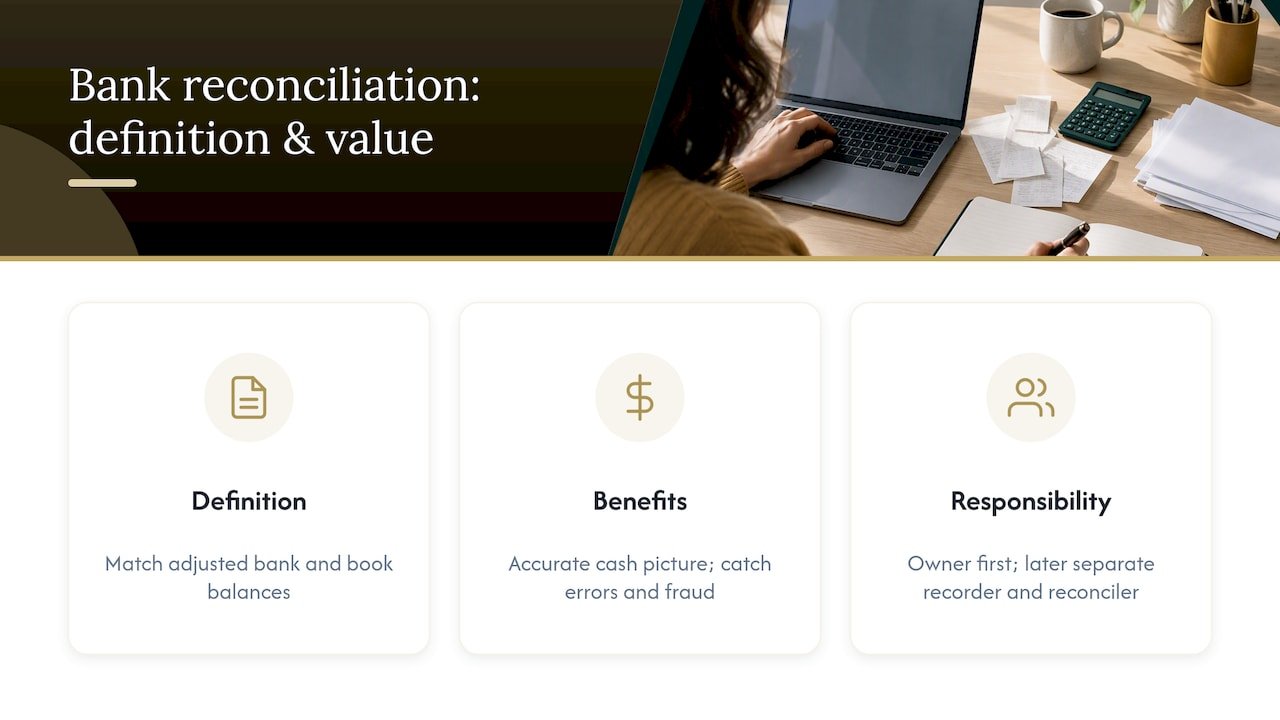
At its core, bank reconciliation confirms that your adjusted bank balance equals your adjusted book balance, according to AccountingCoach’s explanation. You start with two numbers that rarely match on day one: what the bank says you have, and what your ledger says you have. Timing differences and unrecorded items explain most of the gap.
The benefits go beyond tidy bookkeeping. A clean reconciliation gives you an accurate cash picture, which matters when you’re deciding whether to make payroll or take on a new client. It also catches errors and fraud early, before a small mistake becomes a real loss. When tax season arrives, reconciled books mean your reported income and expenses actually hold up.
Who should be doing this? In a very small operation, the owner often reconciles the account personally or reviews the bookkeeper’s work each month. As the business grows, it makes sense to separate the person recording transactions from the person reconciling them, which is a basic control worth understanding if you’re deciding bookkeeping vs accounting responsibilities on your team. Either way, someone needs to look at the reconciliation and sign off on it, not just run it and file it.
Step-by-step bank reconciliation process you can follow now
Reconciling an account is a sequence, not a guessing game. Follow these steps in order and you’ll land on a matched balance every time.
-
Gather your documents. Pull the bank statement and your cash ledger or transaction export for the exact same date range.
-
Compare and mark cleared items. Check off every deposit and payment that appears on both the statement and your ledger.
-
List timing differences. Note deposits in transit (money you’ve recorded but the bank hasn’t posted yet) and outstanding checks (checks you’ve written that haven’t cleared).
-
Prepare the bank-side adjustment. Add deposits in transit to the statement balance and subtract outstanding checks to get your adjusted bank balance.
-
Prepare the book-side adjustment. Add any unrecorded interest or credits, then subtract bank fees, NSF charges, or other withdrawals you hadn’t yet logged.
-
Post journal entries and confirm. Record the book-side items in your ledger, then verify that your adjusted bank balance equals your adjusted book balance.
A few things to keep straight as you work through this:
- Deposits in transit and outstanding checks are timing differences only, so they usually don’t need a journal entry on your side.
- Bank fees, interest, and NSF items already happened in the bank’s system, so your books need a journal entry to catch up.
- Any bank or book error should be traced back to whoever made it and corrected at the source, not patched over.
This same five-step sequence appears in university procedural guides, which recommend comparing items first, completing both sides of the adjustment, confirming the match, then posting entries last. That order matters because posting too early, before you’ve found every difference, tends to create duplicate or incomplete entries.
Pro Tip: Before you post a single journal entry, finish listing every difference you can find. Posting piecemeal is how duplicate entries sneak into your books.
Once you’ve confirmed the adjusted balances match, file your worksheet with the statement and any supporting documents. That file becomes your evidence trail if a question ever comes up about a specific transaction, and it’s the difference between a reconciliation you can defend and one you’re just hoping is right.
Common reconciliation items and how to record them in your books
Most reconciliation differences fall into a handful of repeatable categories, and each one has a correct treatment.
- Deposits in transit and outstanding checks are timing only. You’ve already recorded them, so you typically don’t post a new entry, you just wait for the bank to catch up.
- Bank service charges and automatic withdrawals need a journal entry: debit an expense account and credit cash for the amount the bank already deducted.
- Interest earned and other bank credits get recorded as income: debit cash and credit interest income for the amount the bank added.
- NSF or returned checks get reversed: credit cash for the returned amount and debit accounts receivable if you still expect to collect from the customer.
- Bank or book errors get traced to the source. If the bank made the mistake, you flag it with them; if your ledger has the error, you correct your own entry.
The dividing line worth remembering: if a transaction is already sitting in your ledger and just hasn’t cleared the bank yet, it’s a timing item, not a journal entry. If the bank did something your ledger doesn’t know about yet, like charging a fee or crediting interest, that’s when you post an entry. Mixing up these two categories is the most common beginner mistake, and it’s usually what causes duplicate postings later.
How often to reconcile and how to choose the right frequency
Monthly reconciliation is the practical baseline for most small businesses, and it lines up with how banks issue statements. It’s frequent enough to catch problems early without becoming a daily chore.
That said, frequency should scale with risk. If you process a high volume of transactions, handle a lot of cash, or have staff who touch both the recording and payment side of your accounts, moving to weekly or even daily reconciliation gives you a much tighter window to catch errors or fraud. The IRS recordkeeping guidance points to the same idea: recording transactions as they happen and reconciling regularly keeps your records accurate and supportable, which matters both for day-to-day decisions and for tax time.
The frequency you choose also shapes how quickly you see problems. A business reconciling monthly might not spot a billing error for four weeks; one reconciling weekly catches it in days. If your cash flow is tight enough that a missed fee or an unexpected NSF charge could throw off a payment decision, more frequent reconciliation buys you visibility you can act on.
Troubleshooting checklist when the reconciliation doesn’t balance
When the numbers don’t match, work through the differences methodically instead of forcing a balance.
- Recheck the basics first. Confirm your opening balance and that both the statement and ledger cover the exact same date range.
- Look for duplicated or missing transactions. A transaction entered twice, or one that never made it into the ledger, is a common culprit.
- Check for transposed numbers. A $450 deposit entered as $540 will throw off your total by a suspiciously even amount, which is often a clue.
- Verify fees, NSF items, and auto-withdrawals. Confirm every bank-initiated charge appears in your books and every returned deposit has been reversed.
- Decide who needs to fix it. If the bank made an error, contact them directly; if it’s your ledger, correct the entry at its source.
Pro Tip: Never force a match with a plug entry. A number that “makes it balance” without an explanation is usually hiding a real error that will resurface later.
If you’ve worked through this list and the difference still won’t resolve, it’s worth stepping back and reviewing your records with a bookkeeper rather than guessing further.
Internal controls and best practices to make reconciliations reliable
Good controls turn reconciliation from a once-a-month scramble into a routine check that actually protects your business. According to the OCC’s Comptroller’s Handbook on internal control, timely reconciliations paired with independent review and segregation of duties are core defenses against fraud and error.

If you’re a solo operator, you can’t fully separate duties, but you can still review your own reconciliation critically each month rather than rubber-stamping it. Once you have staff, avoid letting the same person who records and pays transactions also be the one who reconciles the account. Keep your supporting documents organized: bank statements, deposit slips, and reconciliation worksheets filed by month, so anyone can trace an entry back to its source.
Software and bank feeds can speed up the matching process, but they shouldn’t replace human judgment on exceptions. A feed will flag an unmatched transaction; it won’t tell you why it’s unmatched. Finally, review your list of outstanding checks periodically. A check that’s been outstanding for months might be lost, voided, or need to be reissued, and letting stale items pile up makes every future reconciliation harder than it needs to be.
Short numeric example: make a bank reconciliation from start to finish
Say your bank statement shows a balance of $10,000 and your ledger shows $9,700 for the same period.
- Identify the timing differences: a $500 deposit in transit and $300 in outstanding checks.
- Adjust the bank side: $10,000 + $500 deposit in transit − $300 outstanding checks = $10,200 adjusted bank balance.
- Identify the book-side items: a $40 bank service fee and $540 in interest earned that haven’t been recorded yet.
- Adjust the book side: $9,700 − $40 fee + $540 interest = $10,200 adjusted book balance.
The journal entries you’d post for the book-side items:
- Debit Bank Fees Expense $40, credit Cash $40.
- Debit Cash $540, credit Interest Income $540.
Both adjusted balances land at $10,200, so the reconciliation is complete. This mirrors the standard approach AccountingCoach lays out: adjust the bank side for timing items, adjust the book side for unrecorded transactions, then confirm the two totals match. Copy this structure into your own worksheet, swap in your real numbers, and you have a repeatable process for every future period.
How reconciliation supports bookkeeping and tax records
A reconciled cash balance is the foundation everything else gets built on. Your income statement, balance sheet, and tax return all depend on cash figures that have actually been checked against the bank, not just assumed correct.
The IRS expects businesses to keep records that support their entries, and reconciliation is how you generate that proof. Publication 583 describes the kinds of supporting documents you should retain: deposit slips, canceled checks, receipts, and bank statements, all of which back up the numbers in your reconciliation and your tax filing.
Think of your reconciliation file as part of a defensible system rather than a one-time task. If a bank statement, a reconciliation worksheet, and the underlying receipts all tell the same story, you have records that hold up under review. That habit fits naturally into broader bookkeeping best practices worth building into your monthly routine.
Practitioner perspective: Kelli on making bank reconciliations painless
Reconciling your own account makes sense when your transaction volume is low and you have an hour a month to spare. It stops making sense once you’re juggling multiple accounts, chasing NSF items, or noticing your “reconciled” balance never quite matches twice in a row.
When a service provider takes over reconciliations for clients, they deliver a reconciled statement, the posted journal entries behind it, and a documentation file that holds up if anyone ever asks questions. Owners tell us the relief comes less from the number matching and more from not having to wonder if it’s right.
— Kelli
How KelliWorks can help with reconciliations
Reconciling your own books works fine until an NSF item, a mystery fee, or a second bank account turns a ten-minute task into a Saturday afternoon. That’s the gap our Full-Service Accounting and Bookkeeping Services close: we handle the monthly reconciliation, post the journal entries, and file the documentation, so the number matches and the proof is already organized.

What you get when reconciliation is part of your monthly bookkeeping:
- A reconciled bank statement matched against your ledger every month, not just when something looks off.
- Journal entries for fees, interest, and NSF items posted correctly the first time.
- A documentation file organized well enough to answer any question a lender, investor, or the IRS might ask.
If your reconciliations are already behind, our catch-up bookkeeping service gets you current before you start the monthly cycle. Reach out through Kelliworks to talk through what your books need.
Sources
The guidance above draws on the IRS recordkeeping guidance, IRS Publication 583, the OCC’s internal control handbook, and AccountingCoach’s reconciliation explanation. For readers exploring automation options, this overview of accounting software automation covers how bank feeds can speed up the matching step.
- Taking Care of Business: Recordkeeping for Small Businesses | IRS
- Bank Reconciliation: In-Depth Explanation with Examples | AccountingCoach
- Comptroller’s Handbook: Internal Control (Office of the Comptroller of the Currency)
FAQ
What are the four major parts of bank reconciliation?
A typical reconciliation covers the bank statement balance, the book or ledger balance, the timing differences (deposits in transit and outstanding checks), and the book-side adjustments (fees, interest, and NSF items). Once these four pieces are accounted for, the adjusted bank balance and adjusted book balance should match, as described in AccountingCoach’s reconciliation guide.
What two documents do you need to do a bank reconciliation?
You need your bank statement for the period and your cash ledger or transaction list covering that same date range. Comparing these two documents line by line is how you identify cleared items, timing differences, and any unrecorded transactions.
How often should a small business reconcile its bank account?
Monthly reconciliation is a practical baseline for most small businesses, and it aligns with when banks issue statements. Businesses with higher transaction volume or greater fraud risk often move to weekly or daily reconciliation for tighter visibility, a point supported by IRS recordkeeping guidance on keeping accurate, current records.
What should I do if my reconciliation won’t balance?
Recheck your opening balance and date range first, then look for duplicated, missing, or transposed transactions before assuming there’s a bank error. Avoid plugging the difference with an unexplained entry, since that usually hides a real error that resurfaces later.
Can I reconcile multiple bank accounts or foreign currency accounts the same way?
Yes, each account gets its own separate reconciliation using the same statement-to-ledger comparison, even if you manage several accounts at once. For foreign currency accounts, keep the reconciliation in the account’s native currency and handle any currency conversion separately in your books to avoid mixing timing differences with exchange rate changes.