


If your business is registered with a state, you almost certainly must file an annual or periodic report, and the smartest move you can make today is to look up your specific deadline. Nearly every U.S. state requires this filing to keep an entity active, with Ohio a notable exception for some entity types. Miss the window, and you risk fees, loss of good standing, or administrative dissolution.
TL;DR:
- Nearly all states require annual or biennial reports for registered entities, with deadlines either based on formation date, a fixed calendar window, or a specific month.
- Filing fees vary from around $7 in Pennsylvania to $70 in Washington, with additional delinquency charges if deadlines are missed.
- Missing deadlines leads to fees, loss of good standing, and potential administrative dissolution, which can jeopardize legal protection and cause costly reinstatement.
- Businesses should verify their specific filing date, keep current registered agent information, and set calendar reminders to avoid penalties.
- Using a compliance service can help manage multi-state filings and ensure timely updates, especially for businesses operating in multiple jurisdictions.
Table of Contents
- What an annual report is and why states require it
- Who must file and how often
- How to find your state’s deadline, fee, and filing rules
- What information you’ll usually need to supply on the form
- How to file: the online filing process and common pitfalls
- What happens if you file late or not at all
- A practical compliance checklist for small business owners
- How KelliWorks helps with annual report compliance
- What small business admins should prioritize first
- How KelliWorks can directly help you stay compliant
- Sources
- FAQ
What an annual report is and why states require it
An annual report is not a financial statement. It is an administrative update that confirms or corrects the basic information your state’s business filing office keeps on record: your entity’s name, address, registered agent, and sometimes its officers or members. States use this filing to keep their public business registry accurate, which matters for everything from legal notices to due diligence checks by lenders and partners.
This is easy to confuse with other filings that share the “annual report” name. A Form 10-K, filed by public companies with the Securities and Exchange Commission, is a detailed financial disclosure. The annual report you file with your Secretary of State is a much shorter administrative form, and it has nothing to do with your federal or state tax return, which you file separately.
Most active entity types face this obligation, including:
- Limited liability companies (LLCs)
- Corporations (both C-corps and S-corps)
- Nonprofits
- Limited partnerships and limited liability partnerships (LP/LLP)
Sole proprietorships generally do not file, since they are not registered as a separate legal entity with the state. If you formed any other entity type, assume you have a filing obligation until you confirm otherwise on your state’s Secretary of State site.
Who must file and how often
Most states require this filing every year, but a meaningful number use a biennial (every two years) schedule instead, and the pattern varies by entity type even within the same state. Corporations and LLCs are the two entity types you’ll see required almost everywhere, while nonprofit and partnership rules vary more by jurisdiction.
States set frequency and timing through their own business statutes, so there’s no single national rule. Some tie the deadline to your entity’s formation anniversary month. Others use a fixed calendar window that applies to every business of a given type, regardless of when it was formed.
Pennsylvania offers a useful example of just how much this can shift. The state introduced a new annual report requirement starting in 2025, with filing windows that differ by entity type: corporations file between January 1 and June 30, while LLCs have until September 30, according to the Pennsylvania Department of State. Filing fees under the new rule are low for many entities, and the state built in a phased transition period before full enforcement, which is worth watching if your business is registered there.
The lesson here isn’t just Pennsylvania’s specific dates. It’s that rules change, sometimes with little warning to business owners who assumed last year’s process still applied. Checking your state’s current requirement each filing cycle, rather than relying on memory, is the safer habit.
How to find your state’s deadline, fee, and filing rules
The good news is that every state publishes this information, and the lookup process follows a similar pattern almost everywhere. Start with your Secretary of State’s business entity search tool, find your entity’s record, and follow the link to “annual report” or “annual registration.” That record will typically show your current status, your next due date, and a direct path to the filing form.
A few deadline patterns show up repeatedly across states:
- Anniversary-based deadlines: due on or before the anniversary month of your original formation or registration.
- Fixed calendar windows: a set period that applies to all entities of a type, such as January 1 through June 30.
- Last day of a specific month: a flat deadline regardless of formation date.
Your entity record will usually show an expiration or “next report due” date. Many states send an email or mailed reminder before that date, but the filing obligation is yours regardless of whether a notice arrives. Registered agent addresses change, mail gets misrouted, and spam filters catch state emails more often than business owners expect.
Fees vary widely by state and entity type. Washington charges $70 for most for-profit entities filing online, with a $25 delinquency fee if you miss the deadline and an optional $100 expedite fee for faster processing, according to the Washington Secretary of State. Pennsylvania’s new requirement sets a much lower fee for many entities, around $7 for corporations and LLCs, based on the same Pennsylvania Department of State guidance. Some states also layer in a franchise tax alongside the report itself, so check whether your state’s filing portal calculates or requests that payment at the same time.
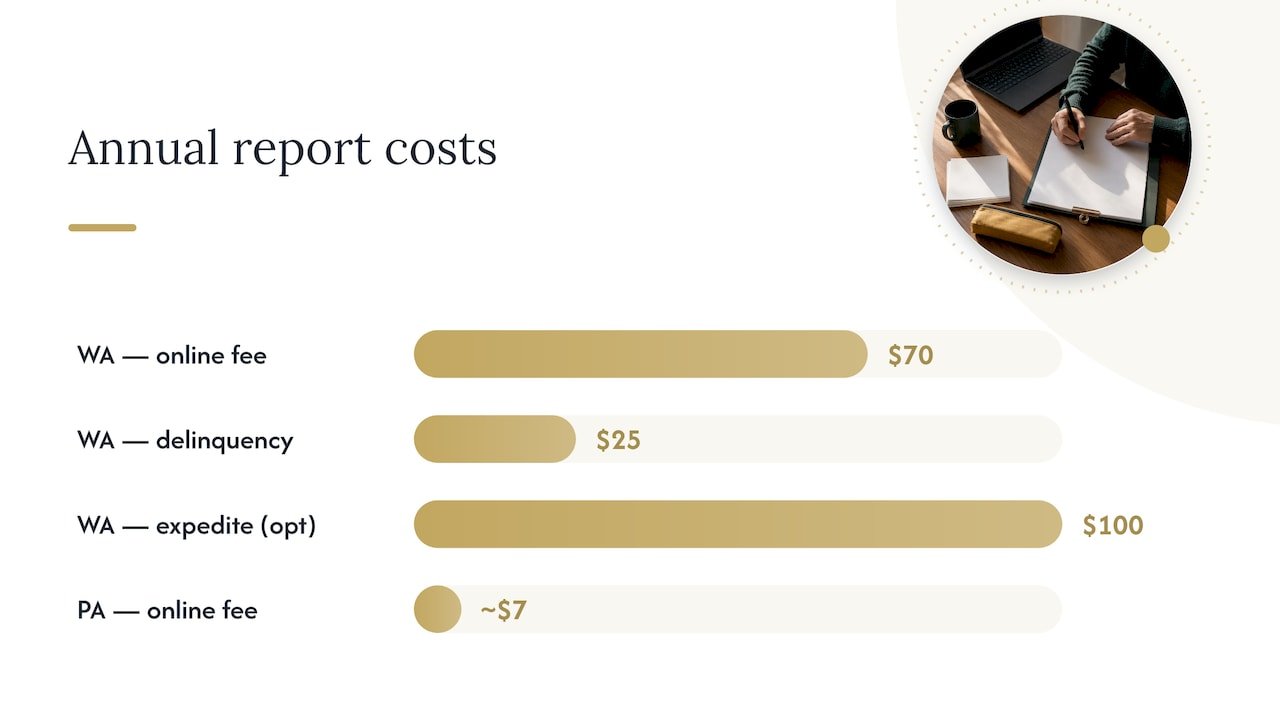
One filing window worth building into your calendar: Washington allows online filing up to 180 days before the expiration date, giving business owners a generous head start on a task that’s easy to postpone.
Two examples illustrate how differently states structure this. Washington’s online system walks filers through a search-and-verify process before routing to payment, with clear fee tiers published on the state site. Pennsylvania, by contrast, rolled out an entirely new statutory requirement in 2025, meaning businesses registered there for years suddenly had a filing obligation that didn’t previously exist. Neither approach is wrong, but they show why assuming your state works like a neighboring state’s is a mistake.
What information you’ll usually need to supply on the form
Before you sit down to file, gather the basics so you’re not scrambling mid-form. Most states ask for a consistent core set of information, even though the exact form layout differs.
- Business name and entity number, exactly as registered with the state.
- Jurisdiction of formation, especially important if you’re filing in a state where your business is registered to do business but not originally formed.
- Principal office address, which some states require to be a physical street address rather than a PO Box.
- Registered agent name and address, including consent from the agent in states that require it.
- Officer, director, or member names, depending on your entity type.
Some states ask additional questions, such as whether there’s been a change in controlling interest, a nature-of-business code describing your industry, or an email address specifically for your registered agent. State filing instructions, including Washington’s annual report form guidance, commonly require a physical address for the registered agent and an authorized signature attesting that the information is accurate.
Many states also require an attestation from an authorized person, meaning someone with legal authority to act for the business, typically an officer, manager, or member, rather than an outside bookkeeper or assistant filling out the form on their own authority.
How to file: the online filing process and common pitfalls
Most states now push filers toward electronic submission, and several have made it close to mandatory in practice, since paper filing is often slower and sometimes carries a higher fee. The core steps look similar across state portals:
- Search for your business by entity name or entity number on the state’s filing site.
- Open your entity’s record and select the annual report or annual registration option.
- Review the prepopulated fields, which usually reflect your last filing.
- Update any information that has changed, such as a new registered agent or address.
- Add the filing to your cart and proceed to checkout.
- Submit payment and save your confirmation.
That prepopulated-record step is worth pausing on. It’s a convenience, but it also means outdated information can roll forward unnoticed if you don’t read carefully before submitting.
A few mistakes trip up filers repeatedly. Some upload internal corporate documents, like operating agreements or board minutes, when the state only asked for a simple form. That extra step often triggers additional review that slows processing, according to state filing instructions. Others list a PO Box where the state requires a physical street address for the registered agent, causing the filing to bounce back. And a declined card at checkout can void the entire filing rather than simply pause it, according to Washington’s online filing instructions, so confirm your payment method and billing address before you start.
Pro Tip: File during your state’s early window if one exists. Washington’s 180-day head start means you can knock out this task during a slow month instead of racing a deadline.
What happens if you file late or not at all
Missing a filing deadline sets off a fairly predictable chain of consequences, and none of them are minor. The first hit is usually a delinquency fee, added on top of the standard filing cost. Washington, for example, adds a $25 delinquency fee to its standard filing fee once a business misses its deadline, according to the Washington Secretary of State.
Beyond the fee, a business that falls out of compliance loses its “good standing” status with the state. That status matters more than many owners realize. Lenders, landlords, and larger business partners often ask for a certificate of good standing before signing a contract, and you can’t get one while a filing is outstanding. Banks may also flag account issues once a state lists a business as delinquent.
If the lapse continues, states move toward administrative dissolution or termination, meaning the state cancels your entity’s legal existence. That can put your personal liability protection at risk, since the legal shield an LLC or corporation provides depends on the entity remaining active. Rebuilding after dissolution typically means a formal reinstatement process, which costs more time and money than simply filing on time would have.

Pennsylvania’s new requirement includes a phased structure with a transition period before penalties apply, based on guidance from the Pennsylvania Department of State. That kind of grace period is not universal, so don’t assume your state offers one.
A practical compliance checklist for small business owners
The businesses that never miss a deadline usually aren’t more organized in general. They just built one small, repeatable process around this specific task.
- Confirm your entity’s current status and next due date on your state’s Secretary of State site.
- Verify your registered agent’s address is current and matches state records.
- Set a calendar reminder at least 60 days before your deadline, not the week of.
- Pull last year’s filed report as a starting reference for this year’s form.
- Decide whether to file during an early window, if your state offers one.
A few habits make this even easier to sustain. Turn on email notifications through your state’s filing portal if available, use a registered agent service so you’re not relying on a home address that might change, and keep a shared folder with your entity number, last filed report, and registered agent contact so anyone on your team can complete the filing in minutes rather than starting from scratch.
Pro Tip: Keep a “corporate records” folder, digital or physical, with your entity number and last report on hand. Businesses that do this typically complete the filing quickly.
If your business operates in more than one state, if ownership recently changed, or if you’ve simply lost track of your entity number and registered agent details, it may be time to hand this off. That’s a common moment when small business owners bring in a compliance partner rather than continuing to track deadlines across multiple states by hand.
Foreign entities, meaning businesses registered to operate in a state other than where they were formed, usually face the same annual report obligation in each state where they’re qualified to do business. That means a company formed in one state but operating in three others may owe four separate filings, each on its own schedule and fee structure. This is one of the more common ways businesses accidentally fall out of good standing: they track their home state’s deadline but forget the qualification states.
How KelliWorks helps with annual report compliance
Staying on top of state filings gets harder the moment a business grows past a single state or a single owner tracking every date by memory. Some service providers support business owners through compliance checks, registered agent service, and managed annual report filing, so the task doesn’t depend on one person remembering a due date months in advance.
For businesses registered in more than one state, managed service providers may coordinate filings across jurisdictions so deadlines don’t get missed simply because they fall on different calendars. Such coordination can extend to registered agent management, calendar tracking, and the paperwork itself, which frees owners to spend their time running the business rather than chasing state portals.
This tends to be the right fit for owners who want a recurring, hands-off compliance relationship rather than a once-a-year scramble, particularly those managing multiple entities or expanding into new states. KelliWorks pairs this compliance support with its broader business formation and accounting services, so the same team that handles your books can also keep your entity in good standing.
What small business admins should prioritize first
If you manage compliance for a small business, the priority is simple: protect your good standing before anything else. A missed annual report rarely destroys a business on its own, but it opens the door to problems that compound, from lost bank relationships to a dissolved entity that takes months to reinstate.
The encouraging part is that once you build a basic system, this becomes routine rather than stressful. A calendar reminder, a current registered agent, and a folder with last year’s filing turn a once-dreaded task into a fifteen-minute job. Most owners I’ve seen struggle with this aren’t disorganized people. They simply never built the habit, because nobody told them how simple the fix actually is.
If your business has grown into multiple states, or if you’re not sure your registered agent information is current, it’s worth a conversation with a compliance partner before your next deadline sneaks up on you.
— Kelli
How KelliWorks can directly help you stay compliant
Keeping track of one state’s deadline is manageable. Keeping track of three, along with registered agent updates, fee schedules, and each state’s own form quirks, is where most small business owners start losing time they’d rather spend on their actual business. Service providers may handle that tracking directly, managing filings, registered agent service, and compliance calendars so nothing falls through during a busy quarter.

Getting started is straightforward. A short onboarding call covers your current entity structure, which states you’re registered in, and your existing registered agent setup, and from there KelliWorks builds a compliance calendar around your specific deadlines. This pairs naturally with the business formation and registered agent services KelliWorks already offers, so formation, ongoing compliance, and your books can sit with one team instead of three separate vendors.
If you’d rather not track another spreadsheet of state deadlines, reach out to KelliWorks to talk through what a managed compliance setup would look like for your business.
Sources
Start with your own state’s Secretary of State business search tool, since it’s the only source that reflects your entity’s actual due date and status. The sources below cover the two states discussed in detail here and are useful models for what to expect elsewhere.
- File an Annual Report (Multiple Entity Types) Online | WA Secretary of State
- Annual Reports | Department of State | Commonwealth of Pennsylvania
Treat your own state’s official site as the final word, since fees, windows, and forms change from year to year.
This article is general information, not a substitute for advice from a qualified lawyer. Consult a qualified legal professional about your own circumstances before acting on anything here.
FAQ
What are the legal requirements for annual reports?
Most states require registered businesses to file a report confirming or updating basic entity details, such as registered agent and office address, on a schedule set by state statute. The exact requirement, fee, and deadline depend on your state and entity type, so check your Secretary of State’s site, such as the Pennsylvania Department of State, for your specific rules.
What states require an annual report?
Nearly all U.S. states require some form of periodic report, whether annual or biennial, with Ohio a notable exception for some entity types. Because frequency and deadlines vary by state and entity type, confirm your specific obligation directly on your state’s business filing site.
Are annual reports mandatory?
Yes, for most registered entity types, including LLCs and corporations, in nearly every state. Skipping the filing typically leads to delinquency fees and eventually loss of good standing or administrative dissolution, as described in Washington’s filing guidance.
What is required for an annual report?
Most states ask for your entity’s name, entity number, principal office address, registered agent information, and the names of officers or members, along with an authorized signature. Some states add questions about controlling interest changes or require a physical street address rather than a PO Box, as noted in state filing instructions.