


If any employee performs work in another U.S. state, register for that state’s payroll accounts and withhold based on where work is performed unless a reciprocity agreement applies. You owe these taxes from the first day the work happens, so tracking employee location and filing deadlines matters as much as getting the paperwork right. When a Department of Labor test points to a different state for unemployment insurance, open that account too.
TL;DR:
- Employers must register for payroll accounts in every state where employees work, including withholding, unemployment, and local taxes, from the first day of work.
- Withholding is generally based on the employee’s work location, not residence, with reciprocity agreements easing withholding between certain states, provided a nonresident certificate is collected.
- Unemployment insurance wages are assigned to a single state using the federal Department of Labor’s localization test, which considers work location, base of operations, control, and residence.
- Many states impose additional payroll programs such as disability insurance, paid leave, or municipal taxes, which often require separate registration and are easy to overlook.
- Using remote work policies requires proactive planning to ensure proper registration in each relevant state, as relocations and temporary work can trigger new compliance obligations.
Table of Contents
- Register and Set Up State Payroll Accounts
- Deciding Who to Withhold For: Work State vs. Resident State
- SUTA and the DOL Localization Test: Picking One State
- Watch State and Local Payroll Taxes and Special Programs
- Tracking, Apportionment, and Payroll System Configuration
- Common Scenarios and Quick Decision Rules
- KelliWorks Practical Checklist and Implementation Resources
- Handling Unemployment Insurance Claims Across States
- Impact of Remote Work Policies on Multi-State Payroll
- Guidance on State-Specific Wage Garnishments and Deductions
- Coordination with State Labor Law Requirements Beyond Payroll
- Overview of Federal Rules Interacting with Multi-State Payroll Obligations
- Prioritize Registration and Tracking to Avoid Penalties
- How KelliWorks Can Help With Multi-State Payroll Compliance
- FAQ
- Sources
- Primary Sources to Verify State Rules and Account Setup
Register and Set Up State Payroll Accounts
Once an employee performs work in a new state, we recommend opening the accounts that state requires before the first paycheck goes out. Most states require a withholding account and a State Unemployment Tax Act (SUTA) account at minimum, and some add local or municipal accounts plus state disability or paid family leave programs.
To register, you typically need your federal EIN, business formation documents, and sometimes officer Social Security numbers. If you lack a physical presence or registered agent in that state, you may also need to file a foreign qualification with the Secretary of State before payroll registration goes through.
- Withholding account: required almost everywhere income tax applies to wages earned in that state.
- SUTA account: required in the state where unemployment insurance wages are reported.
- Local or municipal accounts: needed in cities or counties with wage taxes.
- Disability or paid leave accounts: required in states that run these as separate programs.
Payroll tax obligations begin immediately when an employee performs work in a state, with no revenue threshold triggering the requirement the way sales tax nexus works. Processing times for new state accounts can range from a few days to 90 days, so if an account is still pending when payroll runs, withhold and set the funds aside for remittance once the account is active rather than skipping withholding altogether.
Deciding Who to Withhold For: Work State vs. Resident State
The default rule is simple: withhold income tax for the state where the employee physically performs the work, not necessarily where they live. Reciprocity agreements are the main exception, and they only apply between specific state pairs.
- Identify the work state. This is where the employee sits at a desk, visits clients, or otherwise performs duties, not their mailing address.
- Check for a reciprocity agreement between the work state and the employee’s resident state.
- Collect a nonresident certificate from the employee if reciprocity applies, so you can withhold for the resident state instead.
- Store the certificate in the employee’s file and reconfirm it periodically, since reciprocity status can change.
Reciprocity agreements simplify withholding for commuters, but leave other payroll obligations intact, including SUTA and local municipal taxes, which still follow their own separate rules regardless of any reciprocity arrangement. Missing a nonresident certificate is one of the most common causes of double withholding complaints from employees.
Pro Tip: Request a nonresident certificate during onboarding, not after the first paycheck, so you never have to issue a correction.
SUTA and the DOL Localization Test: Picking One State
Unemployment insurance wages get reported to a single state, and the Department of Labor’s localization of work provisions lay out a four-part test, applied strictly in order, to determine which one.
- Localization: is all or most of the work performed in one state? If yes, that is the SUTA state.
- Base of operations: if work spans states, where does the employee report or receive assignments?
- Direction and control: if there is no clear base of operations, where is the work directed or controlled from?
- Residence: if none of the above applies, the employee’s state of residence becomes the default.
For most full-time remote employees, the home state satisfies the localization test and becomes the SUTA state without needing to go further down the list. A commuter who works five days a week in one state but lives in another is usually localized to the work state. A split-week employee who divides time roughly evenly between two states often needs the base of operations or direction and control tests to resolve. If work patterns shift, for example an employee relocates or changes their primary work location, you can and should update the SUTA assignment going forward.
Watch State and Local Payroll Taxes and Special Programs
Income tax and SUTA are not the whole picture. Several states run additional payroll programs that are easy to miss until an audit or employee complaint flags them.
- State disability insurance (SDI): separate employee-funded program in a handful of states, with its own account and deposit schedule.
- Paid family and medical leave: increasingly common, often with employer and employee contributions reported separately from income tax withholding.
- Municipal or city wage taxes: apply in some cities regardless of state income tax status, and are easy to overlook when onboarding happens quickly.
Nine states impose no state individual income tax on wages, including Texas, Florida, and Washington, but employers there can still owe SUTA, SDI, or local wage taxes. Check each state’s department of revenue and workforce agency pages directly, since these programs change and are rarely covered by generic payroll guidance.
Tracking, Apportionment, and Payroll System Configuration
Before running payroll for a multi-state employee, confirm your system can apportion wages correctly and that your records capture where work actually happens.
- Track location by pay period, not just at hire, since remote and hybrid arrangements shift over time.
- Apportion wages based on days or hours worked in each state when an employee splits time, and reflect that split on pay stubs and quarterly reports.
- Run a test pay stub for any newly added state before the first live payroll run to catch configuration errors.
- Calendar every filing and deposit deadline tied to the new state and local accounts you opened.
- Audit quarterly to confirm wage apportionment and account balances match your actual workforce footprint.
Pro Tip: Build a simple spreadsheet tracker with employee name, work state, resident state, and account status before your payroll provider needs that data.
Common Scenarios and Quick Decision Rules
Most multi-state payroll questions fall into a handful of repeating scenarios.
- Permanent move: update the employee’s work state, register new accounts if needed, collect a new nonresident certificate if reciprocity applies, and close out the old state’s filings per that state’s instructions.
- Split-state work: apportion wages by days or hours worked in each state and register for withholding and SUTA in every state where work occurs.
- Short-term travel or temporary assignments: check whether the destination state has a de minimis threshold for withholding, since some states exempt a small number of workdays, but always confirm local tax rules separately since thresholds vary widely by state.
When in doubt, treat the work location as the default answer and look for a specific exception, rather than assuming your home state rules apply everywhere.
KelliWorks Practical Checklist and Implementation Resources
We outline a straightforward sequence for onboarding a first out-of-state employee:
- Confirm the employee’s work state and resident state.
- Register for withholding and SUTA in the work state.
- Collect a nonresident certificate if reciprocity applies.
- Check for local wage taxes, SDI, or paid leave programs.
- Configure payroll software with the correct state and local codes.
- Run a test pay stub before the first live payroll.
- Calendar every filing deadline tied to the new accounts.
Our payroll compliance checklist walks through each registration step in order, and our year-end checklist helps confirm W-2s reflect the correct state wage splits before filing season.
| Resource | What it helps you do |
|---|---|
| Payroll Compliance Checklist | Sequence state registrations and deadlines |
| Payroll Year-End Checklist | Verify W-2 state wage apportionment |
| New Hire Paperwork Checklist | Collect onboarding forms, including nonresident certificates |
Handling Unemployment Insurance Claims Across States
When a multi-state employee is laid off or files for unemployment, the claim goes to the state where their wages were reported under SUTA, which may not be the state where they currently live. This surprises many small business owners who assume unemployment claims follow residency.
If you reported wages correctly to a single state under the localization test, the claims process works the same way it would for any single-state employee: the state unemployment agency contacts you to verify wages and separation details, and you respond within that state’s deadline, typically a short window measured in days. Missing a response deadline can result in the claim being approved by default, which raises your SUTA rate going forward.
Problems arise when wages were apportioned incorrectly or reported to the wrong state in the first place. An employee who worked primarily in one state but had wages reported to another may find their claim delayed while agencies sort out jurisdiction, which is one more reason to apply the DOL localization test carefully at the time of hire rather than after a layoff.
If your workforce includes employees in several states, expect to interact with multiple state workforce agencies over time, each with its own claim portal, response format, and appeal process. Keeping organized records of work location, wage apportionment, and SUTA account numbers for each state makes responding to claims faster and reduces the chance of a default judgment against your account.

Impact of Remote Work Policies on Multi-State Payroll
A remote work policy that lets employees choose where they live effectively multiplies your payroll compliance obligations, since each new state an employee relocates to can trigger new withholding, SUTA, and local tax registrations. Telework has become far more common across U.S. employers, and that shift means payroll teams increasingly manage obligations across states where the business has no office at all.
The practical impact shows up in a few places. Hiring decisions that once ignored geography now carry a compliance cost, since approving a remote hire in a new state means opening accounts there before the first paycheck. Policies that allow employees to work temporarily from a different state, such as extended travel or seasonal relocation, create short-term obligations that are easy to miss because they do not look like a permanent move.
We recommend writing your remote work policy with payroll in mind from the start: require employees to notify HR before relocating, build in a short lead time for account registration, and specify which states the business is willing to support for remote hires. A policy that treats location changes as a simple address update, rather than a payroll event, is the most common source of multi-state compliance gaps we see.
Guidance on State-Specific Wage Garnishments and Deductions
Garnishment rules, including how much of an employee’s wages can be withheld and in what order multiple garnishments are paid, vary by state and by the type of debt involved, such as child support, tax levies, or creditor judgments. When an employee who is subject to a garnishment order works in or moves to a different state, the garnishment calculation generally follows the rules of the state where the employee works, not necessarily where the original order was issued.
This means a garnishment that was calculated correctly under one state’s exemption limits may need to be recalculated if the employee relocates or splits work across state lines. Employers are expected to apply the correct state’s garnishment limits and protected income exemptions, and getting this wrong can expose the business to liability for over-withholding or under-withholding.
We recommend confirming the applicable state’s garnishment rules whenever an employee’s work location changes, rather than assuming the original order’s state continues to apply. State labor departments and the agency that issued the garnishment order are the most reliable sources for confirming current limits and exemption amounts for that specific state.
Coordination with State Labor Law Requirements Beyond Payroll
Payroll compliance does not exist in isolation from other state labor law requirements, and a multi-state employer usually needs to coordinate several obligations at once for every new state where employees work. Minimum wage rates, overtime rules, final paycheck timing after termination, and required pay stub disclosures all vary by state and often differ from federal minimums.
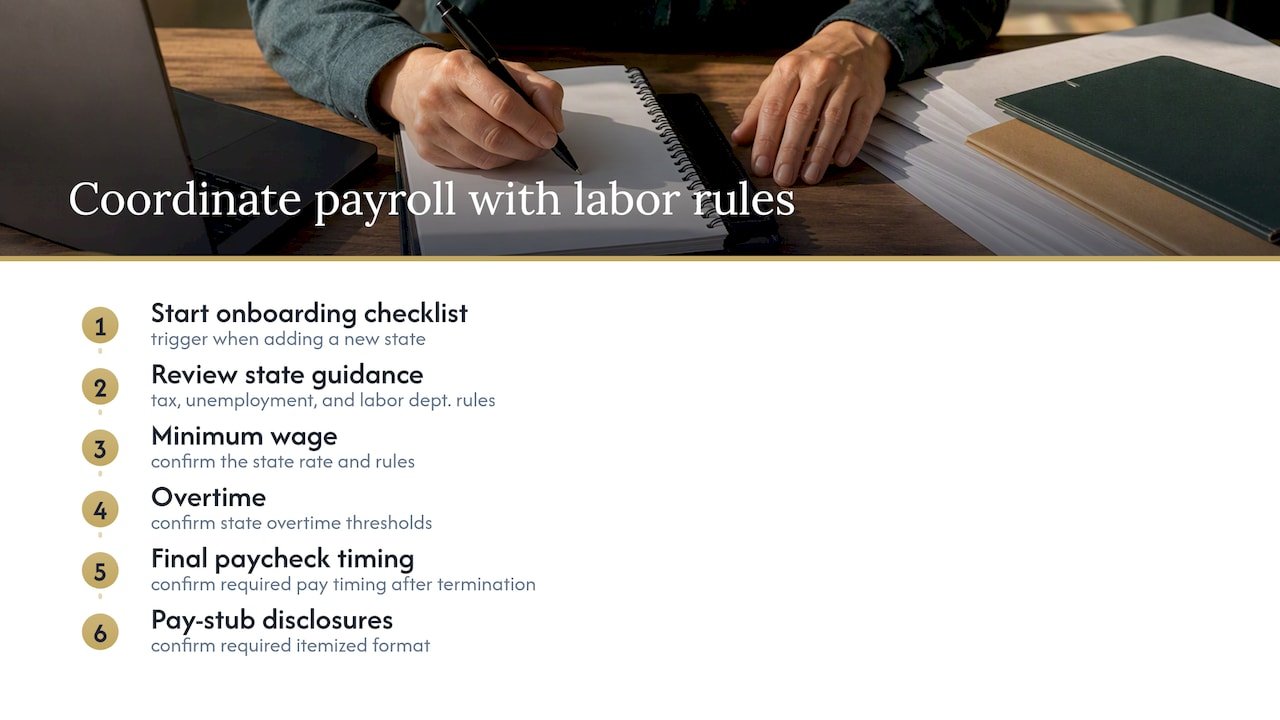
A state that requires wage statements to itemize specific deductions, for example, may have different formatting rules than your home state, which means a payroll system configured correctly for one state can still produce noncompliant pay stubs in another. Final paycheck timing is a particularly common trap: some states require payment immediately upon termination, while others allow until the next scheduled payday, and the wrong choice can trigger penalties independent of any payroll tax issue.
We recommend reviewing each new state’s labor department guidance alongside its tax and unemployment rules, rather than treating payroll setup and labor law compliance as separate projects. The two are easiest to manage together when a single onboarding checklist covers both at the point a new state is added to your operations.
Overview of Federal Rules Interacting with Multi-State Payroll Obligations
Federal rules set the floor underneath every state’s payroll requirements, and IRS Publication 15 lays out employer responsibilities for federal income tax withholding, Social Security and Medicare taxes, and depositing and reporting requirements that apply regardless of how many states an employee works in. Federal withholding stays the same no matter where an employee performs work inside the United States, which is one reason it is easy to assume state rules work the same way. They do not.
Publication 15 also directs employers to check state and local tax departments for state-specific rules, which is a useful reminder that federal guidance was never meant to answer multi-state questions on its own. Federal unemployment tax, reported through FUTA, is a separate system from state SUTA and generally applies uniformly regardless of which state reports the underlying wages.
The practical takeaway is that federal payroll compliance and multi-state payroll compliance are two different projects running in parallel. Getting federal deposits and filings right protects you from IRS penalties, but it says nothing about whether you have registered correctly in every state where employees perform work, which is the layer most small businesses underestimate.
Prioritize Registration and Tracking to Avoid Penalties
Missed withholding and late state deposits can trigger trust fund penalties that personally follow business owners, which is why we treat registration and location tracking as day-one priorities, not cleanup tasks. Many small businesses handle payroll in-house until a second state is added, then find that a virtual accounting partner saves more in avoided penalties than it costs.
— Kelli
How KelliWorks Can Help With Multi-State Payroll Compliance

Setting up accurate multi-state payroll does not have to fall entirely on your shoulders. Our services include assistance with state registrations, account setup, and ongoing filings to help manage deadlines across multiple state agencies.
- Register withholding, SUTA, and local accounts in each state where employees work.
- Configure payroll systems to apportion wages correctly and apply reciprocity rules.
- Perform ongoing compliance checks to ensure new hires in new states are managed appropriately.
If you are adding your first out-of-state employee or already juggling payroll across several states, our accounting and payroll services page outlines how an engagement typically starts and what we handle from there. A short initial conversation is usually enough to map out what needs to happen before your next payroll run.
This article is general information, not a substitute for advice from a qualified financial advisor. Consult a qualified financial professional about your own circumstances before acting on anything here.
FAQ
How should I handle payroll for a multi-state workforce?
Register for withholding and SUTA accounts in every state where employees perform work, and withhold based on the work state unless a reciprocity agreement and nonresident certificate apply. Track each employee’s work location and calendar every filing deadline tied to the accounts you open, since obligations begin the first day work is performed.
What happens if an employee works in two different states?
Apportion their wages based on days or hours worked in each state, and register for withholding and SUTA in both if work is ongoing in each. For unemployment insurance, apply the Department of Labor’s localization test in order to determine which single state receives the SUTA wages.
What are the main payroll rules employers need to follow in the US?
At a minimum, employers must withhold and deposit federal income tax, Social Security, and Medicare under rules set out in IRS Publication 15, plus register for state withholding and unemployment accounts wherever employees perform work. State and local rules layer on top, covering items like disability insurance, paid leave, and municipal wage taxes depending on the state.
What should small businesses expect for payroll in 2026?
Expect the same core requirements as prior years: federal withholding and deposit rules from Publication 15, state-specific withholding and SUTA registration tied to where work is performed, and growing attention to remote work locations as more employees work outside their employer’s home state. Reviewing your state registrations each year, especially after any new hire in a different state, remains the most reliable way to stay current.
Does a reciprocity agreement remove all multi-state payroll obligations?
No, a reciprocity agreement only affects which state receives income tax withholding and requires a nonresident certificate on file to apply. SUTA registration and any local or municipal taxes in the work state still apply regardless of reciprocity status.
Sources
- UIPL20-04: Localization of Work Provisions (U.S. Department of Labor)
- Publication 15 (Employer’s Tax Guide) — IRS
- States with no income tax (SoFi Learn)
Primary Sources to Verify State Rules and Account Setup
Confirm specifics against the DOL’s localization of work guidance for unemployment insurance assignment and IRS Publication 15 for federal withholding responsibilities. For account registration, forms, and deadlines, check the specific state’s department of revenue and workforce agency pages directly, since these details change and vary by state.