


Yes, you can expand your business to the United States, and the first three actions matter more than anything else: pick your entity type and formation state, apply for an Employer Identification Number (EIN), and audit the last 12 months of US sales for state tax nexus. Most penalty risk comes later, from missed federal reporting like Form 5472 and overlooked state sales tax registrations, not from the formation step itself.
TL;DR:
- A foreign owned corporation or disregarded entity with at least 25% foreign ownership must file Form 5472 annually; one missed form can cost $25,000.
- Compare 12 months of sales in each state with its economic nexus threshold; marketplace platforms generally collect tax only on marketplace transactions.
- Apply for an EIN immediately after formation; international applicants may need slower fax, mail, or phone routes, and banks usually require the number.
- Choose Delaware for institutional funding plans; operating elsewhere can require qualification, registered agents, and filings in each state where you do business.
- Register payroll withholding where each employee physically works before the first paycheck; an employer of record can help while you test hiring across states.
Table of Contents
- Choosing the Right US Legal Structure for Your Expansion
- Federal Registrations and Reporting Deadlines You Cannot Miss
- Sales Tax Nexus: Where You Owe Tax and How to Register
- Opening US Bank Accounts and Payment Processors as a Foreign Owner
- Which Visas Let You Work in or Staff Your US Operation
- Permits and Local Registrations Before You Launch
- Finding Incentives and Spotting Early Legal Risk
- How We Handle the Compliance Work So You Can Focus on Growth
- Your Step-by-Step Timeline From Formation to Launch
- What US Expansion Actually Costs
- Setting Up Accounting for a Foreign-Owned US Entity
- US Employment Law and Payroll Basics for Your First Hires
- Protecting Your Brand and Products With US IP Registration
- Staying Compliant Year After Year
- What I’d Do Differently If I Were Starting Today
- Let’s Talk Through Your US Expansion Plan
- FAQ
- Sources
Choosing the Right US Legal Structure for Your Expansion
Your entity choice should follow your actual plans, not a generic template. A representative office works for market research with no sales activity, but it cannot generate US revenue. A branch office lets a foreign company operate directly in the US, though it exposes the parent company’s assets to US liability and often creates more complex tax treatment. A wholly owned subsidiary, usually formed as a C corporation, separates US liability from the parent company and is generally preferred by investors and by companies planning to raise US venture capital.
An LLC taxed as a disregarded entity or partnership suits founders who want pass-through treatment and fewer corporate formalities, though it comes with its own federal reporting obligations once foreign ownership crosses 25%.
State selection is a separate decision from entity type. Forming in Delaware is common for companies planning to raise institutional capital, but if you have no Delaware operations, you will also need to foreign qualify in every state where you actually do business, which means paying for registered agents and filings in multiple states.
Before choosing, answer these questions:
- Will you have customers, inventory, or employees physically present in a specific state?
- Do you plan to raise venture capital or sell equity to US investors?
- Will you hire US-based staff within the first year?
- Do you need to keep the US entity legally separate from the parent company for liability reasons?
The U.S. Small Business Administration notes that registering in a new state often triggers state taxes, licenses, and annual report obligations, so the state decision carries ongoing costs beyond the initial filing.
Federal Registrations and Reporting Deadlines You Cannot Miss
Once you have an entity, two federal filings sit at the top of the priority list: the EIN and Form 5472.
- Apply for your EIN as soon as the entity is formed. The IRS explains that international applicants who cannot use the online EIN portal must use the SS-4 process through fax, mail, or telephone, and these routes take longer, so start immediately after formation rather than waiting for a bank appointment.
- Determine whether Form 5472 applies to you. The IRS instructions for Form 5472 state that any US corporation or disregarded entity that is 25% or more foreign owned must file this form annually to report transactions with related foreign parties, often attached to a pro forma Form 1120.
- If you plan to hire US employees, register for state and federal payroll withholding before the first paycheck is issued, not after.
One missed Form 5472 filing can trigger a $25,000 penalty per form, per year, and the form requires detailed schedules on loans, royalties, and other related-party transactions, so accurate recordkeeping throughout the year matters as much as the filing itself.
Set up a compliance calendar the moment your entity exists. Track your EIN application date, your first Form 5472 deadline, and any payroll registration dates in one place, and hire a US CPA early rather than after a notice arrives. Preserve every intercompany invoice, loan agreement, and transfer record from day one, because reconstructing a year of transactions after the fact is far harder than filing as you go.
Sales Tax Nexus: Where You Owe Tax and How to Register
Since the Supreme Court’s Wayfair decision, physical presence is no longer required to owe sales tax in a state. Economic nexus now applies once your sales into a state cross a set threshold, and according to a foreign sellers guide to US sales tax, many states use a common revenue threshold for economic nexus, though some states set higher thresholds and others have dropped transaction-count tests entirely.
If you sell through a marketplace like Amazon or Etsy, marketplace facilitator laws in most states shift the sales tax collection duty to the platform, but any direct sales you make outside that marketplace remain your own responsibility to track and remit.
Start by pulling 12 months of sales data broken down by state, then compare those totals against each state’s threshold to find where you have already crossed into nexus. Prioritize registration in states where you are furthest past the threshold, since those carry the longest exposure window.
To register and do business in a state, you typically need:
- A Certificate of Authority, sometimes called foreign qualification, filed with the state’s business registry.
- A registered agent with a physical address in that state.
- A Certificate of Good Standing from your home formation state, which some states require before approving foreign qualification.
Our own breakdown of sales tax nexus walks through how to map thresholds against your sales data in more detail. Many businesses use automated sales tax software to track multi-state thresholds and file returns, since doing this manually across a dozen states becomes unmanageable quickly.
Opening US Bank Accounts and Payment Processors as a Foreign Owner
Banks and payment processors evaluate foreign-owned entities more cautiously than domestic ones, and approval is not guaranteed even with a properly formed entity. Expect to provide your EIN, formation documents, an operating agreement or by laws, government-issued ID for all beneficial owners, and proof of a US business address.
Common rejection causes include missing beneficial ownership documentation, a formation state with no connection to where you actually operate, and an inability to appear in person at some traditional banks. Fintech platforms built for international founders often have more flexible onboarding than traditional banks, though they may carry different fee structures or transaction limits, so compare both paths before committing.
Pro Tip: Apply for your EIN and set up a US business mailing address before approaching any bank, since incomplete documentation is the most common reason applications stall.
Which Visas Let You Work in or Staff Your US Operation
A B-1 visa allows short business visits like meetings or negotiations, but it does not permit you to work or draw a salary in the US. An E-2 investor visa allows nationals of treaty countries to live in the US and actively run a business they have invested in, though it only applies if your home country has a qualifying treaty with the United States.
For staffing decisions:
- Hire a US employee when the role requires ongoing physical presence, and register for payroll withholding before the first pay date.
- Use an independent contractor only when the work genuinely meets contractor classification standards, since misclassification creates back-tax and penalty exposure.
- Consider an Employer of Record to legally employ US staff without registering your own entity for payroll in every state where you hire, which is useful while you are still testing the market.
Permits and Local Registrations Before You Launch
Most federal licenses only apply to regulated sectors like broadcasting, firearms, or alcohol, so the bulk of your permit work happens at the state and local level.
- Check your target state’s business portal for any state-level occupational license tied to your industry.
- Confirm city or county requirements for a general business license, which many municipalities require regardless of industry.
- File a DBA or trade name registration if you operate under a name different from your legal entity name.
- Note your state’s annual report deadline immediately, since missing it can lapse your good standing and complicate future state registrations.
When your activity touches a regulated industry such as healthcare, finance, or food service, loop in a business attorney before launch rather than after a violation notice.
Finding Incentives and Spotting Early Legal Risk
SelectUSA, run by the US Department of Commerce, connects foreign companies with state and local partners offering tax credits, grants, and workforce training programs, and most state economic development agencies run parallel programs that are worth checking before you commit to a location.
Two risks deserve early attention. CFIUS review applies mainly to transactions involving critical technologies, defense-adjacent sectors, or foreign government-linked investment, so it is not a universal concern but a sector-specific one. Separately, state conformity to federal tax law varies, meaning a transfer pricing structure that looks clean federally can still create state-level exposure, so state tax planning needs its own review, not an assumption that federal compliance covers it.
How We Handle the Compliance Work So You Can Focus on Growth
Expanding into the United States involves more moving pieces than most founders expect, from entity formation and registered agent service to EIN applications, Form 5472 preparation, payroll tax compliance, and ongoing sales tax monitoring across states. We handle each of these as part of our business management and accounting services, keeping a compliance calendar so deadlines for annual reports, payroll filings, and federal reporting do not slip. The focus is on small and medium businesses navigating exactly the filings covered in this guide.
Your Step-by-Step Timeline From Formation to Launch
A realistic US expansion timeline runs in overlapping phases rather than one straight line.
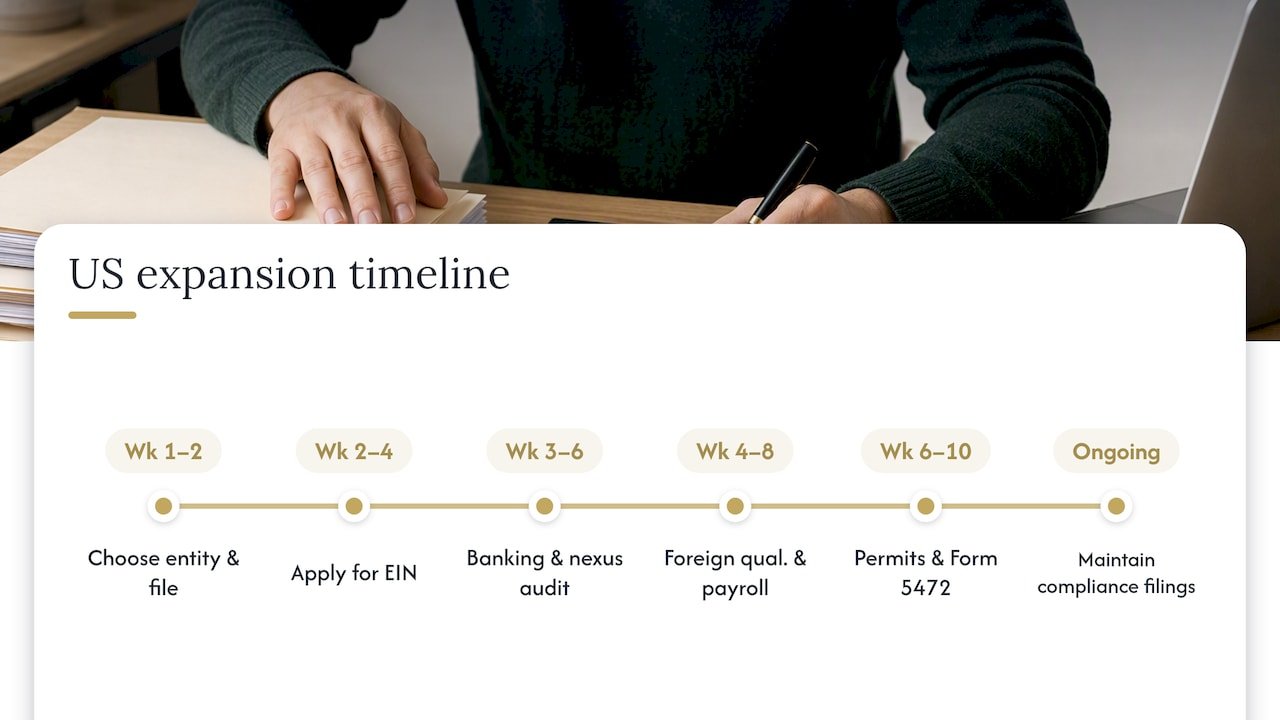
Weeks 1 to 2: Choose your entity type and formation state, then file formation documents. This is also when to request a registered agent if you are not forming in your primary operating state.
Weeks 2 to 4: Apply for your EIN immediately after formation is confirmed. International applicants should expect the SS-4 fax, mail, or phone routes to take longer than the online system available to US residents, so build in buffer time here.
Weeks 3 to 6: Begin bank and payment processor applications once your EIN arrives, since most institutions require it before opening an account. Run your sales tax nexus audit in parallel using the prior 12 months of sales data if you already have US revenue.
Weeks 4 to 8: File foreign qualification paperwork in any state where your nexus audit shows you have crossed a threshold, and register for payroll withholding if you plan to hire within this window.
Weeks 6 to 10: Secure any required state or local permits and licenses, finalize your DBA filing if needed, and confirm your Form 5472 recordkeeping is in place if your entity is 25% or more foreign owned.
Ongoing from launch: Maintain your compliance calendar for annual report deadlines, quarterly payroll filings, and annual federal reporting. The SBA’s expansion guidance frames this sequence clearly: formation, then EIN, then banking, then state tax registration, then payroll setup if hiring, then annual federal filings. Treat each phase as dependent on the one before it rather than rushing steps in parallel.
What US Expansion Actually Costs
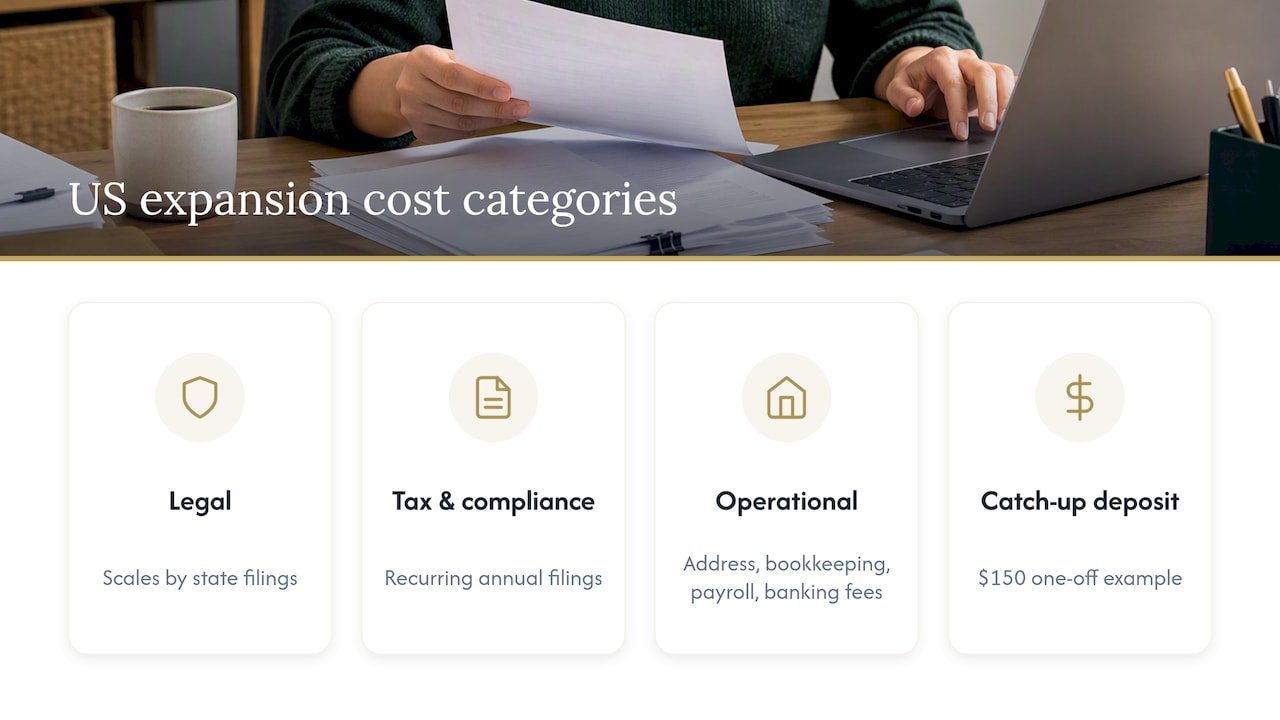
Budgeting for US expansion means accounting for four separate cost categories, and founders who only plan for formation fees are usually surprised by what follows.
Legal costs cover entity formation, registered agent fees in each state where you operate, and any attorney time spent on regulated-industry permits or contract review. These costs scale with how many states you register in, since each additional foreign qualification adds its own filing fee and ongoing registered agent cost.
Tax and compliance costs include EIN setup, annual Form 5472 preparation if your entity is foreign owned at 25% or more, state sales tax registration and filing across every nexus state, and annual report fees in each state of registration. These are recurring, not one-time, so they belong in your annual operating budget rather than a startup cost sheet.
Operational costs include a US business address or virtual mailbox service, bookkeeping and accounting support, and payroll processing if you hire staff. Banking and payment processor fees also vary depending on whether you use a traditional bank or a fintech platform built for international founders.
The deposit structure for getting a backlog of US tax filings current, such as our own $150 one-off deposit for outstanding tax returns, illustrates how catch-up compliance work is often priced separately from ongoing filing support. Build your budget around the recurring categories first, since those are the ones that compound if ignored, and treat the formation fee itself as the smallest line item in the whole plan.
Setting Up Accounting for a Foreign-Owned US Entity
Bookkeeping for a foreign-owned US entity carries extra requirements that a purely domestic business does not face. Every intercompany transaction with the foreign parent, whether a loan, a royalty payment, or a cost-sharing arrangement, needs to be tracked with enough detail to populate Form 5472 schedules accurately at year end.
Set up your chart of accounts to separate US-source revenue from any foreign-sourced funds moving through the entity, since commingled records make both tax prep and bank compliance reviews harder. QuickBooks or a comparable cloud accounting platform works well for this, provided the setup accounts for multi-currency transactions if your parent company invoices in a foreign currency.
Reconcile your books monthly rather than annually. Waiting until tax season to reconstruct a year of related-party transactions is one of the more common and avoidable sources of late or inaccurate Form 5472 filings. Our full-service bookkeeping work with foreign-owned entities is built around this exact structure: tracking intercompany activity in real time so the annual filing is a formality rather than a scramble. Keeping clean monthly books also strengthens your position when a bank or payment processor requests financial statements during onboarding.
US Employment Law and Payroll Basics for Your First Hires
Hiring your first US employee triggers obligations at the federal, state, and sometimes local level, all starting before the first paycheck goes out.
Federal law requires withholding for income tax, Social Security, and Medicare, along with unemployment insurance contributions. States layer on their own income tax withholding where applicable, state unemployment insurance registration, and in some cases paid leave or disability insurance programs.
Classify workers correctly from the start. A worker treated as a contractor when the relationship actually meets employee criteria creates back-tax liability and potential penalties, and the line is determined by control over the work, not by the title on a contract.
Register for payroll withholding in any state where an employee physically works, not just the state where your entity is formed, since payroll tax obligations follow the employee’s work location. Running payroll manually across multiple states quickly becomes unmanageable, so many expanding businesses use a payroll service or Employer of Record during the early hiring phase rather than building internal payroll infrastructure immediately.
Protecting Your Brand and Products With US IP Registration
US trademark and patent protection do not transfer automatically from your home country, so registration here is a separate process worth starting early if your brand or product is central to your expansion.
A federal trademark, filed through the United States Patent and Trademark Office, protects your business name, logo, or slogan nationwide and strengthens your position if a similar mark appears later. Filing before launch, rather than after a competitor registers a similar mark, avoids a costly rebranding scenario.
Patents protect inventions and require a more detailed filing process, generally worth an attorney’s involvement given the technical and legal precision required. Copyright protection for original works like software or written content exists automatically upon creation, though formal registration still strengthens your ability to enforce it in court.
If your product or brand name is a core part of your market entry strategy, treat IP filing as part of your pre-launch checklist, not a task to revisit once the business is already operating.
Staying Compliant Year After Year
Expansion does not end at launch. Every state where you are registered expects an annual report, usually tied to your formation anniversary, and missing it can lapse your good standing and complicate everything from bank renewals to future financing.
Federally, if your entity remains 25% or more foreign owned, Form 5472 is an annual obligation, not a one-time filing, and it needs to reflect every related-party transaction from that tax year. Sales tax filing frequency varies by state, with some requiring monthly returns and others quarterly or annual, depending on your sales volume in that state.
Payroll tax filings follow their own federal and state calendars, typically quarterly for federal purposes with state variations layered on top. Building a single compliance calendar that tracks all of these deadlines across every state and federal agency is the most reliable way to avoid the penalties that catch most foreign-owned businesses off guard in year two, once the novelty of launch has worn off and routine filings start slipping.
What I’d Do Differently If I Were Starting Today
The most common mistake I see is sequencing: founders chase a bank account before they have an EIN, or pick a state based on tax rates alone and ignore where their customers actually are. Form a business attorney relationship early if your industry is regulated, and bring in a CPA the moment your entity exists, not after your first Form 5472 deadline passes.
— Kelli
Let’s Talk Through Your US Expansion Plan
This service is offered to small and medium businesses expanding into the United States, addressing process elements such as entity choice, EIN timing, Form 5472, and state sales tax registration. 
A short consultation lets us map your specific situation against the filings that actually apply to you, rather than every filing that could apply to any business. Before we talk, gather a few things:
- Your current formation documents, if you already have a US entity.
- Recent financials and a list of the states where you have customers or plan to hire.
- Any existing US contracts and a summary of your ownership structure.
Schedule a consultation and we will walk through formation, EIN timing, and your sales tax exposure together.
This article is general information, not a substitute for advice from a qualified financial advisor. Consult a qualified financial professional about your own circumstances before acting on anything here.
FAQ
What is a US-based business?
A US-based business is an entity formed under the laws of a US state, such as an LLC or corporation, that operates within the United States regardless of where its owners live. Foreign nationals can own a US-based business, but the entity itself must be registered with a state and typically needs an EIN from the IRS.
Is $5,000 enough to start a business?
It depends heavily on your entity type, industry, and how many states you register in, since formation fees, registered agent costs, and bookkeeping support all add up quickly for a foreign-owned entity. A tighter budget usually means starting in a single state and delaying additional foreign qualifications until revenue justifies the expansion.
How do I promote my business globally?
Promoting a business globally starts with confirming you are legally allowed to sell into each target market, since marketing ahead of compliance creates its own risks. For the US specifically, resolving your entity structure, sales tax nexus, and any required licenses before scaling marketing spend protects you from penalties tied to selling in states where you are not yet registered.
What is it called when a company expands to another country?
This is generally called international expansion or market entry, and when a US business expands abroad or a foreign business enters the US, it is often described as cross-border expansion. The SBA’s guidance on expanding to new locations uses this same framing for businesses entering new US states, treating each state much like a distinct market.
Sources
- Expand to new locations | U.S. Small Business Administration
- Foreign Sellers Guide to US Sales Tax Compliance 2026 | GoodVat