


An IRS-compliant accountable plan keeps qualifying employee reimbursements free from income and payroll taxes once three conditions are met: a clear business connection, timely substantiation, and return of any excess payment. This guide walks through the legal basis for each requirement, the IRS safe-harbor timing windows, and the written policy and workflow a small employer needs to put in place.
TL;DR:
- Strict adherence to the three IRS conditions—business connection, timely substantiation, and return of excess—ensures reimbursements stay tax-free and avoid payroll taxes.
- Small businesses must document expenses within 30 days of payment, with receipts or mileage logs, and return any unspent advances within 120 days to maintain compliance.
- Using electronic records and automated tools can simplify proper recordkeeping, timely submission, and enforcement of policy deadlines, reducing audit risk.
- A formal written policy covering submission deadlines, required expense details, receipt thresholds, and return procedures is crucial for audit defense.
- Regularly reviewing and enforcing the return of excess funds is the most common compliance failure; automating reminders helps maintain policy discipline.
Table of Contents
- IRS requirements and regulatory basis for accountable plans
- Safe-harbor timing windows and acceptable documentation methods
- Practical written-policy checklist and sample accountable plan elements
- Operational workflow: collecting reports, separating reimbursements from payroll, and payroll integration
- Common pitfalls, audit readiness, and how the IRS examines accountable plans
- Tools and automation: categories and integration patterns for small businesses
- How we implement accountable plans for small businesses
- What small businesses get wrong about accountable plans
- How KelliWorks can help you set up a compliant accountable plan
- FAQ
- Sources
IRS requirements and regulatory basis for accountable plans
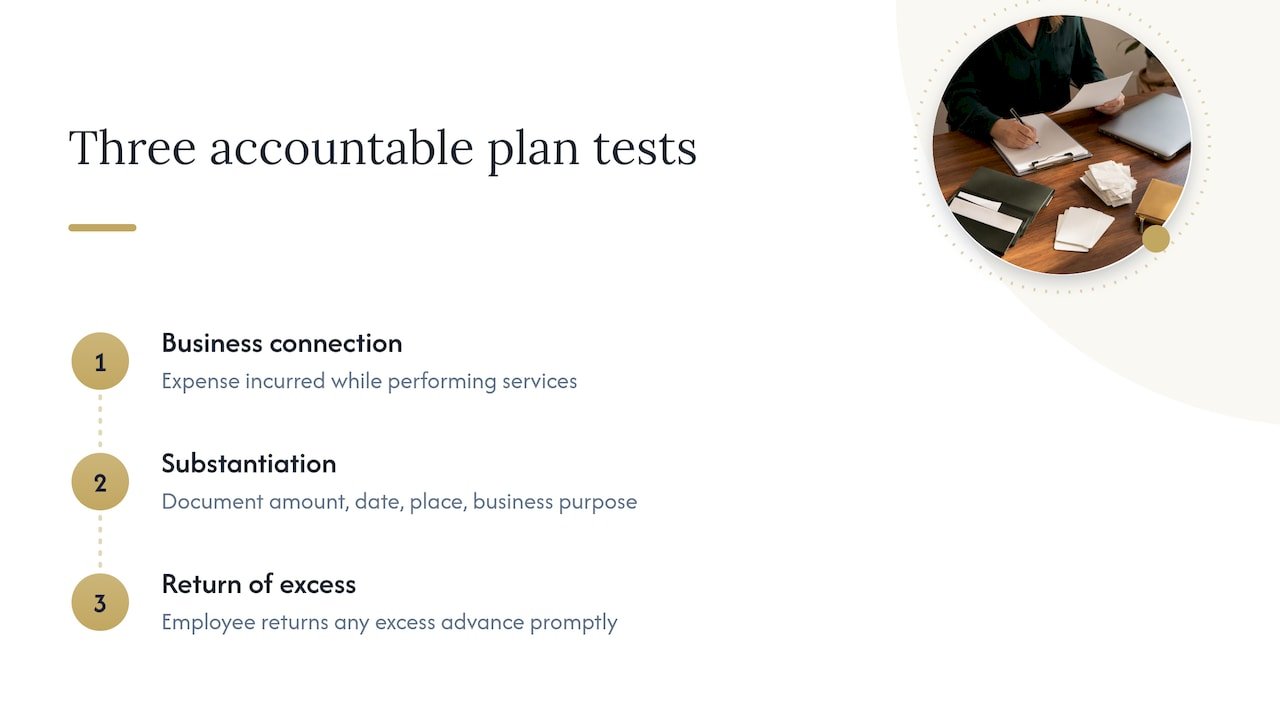
The accountable plan rules come from federal tax regulations, specifically 26 CFR § 1.62-2, which spells out when reimbursement arrangements qualify for tax-free treatment. Under this regulation, amounts paid to an employee are excluded from gross income and are not subject to employment taxes, but only when the arrangement meets all three tests. Miss one, and the payment becomes wages, reportable on Form W-2 and subject to withholding.
Business connection is the first test. The expense has to be one the employee incurs while performing services for the business, and it has to be the kind of cost the employee could otherwise deduct if they paid for it themselves. A salesperson’s mileage to visit a client qualifies. A reimbursement for an employee’s home internet bill with no documented work use does not, unless the business can tie it directly to job duties. The line matters because personal expenses never qualify for accountable plan treatment, even if the employer decides to pay for them.
Substantiation is the second test, and it’s where most small employers run into trouble. Research from Illinois State University confirms that an arrangement qualifies only when the employee provides adequate substantiation within a reasonable time, meaning enough detail for the employer to verify the amount, date, place, and business purpose of each expense. For meals or entertainment where attendees matter, the names and business relationship of those present should also be recorded. This isn’t paperwork for its own sake. Without it, the IRS has no way to distinguish a legitimate reimbursement from disguised compensation.
Return of excess is the third test. If an employee receives an advance larger than what they actually spent, or submits an expense report showing less than the advance covered, the employer has to require the employee to return the difference within a reasonable period. An employer that lets excess advances slide, without a formal process to claw them back, risks having the entire advance reclassified as wages.
When a plan fails any of these three tests, the consequences flow through payroll. Reimbursements paid under a nonaccountable plan are treated as regular wages: subject to income tax withholding, Social Security, Medicare, and federal unemployment tax, the same Illinois State University research confirms. That means a business that thought it was simply covering an employee’s travel costs could end up owing back payroll taxes, penalties, and interest on amounts it never intended to pay as salary. It also means the employee loses the tax-free benefit and sees the reimbursement show up as taxable income instead.
This is why the three-part test isn’t a bureaucratic technicality. It’s the dividing line between a reimbursement that costs nothing extra in taxes and one that quietly becomes payroll, with all the tax exposure that comes with it.
Safe-harbor timing windows and acceptable documentation methods
The IRS gives employers two ways to satisfy the “reasonable time” standard built into the substantiation and return-of-excess tests, and both come with specific day counts worth memorizing.
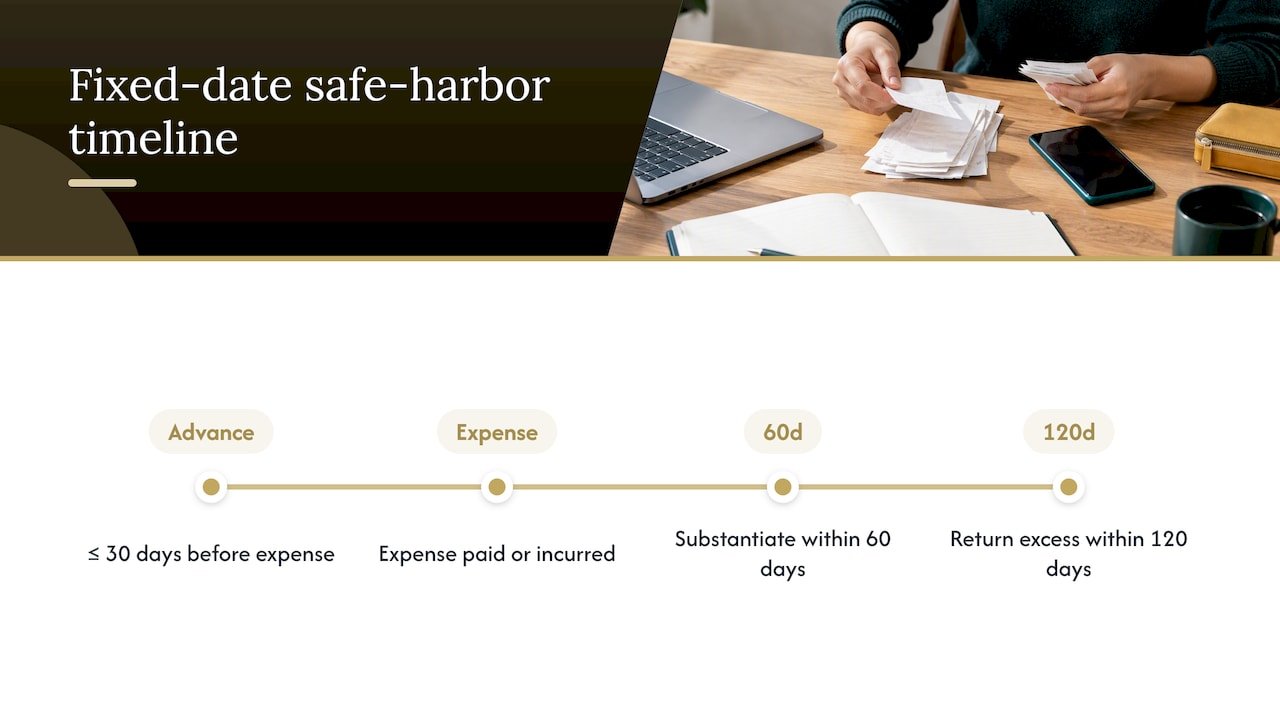
The fixed-date method is the one most small businesses use. According to guidance summarized by Kent State University’s tax resource, an advance made no more than 30 days before the anticipated expense is treated as reasonable. The employee then has 60 days after the expense is paid or incurred to substantiate it with adequate records. If there’s excess money left over, the employee has to return it within 120 days of when the expense was paid or incurred. Miss any of those three windows and the IRS can treat the payment as failing the safe harbor, even if the employer eventually sorts out the paperwork.
The periodic-statement method works differently and suits businesses that issue recurring advances, like a monthly travel stipend. Instead of tracking 30/60/120 days per transaction, the employer sends employees a statement at least quarterly listing amounts paid in excess of substantiated expenses. The employee then has 120 days from that statement to either substantiate the amount or return it. This method trades per-expense tracking for a periodic cleanup cycle, which can be easier for businesses with frequent, smaller reimbursements.
On documentation itself, Revenue Ruling 2003-106 confirms that electronic records satisfy substantiation requirements as long as they capture the same elements the IRS has always required: amount, date, place, and the essential business character of the expense. A scanned receipt stored in a cloud folder is valid evidence just as a paper one in a filing cabinet, provided the underlying details are legible and complete.
For mileage, the documentation standard shifts slightly. Instead of a receipt for every mile, the IRS expects a mileage log showing date, destination, business purpose, and miles driven, which IRS Publication 463 covers in detail along with per diem and lodging substantiation rules. Per diem arrangements that follow federal per diem rates generally simplify substantiation because the rate itself stands in for a detailed expense breakdown, though the business purpose and travel dates still need to be documented.
A common point of confusion is the so-called $75 receipt rule. In practice, this refers to older guidance under which expenses below a certain threshold didn’t require a physical receipt, relying instead on other reasonable evidence like a calendar entry or credit card statement. Many small businesses still apply a similar informal cutoff internally as a practical matter, though the safer approach is to require documentation for every expense a corporate card or reimbursement check covers, regardless of amount. Separately, employers should expect extra scrutiny around larger reimbursement amounts, since a $2,500 travel advance or a recurring allowance in that range is far more likely to draw a closer look during an IRS exam than a $40 lunch receipt.
Practical written-policy checklist and sample accountable plan elements
The IRS doesn’t technically require a written accountable plan document, but a business that tries to run one informally is asking for trouble the moment an auditor asks how expenses get approved. A written policy turns the three-part test into something employees and managers can actually follow day to day, and it gives the business something concrete to hand an auditor instead of explaining verbally how things “usually work.”
A solid policy maps directly to the IRS tests. The business-connection requirement gets satisfied by defining, in plain language, which expense categories qualify (travel, client meals, mileage, certain equipment) and which don’t (commuting costs, personal subscriptions). The substantiation requirement gets satisfied by specifying exactly what information an expense report must capture. The return-of-excess requirement gets satisfied by stating, in writing, what happens when an advance exceeds actual spending.
A checklist of what the policy document should cover:
- Submission window: how many days an employee has to submit an expense report after the expense occurs, ideally inside the 60-day safe harbor.
- Required fields: amount, date, business purpose, location, and attendees where meals or entertainment are involved.
- Receipt threshold: what dollar amount requires a physical or scanned receipt versus another form of reasonable evidence.
- Return-of-excess procedure: how and when unspent advance funds get returned, tied to the 120-day window.
- Approval authority: who signs off on expense reports before reimbursement is issued.
- Record retention period: how long substantiation records stay on file after submission.
Short, specific phrases work better than vague ones. A policy that says “employees must submit expense reports with receipts and business purpose within 60 days of the expense date” satisfies the substantiation test far more cleanly than one that says “employees should turn in expenses promptly.” A line like “any advance exceeding substantiated expenses must be returned within 120 days of payment” directly answers the return-of-excess test rather than leaving it implied.
Responsibility should be split across three roles. The employee submits a complete, timely expense report with proper documentation. The manager reviews the report for business justification and approves or questions it before it reaches accounting. The payroll or bookkeeping reviewer checks that the report matches policy requirements, confirms it’s coded correctly, and processes the reimbursement outside of regular wage payments.
Pro Tip: Build your expense report template with the required fields baked in as mandatory entries, so an incomplete submission simply can’t be approved.
Operational workflow: collecting reports, separating reimbursements from payroll, and payroll integration
A compliant policy only works if the day-to-day workflow actually follows it. Small businesses that handle this well tend to run the same basic sequence every time, with no exceptions carved out for convenience.
- Purchase occurs: the employee pays for a qualifying business expense, ideally on a designated card tied to the business.
- Receipt capture: the employee photographs or saves the receipt immediately, while the details are fresh and before paper fades or gets lost.
- Employee submission: the expense report is filed within the policy’s submission window, with all required fields completed.
- Manager approval: a supervisor reviews the report for business connection and flags anything unclear before it moves forward, a step our expense approval workflow guide breaks down in more detail.
- Bookkeeping reconciliation: the reviewer matches the report against card statements or bank records and confirms the amount and coding.
- Reimbursement payment: the employer issues payment as a distinct transaction, not folded into a paycheck.
That last step matters more than it looks. Reimbursements processed through payroll software can accidentally get swept into taxable wage calculations if they’re not flagged as nontaxable reimbursement codes, which is one of the quieter ways businesses stumble into the payroll tax exposure we cover in our payroll taxes guide for small businesses. The safest practice is to issue reimbursements as a separate payment, whether that’s a distinct direct deposit, a check, or a clearly labeled line item that payroll software excludes from taxable wage calculations.
Advances and corporate-card feeds need the same discipline. When an employee uses a company card, the card transaction itself isn’t the substantiation. The employee still has to submit the business purpose, date, and details tying that charge to a legitimate expense, or the charge risks being treated as an unsubstantiated advance.
On retention, Revenue Procedure 98-25 confirms that electronic records satisfy federal recordkeeping obligations under IRC §6001, so a business keeping digital expense reports and receipts for at least three years, matching standard IRS audit statute periods, is on solid ground.
Common pitfalls, audit readiness, and how the IRS examines accountable plans
Most accountable plan failures aren’t dramatic. They’re small, repeated lapses that add up to a pattern an auditor can spot in minutes.
- Late receipts: expenses substantiated well outside the 60-day window, especially when it becomes a habit rather than an exception.
- Unreturned excess advances: travel advances that exceed actual spending with no record of the difference being repaid.
- Commingled reimbursements and wages: expense payments folded into regular paychecks without separate coding.
- Vague business purposes: expense reports that say “client meeting” with no name, company, or reason attached.
- Weak meal and entertainment records: missing attendee names or business relationship details on higher-cost meals.
Practitioner guidance from the Journal of Accountancy points out that the real burden for small businesses isn’t the tax law itself but inconsistent recordkeeping and workflows, which is exactly what trips up otherwise compliant employers during an exam.
Automation and consistent submission cadences materially reduce audit risk, according to the same Journal of Accountancy reporting, because a repeatable process leaves a cleaner paper trail than ad hoc approvals ever do.
When the IRS examines an accountable plan, the focus is almost always on whether the three-part test was actually followed in practice, not just on paper. Auditors ask for sample expense reports, look for gaps between the advance date and substantiation date, and check whether excess amounts were genuinely returned. Having a written policy, a consistent approval trail, and organized digital records ready to hand over turns an exam from a stressful scramble into a quick document pull.
If you discover a gap after the fact, the remediation path is straightforward: reclassify any noncompliant reimbursements as wages for the affected period, make the necessary payroll tax adjustments, and tighten the written policy so the same gap doesn’t recur. Acting on it voluntarily, before an audit finds it, is always the better position to be in.
Tools and automation: categories and integration patterns for small businesses
Manual expense tracking is where most accountable plans quietly fall apart, which is why the right tool stack matters almost as much as the policy itself.
- Receipt-capture apps: mobile tools that photograph and timestamp receipts at the point of purchase, creating an automatic record of date and amount.
- Mileage trackers: apps that log trips automatically using GPS, satisfying the mileage substantiation standard outlined in our mileage tracking checklist.
- Corporate-card reconciliation tools: software that matches card charges to submitted receipts and flags unmatched transactions.
- Accounting and payroll integrations: platforms that route approved reimbursements into the general ledger as nontaxable payments rather than wages, which pairs well with the broader automation patterns in our accounts payable automation guide.
Automation supports every safe-harbor window by design. A receipt captured and submitted the same day the expense occurs makes the 60-day substantiation deadline trivial to hit, and a system that flags outstanding advances automatically makes the 120-day return window far easier to enforce.
When choosing tools, small businesses should weigh price against the size of their expense volume, how easy the tool is for non-accounting staff to use without training, and whether it integrates directly with QuickBooks or the payroll system already in place. A tool that requires manual re-entry into accounting software defeats much of the point.
Pro Tip: Set receipt-capture apps to timestamp and geotag purchases automatically, so the date and place fields on your expense report fill themselves in instead of relying on an employee’s memory a week later.
How we implement accountable plans for small businesses
We build accountable plan policies as part of a broader financial cleanup for small business clients, starting with a written policy document tailored to the business’s expense categories and approval structure. From there, we set up the QuickBooks coding that keeps reimbursements separate from payroll, configure expense-report workflows that match the 60-day and 120-day safe harbors, and train the staff responsible for reviewing and approving reports.
Handling bookkeeping, payroll, and tax preparation together helps to see how a reimbursement policy affects the general ledger, payroll tax filings, and year-end tax returns all at once, rather than treating each as a separate problem. That connected view is often what catches a misclassified reimbursement before it becomes a payroll tax liability.
What small businesses get wrong about accountable plans
The biggest misconception we see is that accountable plans are a one-time setup task. In practice, the policy document is the easy part. The workflow discipline, submitting on time, approving consistently, returning excess advances without exception, is what actually determines whether the plan holds up.
Conventional advice tends to over-focus on the paperwork template and under-focus on the habit of enforcing it every pay cycle. A business owner who downloads a sample policy and never revisits whether employees are actually following the 60-day window has built a document, not a compliant plan.
If you take one thing from this guide, prioritize the return-of-excess step. It’s the rule employers forget most often, because unlike submitting a receipt, nobody reminds an employee to hand back $40 in unused travel funds. Build that reminder into your process before you worry about anything else.
— Kelli
How KelliWorks can help you set up a compliant accountable plan
Setting up an accountable plan touches policy writing, payroll coding, and bookkeeping all at once, which is cross-functional work often needed for small business clients. Our services can include drafting the written policy, configuring accounting and payroll systems so reimbursements stay separate from wages, and building approval workflows that managers and staff can follow without difficulty.

A typical engagement starts with a short consultation where we review your current expense process, identify gaps against the IRS safe-harbor windows, and scope out what the policy and workflow setup will involve for your specific business. From there we deliver the written policy, the QuickBooks configuration, and a short training session for whoever approves expense reports. If you’re ready to get this off your plate, schedule a consultation and we’ll take it from there.
This article is general information, not a substitute for advice from a qualified financial advisor. Consult a qualified financial professional about your own circumstances before acting on anything here.
FAQ
What are the IRS requirements for an accountable plan?
An accountable plan must meet three tests under 26 CFR § 1.62-2: the expense needs a business connection, the employee must substantiate it within a reasonable time, and any excess advance must be returned to the employer. Meeting all three keeps the reimbursement free from income and payroll taxes.
Is there a template for an accountable plan?
The IRS doesn’t publish an official template, but a compliant written policy should include a submission deadline, required expense-report fields, a receipts threshold, a return-of-excess procedure, and defined approval authority. Many accounting firms, including our team, draft custom policy documents built around these same elements.
What is the $75 receipt rule?
This refers to informal guidance some employers apply internally, treating expenses under a certain small-dollar threshold as not requiring a physical receipt if other reasonable evidence exists. The safer practice for most small businesses is to document every expense regardless of amount, since the IRS evaluates substantiation quality case by case.
What is the $2,500 expense rule?
There’s no formal IRS rule set exactly at $2,500, but reimbursements or advances near that amount tend to draw closer scrutiny during an exam because of the size of the potential tax exposure if the substantiation is weak. Treat larger advances with the same documentation rigor you’d apply to a smaller one, since the three-part test doesn’t change based on dollar amount.
Sources
- 26 CFR § 1.62-2 – Reimbursements and other expense allowance arrangements (LII)
- Revenue Ruling 2003-106 (IRS)
- Employee expenses and accountable plans (Journal of Accountancy)
- Accountable plans and the 60-day substantiation rule (Illinois State University)