


Most small businesses lose 3–7% of revenue annually to quiet, recurring profit leaks — not one dramatic expense but a cluster of small drains that compound month after month. On a $1M business, that’s $30,000–$70,000 lost every year. The good news: most of these leaks are fixable within days, not months.
Here are the top leaks and a one-line fix for each:
- Subscription/SaaS creep — Pull your last 12 months of recurring charges and cancel anything unused. Estimated recovery: a small fraction of revenue.
- Aging accounts receivable — Run an AR aging report today and call every invoice over 30 days. Estimated recovery: a modest portion of revenue in freed cash.
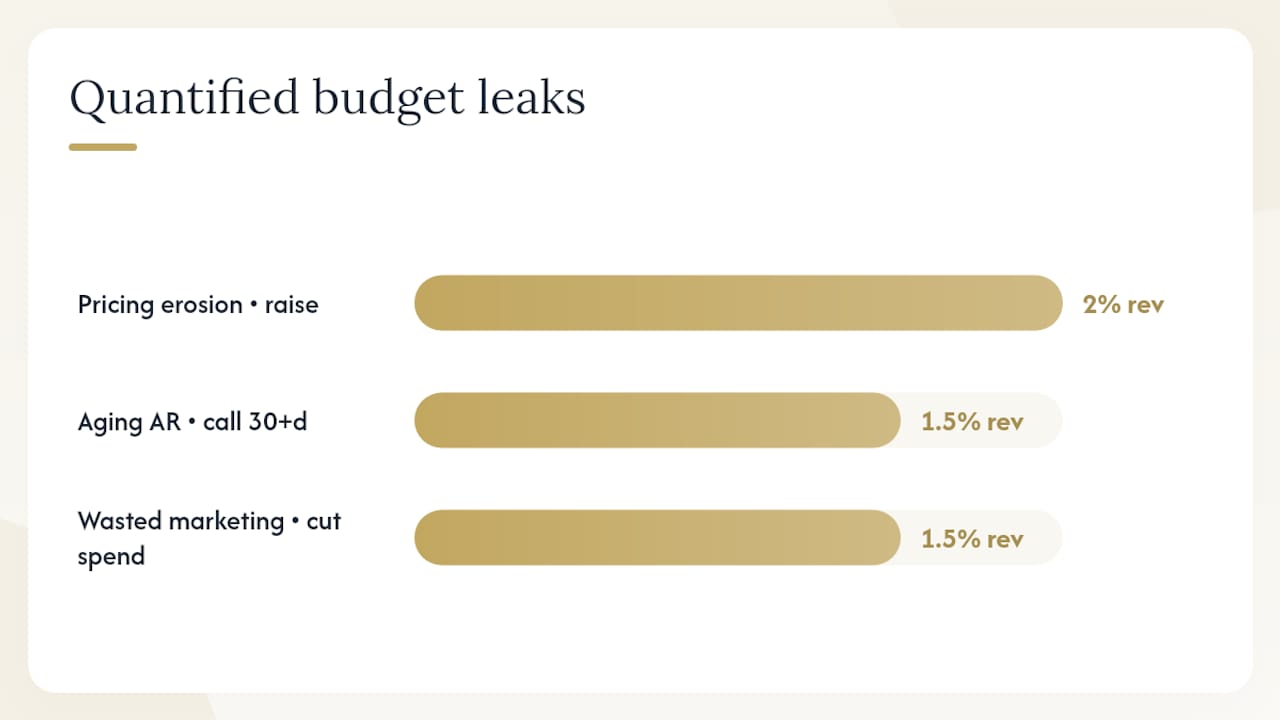
- Pricing erosion — Review your gross margin by product or service line; raise prices where margin has slipped below target. Estimated recovery: a minor share of revenue.
- Payment processing fees — Compare your effective rate against current market rates and renegotiate or switch processors. Estimated recovery: a small fraction of revenue.
- Inventory/WIP shrinkage — Reconcile physical counts against your system monthly to catch discrepancies early. Estimated recovery: a modest fraction of revenue.
- Payroll/staffing misalignment — Compare billable hours or output per role against loaded labor cost using BLS benchmarks. Estimated recovery: varies by situation.
- Vendor contract waste — Pull every active vendor contract and flag any auto-renewing terms you haven’t reviewed in 12+ months. Estimated recovery: a small fraction of revenue.
- Wasted marketing spend — Identify your cost per lead by channel and cut or reallocate spend from channels with no measurable return. Estimated recovery: a modest portion of revenue.
- Inefficient processes — Time your highest-volume workflows; bottlenecks that add unbillable hours are direct profit drains. Estimated recovery: varies by situation.
Profit Leak Audits commonly find $60,000–$140,000 in annual recoverable profit for businesses doing $2M in revenue, and proportionally less for smaller firms. The leaks above are where that money hides.
Table of Contents
- What do common budget leaks in small businesses actually look like?
- How to run a simple 5-step budget audit this week
- What controls and tools prevent leaks from coming back?
- How Kelliworks helps you find and fix budget leaks
- How does cash flow forecasting help you catch budget leaks earlier?
- How do economic shifts create unexpected spending leaks?
- Key Takeaways
- Why closing leaks beats chasing more revenue
- Your budget-leak audit, done for you by Kelliworks
- Authoritative sources and suggested reading
What do common budget leaks in small businesses actually look like?
Every leak on that list has a specific fingerprint in your financial reports. Knowing what to look for cuts the time to find and fix each one.
Pricing erosion
This shows up as a declining gross margin percentage on your P&L, even when revenue is growing. Pull a “Gross Margin by Product/Service” report in QuickBooks or your accounting system. If margin has dropped more than 2–3 percentage points year-over-year without a deliberate reason, you have pricing erosion. Common causes: discounts given informally, cost increases not passed to customers, or scope creep on fixed-price contracts.
Immediate fixes: Audit your last 20 invoices for unauthorized discounts. Add a cost-escalation clause to new contracts. Schedule a pricing review for your top five revenue lines.
Subscription and SaaS creep
Pull your credit card and bank statements for the last 12 months and filter for recurring charges. Forgotten subscriptions, processing fee overpayments, and redundant tools are among the most frequent and quantifiable spending leaks for small businesses. Businesses commonly find three to nine subscriptions they can cancel in a single afternoon. Grouping charges under $10 is worth the effort too — micro-charges can surface $500–$1,500 in annual leakage that most owners never notice.
Immediate fixes: Build a subscription register (tool name, cost, renewal date, owner). Cancel anything with no active user. Consolidate overlapping tools.
Aging accounts receivable
Run your AR aging report. Any invoice over 30 days is costing you real cash, and invoices over 60 days have a meaningfully lower collection rate. For B2B service businesses, AR is often the single largest leak. Target AR days below 30; anything above 45 warrants a collections process review.
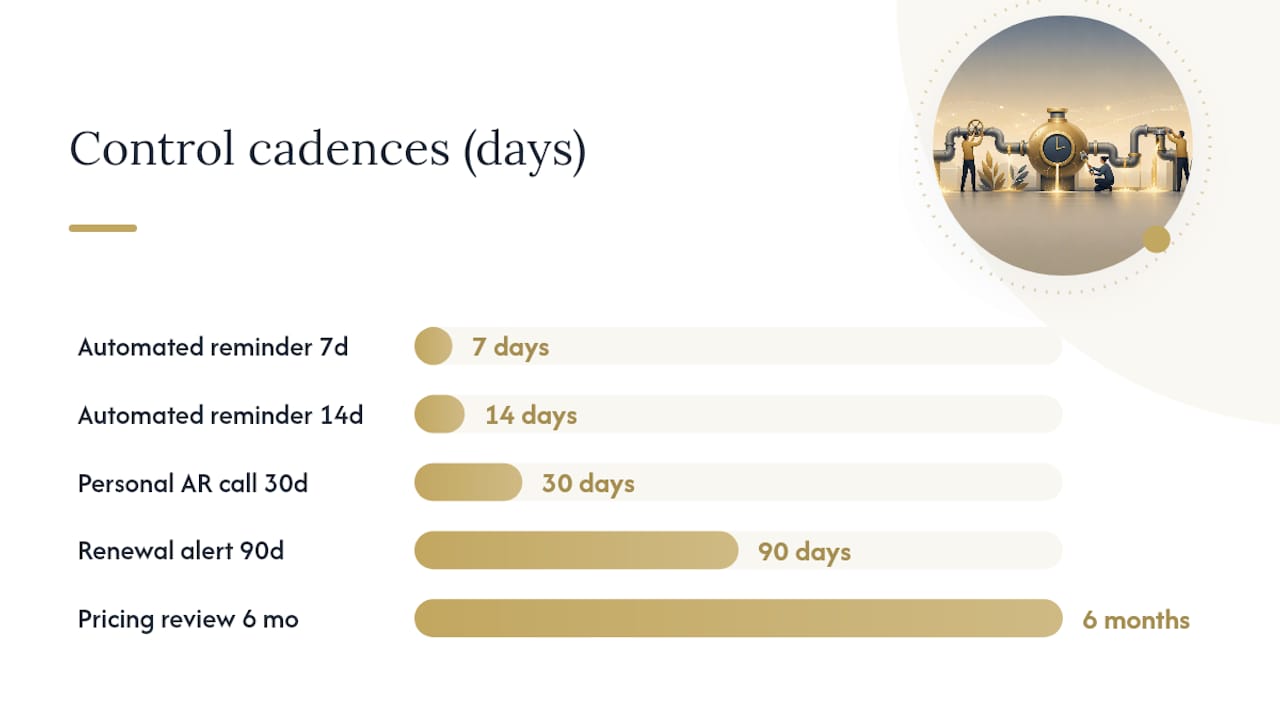
Immediate fixes: Call (don’t just email) every invoice over 30 days. Offer a small early-payment discount for chronic late payers. Set up automated payment reminders at 7, 14, and 30 days past due.
Payroll and staffing misalignment
This leak is harder to see but often large. Compare your loaded labor cost per role (salary plus benefits plus payroll taxes) against the revenue or output that role generates. BLS labor metrics provide useful industry benchmarks for loaded labor costs by firm size. Signs of misalignment: roles with low billable utilization, overtime costs that recur without a revenue spike, or contractors paid at rates that exceed the value of their deliverables.
Immediate fixes: Pull a payroll hours-by-role report for the last 90 days. Flag any role where billable or productive hours fall below 70% of total hours. Review contractor invoices against deliverables.
Inventory and WIP shrinkage
Shrinkage in product businesses comes from theft, damage, or miscounting. In service businesses, it shows up as work-in-progress that never gets billed. Both drain cash silently. Pull a WIP or inventory reconciliation report and compare it against your last physical count or billing records.
Immediate fixes: Schedule a monthly physical count for your top 20 SKUs. For service businesses, reconcile WIP to invoices weekly. Flag any project that has been “in progress” for more than twice its estimated duration.
Vendor and supplier contract waste
Auto-renewing contracts are one of the quietest leaks. Pull every active vendor agreement and check the renewal date, notice period, and current rate against market alternatives. Marketing and operational audits regularly surface underperforming channels and scope creep as meaningful budget drains, and fixing them often recovers tens of thousands annually.
Immediate fixes: Create a vendor renewal calendar. Flag any contract renewing in the next 90 days for a competitive review. Renegotiate annual commitments to monthly where flexibility matters more than the discount.
Wasted marketing spend
Pull a cost-per-lead or cost-per-acquisition report by channel. If you can’t produce that report, that’s the first problem. Channels with no measurable conversion data are almost always underperforming. Reallocating even 20% of spend from a low-performing channel to a proven one can meaningfully improve marketing ROI without increasing the total budget.
Inefficient processes and production bottlenecks
Time your highest-volume workflows from start to finish. Bottlenecks that add unbillable hours, require rework, or delay invoicing are direct profit drains. A service business that invoices two weeks after project completion is effectively giving clients a two-week interest-free loan.
Immediate fix: Map your top three workflows end-to-end. Identify the one step that most often causes delay and assign an owner to fix it within 30 days.
Summary table: leaks, typical impact, and fastest fix
| Budget Leak | Typical Impact (% of revenue) | Fastest Fix |
|---|---|---|
| Pricing erosion | 1–3% | Gross margin by product/service report; raise prices |
| Subscription/SaaS creep | a small fraction | 12-month recurring charge audit; cancel unused |
| Aging AR | 1–2% | AR aging report; call invoices over 30 days |
| Payment processing fees | a small fraction | Compare effective rate; renegotiate or switch |
| Inventory/WIP shrinkage | a modest fraction | Monthly physical count or WIP reconciliation |
| Payroll misalignment | Variable | Hours-by-role report; compare to BLS benchmarks |
| Vendor contract waste | a small fraction | Renewal calendar; competitive review at 90 days |
| Wasted marketing spend | 1–2% | Cost-per-lead by channel; cut zero-ROI spend |
| Process bottlenecks | Variable | Workflow map; assign owner to top delay point |
How to run a simple 5-step budget audit this week
The objective is straightforward: find recurring drains that cost you cash but don’t deliver value. A focused 30–60 minute weekly review of statements and recurring charges is enough to identify and eliminate runaway expenses quickly. Here’s the full audit sequence:
-
Pull your bank and credit card statements for the last 12 months. Filter for recurring charges. In most banking portals, you can search by merchant name or amount. Time: 30–45 minutes. Owner or bookkeeper.
-
Map every recurring charge to a subscription register. List the tool or service, monthly cost, renewal date, and the team member who uses it. Flag anything with no named user or no recent login. Time: 45–60 minutes. Owner or bookkeeper.
-
Run your AR aging report. In QuickBooks, this is under Reports > Customers & Receivables > A/R Aging Detail. In Xero, it’s under Accounting > Reports > Aged Receivables. Flag every invoice over 30 days. Time: 15–20 minutes. Owner or bookkeeper.
-
Pull a P&L by month for the last 12 months and a Gross Margin by Product/Service report. Look for months where gross margin dropped without a clear reason. Look for product or service lines where margin is below your target. Time: 30–45 minutes. Owner or financial consultant.
-
Run a vendor contract review. Pull every active vendor agreement. Check renewal dates, current rates, and whether the service is still delivering value. Flag any contract renewing in the next 90 days. Time: 60–90 minutes. Owner or head of operations.
Pro Tip: Run Steps 1–3 monthly. Steps 4–5 are quarterly work. Audits that search across multiple systems — bank, processor, inventory, and time tracking — find the leaks that a single dashboard will miss. Coordinate a cross-system review at least once per quarter.
For deeper guidance on building these routines into your regular bookkeeping cycle, Kelliworks’s bookkeeping best practices guide covers reconciliation checklists and recurring charge registers in detail.
What controls and tools prevent leaks from coming back?
Finding a leak once is useful. Preventing it from returning is where the real value compounds. These controls require minimal overhead and can be implemented without dedicated finance staff.
Policy controls:
- Require written approval for any new subscription or software purchase above $50/month.
- Maintain a renewal calendar with 90-day advance alerts for every vendor contract.
- Schedule a pricing review for your top revenue lines every six months.
- Set a vendor review cadence: quarterly for top five vendors, annually for the rest.
- Establish an AR follow-up workflow: automated reminders at 7 and 14 days, personal call at 30 days.
Tool categories to consider:
- Subscription management tools that track recurring charges and flag new ones automatically.
- Invoice automation that sends reminders and tracks payment status without manual follow-up.
- Payment routing that directs customers toward lower-fee payment methods (ACH over credit card where possible).
- Basic inventory or WIP tracking integrated with your accounting system.
- A lightweight budgeting app like Prism Wallet for freelancers and small professional-service businesses managing recurring-charge controls.
Sample dashboard KPIs to monitor monthly:
- AR days: Target under 30; alert at 45+.
- Gross margin by service/product line: Flag any line that drops more than 2 points month-over-month.
- Recurring spend per active user: Divide total SaaS/subscription spend by headcount; flag increases above 10% quarter-over-quarter.
- Vendor concentration %: No single vendor should represent more than 30% of your total operating spend without a strategic reason.
- WIP burn-down: Track the ratio of WIP to monthly billings; a rising ratio signals unbilled work accumulating.
Workflow template for renewals and approvals:
- Owner approves any new vendor or subscription above $100/month.
- Bookkeeper maintains the subscription register and flags renewals 90 days out.
- Head of ops or sales signs off on vendor contract renewals above $5,000/year.
- All approvals are documented in a shared folder with the contract and renewal date.
Pro Tip: The cost-saving accounting strategies Kelliworks publishes include ready-to-use templates for recurring-expenditure registers and vendor review checklists — a practical starting point if you’re building these controls from scratch.
How Kelliworks helps you find and fix budget leaks
A Kelliworks engagement typically follows three phases: a discovery audit, a prioritized fix plan, and ongoing monthly monitoring. Most clients complete the discovery audit within two weeks of their first consultation.
What Kelliworks delivers:
- A subscription and recurring-charge register with cancellation and renegotiation recommendations.
- An AR aging analysis with a follow-up workflow your team can run independently.
- A vendor contract review with a renegotiation plan for the highest-value contracts.
- A monthly dashboard with variance alerts tied to your specific KPIs (AR days, gross margin, recurring spend per user).
- A written prioritization plan ranking fixes by estimated dollar recovery and implementation effort.
What to prepare before your consultation:
- Last 3 months of bank and credit card statements.
- Your most recent AR aging report.
- A list of active vendor contracts (or access to your accounting system).
- Your last 12 months of P&L, ideally broken down by product or service line.
- Any payroll or contractor invoices from the last 90 days.
Kelliworks’s bookkeeping best practices and cost-saving strategies guides are available as free resources for owners who want to start the process independently before booking a consultation.
How does cash flow forecasting help you catch budget leaks earlier?
Cash flow management and forecasting are the early-warning system for profit leaks. A business can show positive net income on its P&L and still run out of cash because of timing mismatches between revenue and expenses. Forecasting makes those mismatches visible before they become crises.
A rolling 13-week cash flow forecast, updated weekly, will surface patterns that monthly P&L reports miss: a vendor payment that always hits before client payments clear, a payroll cycle that creates a predictable cash trough, or a seasonal dip in collections that strains operations every year. These patterns are budget leaks in disguise — they force you into expensive short-term borrowing or cause you to delay vendor payments, which damages relationships and sometimes triggers late fees.
The connection to leak detection is direct. When you manage cash flow with consistent bookkeeping, you create a baseline that makes anomalies obvious. A month where operating expenses spike 8% without a revenue explanation is a signal worth investigating immediately. Without a forecast baseline, that spike goes unnoticed until it’s already recurring.
Practical steps: build a simple cash flow forecast in your accounting system or a spreadsheet, update it weekly with actual figures, and review the variance between forecast and actual at the end of each month. Variances above 5% in any expense category warrant a line-by-line review.
How do economic shifts create unexpected spending leaks?
External factors create budget leaks that no internal audit can fully prevent — but they can be anticipated and managed. The businesses that get hurt most are the ones that set budgets annually and never revisit them when conditions change.
Inflation is the clearest example. When input costs rise faster than your pricing, gross margin erodes automatically, even if you haven’t changed a single internal process. A vendor who raises rates by 12% mid-contract, a freight cost that doubles, or a software tool that reprices at renewal — each of these is an externally driven leak that requires an active response.
Interest rate environments affect small businesses through the cost of credit lines, equipment financing, and the opportunity cost of holding excess inventory. When rates are elevated, carrying unnecessary inventory or maintaining a large AR balance is more expensive than it looks on a simple aging report.
Industry-specific trends matter too. A shift in customer payment preferences (more credit card, less ACH) raises your effective processing fee rate without any change in your pricing. A labor market tightening in your sector raises your loaded labor cost even if you haven’t given raises, because overtime and recruiting costs climb.
The practical response is a quarterly budget review, not just an annual one. Compare your current input costs against the assumptions you made when you set the budget. Any line item that has moved more than 5% warrants a pricing or process adjustment. Businesses that treat their budget as a living document — not a once-a-year exercise — catch these external leaks before they compound.
Key Takeaways
Fixing profit leaks is faster and more certain than growing revenue by the same dollar amount — and most small businesses can recover meaningful cash within the first week of a focused audit.
| Point | Details |
|---|---|
| Scale of the problem | Most small businesses lose 3–7% of revenue annually to recurring profit leaks across five core categories. |
| Fastest wins | Subscription audits and AR collections are the lowest-effort, highest-velocity fixes — start there. |
| Audit cadence | Run bank/subscription and AR reviews monthly; vendor contracts and gross margin quarterly. |
| Tax planning gaps | Missed deductions, entity structure mismatches, and underpayment penalties are avoidable leaks that compound annually. |
| Kelliworks | Kelliworks provides a done-for-you discovery audit, prioritized fix plan, and monthly monitoring to close leaks and keep them closed. |
Why closing leaks beats chasing more revenue
The conventional advice for a struggling small business is almost always “grow your way out of it.” More clients, more marketing, more revenue. That advice isn’t wrong, but it consistently underestimates how hard revenue growth actually is — and how fast and certain leak recovery can be by comparison.
Consider the math. If your business earns a 15% net margin and you want an extra $30,000 in profit, you need $200,000 in new revenue to get there. That’s a significant sales effort, with no guarantee of success and a timeline measured in quarters. Recovering $30,000 from a subscription audit, an AR collections push, and a pricing correction? That’s often achievable in 30 days, with no new customers required.
The leaks covered in this article aren’t exotic or unusual. They’re the predictable result of a business that’s growing faster than its financial controls. Subscriptions accumulate because nobody owns the renewal calendar. AR ages because collections feel awkward. Pricing erodes because raising rates feels risky. None of these are failures of effort — they’re failures of system.
The audit framework here is designed to give you the system. Run it once, implement the quick wins, and build the controls that prevent the leaks from returning. If you’d rather hand that work to a team that does it every day, that’s exactly what Kelliworks is built for.
Your budget-leak audit, done for you by Kelliworks
Kelliworks acts as your virtual accounting department — handling the discovery audit, implementing the fixes, and monitoring your financials monthly so leaks don’t quietly return. For businesses doing $500K–$2M in revenue, the audit typically identifies $60,000–$140,000 in recoverable profit. The engagement pays for itself.
Before your consultation, gather your last three months of bank and credit card statements, your most recent AR aging report, and your 12-month P&L. Kelliworks handles the rest: the subscription register, the vendor renegotiation plan, the AR follow-up workflow, and the monthly dashboard. If you want to understand exactly what hiring a virtual accountant looks like in practice, that page walks through the full engagement model. Ready to stop the leaks? Book a free consultation with Kelliworks today.
Authoritative sources and suggested reading
Research and industry sources:
- 5 Cash Leaks Every Small Business Has (And How to Find Them) | Fynso
- The Profit Leak Audit: How to Find and Fix the $50K+ Your Business Is Bleeding Every Year
- 7 Spending Leaks That Are Quietly Draining Your Business (and How to Find Them)
- 7 Financial Leaks That Are Quietly Killing Small Businesses — Cashowa Blog — Cashowa
- 5 Simple Steps to Stop Money Leaks in Your Small Business — Grow America
- bls.gov
- Cost-Saving Accounting Strategies for Small Business – Kelliworks Accounting FIrm
- Bookkeeping Best Practices for Small Business Owners
Kelliworks guides and templates:
- Cost-Saving Accounting Strategies for Small Business — Templates and strategies for reducing recurring costs. (Practical checklist)
- Bookkeeping Best Practices for Small Business Owners — Reconciliation checklists and recurring charge registers. (Operational template)



One Response