


If your business missed a tax deadline, file the return now, even if you cannot pay the full balance. Penalties grow every month the return stays unfiled, and filing quickly is the single step that stops the larger one. We handle late business returns for owners every day. We can prepare and file them ourselves, or work alongside the CPA you already have.
TL;DR
- File the past-due return as soon as possible, whether or not you can pay in full. The failure-to-file penalty is 5% of the unpaid tax for each month or part of a month, up to 25%.
- Filing late and paying late are separate penalties. Paying what you can now reduces the second one.
- If you cannot pay, the IRS offers extra time to pay, installment agreements and, in some cases, an offer in compromise.
- A first-time or reasonable-cause situation may qualify for penalty relief, but the IRS decides case by case, so we never promise an outcome.
- U.S. tax rules vary by state, so a late federal return usually means a late state return, too.
Table of Contents
- What to do first when a deadline has passed
- Which return and which deadline applied to you
- What late filing costs
- Why an extension does not rescue a late return, and what it does
- If you cannot pay what you owe
- What happens if you never file
- Asking the IRS to remove a penalty
- State and local deadlines are a separate clock
- A recovery plan you can follow this week
- Where we fit in
- Our perspective
- FAQ
- Sources
What to do first when a deadline has passed
Start by finding out which return you missed and for which year. The IRS tells businesses to file all past-due returns the same way and to the same place an on-time return would go, whether or not the business can pay in full. If you received an IRS notice, send the return to the address on the notice.
Then gather what the return needs:
- Bank and credit card statements for the full year.
- Sales records, invoices and 1099s you received or issued.
- Payroll reports, if you have employees.
- Last year’s return, if one exists, for depreciation schedules and carryovers.
- Any IRS or state notices, unopened mail included.
The usual obstacle is not the form. It is books that were never closed. A return built on unreconciled records can be wrong, and a wrong return leads to amended filings later. If your records are behind, closing the books for taxes is the first job, and it is the part we take off your plate.
Once the return is filed, expect a wait. The IRS says it takes about 6 weeks to process an accurately completed past-due return, according to the same IRS guidance.
Which return and which deadline applied to you
The form depends on how your business is taxed, and so does the original due date. That date is the starting point for every penalty.
| Business type | Federal return | Original due date (calendar-year) |
|---|---|---|
| Sole proprietorship | Schedule C attached to Form 1040 | April 15 |
| Partnership | Form 1065 | March 15 |
The IRS explains both dates in Starting or ending a business: a Schedule C return is due on the 15th day of the fourth month after year-end, and a partnership return on the 15th day of the third month. Single-member LLCs are usually taxed like a sole proprietorship and multi-member LLCs like a partnership, unless the LLC elected corporate treatment. Corporations have their own forms and dates, and your tax preparer can confirm the one that applies to your entity.
If you meant to be taxed as an S corporation and never filed the election, that is a separate problem with its own clock. Our Form 2553 checklist walks through it.
What late filing costs
There are two main federal penalties, and they run side by side.
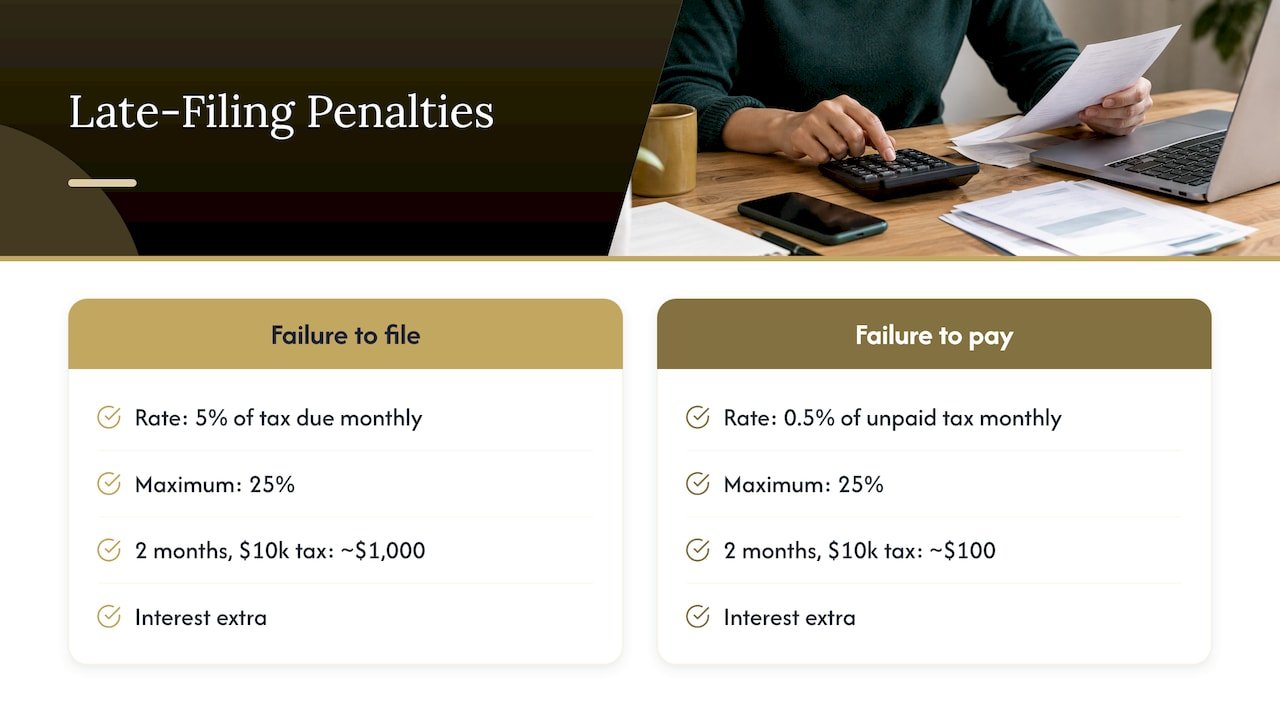
Failure to file. The IRS charges 5% of the tax due, less any tax paid on time and any available credits, for each month or part of a month the return is late, up to 25%. For Forms 1040 and 1120 more than 60 days late, there is a minimum penalty: $525 for returns due after December 31, 2025, or 100% of the tax owed if that is less.
Failure to pay. The late-payment penalty is one-half of 1% of the unpaid tax for each month or part of a month, capped at 25%. Interest accrues on top of both.
Here is a simplified example, not a prediction. Say a business owes $10,000 and files two months late without paying. The failure-to-file penalty is roughly 5% times 2 months, or $1,000. The failure-to-pay penalty is roughly 0.5% times 2 months, or $100. Interest is extra, and the exact figure depends on how the IRS applies the two penalties together. The point is that the filing penalty is about ten times larger per month, so getting the return in is the priority even when cash is short.
Both penalties can be waived if you show reasonable cause. More on that below.
Why an extension does not rescue a late return, and what it does
An extension has to be requested by the original due date. Form 7004 gives most businesses an automatic extension to file, generally 6 months, if the form is completed properly, a proper estimate is made, it is filed on time and any tax due is paid, according to the Form 7004 instructions. If you are reading this after the deadline, that route has closed for the year you missed, but it matters for next year.
Two points owners often miss:
- An extension gives more time to file, not more time to pay. The IRS says interest and penalties keep accruing on unpaid tax until it is paid in full.
- Filing an extension may help avoid the failure-to-file penalty, but without a payment of estimated tax, the Taxpayer Advocate Service notes a failure-to-pay penalty will generally be assessed.
We cover the forms and payment mechanics in our guide to the business tax extension. If your estimated payments were short during the year, the estimated tax safe harbor explains how to set them so next year goes more smoothly.
If you cannot pay what you owe
Do not hold the return back because the balance is large. The IRS says to file regardless and then deal with payment. Its options, described in the past-due returns guidance, include:
- More time to pay. You can request an additional 60 to 120 days through the Online Payment Agreement application or by calling 800-829-1040, with no user fee.
- An installment agreement. Monthly payments over time.
- An offer in compromise. Some taxpayers qualify to settle for less than the full amount.
The sooner tax is paid, the less penalty and interest builds, as the Taxpayer Advocate Service points out. Even a partial payment with the return helps.
What happens if you never file
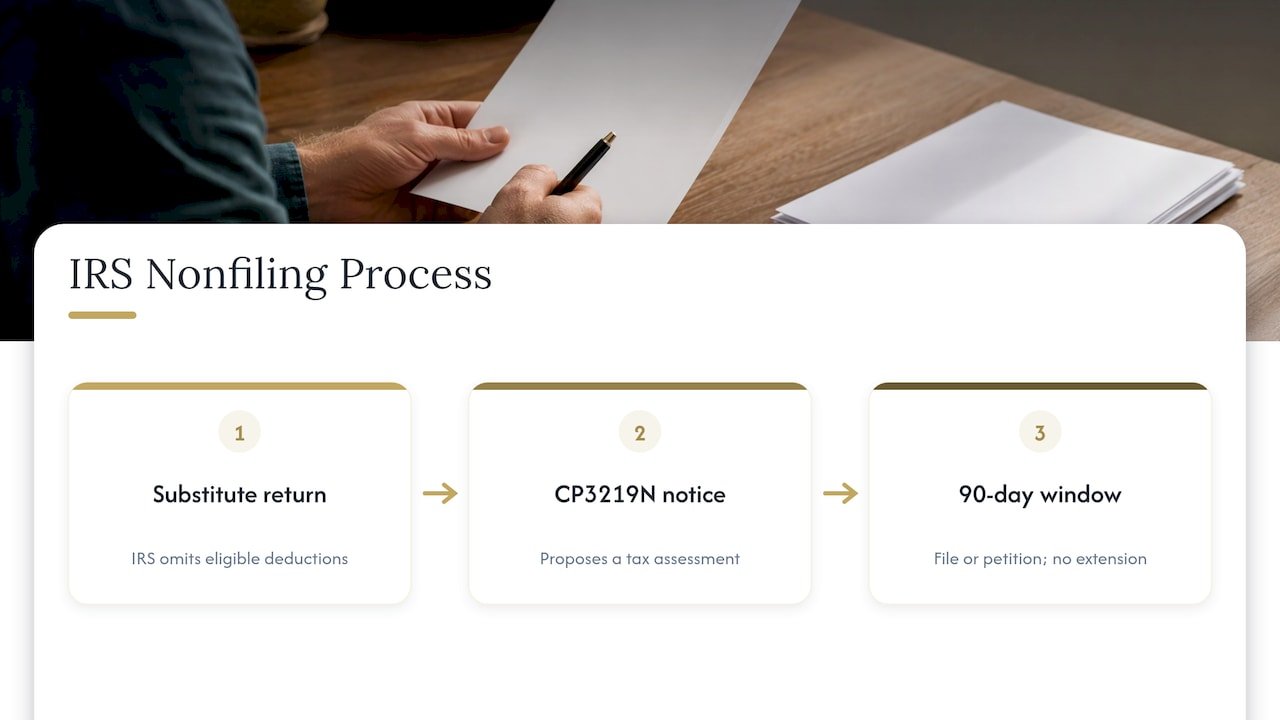
The IRS does not wait forever. If a business does not file, the IRS may prepare a substitute return for you. That return does not credit deductions and exemptions you may be entitled to. The IRS can then send a Notice of Deficiency, CP3219N, often called a 90-day letter, proposing a tax assessment. You have 90 days to file the past-due return or petition the Tax Court, and once you have received CP3219N you cannot request an extension to file. All of this is laid out on the IRS past-due returns page.
This is the answer for owners who ask what happens when an LLC simply does not file. The IRS can build the return for you, and it will be built without your deductions. Filing your own return, with your real expenses, is nearly always the stronger position.
There is also a deadline that works in your favor. A business owed a refund from withholding or estimated taxes must file within 3 years of the due date to claim it, and the same 3-year rule applies to credits, again per the IRS guidance linked above. Waiting past that point can forfeit money that was yours.
Asking the IRS to remove a penalty
Penalties are not always final. If something outside your control kept you from filing, such as a serious illness, a disaster or records you could not obtain, you can ask the IRS to abate the penalty by writing a statement of what kept you from filing on time. The Taxpayer Advocate Service describes this process on its extensions page. Both the filing and payment penalties are not charged when you show reasonable cause.
A strong request is specific: dates, what happened, what you did to fix it once you could, and documents that back it up. Whether the IRS grants relief is its decision, and we cannot promise a result. We can help you put the request together.
State and local deadlines are a separate clock
Federal filing is only part of the picture. U.S. tax rules vary by state, and many states and cities have their own penalty schedules, which can be steep. A few examples from official sources show how different they are:
- California. The Franchise Tax Board charges a 5% monthly delinquent-filing penalty, up to 25%, on corporations and partnerships. For LLCs and partnerships with original due dates on or after January 1, 2011, the late-filing penalty is $18 per member or partner per month, up to 12 months and $216 per member or partner. California automatically allows an extension to file for corporations and LLCs that are not suspended or forfeited, but late payment penalties and interest still apply if tax is not paid by the original due date.
- Oregon. The Department of Revenue applies a 5% late-pay penalty to tax unpaid by the original due date even with an extension, unless at least 90% was paid by then. A 20% late-filing penalty can apply when a return is filed more than three months late. Details are on the Oregon corporation penalties page.
- Tukwila, Washington. The city’s business and occupation tax carries a late-return penalty of 9% to 29% of tax due, depending on whether the return is 1 day to 1 month, 1 to 2 months, or more than 2 months overdue.
- Westerville, Ohio. A late municipal return draws $5.00 per day up to $300, plus a 10% late-payment penalty and 1% monthly interest.
- Shelby, Ohio. The city grants the same extension as your federal extension, but it is not an extension to pay.
Annual reports and other entity filings run on their own calendar as well. Florida LLCs, for instance, can face a $400 penalty for a missed annual report. A business that is late on income tax is often late on these too, so check the state’s filing history for your entity.
Also check sales tax and payroll tax. They have separate returns and separate penalties, and they are easy to overlook when the income tax return is the one on your mind. Our guide to sales tax filings covers the process and deadlines.
A recovery plan you can follow this week
- List what is missing. Every federal, state and local return, by year. Check IRS and state online accounts or notices for what is on record.
- Reconcile the records. Match bank activity to your books for each period you missed, oldest first.
- Prepare the returns. File the oldest first, using the correct form for that year.
- Pay what you can. Send a payment with each return, then set up a payment plan for the balance.
- Request relief where it fits. Write the reasonable-cause statement with documentation.
- Fix the cause. Missed deadlines usually come from missing systems, not from carelessness. A monthly close, a tax calendar and someone responsible for each date solve most of it.
If you filed and later found an error, an amended business tax return corrects it. For the common slips that lead to late or wrong filings, see our list of small business tax mistakes.
Where we fit in
Catching up on late returns is stressful, and the stress usually delays the fix. Our tax preparation and filing team prepares past-due returns, and we can handle the tax work ourselves or work alongside your existing CPA. If the books are the bottleneck, our accounting and bookkeeping services bring them current first. For businesses that also need entity compliance and annual report filings kept in good standing, that is part of our business formation and compliance work.
Our pricing is one flat monthly fee agreed up front, never a percentage of your income. Confidentiality is standard practice for us, and we are glad to sign an NDA before we start.

Our perspective
Most late business returns are not a tax problem. They are a records problem that turned into a deadline problem. The owner was busy running the business, the books fell behind, and every month of delay made the next step feel heavier.
What we tell owners is simple: the penalty clock is the enemy, not the paperwork. Getting the return filed stops the largest penalty from growing, and everything else, payment plans, relief requests, state filings, can be handled in order once that is done.
We built KelliWorks as a real team, not an app. We pay the bills, chase what clients are owed and keep the business in good standing, so deadlines do not depend on one person’s memory. We do not promise specific tax outcomes, because no honest preparer can. We promise to do the work carefully and tell you plainly where you stand.
Kelli
FAQ
What is the penalty for a company filing its income tax return late?
For most business returns, the IRS charges 5% of the unpaid tax for each month or part of a month the return is late, up to 25%. A separate late-payment penalty of one-half of 1% per month also applies to unpaid tax. State and local governments add their own penalties, and U.S. tax rules vary by state.
What happens if an LLC does not file taxes?
The IRS may file a substitute return without your deductions and send a 90-day notice proposing a tax assessment. Penalties and interest keep building in the meantime. Filing your own accurate return is usually the better path, and we can prepare it or work alongside your CPA.
Should I file now if I cannot pay the balance?
Yes. The IRS says to file past-due returns whether or not you can pay in full, since the filing penalty is much larger than the payment penalty. You can then ask for 60 to 120 more days to pay, an installment agreement, or, if you qualify, an offer in compromise.
Can the IRS waive a late-filing penalty?
It can, if you show reasonable cause, such as an event outside your control that kept you from filing. You request relief with a written statement describing what happened. The IRS decides each case, so results are never guaranteed.
How long does a past-due return take to process?
The IRS says about 6 weeks for an accurately completed past-due return. Errors and missing information slow it down. If you would like help getting your late returns filed correctly, we offer a free consultation at kelliworks.com/consultation.
Sources
- Filing past due tax returns, IRS
- Instructions for Form 7004, IRS
- Failure to file penalty, IRS
- Starting or ending a business 3, IRS
- Actions taxpayers should take if they missed the April filing and payment deadline, IRS
- Extensions of Time to File, Taxpayer Advocate Service
- Consequences of Not Filing, Taxpayer Advocate Service
- FTB 1138 Business Entity Refund/Billing Information, California Franchise Tax Board
- Corporation penalties, Oregon Department of Revenue
- Guide to the City of Tukwila’s Business and Occupation Tax
- Income tax FAQ, City of Westerville, OH
- 2025 Business Income Tax Return, City of Shelby, OH
Recommended
- Business Tax Extension: Forms, Deadlines, and Payments
- Small Business Tax Mistakes and How to Avoid Them
- Amended Business Tax Returns: Forms Small Firms Need to Fix Errors
- Avoid the $100,000 Trap: Payroll Taxes for U.S. Small Businesses
This article is general information, not tax, legal or financial advice. Talk to a professional about your situation.