


A fractional controller is an experienced accounting professional who oversees your books, your monthly close, your financial reports and your internal controls on a part-time basis. You get senior judgment a few days a month, without the cost of a full-time executive. This guide explains what the role covers, how it differs from a bookkeeper and a fractional CFO, what drives the cost, and how to tell when your business is ready for one.
TL;DR
- A fractional controller owns the accuracy of your financial data: the monthly close, reporting, internal controls and audit readiness. They do it part-time, for a set number of hours.
- A bookkeeper records transactions. A controller reviews and stands behind the numbers. A fractional CFO looks forward at strategy, fundraising and planning.
- The usual trigger is not volume. It is when someone who can say no, such as a lender, investor or auditor, starts reading your numbers.
- Cost depends on revenue, complexity and hours. At KelliWorks we work for one flat monthly fee agreed up front, never a percentage of income.
- U.S. tax rules vary by state, so the person overseeing your finances needs to know where you operate.
Table of Contents
- What a fractional controller is
- What a fractional controller does
- Fractional controller vs. bookkeeper
- Fractional controller vs. fractional CFO
- When your business needs a fractional controller
- What fractional controller services cost
- How to choose the right fractional controller
- A typical first 90 days
- Why many small businesses start with a team, not a single hire
- How we can help
- FAQ
- Sources
What a fractional controller is
A controller is the person responsible for the integrity of a company’s accounting. In a larger company that is a full-time job. In a small or growing business, you rarely need someone in the office every day. You need someone who can look at the whole picture, spot what is wrong, and make sure the numbers can be trusted.
That is the idea behind the fractional model. According to BeaconCFO Plus, a fractional controller is an experienced accounting professional who works with businesses on a part-time or project basis. They oversee accounting functions to support accurate reporting, regulatory compliance and efficient financial operations. Activated Scale adds that they typically serve several clients at once, giving each a set number of hours per week or month.
The word “fractional” describes the time commitment, not the quality of the work. You are buying a fraction of a senior person’s week, aimed at the parts of your finances that need senior attention.
You may also see the same service called outsourced controller services or a virtual controller. The names differ, but the idea is the same: controller-level work delivered by someone outside your payroll.
What a fractional controller does
The U.S. Bureau of Labor Statistics describes the controller role, as summarized by KORE1, as directing the preparation of financial reports, handling the filings regulators require, and usually overseeing accounting, audit and budget work. A fractional controller does the same job at a scale that fits a smaller business.
In practice, the work falls into a few areas.
Monthly close and reporting
The controller owns the month-end process. That means checking that every account is reconciled, that revenue and expenses sit in the right periods, and that the financial statements are accurate before anyone relies on them. You receive a profit and loss statement, a balance sheet and a cash flow view that you can read and act on, along with an explanation of what changed since last month.
Internal controls
Internal controls are the checks that keep money from going wrong: who can approve a payment, who can add a vendor, who reviews the bank reconciliation, how expenses are documented. A controller sets these up in proportion to your size. Even a business with three people benefits from a rule that the person who pays the bills is not the only person who sees the bank statement.
Oversight of the accounting team and systems
If you already have a bookkeeper, the controller reviews and guides that work. If your accounting software is a mess, they clean up the chart of accounts, tighten the workflow and make sure the system produces reports you can use. Our guide to the bookkeeping cycle shows the steps that sit underneath this oversight.
Budgets, forecasts and cash visibility
Many controllers prepare budgets and cash forecasts, since they know the data best. If you want to see what that looks like, our walkthrough of cash flow forecasting covers the method step by step.
Compliance and audit readiness
A controller keeps records organized so that tax filings, lender requests and any outside review go smoothly. They coordinate with your tax preparer, or in some cases the tax work sits with the same team. Because U.S. tax rules vary by state, they track where your business has obligations, including state filings and annual reports.
Protecting financial data
Controllers also care about where financial records live and who can reach them. Good habits around access, backups and phishing protection matter as much as the ledger itself. This accounting firm cybersecurity guide explains practical safeguards for financial data.
Fractional controller vs. bookkeeper
The two roles are often confused, and the difference is simple. A bookkeeper records and categorizes transactions accurately. A controller reviews that record, makes judgment calls about how things should be treated, and answers for the reliability of the result.
| Bookkeeper | Fractional controller | |
|---|---|---|
| Main job | Records transactions, reconciles accounts | Oversees accounting, owns the close and reporting |
| Focus | Accuracy of entries | Accuracy and meaning of the whole picture |
| Typical output | Up-to-date books | Reviewed financial statements, controls, audit readiness |
| Judgment level | Follows set processes | Designs the processes and makes accounting calls |
| Best for | Keeping the records current | Making the records trustworthy to others |
Most businesses need both functions. They do not need them as two separate hires. Our article on controller vs. bookkeeper goes deeper, and bookkeeping vs. accounting explains where each starts and stops.
Fractional controller vs. fractional CFO
This is the comparison readers ask about most. The short answer: a controller looks at what happened and makes sure it is correct. A CFO looks at what should happen next.
According to Activated Scale, the controller concentrates on day-to-day accounting operations and reporting, while the CFO concentrates on high-level strategy, fundraising and financial planning. They also differ in price: the same source puts a fractional CFO well above a fractional controller.
| Fractional controller | Fractional CFO | |
|---|---|---|
| Time orientation | Past and present: what the numbers say | Future: what to do with them |
| Core work | Close, reporting, controls, compliance | Strategy, fundraising, financial planning |
| Main question | Can we trust these numbers? | Where should the business go, and how do we fund it? |
| Usual order of hiring | Usually first | Usually later |
One is not higher than the other in any way that matters to a small business. They are different jobs. Logiframe notes that a controller usually comes first as a fractional role, because what the business needs is judgment a few days a month rather than a full-time hire. Strategy comes after the foundation is sound.
If you are early in your growth, our founder-focused piece on the role of an accountant in startup growth shows how those needs change over time.
When your business needs a fractional controller
Volume is not the signal many owners expect. Logiframe’s view is that the real trigger is when the numbers start being used by people who can say no, such as a lender, an investor or an auditor. They also point to the moment when more than one person can commit money without independent review. Both are about trust, not size.
Here are the situations where we see the need most clearly.
- A lender or investor wants reliable statements. Loan applications, lines of credit and outside funding all depend on financials that hold up to questions.
- The books are current but nobody trusts them. Reports arrive late, numbers change between versions, or you cannot explain a swing in profit.
- Several people spend company money. Once a team, a partner or a manager can approve purchases, you need controls and a second set of eyes.
- You are growing fast or adding complexity. New entities, multiple states, payroll, inventory or several revenue streams all raise the stakes on accuracy.
- You keep making decisions on a hunch. If cash surprises you every quarter, a controller can build the reporting that shows what is coming. Our piece on the signs you need financial consulting lists more of these.
- Tax time is a scramble. Clean records through the year make filing faster and planning possible.
If two or three of those sound familiar, controller-level oversight is probably the right next step. A full-time hire is probably not.
What fractional controller services cost
The honest answer is that it depends, and the main drivers are consistent across the market. According to Stealth Agents, the fee is affected by company size and revenue, the complexity of the engagement, the credentials of the controller and geography. The same source reports that a fractional arrangement comes in well under the fully loaded cost of a full-time controller at most growth-stage companies. KORE1 also publishes interim and fractional controller rates alongside full-time salary ranges if you want to compare for yourself.
Four things move the price most:
- Transaction volume and number of accounts. More activity means more to review.
- Condition of your books. Cleanup work is a separate effort from steady-state oversight.
- Scope. Close and reporting alone cost less than close, bill pay, payroll coordination, compliance and forecasting together.
- Number of entities and states. Each adds reconciliation and filing work.
Two pricing models are common: hourly billing and a recurring fee. Hourly billing can be hard to predict, and the invoice grows when your business is busiest. We prefer a single flat monthly fee agreed up front, never a percentage of your income, so you know the cost before the work starts. For more on how accounting fees are structured, see our guide to accounting service pricing.
How to choose the right fractional controller
Whether you hire an individual, a firm or a team, look at these points.
- Scope in writing. Which deliverables arrive each month, by what day, and who prepares them?
- Who does the work. Ask whether the senior person reviews the work or only appears in the sales meeting.
- Systems. Confirm they work in the accounting software you use, or will set it up properly.
- Tax approach. Find out whether they handle tax themselves or coordinate with your existing CPA. Either can work. What matters is that someone owns it.
- Coverage beyond reporting. Reports tell you what happened. Will anyone pay the bills on time, follow up on money owed to you, and keep your entity in good standing?
- Confidentiality. Your financials are sensitive. Ask how the firm treats confidentiality and whether it will sign an NDA.
- Pricing clarity. Look for a predictable fee and a clear description of what is and is not included.
- Fit with payroll and time tracking. If you have hourly staff, controls should reach payroll. A clear process for time clocks versus timesheets helps keep hours accurate before they reach the books, and our guide on tying timesheets to payroll shows the next step.
A typical first 90 days
A good engagement follows a pattern, even when the details differ.
Month one: assess and stabilize. The controller reviews your accounts, bank feeds, chart of accounts and open items. They list what needs fixing and in what order, then close the most recent month properly.
Month two: build the routine. Reconciliations, approvals and bill payment follow a schedule. You receive your first complete set of statements, with commentary.
Month three: add visibility. The reporting settles into a rhythm and the controller adds forecasts, cash views and a tax-planning conversation. At this point you should be making decisions from the reports, not from the bank balance. Our guide to management reports that flag cash risks shows the kind of reporting to expect.
Why many small businesses start with a team, not a single hire
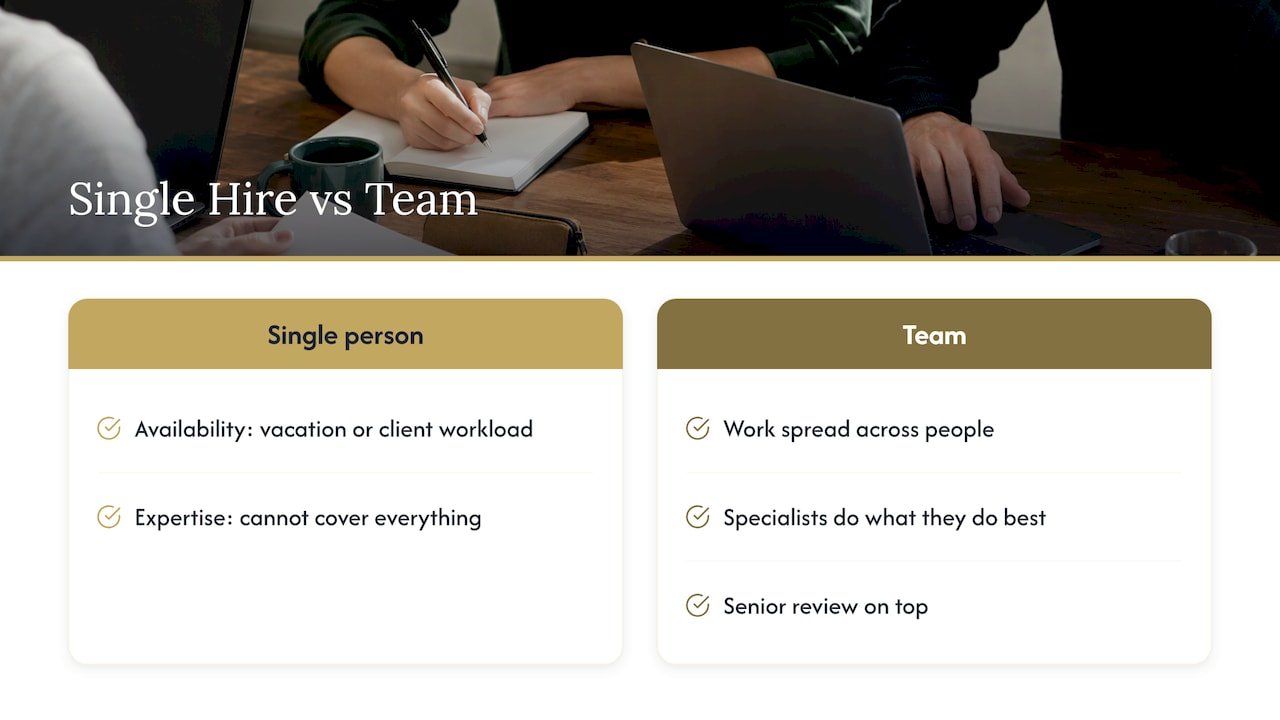
A single part-time person has limits. They go on vacation, they get busy with other clients, and they cannot be an expert in everything. A team spreads the work across people who each do what they do best, with senior review on top. That is the structure behind a full-service accounting department, which we describe in what full-service accounting means for a small business.
It also fits a growing trend toward remote work. Our article on why to hire a virtual accountant covers how that works day to day.
Our perspective
We talk with business owners who tell us the same thing: they are not short on effort, they are short on certainty. The books are mostly done, yet they still hesitate before a big decision, because nobody has looked at the whole picture and said, “These numbers are right.”
That is the gap a controller fills, and it is why we built KelliWorks as a real team rather than an app. An app can record. It cannot call a vendor, chase a late payment, notice that a bill was paid twice, or tell you that your entity is about to fall out of good standing. We do those things. We pay the bills, collect what clients owe you, keep your business compliant, and report on it every month.
We also believe pricing should be calm. One flat monthly fee, agreed up front, never a percentage of your income. You should know what the service costs before we start, and it should not rise because you had a good year.
On tax, we can handle it ourselves or work alongside the CPA you already trust. Either way, the goal is the same: one team that sees your whole financial picture. Discretion is standard practice for us, and we are glad to sign an NDA before we begin.
Kelli
How we can help
If you want controller-level oversight without a full-time salary, our business management service covers financial management and compliance, workflows and operational support, and payroll and HR solutions. Our accounting service includes bookkeeping, cash flow management, budgets and forecasting, and balance sheets. Both are offered for one flat monthly fee.

We will look at where your books stand today and suggest a scope that fits. If you already have a CPA, we work alongside them. If you do not, we can handle tax preparation and filing for you. U.S. tax rules vary by state, so we plan around where you operate. Book a free consultation at kelliworks.com/consultation.
FAQ
What does a fractional controller do?
A fractional controller oversees your accounting on a part-time basis. They own the monthly close, review reconciliations, prepare or check financial statements, set up internal controls and keep your records ready for tax filings or outside review. They work for a set number of hours rather than full time.
Is a fractional controller the same as a bookkeeper?
No. A bookkeeper records and categorizes transactions. A controller reviews that work, makes accounting judgments and is responsible for the reliability of the final reports. Many small businesses get both functions from one team.
Is a controller higher than a CFO?
Neither role outranks the other in a way that matters for a small business. In larger companies the CFO usually oversees the controller, but the jobs differ: the controller focuses on accurate reporting and controls, while the CFO focuses on strategy and financing. Small businesses often need controller-level work first.
How much does a fractional controller cost?
It depends on your revenue, transaction volume, the state of your books, the scope of work and the number of entities. Published ranges vary widely for that reason. At KelliWorks, you pay one flat monthly fee agreed before we start, never a percentage of your income.
When should I hire a fractional controller?
Consider one when a lender, investor or auditor will be reading your numbers, when several people can spend company money, or when you no longer trust your own reports. Those moments matter more than your headcount or revenue.
Sources
- What Is a Fractional Controller? | BeaconCFO Plus
- Fractional Controller: What They Do and When to Hire Them | Activated Scale
- Controller Salary Guide 2026 | KORE1
- Bookkeeper vs Accountant vs Controller for US | Logiframe
- Cost of Hiring a Controller in 2026 | Stealth Agents
- Accounting Firm Cybersecurity: A Practical Guide for 2026
- Time Clocks vs. Timesheets: Free FLSA Setup | Kloqk
Recommended
- Controller vs Bookkeeper: What Small Business Owners Need
- Types of Financial Consulting Services for Entrepreneurs
- Why Hire a Virtual Accountant for Your Small Business
- Small Business Founders: Hire a Bookkeeper and Start a Catch Up Plan
This article is general information, not tax, legal or financial advice. Talk to a professional about your situation.