


Managing cash flow with bookkeeping means using accurate financial records and forecasting tools to ensure your business always has enough cash to operate, pay bills, and grow. Cash flow management, the formal term for tracking and controlling money moving in and out of your business, depends entirely on the quality of your bookkeeping. Without clean, current records, you are guessing. Tools like QuickBooks and Xero turn that guesswork into a clear, real-time picture of your financial position. A 3–6 month cash reserve is the standard recommendation for small businesses, and you cannot build that reserve without knowing exactly where your money stands today.
What bookkeeping practices directly impact cash flow management?
Accurate bookkeeping for cash flow starts with consistency. Weekly record updates keep your data current and reduce the risk of surprises at month end. Monthly bank reconciliations catch discrepancies before they compound into larger problems.
Tracking accounts receivable aging is one of the most overlooked cash flow management tips. An aging report shows you exactly which invoices are 30, 60, or 90 days overdue. That visibility lets you prioritize collections calls and stop chasing the wrong clients.

Separating business and personal finances is non-negotiable. Mixed accounts make it impossible to track growth or plan finances accurately. Open a dedicated business checking account from day one, and never blur that line.
Automated transaction categorization, available in platforms like QuickBooks and Xero, reduces manual entry errors and saves hours each month. Fewer errors mean more reliable cash flow data. More reliable data means better decisions.
- Update financial records every week, not monthly
- Reconcile your bank account at the end of every month
- Run an accounts receivable aging report weekly
- Keep business and personal accounts completely separate
- Use automated categorization to reduce data entry errors
- Integrate bookkeeping data with your tax obligations quarterly
Pro Tip: Set a recurring 30-minute block every Monday to update your books. Consistent weekly entries take far less time than catching up on three months of transactions at once.
How can you improve your collections and payments process?
A structured collections process is one of the most direct improve cash flow strategies available to small business owners. The process starts before you even send an invoice. Clear payment terms, Net 15 or Net 30, must be communicated in your contract, on your invoice, and in your client onboarding.
Automated invoice reminders at 7, 14, and 30 days past due remove the awkwardness of chasing payments manually. Most accounting platforms, including FreshBooks and QuickBooks, send these automatically. You set the schedule once and the software handles follow-up.
- Send the invoice immediately upon delivery or project completion, not at the end of the month
- Set automated reminders at 7, 14, and 30 days past due
- Track all overdue accounts in a single aging report reviewed weekly
- Offer digital payment options such as ACH transfer or credit card to speed up receipt
- Negotiate vendor payment terms of Net 45 or Net 60 to align outflows with your inflows
Automated payment tools also offer digital payment options that increase payment speed and reliability. When clients can pay with one click, they pay faster. That single change can shorten your average collection period by a week or more.
Pro Tip: Add a 1.5% monthly late fee clause to your contracts. You may never enforce it, but it signals that you take payment terms seriously, and clients respond accordingly.
What is cash flow forecasting, and how does it work with bookkeeping?
A rolling 13-week cash flow forecast is the single most powerful tool a small business can use to anticipate shortfalls and act before a crisis hits. It maps every dollar coming in and going out, week by week, giving you enough lead time to adjust spending, accelerate collections, or arrange a credit line. Without it, you react to cash problems. With it, you prevent them.
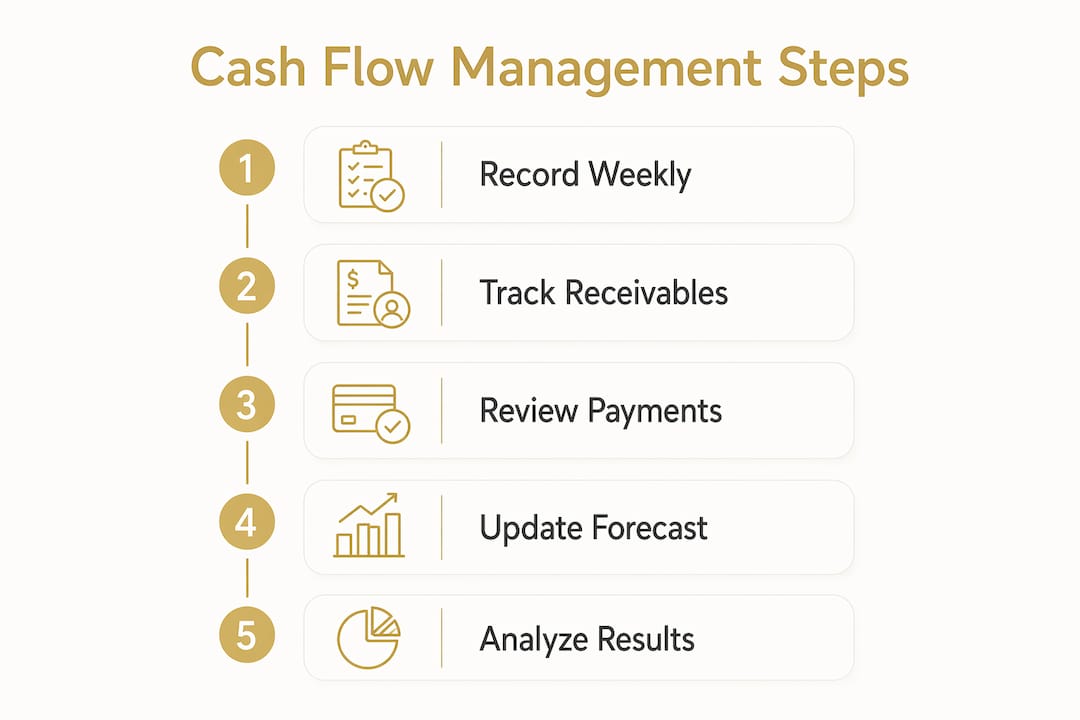
The forecast only works when it is fed by live bookkeeping data, not a static spreadsheet you update once a month. Your bank transactions, accounts receivable aging report, recurring bills, and payroll calendar are the four core data sources. When these feed directly into your forecast, it becomes a living control tool rather than a monthly chore.
| Forecast Input | Data Source | Update Frequency |
|---|---|---|
| Expected receipts | Accounts receivable aging | Weekly |
| Known expenses | Recurring bills and payroll calendar | Weekly |
| Current cash position | Bank transaction feed | Daily |
| Outstanding invoices | Invoicing software | Real-time |
The table above shows how each input connects to a specific bookkeeping data source. Notice that three of the four inputs update weekly or more often. A forecast built on stale data is not a forecast. It is a guess with extra steps.
Treat your 13-week forecast as a living document. Review it every Monday alongside your weekly bookkeeping update. When a large client pays late, adjust the forecast immediately. When you land a new contract, add the expected receipt. That discipline turns forecasting from a planning exercise into a genuine cash management tool.
What tools and software support bookkeeping for cash flow?
The right software makes tracking cash flow far less time-consuming. QuickBooks, Xero, and Nav’s Cash Flow Health tool each approach the problem differently, but all three automate transaction categorization and generate real-time cash flow reports. That automation reduces manual errors and gives you visibility into unusual expenses before they affect your liquidity.
| Platform | Best For | Key Cash Flow Feature |
|---|---|---|
| QuickBooks | Small businesses with employees | Payroll integration and cash flow dashboard |
| Xero | Freelancers and growing businesses | Real-time bank feeds and receivables tracking |
| Nav Cash Flow Health | Businesses monitoring credit and cash | Automated categorization and tax prep support |
| FreshBooks | Service-based freelancers | Automated invoicing and payment reminders |
Dashboards and low-balance alerts are the features that matter most for day-to-day cash management. A dashboard that shows your current cash position, outstanding invoices, and upcoming bills in one view removes the need to pull multiple reports. An alert that fires when your balance drops below a set threshold gives you time to act.
Cloud-based platforms carry a specific advantage for freelancers and remote business owners. You can check your cash position from your phone before a client meeting, approve a payment from a coffee shop, or share read-only access with your accountant in seconds. That accessibility makes consistent bookkeeping far more realistic for busy owners.
- Look for platforms with direct bank feed connections, not manual import
- Prioritize automated invoice reminders and digital payment acceptance
- Choose software that generates a cash flow statement with one click
- Confirm the platform integrates with your payroll provider
Key Takeaways
Consistent bookkeeping practices, structured invoicing, and a rolling 13-week cash flow forecast are the three foundations of reliable cash flow management for small businesses and freelancers.
| Point | Details |
|---|---|
| Weekly bookkeeping is non-negotiable | Update records every week to maintain accurate, real-time cash visibility. |
| Separate accounts prevent costly errors | Keep business and personal finances in distinct accounts at all times. |
| Automate collections follow-up | Set invoice reminders at 7, 14, and 30 days past due to accelerate payment. |
| Build a rolling 13-week forecast | Feed it with live bookkeeping data to anticipate shortfalls before they happen. |
| Choose software with bank feeds | Platforms like QuickBooks, Xero, and Nav automate categorization and reduce manual errors. |
What I have learned after years of working with small business finances
Most small business owners treat bookkeeping as a compliance task. They keep records because they have to, not because those records tell them something useful. That mindset is the second-biggest cash flow mistake I see, right after mixing personal and business accounts.
The businesses that genuinely control their cash flow treat their books as a decision-making tool. They review their aging report every week. They update their forecast every Monday. They know their current cash position without having to call their accountant. That discipline does not require a finance degree. It requires a consistent habit and the right setup.
The other thing I push back on is the idea that forecasting is complicated. A rolling 13-week forecast built from your bookkeeping data is not complicated. It is a spreadsheet or a software view that answers one question: will I have enough cash to cover my obligations over the next three months? When the answer is no, you have time to fix it. That lead time is everything.
Static spreadsheets updated in August and forgotten until december are not forecasts. They are historical documents. The only forecast that protects you is one connected to live data and reviewed weekly. If you are not doing that yet, start this week. The setup takes a few hours. The payoff is months of financial clarity.
— Kelli
How Kelliworks helps you take control of your cash flow
Running a business is demanding enough without spending your evenings reconciling accounts or chasing overdue invoices. Kelliworks offers full-service bookkeeping and accounting tailored specifically to small business owners and freelancers who need accurate records, reliable forecasting support, and clean books at tax time.
Our team handles the weekly record-keeping, bank reconciliations, and accounts receivable tracking that form the foundation of solid cash flow management. We also support cash flow forecasting so you always know what the next 90 days look like. If you are ready to stop guessing and start managing your finances with confidence, schedule a free consultation with Kelliworks today. We will review your current setup and show you exactly where your cash flow can improve.
FAQ
What does it mean to manage cash flow with bookkeeping?
Managing cash flow with bookkeeping means using accurate, up-to-date financial records to track money coming in and going out of your business. Clean books give you the data needed to forecast shortfalls, time payments, and build cash reserves.
How often should I update my books for cash flow accuracy?
Weekly record updates are the standard for maintaining real-time cash flow visibility. Monthly updates leave too many gaps and increase the risk of missing overdue invoices or unexpected expenses.
What is a rolling 13-week cash flow forecast?
A rolling 13-week forecast maps every expected cash inflow and outflow week by week over a 90-day window. It is the most effective tool for anticipating shortfalls before they become a crisis.
How much cash reserve should a small business keep?
Small businesses should maintain a cash reserve of 3–6 months of operating expenses, held in a separate account. That buffer covers slow periods, late-paying clients, and unexpected costs without disrupting operations.
Which bookkeeping software is best for cash flow management?
QuickBooks, Xero, and Nav’s Cash Flow Health tool each offer automated categorization, real-time bank feeds, and cash flow reporting. The best choice depends on your business size, whether you have employees, and how much invoicing automation you need.




One Response