


The core reasons freelancers mismanage finances come down to a handful of repeating patterns: no dedicated budget or separate business account, lumpy cash flow worsened by late-paying clients, undercharging without regular rate reviews, unbillable work from vague project scopes, poor tax planning, missing contracts, over-reliance on a single client, and psychological barriers that keep rates artificially low. Each of these compounds the others. The good news is that every one of them has a concrete fix.
Here is how each cause typically shows up:
- No budget or financial plan: Income lands and gets spent without a system, leaving nothing for slow months.
- Mixed personal and business accounts: Deductions get missed, tax time becomes a guessing game, and cash flow is invisible.
- Lumpy cash flow and late payments: A great month followed by a dry one creates reactive spending and credit reliance.
- Undercharging: Rates set at the start of a career rarely keep pace with rising costs and non-billable time.
- Unbillable work and scope creep: Vague agreements turn into free hours that never appear on an invoice.
- Missing contracts and weak payment terms: No deposit requirement and no late fee language mean clients pay whenever they feel like it.
- Single-client dependence: One client canceling can eliminate a large portion of monthly income overnight.
- Poor tax planning: Treating gross income like take-home pay leads to a painful IRS bill in April.
- Low financial literacy and psychology: Fear of raising rates and procrastination on bookkeeping quietly drain thousands per year.
Your next step, right now: Open a dedicated savings account, label it “Taxes,” and move 25–30% of your last payment into it today. That single action prevents the most common and most painful freelance financial crisis.
You will never have to remember to do it manually.*
Key Takeaways
| Point | Details |
|---|---|
| Separate accounts immediately | Open a dedicated business account and a tax savings account this week to gain real cash visibility. |
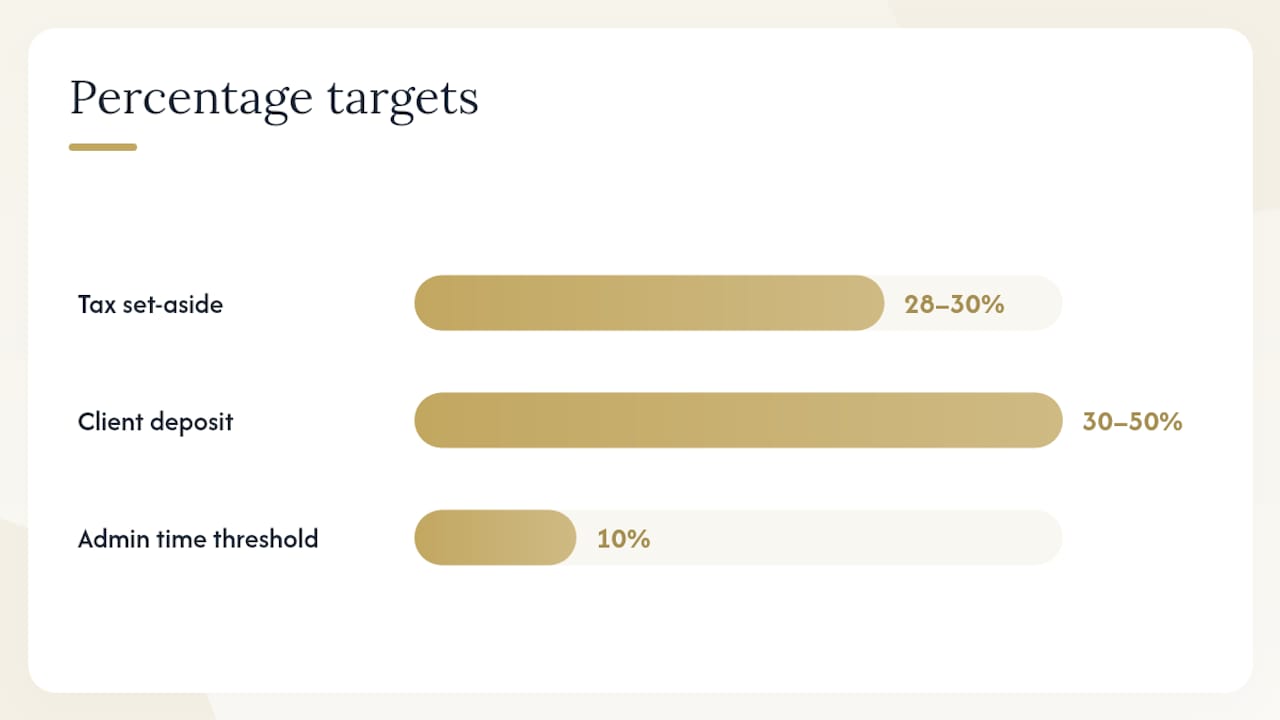
| Set aside 28–30% for taxes | Transfer this share of every payment on arrival to avoid underpayment penalties and April surprises. |
| Require deposits and clear terms | A 30–50% deposit plus net-15 terms and a 1.5% late fee resolves most payment disputes before they start. |
| Build a 3–6 month emergency fund | A cash reserve covering 3–6 months of fixed costs protects against the feast-or-famine income cycle. |
| Hire help when admin exceeds 10% of your time | A virtual accounting department like Kelliworks handles bookkeeping, taxes, and cash-flow planning so you can focus on billable work. |
For a step-by-step walkthrough on opening accounts and separating your finances, see the Kelliworks guide on how to separate personal and business finances.
Table of Contents
- The Most Common Reasons Freelancers Mismanage Finances
- What the Numbers Say About Freelance Financial Struggles
- A Concrete Week, Month, and Quarter Plan to Fix the Leaks
- When to Hire a Bookkeeper or Virtual Accounting Department
- The Pattern Behind These Mistakes Persists for a Reason
- Kelliworks Handles the Financial Work You Keep Putting Off
- Sources
The Most Common Reasons Freelancers Mismanage Finances
Understanding the cause is the fastest path to the fix. Each pattern below describes what the problem looks like on a Tuesday afternoon, the damage it does, and the one thing you can do to stop it.
No budget or financial plan
Most freelancers start without one. Survey data from the Freelancers Union confirms that a majority of new freelancers begin without a budget or financial plan, and that this gap is directly tied to early cash-flow failures. Without a budget, you cannot tell whether a $6,000 month actually covered your costs or just felt like it did.
Fix: Write down your fixed monthly costs (rent, software, insurance, subscriptions) and your variable costs (contractors, supplies, travel). That number is your floor. Every pricing and savings decision flows from it.
Mixing personal and business finances
Paying a business expense from your personal checking account feels harmless once. Done consistently, it makes bookkeeping nearly impossible, causes you to miss legitimate deductions, and leaves your actual business cash position invisible. At tax time, you are reconstructing months of transactions from memory.
Fix: Open a dedicated business checking account this week. Use it exclusively for business income and expenses. The separation alone materially improves your visibility into what the business actually earns and spends.
Lumpy cash flow and late client payments
Industry data shows that a large share of freelancers experience late payments, with many waiting over 30 days past the invoice due date. Chasing those invoices can consume close to 100 hours per year. The result is a cash-flow pattern that looks like feast or famine even when annual revenue is healthy.
Most clients pay faster when the terms are clear from the start.
Undercharging and skipping rate reviews
Many freelancers set their rates early in their career and never revisit them. Meanwhile, costs rise, non-billable time increases, and the effective hourly rate quietly shrinks. One survey cited in freelance financial coverage found only a minority of freelancers raise their rates in their first year. Learning how to set freelance rates without undervaluing yourself is one of the highest-return skills you can develop.
Fix: Schedule a rate review every six months. Calculate your effective hourly rate (total revenue divided by total hours worked, including admin and unpaid revisions).
Unbillable work and scope creep
Vague scope language is one of the largest economic leaks in freelance work. When a project agreement says “website design” without specifying the number of pages, revision rounds, or what happens when the client adds features mid-project, you absorb those extra hours for free. Written agreements with explicit exclusions are operational protection, not bureaucracy.
Fix: Every proposal should name exactly what is included and what is not. Add a change-order clause: any work outside the original scope requires a new written agreement and additional payment before work begins.
Missing contracts and weak payment terms
No contract means no legal footing when a client disputes an invoice or disappears. No late fee language means clients have no financial reason to pay on time.
Fix: Use a simple written agreement for every engagement, no matter how small. These three terms alone resolve most payment disputes before they start.
Over-reliance on a single client
You are an unprotected employee with no benefits. If that client pauses, cuts budget, or simply moves on, your income drops by half or more with no notice.
Actively pursue new clients even during busy periods. Diversification is the only real protection against this risk.
Poor recordkeeping and bookkeeping gaps
Paying business costs from a personal account, losing receipts, and skipping monthly reconciliation all make tax time harder and more expensive. Missing records also mean missing deductions. Operational disorganization is one of the most consistent predictors of a painful tax season.
Fix: Spend 30 minutes every Friday reconciling the week’s transactions. Keep digital copies of every receipt. A simple spreadsheet or entry-level bookkeeping software is enough to start. See the financial records guide for freelancers for a practical checklist of what to keep and for how long.
Failing to save for taxes and quarterly estimates
Treating gross income like take-home pay is one of the most reliable ways to end up owing thousands in April with no reserves to cover it. Experts consistently recommend setting aside 25–35% of income for taxes and making quarterly estimated payments to avoid underpayment penalties.
Pay estimated taxes quarterly (due in April, June, September, and January). Missing a quarterly payment triggers a penalty even if you pay the full amount in April.
Neglecting retirement savings
Without an employer-sponsored 401(k), retirement savings require deliberate action. Many freelancers defer this indefinitely, which means losing years of tax-advantaged compounding.
Fix: Open a SEP-IRA or Solo 401(k) and automate a monthly contribution, even a small one. The tax deduction alone often makes this one of the highest-return financial moves available to a freelancer.
Psychological barriers: fear of raising rates and procrastination
The shift from employee to business owner is not just operational. It is psychological. Many freelancers fear that raising rates will cost them clients, so they absorb rising costs silently. Others procrastinate on bookkeeping until the backlog feels too large to tackle. Both patterns cost real money. Fear of a rate conversation typically costs more annually than any single lost client would.
Pro Tip: Raise your rate with new clients first. You do not need to justify it at length.
What the Numbers Say About Freelance Financial Struggles
The data on freelance financial mismanagement is consistent across multiple surveys and industry reports. These are not edge cases.
Roughly 85% of freelancers report experiencing late payments, with many waiting more than 30 days past the invoice due date — and the time spent chasing those payments can reach close to 100 hours per year.
| Evidence Point | What It Measures | Source |
|---|---|---|
| ~85% experience late payments | Share of freelancers receiving payment after the due date | Work Club |
| Majority start without a budget | Share of new freelancers with no financial plan at launch | Freelancers Union |
| self-employment tax rate | Employer + employee Social Security and Medicare share | Work Club |
| 25–35% recommended tax set-aside | Portion of gross income to reserve for federal and self-employment taxes | AOL Finance |
| 3–6 months emergency fund | Recommended cash reserve to survive income gaps | Bonsai |
The pattern across all of these figures points to the same structural gap: most freelancers operate without the systems that salaried employees have built for them automatically. No payroll withholding, no employer retirement match, no HR department enforcing payment terms. Building those systems manually is the job.
For a deeper look at how financial planning for freelancers fits into a longer-term stability strategy, the Finblog guide covers forecasting and income smoothing in practical detail.
A Concrete Week, Month, and Quarter Plan to Fix the Leaks
Diagnosis without a timeline stays diagnosis. Here is a time-boxed plan that moves from immediate triage to structural stability.
This week (days 1–7)
- Open a dedicated business checking account if you do not already have one.
- Open a separate savings account labeled “Taxes” and transfer 28–30% of your most recent payment into it.
- Add a deposit requirement (30–50%) to your next new client proposal.
- Add net-15 payment terms and a 1.5% monthly late fee to every outstanding invoice template.
- Set up automated payment reminders at 1 day before due, 7 days after due, and 14 days after due.
This month (days 8–30)
- Build a simple monthly budget: fixed costs, variable costs, and a target monthly “paycheck” to yourself.
- Schedule your next quarterly estimated tax payment (check the IRS calendar for the current due date).
- Run a single-month cash-flow forecast: list every expected payment in and every known expense out for the next 30 days.
- Review your effective hourly rate and flag any client relationship where it has dropped below your target.
Set it once and it runs without any decision-making on your part.*
This quarter (days 31–90)
- Conduct a full rate review and raise rates on at least one client or service tier.
- Build your emergency fund toward a 3-month operating reserve. Three months of fixed costs is the minimum; six months is the target.
- Formalize contracts for every active client relationship. Use a written agreement that includes scope, deliverables, revision limits, deposit terms, and late fee language.
- Automate your bookkeeping workflow: connect your business bank account to bookkeeping software and set category rules so that routine transactions categorize themselves. The cash flow and bookkeeping guide from Kelliworks walks through this setup step by step.
Sample invoice terms to copy:
- Deposit: 40% of project total due before work begins.
- Balance: Due net-15 from delivery of final files.
- Late fee: 1.5% per month on any balance unpaid after the due date.
- Scope changes: Any work outside the agreed scope requires a written change order and additional payment prior to execution.
When to Hire a Bookkeeper or Virtual Accounting Department
Some financial problems are best solved with a system. Others have grown past the point where a system alone is enough. These are the signals that it is time to bring in professional help.
Hire now if any of these apply to you:
- You have more than 10 invoices unpaid beyond 60 days.
- You were surprised by a tax bill in the last 12 months and had no reserves to cover it.
- Your bookkeeping is more than 6 months behind.
- You spend more than 10% of your working hours on financial admin, invoicing, or chasing payments.
- You have no clear picture of your monthly profit or cash position.
- You are considering raising rates or restructuring your business but do not know where to start.
A virtual accounting department handles the full scope of financial operations that most freelancers either skip or do poorly: bookkeeping, tax preparation and filing, quarterly estimated tax payments, cash-flow forecasting, payroll (if applicable), invoicing systems, and financial reporting. The difference between a bookkeeper and a full virtual accounting department is scope. A bookkeeper records transactions. A virtual accounting department interprets them, plans around them, and keeps you compliant.
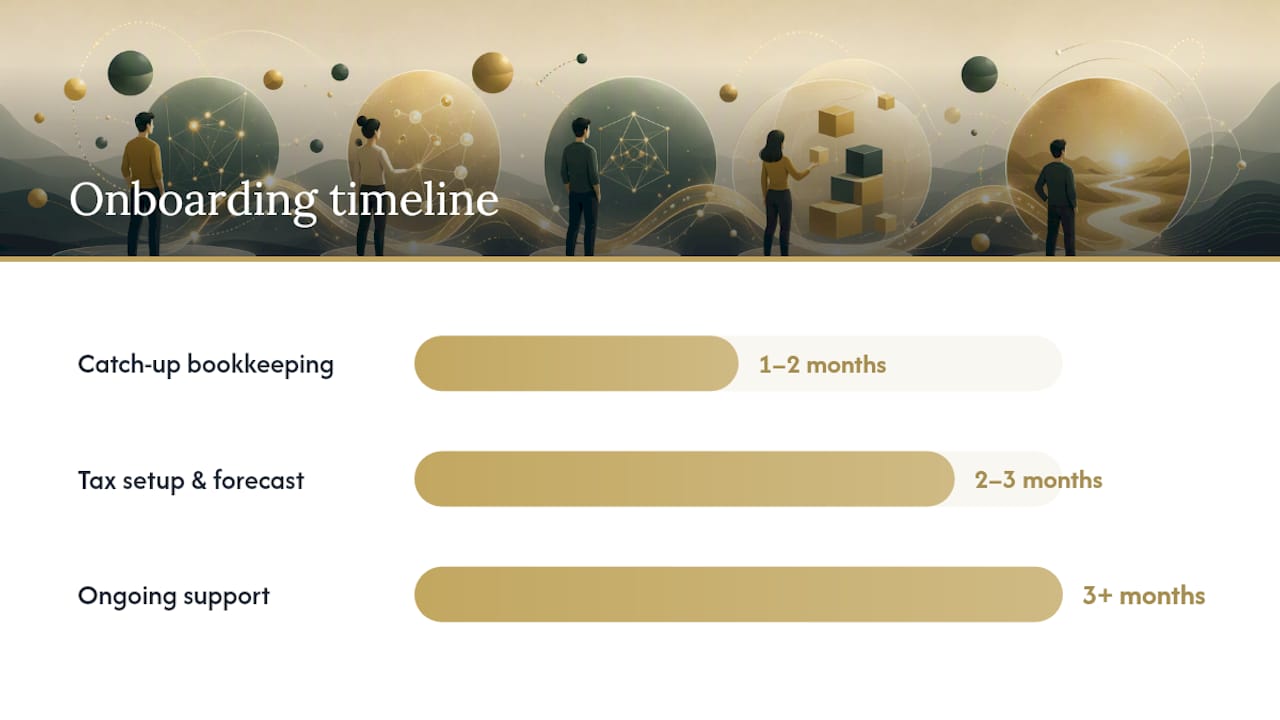
What to expect in the first 30–90 days with professional support:
- Months 1–2: Catch up on backlogged bookkeeping, separate accounts, and establish a clean chart of accounts.
- Month 2–3: Set up tax savings automation, file any overdue estimated payments, and build a 90-day cash-flow forecast.
- Month 3+: Ongoing monthly reconciliation, quarterly tax planning, and rate/pricing strategy input.
The cost of outsourced bookkeeping and tax support is almost always lower than the cost of a missed deduction, a late-payment penalty, or the hours you spend doing it yourself at a rate far below what your billable time is worth. For a clear breakdown of cost-saving accounting strategies that work for small businesses, Kelliworks has a practical guide worth reading before your first call.
The Pattern Behind These Mistakes Persists for a Reason
Most freelancers do not mismanage money because they are careless. They mismanage it because nothing in the transition from employee to self-employed prepares them for the operational reality of running a business. Payroll withholding disappears. Employer retirement contributions disappear. The HR department that enforced payment terms disappears. What replaces all of that is personal initiative, and most people underestimate how much structure that requires.
The psychological piece is just as real as the operational one. Fear of raising rates keeps income artificially low for years. Procrastination on bookkeeping turns a manageable monthly task into a quarterly crisis. And the feast-or-famine spending pattern, where a good month triggers spending that a slow month cannot sustain, is almost universal among freelancers who have not yet built a fixed monthly paycheck system.
The before-and-after is usually not dramatic. Knowing your actual cash position is not a luxury. It is the foundation every other financial decision rests on.
Kelliworks Handles the Financial Work You Keep Putting Off
Freelancers who are behind on bookkeeping, surprised by tax bills, or spending hours chasing invoices are not failing at freelancing. They are running a business without the back-office support that business requires. Kelliworks functions as a full virtual accounting department for freelancers and small business owners, covering bookkeeping, tax preparation, cash-flow planning, and financial consulting, all without the overhead of a traditional accounting firm.

Working with Kelliworks typically produces three near-term outcomes: tax surprises stop because estimated payments are planned and automated; invoicing becomes a system rather than a chore; and most clients reclaim 5–10 hours per week previously spent on financial admin. The first step is a straightforward assessment call where we review your current accounts, tax situation, and bookkeeping gaps, then outline exactly what needs to happen in the next 30 days. To get started or learn more about what a virtual accounting department actually does for a freelance business, visit Kelliworks.com and schedule your first conversation.
Sources
This article is general information, not a substitute for advice from a qualified financial advisor. Consult a qualified financial professional about your own circumstances before acting on anything here.