


There is no national rule for SaaS sales tax. Each state decides whether subscription software is taxable, at what rate, and when an out-of-state seller has to collect. Some states tax it as software, some as a service, and some do not tax it at all. If you sell subscriptions to customers in more than one state, you need to check each state where you have customers, not just the one where you are based.
This guide explains how the main approaches differ, which states show up in the examples most often, how local rates and nexus change the math, and how to keep your list current. We are an accounting firm that works with small businesses, so we focus on what a founder needs to decide and do next.
TL;DR
- SaaS taxability is set state by state. Some states tax it as prewritten software, others as a data processing or information service, and others do not tax it.
- Rules change. Colorado and Vermont are recent examples of states moving toward taxing software no matter how it is delivered.
- Your total rate is the state rate plus any local rates, so the customer’s address matters.
- Selling into a state can create a collection duty even with no office or employees there. Check each state’s thresholds.
- Re-verify your key states on a schedule, using the state revenue department’s own guidance.
Table of Contents
- Why SaaS sales tax differs so much from state to state
- SaaS taxability by state: examples to start with
- When taxability depends on how the product works
- Your rate is more than the state rate
- When you have to collect: nexus
- What we see in practice
- A practical process for checking your states
- Keeping your list current
- How we help
- FAQ
- Sources
Why SaaS sales tax differs so much from state to state
Sales tax laws were written for physical goods. When software moved from discs to browsers, states stretched old definitions to fit. The Streamlined Sales Tax Project explains that states differ in whether and how they tax software, with distinctions for prewritten and custom software, electronic delivery, licenses and related services. That is why you cannot infer one state’s treatment from another’s.
In practice, states take one of a few approaches:
- Taxed as prewritten (canned) software. Access to software hosted on a remote server is treated like a sale of software.
- Taxed as a service. The subscription is classed as a data processing, information or digital service.
- Not taxed. Remote access is treated as a nontaxable service, or software is only taxable when delivered on a physical medium.
- Depends on the facts. The product’s features, how it is delivered and what else is bundled with it decide the outcome.
The same product can land in different categories in different states. Treat each state as its own question.
SaaS taxability by state: examples to start with
Counts of “how many states tax SaaS” differ between publishers, because they classify borderline states differently and because rules keep changing. Rather than quote one number, here are states with documented treatment, and what each tells you.
| State | How SaaS is treated | What to know |
|---|---|---|
| Texas | Taxable as a data processing service | The Texas Comptroller’s office has described 80 percent of the SaaS price as subject to sales tax, compared with full taxation of traditional software licenses. |
| Massachusetts | Taxable | The state’s highest court has treated remote-server software subscriptions as taxable sales of tangible personal property. |
| Vermont | Taxable | Since July 1, 2024, all prewritten computer software is subject to sales tax, whether downloaded or accessed remotely. |
| Colorado | Taxable from 2027 | From January 1, 2027, Colorado generally taxes computer software regardless of delivery method. |
| Michigan | Fact-dependent | The Treasury says SaaS as a label does not decide taxability; the question is whether the product is prewritten computer software. |
New York and Pennsylvania are also commonly described as taxing SaaS, New York as prewritten software and Pennsylvania as canned software. Several large states, including California and Florida, are commonly described as not taxing it, though that can change. Before you rely on any of these, open the state’s revenue department page and read the current rule for your type of product.
States with no statewide sales tax
Alaska, Delaware, Montana, New Hampshire and Oregon have a 0% state sales tax rate, according to the Tax Foundation’s 2026 rate table. Alaska has no statewide rate but allows local sales taxes, so a sale there can still carry tax. For the other four, SaaS sales tax is not a concern at the state level.
When taxability depends on how the product works
Even inside one state, two SaaS products can be treated differently. Michigan’s bulletin is a useful model because it spells out the questions a reviewer asks:
- Is the software prewritten, or custom developed for a specific purchaser? Custom software can be exempt.
- Is the software delivered in full, in part or not at all?
- Is the software incidental to a service? Mixed transactions may be nontaxable when the software is only a minor part of a service, and the department may apply the Catalina test to sort out mixed transactions.
These same questions apply in many states, even if the legal wording differs. If your product includes both software access and services, such as onboarding, data analysis or support, ask how each piece is billed. Separately stated charges and bundled charges can be treated differently, so the way you invoice matters.
Your rate is more than the state rate
The tax you charge is the state rate plus any county, city or district rates that apply to the customer’s location. State rates in 2026 run from 0% to 7.25% in California, with Indiana, Mississippi, Rhode Island and Tennessee at 7%, per the Tax Foundation. That table lists state, average local, maximum local and combined rates separately, which shows how far the combined figure can exceed the base rate.
Two practical consequences follow:
- You need the customer’s address. Rates can vary within a county, city or ZIP code, so collect a full billing address at checkout, not just a state.
- Not every state taxes SaaS at the local level. Some states tax software at the state rate only. Confirm whether local taxes attach to your product in each state.
A worked example: say a customer in a state that taxes SaaS pays $200 a month, and their combined rate is the state rate plus a local rate. You charge the combined rate on $200, collect it with the invoice, and remit it to the state on its filing schedule. The tax is not your revenue. It belongs to the state from the moment you collect it.
When you have to collect: nexus
Taxability answers whether your product is taxed. Nexus answers whether you must collect. A seller with a physical presence in a state should check that state’s requirements, and the Streamlined Sales Tax Project notes that remote sellers may have to register, collect and remit regardless of physical presence, with requirements and thresholds varying by state.
Since the Supreme Court’s South Dakota v. Wayfair decision, most states with a sales tax use an economic nexus threshold based on sales into the state, commonly a dollar amount or a number of transactions in a year. The exact numbers and the way they are measured differ, so read each state’s rule. For a deeper walk-through, see our guide to sales tax nexus for small business owners.
The key habit is to track revenue and transaction counts by state every month. A founder who only discovers a threshold after a year has crossed it may owe tax they never collected from customers.
What we see in practice
A short perspective from our side of the desk.
Most SaaS founders we meet are not avoiding sales tax. They simply never had a reason to look at it. The product sold in all fifty states from day one, the payment processor took the money, and nobody asked which states wanted tax on it. Then a customer asks for an exemption certificate, or a state sends a notice, and a small problem becomes a cleanup project.
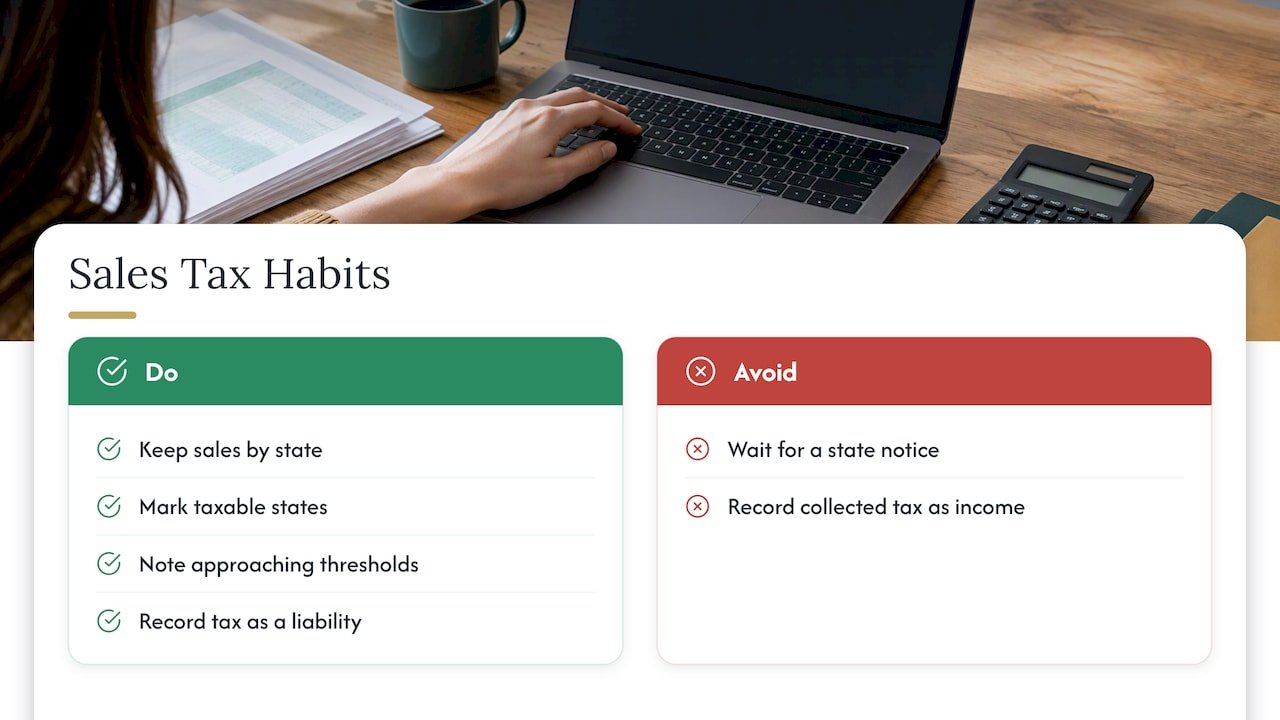
Our advice is to build the habit before you need it. Keep a simple sheet of sales by state, mark the states where your product is taxable, and note where you are approaching a threshold. When you register, register on purpose, and set up your bookkeeping so that tax collected is recorded as a liability, not as income. That keeps your books clean and your filings accurate. If you are new to this, our step-by-step guide to sales tax for new business owners covers the basics.
Sales tax rarely requires heroic effort. It requires a calendar, a clean record of sales, and someone who checks the state rule when it matters.
— Kelli
A practical process for checking your states
Use this order to avoid wasted work.
- Export sales by state. Pull the last 12 months of revenue and transaction counts by customer location.
- Rank the states. Start with those where your sales are largest or growing fastest.
- Check taxability. For each ranked state, read the revenue department’s page on software, digital products or data processing. Write down the category and the date you checked.
- Check the nexus rule. Compare your sales to the state’s threshold and its measurement period.
- Register where required. Register before you start collecting. Collecting tax without a permit is a problem of its own.
- Configure collection. Set up your billing system to charge the right rate by address, and record the tax collected separately.
- File on schedule. Filing frequency is set by the state, and it can change as your volume grows. If you end up in several states, our piece on sales tax filing frequency across multiple states explains when to hand it off.
If you find you already crossed a threshold in a past period, talk to a tax professional before contacting the state. Some states offer voluntary disclosure programs, and the terms depend on the state and your facts.
Keeping your list current
SaaS rules move. Colorado’s change takes effect in 2027 and Vermont’s began in 2024, so a list built two years ago may already be wrong. State revenue departments can also issue rulings or bulletins that reclassify products, which is exactly what Michigan’s bulletin does when it addresses prewritten software.
We suggest a quarterly reminder to re-verify your top states, and a review any time you launch a new feature, change pricing structure or add a service component. Subscribe to the revenue department email lists in the states where you are registered. Keep a dated note of each state’s treatment and the page you relied on, so that if a state asks, you can show how you reached your position.
How we help
If you would rather not track this yourself, our team handles accounting and bookkeeping with sales tax collected and reported correctly, and our tax preparation and filing service covers the returns. We work virtually or in person, and we tailor the setup to your product and the states you sell into.
To talk through your states, book a free consultation with our team.
FAQ
Are SaaS subscriptions taxable?
It depends on the state. Some states tax them as prewritten software or as a data processing service, while others do not tax them. Texas, for example, treats SaaS as a taxable data processing service with 80 percent of the price taxed. Check the revenue department of each state where you have customers.
Which states have no sales tax?
Alaska, Delaware, Montana, New Hampshire and Oregon have no statewide sales tax in 2026, according to the Tax Foundation. Alaska allows local sales taxes, so a sale there can still be taxed locally. The other four states do not tax SaaS at the state level.
Do I have to collect sales tax if I have no office in the state?
Possibly. Remote sellers may have to register, collect and remit sales tax even without a physical presence, depending on the state’s thresholds. Track your sales by state so you know when you approach one.
Does the customer’s location or my location decide the tax?
For most SaaS sales, the customer’s location is what matters, because sales tax is generally based on where the customer uses or receives the product. That is why you should collect a full billing address, since rates can differ within a county or ZIP code.
Sources
- Streamlined Sales Tax Project: computer software issue paper
- Streamlined Sales Tax: remote sellers FAQ
- Texas Comptroller: data processing services, SaaS and software licenses
- Massachusetts SJC: Citrix Systems v. Commissioner of Revenue
- Vermont Department of Taxes: prewritten computer software
- Colorado Department of Revenue: computer software
- Michigan Treasury: Revenue Administrative Bulletin 2023-10
- Tax Foundation: 2026 sales tax rates by state



2 Responses