


A scalable accounting service is a financial management system that grows alongside your business, adapting to higher transaction volumes, more complex reporting needs, and greater operational demands without requiring a full system replacement. The industry term for this model is Accounting as a Service (AaaS), which delivers flexible solutions using cloud platforms and automation to match your changing business needs. Platforms like Intuit Enterprise Suite are built specifically for this kind of growth, offering multi-entity support, automated workflows, and real-time reporting. For small business owners, choosing a system with this kind of built-in capacity from the start is one of the most cost-effective financial decisions you can make.
What is a scalable accounting service and why does it matter?
A scalable accounting service is defined by its ability to handle more without breaking down. As your revenue grows, your transaction count increases, your payroll expands, and your tax obligations become more complex. A system that cannot keep pace forces you into expensive, disruptive migrations at exactly the wrong time.
Multi-entity accounting software supports separate books for subsidiaries with consolidated reporting, so you can expand across locations without changing your core system. This matters the moment you open a second location, bring on a business partner, or start operating in multiple states. Without that capability built in, you are patching gaps with spreadsheets and manual workarounds.

The benefits of scalable accounting go beyond convenience. Accuracy improves because automated reconciliation catches errors in real time rather than at month end. Compliance becomes easier because your records are always current and audit-ready. And your time shifts away from data entry toward actual financial analysis.
What features make an accounting service truly scalable?
Not every cloud-based bookkeeping tool qualifies as a genuinely scalable accounting solution. The features below separate systems that grow with you from systems that slow you down.
- Multi-entity and multi-currency support. You need separate ledgers for each business unit, with the ability to consolidate reporting across all of them. Intuit Enterprise Suite handles this natively.
- Automated workflows. Automated systems shift finance focus from data entry to analysis and enable real-time reconciliation, avoiding month-end scrambles.
- API integrations. Your accounting system should connect directly to your CRM, payroll provider, and e-commerce platform. Disconnected systems create duplicate entries and reporting gaps.
- User and data capacity. Cloud-based platforms support increasing user counts and transaction volumes without performance loss. This is non-negotiable as your team grows.
- Flexible financial reporting. You need reports that can be customized by department, project, or entity without requiring a developer.
- Security controls. Audit logs, role-based permissions, and data encryption protect your records and satisfy compliance requirements.
Pro Tip: When evaluating any accounting platform, ask the vendor specifically how many transactions per month the system handles before performance degrades. Get that number in writing.
How does scalable accounting work behind the scenes?
The technology behind scalable financial services combines three elements: cloud infrastructure, API connections, and process discipline. Each one matters. Remove any of them, and the system underperforms.
Cloud platforms provide real-time, remote access to your financial data. Your bookkeeper, accountant, and CFO can all work from the same live data set without emailing spreadsheets back and forth. That alone eliminates a significant category of errors.
APIs connect your accounting system to every other tool in your business stack. Here is a practical example of how a well-built scalable accounting workflow operates:
- A customer places an order in your e-commerce platform.
- The sale posts automatically to your accounting system via API.
- Inventory and revenue accounts update in real time.
- The system flags the transaction for sales tax calculation based on the customer’s location.
- At month end, reconciliation runs automatically against your bank feed.
- Your accountant reviews exceptions rather than re-entering data.
Investor-ready data and audit-proof processes require well-designed workflows alongside cloud and automation tools. Technology alone does not produce clean books. The workflows feeding that technology must be consistent and well-documented.
Pro Tip: Before deploying any automation, map your current process on paper first. Automating a broken process just produces errors faster.
Not all automation tools deliver efficiency. Some require extensive setup and ongoing maintenance that negates the time savings entirely. Focus on automation that plugs directly into your existing workflow rather than adding a new layer of complexity.
Scalable accounting services vs. traditional accounting setups
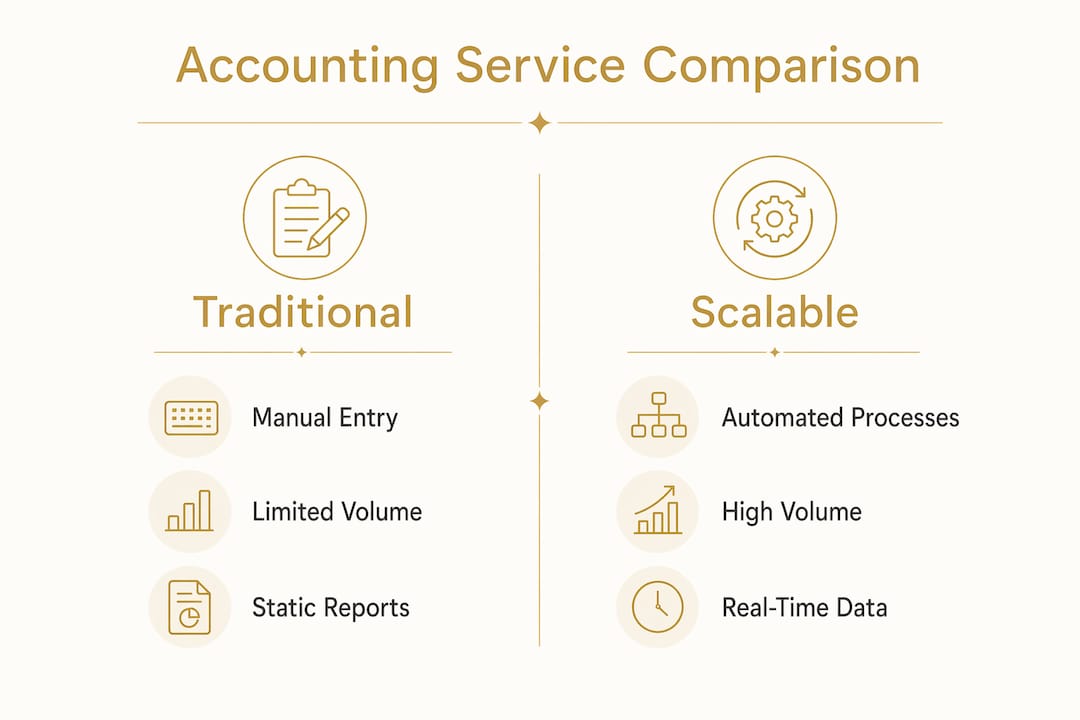
The difference between scalable and traditional accounting is not just about software. It is about what happens to your business when volume increases.
| Metric | Traditional accounting | Scalable accounting service |
|---|---|---|
| Transaction volume | Manual entry slows down at scale | Automated posting handles high volume |
| Reporting | Static monthly reports | Real-time, customizable dashboards |
| Multi-entity support | Separate systems per entity | Consolidated reporting across all entities |
| Compliance | Manual updates to tax rules | Automated rule updates via platform |
| Staff requirements | More volume requires more staff | Volume increases without proportional hiring |
| Migration risk | High, frequent system changes | Low, built-in capacity for growth |
Traditional setups built on spreadsheets and manual bookkeeping create three specific problems at scale. First, errors compound. A miscategorized transaction in january becomes a reporting problem in december. Second, month-end close takes longer as volume grows, delaying decisions. Third, audit preparation becomes a project rather than a routine task.
Migrating from non-scalable to scalable systems carries significant soft costs, including productivity losses and retraining time that often exceed the initial software purchase price. This is the number most business owners miss when they delay the switch. They calculate the software cost but not the cost of the transition itself.
Choosing software with headroom to support future growth prevents costly and disruptive system migrations later. Systems that just meet current needs require expensive upgrades as growth occurs. The math strongly favors investing in capacity you do not yet need.
How to choose and implement the right scalable accounting service
Choosing the right system starts with an honest assessment of where your business is today and where it will be in three years. Most small business owners underestimate their growth trajectory, and that underestimation leads directly to premature system migrations.
Work through these criteria before selecting any platform:
- Current transaction volume and projected growth. Count your monthly transactions now, and estimate what that number looks like if revenue doubles. Choose a platform that handles the doubled number comfortably.
- Integration requirements. List every tool your business currently uses: payroll, CRM, e-commerce, inventory, and point of sale. Confirm that your accounting platform integrates with all of them via API, not manual export.
- Reporting needs. If you have investors, lenders, or board members, you need financial statements that meet their standards without manual reformatting.
- User access levels. Determine who needs access to what. Your bookkeeper does not need the same permissions as your CFO.
- Support and training. A platform is only as good as your team’s ability to use it correctly. Budget for training time, not just software cost.
- Compliance requirements. If you operate in multiple states or countries, confirm the platform handles the relevant tax rules automatically.
The most common implementation mistake is going live before your data is clean. Migrating disorganized records into a new system does not fix the disorganization. It just moves it. Spend time cleaning up your chart of accounts, reconciling open items, and documenting your processes before you switch.
Selecting scalable systems with ample future capacity rather than just enough functionality for today is the single most consistent recommendation from business finance experts. The upfront cost difference between a system that fits today and one that fits your three-year plan is almost always smaller than the migration cost you will face if you choose wrong.
Key takeaways
A scalable accounting service is the most cost-effective financial infrastructure choice for any small business planning to grow, and the right time to implement it is before you need it.
| Point | Details |
|---|---|
| Define scalability clearly | A scalable accounting service handles more volume and complexity without requiring a full system replacement. |
| Prioritize built-in capacity | Choose a platform that handles your projected three-year transaction volume, not just today’s numbers. |
| Automation requires good process | Automating a broken workflow produces errors faster. Clean your data and document your processes before going live. |
| Migration costs are underestimated | Soft costs like retraining and lost productivity during migration often exceed the software purchase price. |
| Cloud and API integration are non-negotiable | Real-time data access and direct system connections are what separate genuinely scalable platforms from basic bookkeeping tools. |
What I have learned from watching businesses outgrow their accounting systems
I have worked with enough small business owners to know that the accounting conversation almost always happens too late. Someone calls us after their books are a mess, after they have missed a tax deadline, or after a lender asked for financial statements they could not produce cleanly. By that point, the fix is harder and more expensive than it needed to be.
The businesses that handle growth well share one habit: they set up their financial infrastructure for where they are going, not just where they are. That means choosing platforms with real capacity, not the cheapest tool that works today. It also means building consistent processes around that technology. I have seen businesses with excellent software produce unreliable books because no one documented who does what, when, and how.
The other thing I want to be direct about is automation. More features do not equal better results. I have watched business owners get sold on platforms with dozens of automation tools, then spend months configuring them and still end up with manual workarounds. The question is not “does this platform automate X?” The question is “how long does it take to set up, and what happens when it breaks?” Choose automation that is simple, direct, and fits your actual workflow.
The businesses I am most confident about are the ones that treat their accounting system as a core business asset, not an afterthought. If you are still running your finances on spreadsheets or a basic tool you outgrew two years ago, the cost of staying put is already higher than you think.
— Kelli
How Kelliworks can help you build a scalable accounting foundation
Kelliworks operates as a full-service virtual accounting department for small businesses that are serious about growth. We handle bookkeeping, tax preparation, and financial consulting, and we build our services around your current needs with clear capacity for where your business is headed.
If you are evaluating your accounting setup and wondering whether it can support the next stage of your growth, our accounting services are designed exactly for that conversation. We work with small business owners to assess their current systems, identify gaps, and implement solutions that do not require replacement every two years. You can also schedule a consultation to talk through your specific situation with no obligation. We believe your accounting system should give you confidence, not create more work.
FAQ
What is a scalable accounting service in simple terms?
A scalable accounting service is a financial management system that handles more transactions, users, and complexity as your business grows without requiring a full replacement. Accounting as a Service (AaaS) is the formal industry term for this model.
How does scalable accounting differ from traditional bookkeeping?
Traditional bookkeeping relies on manual entry and static reports, which slow down and produce errors as volume increases. Scalable accounting uses cloud platforms, automated workflows, and API integrations to maintain accuracy and speed regardless of volume.
When should a small business switch to a scalable accounting solution?
The best time to switch is before you hit your current system’s limits. Choosing a platform with future capacity prevents the costly and disruptive migrations that happen when businesses wait until they are already overwhelmed.
What are the main benefits of scalable accounting for small businesses?
The core benefits include real-time financial reporting, reduced manual errors, lower staffing costs as volume grows, and audit-ready records. Cloud-based scalable accounting also supports remote team access and multi-entity management.
Is scalable accounting right for a business that is just starting out?
Yes. The soft costs of migrating from a non-scalable system later, including retraining and lost productivity, often exceed the cost difference between a basic tool and a scalable platform from day one.