


Bookkeeping for startups is the discipline of recording, categorizing, and reconciling every dollar that moves through your business, so you always know where you stand. The single first move: open a dedicated business bank account and connect it to cloud accounting software before your first transaction posts. That one decision protects your runway visibility, keeps payroll and tax filings clean, and keeps your books investor-ready from day one.
TL;DR:
- Connecting all bank and credit card accounts to your cloud accounting software in week one prevents manual data entry and minimizes reconciliation errors.
- Maintaining accrual accounting from the start simplifies future GAAP reporting and reduces costly restatements when raising funds or preparing for acquisition.
- Regular weekly and monthly routines, including transaction categorization and reconciliation within 15 to 20 days of month-end, prevent backlog and late catches.
- Founders must know their bank balance, upcoming expenses, and incoming revenue precisely, updating a rolling 12-month cash forecast monthly for accurate runway insights.
- Hiring a virtual bookkeeping team is advisable before book closes extend beyond three weeks, payroll gets complex, or detailed historical data is needed for fundraising or investor diligence.
Table of Contents
- Bookkeeping vs. Accounting: What Founders Need to Track
- What Six Day-One Decisions Should Founders Lock In First?
- How Often Should Startups Update Their Books?
- When Should You Hire a Bookkeeper, Controller, or CFO?
- What Are the Three Numbers Every Founder Must Know?
- What I See Most Often With Startup Books
- Get a Virtual Accounting Department Built for Startups
- Where to Verify These Numbers and Deadlines
- Sources
Bookkeeping vs. Accounting: What Founders Need to Track
Bookkeeping and accounting get lumped together constantly, but they solve different problems. Bookkeeping is the mechanical work: capturing transactions, categorizing them correctly, and reconciling your bank feed against your ledger. Accounting sits a level higher. It uses those clean records to make judgment calls, produce financial statements, and prepare tax filings. A qualified bookkeeper organizes records so tax preparation goes faster and legitimate deductions don’t get missed, but the accountant is who interprets what those records mean for your tax position.
Three financial statements matter most for early-stage founders, and they each answer a different question.
- Profit and loss (P&L): Shows whether the business is profitable over a period, and highlights which expense categories are growing faster than revenue.
- Balance sheet: Captures what you own versus what you owe at a single point in time, which matters the moment an investor or lender asks for it.
- Cash flow statement: Tracks actual cash moving in and out, independent of when revenue gets recognized on paper.
Cash flow deserves the most attention of the three. A startup can show a profit on paper while running out of cash because customers haven’t paid yet or because a big vendor invoice just cleared. Runway decisions, like whether you can afford another hire or need to cut spend, live in the cash flow statement, not the P&L.
If your bookkeeping is working, you should receive three things every month without asking: an up-to-date P&L, a fully reconciled bank and card feed, and a rolling cash forecast that reflects last month’s actuals. If you’re not getting those three deliverables consistently, something in your process is broken, and it’s worth reviewing the difference between bookkeeping and accounting to see where the gap sits.
What Six Day-One Decisions Should Founders Lock In First?
Most startup books that fall apart during due diligence fail for the same reason: nobody made a deliberate choice at the start, so the business drifted into whatever the founder happened to do first. Six decisions made in the first weeks determine whether your books survive an investor’s diligence request later, and each one takes an hour or two to get right now versus a costly cleanup project later.
- Entity and tax election. Decide your legal structure (LLC, C-corp, S-corp) within your first month, since this affects how you file and how investors view the cap table.
- Accounting method. Choose cash or accrual before your first invoice goes out. Reversing this after a year of transactions means restating every prior month.
- Chart of accounts. Build a category structure that matches how you’ll eventually report to investors, not just what feels intuitive today.
- Bank and card feeds. Connect every account to your accounting software in week one so no transaction ever gets entered by hand from a statement.
- Payroll registration. Register with your state and the IRS before your first hire’s start date, not after their first paycheck is due.
- Document trail. Establish a system for storing receipts, contracts, and invoices from transaction one, since reconstructing six months of missing documentation is painful and slow.
On the accounting method, maintaining accrual-based books from month one lets you convert to GAAP presentation faster and avoids expensive retrofits when you raise a round or prepare for acquisition. This holds even if your tax return uses the cash method. The IRS permits many small businesses to file taxes on a cash basis while keeping accrual books internally for investor reporting, so you don’t have to choose one method for every purpose.
Tooling breaks into five categories, and getting the stack right matters as much as the decisions themselves. Cloud accounting platforms form the backbone, giving you real-time visibility and native bank integrations. Layer in bank and card feed connections, a receipt capture tool for expense documentation, payables automation for bill approval workflows, and a payroll provider that files your quarterly forms automatically. The goal is one connected system, not five disconnected tools that require manual reconciliation between them.

Pro Tip: Set up your chart of accounts by copying a template from your specific industry rather than building one from scratch. A generic template misses categories investors expect to see, like customer acquisition cost or deferred revenue, and you’ll end up rebuilding it during your first fundraise anyway.
How Often Should Startups Update Their Books?
A consistent cadence is what separates founders who know their numbers from founders who find out too late. Break it into four rhythms and follow each one without skipping weeks, because gaps compound fast.
Weekly tasks keep the backlog from forming:
- Categorize every new transaction as it hits your bank feed.
- Follow up on unpaid invoices before they cross 30 days past due.
- Attach receipts to their matching transactions immediately, not in a batch later.
Monthly tasks are where the real close happens:
- Reconcile every bank and credit card account against your ledger.
- Compare actual P&L performance against your forecast and flag variances.
- Update your rolling cash forecast with the month’s actual numbers.
- Close the books within 15 to 20 days of month end. Beancount, not just a busy month.
Quarterly and annual tasks carry legal deadlines that don’t move. IRS Form 1040-ES governs estimated tax payments for owners and pass-through entities, due four times a year, and missing a quarter triggers penalties even if you pay in full by year end. Payroll deposit schedules follow a separate calendar set by your lookback totals, and W-2s and 1099-NECs are due to recipients by January 31 regardless of when you filed your own return. Mark these dates before the quarter starts, not when the reminder email arrives.
When Should You Hire a Bookkeeper, Controller, or CFO?
DIY bookkeeping works for a founder in the first few months, but it has a shelf life. A handful of clear signals tell you it’s time to bring in help before the books get away from you.
- You can’t close the previous month within 15 to 20 days.
- You’re spending more than five hours a month on bookkeeping tasks instead of building the business.
- You’re preparing to raise a round and need clean historicals for diligence.
- Payroll has grown complex enough that you’re unsure if deposits and filings are correct.
- You genuinely don’t know your cash position without opening three different tabs.
Each of these signals maps to a different level of help, and the roles build on each other rather than replacing one another.
A part-time bookkeeper, freelance or through a firm, typically handles the weekly and monthly cadence described above, often for a few hundred to a couple thousand dollars a month depending on transaction volume. A controller steps in when you need someone owning the close process end-to-end, reviewing the bookkeeper’s work, and managing more complex revenue recognition. A fractional CFO enters the picture when you need forecasting, board-ready reporting, and someone in the room for fundraising conversations, usually on a part-time retainer rather than full-time salary.
Outsourcing the mechanics doesn’t mean outsourcing your judgment. Even with a full team in place, founders still need to understand their own three key numbers, approve unusual expenses before they clear, and make the runway calls themselves. Nobody else should be deciding when to cut spend.
Pro Tip: Before you hire anyone, ask a candidate bookkeeper or firm to walk you through their exact monthly close checklist. If they can’t describe a repeatable process in under two minutes, they don’t have one.
What Are the Three Numbers Every Founder Must Know?
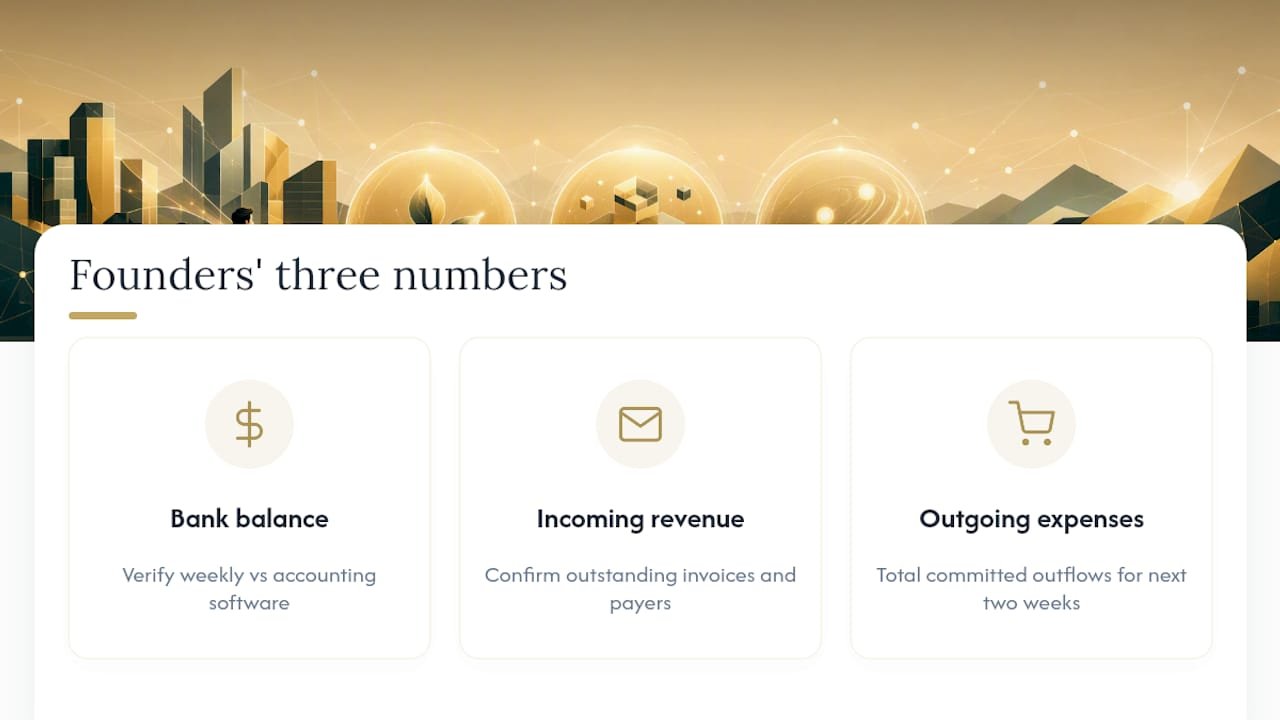
Regardless of who handles the mechanics, founders should always know three numbers cold: bank balance, incoming revenue, and outgoing expenses. Not approximately. Not “somewhere around.” Cold.
Founders frequently over-invest in fancy software and under-invest in owning these three fundamentals. Software is a tool for tracking the numbers, not a substitute for knowing them yourself.
A simple weekly verification routine works: check your bank balance against your accounting software, confirm what invoices are outstanding and from whom, and total what’s committed to go out in the next two weeks. That fifteen-minute check catches problems long before they become emergencies.
Beyond the weekly check, a rolling 12-month cash forecast with at least two scenarios, a base case and a downside case, updated every month with actuals is a core practice for understanding runway and downside risk before you need to react to it. The forecast is only useful if you actually update it monthly rather than building it once and forgetting it exists.
Three process fixes prevent most of the backlog problems founders run into. Route every incoming invoice to a shared inbox instead of a founder’s personal email. Attach receipts to their transaction the moment they arrive, not during a monthly scramble. And small process fixes like these prevent the majority of bookkeeping backlogs that firms otherwise spend hours untangling. Add a quarterly review of vendor subscriptions. Startups accumulate SaaS tools fast, and a lot of them keep billing long after anyone uses them.
What I See Most Often With Startup Books
The mistake I see most is founders treating their business bank account like a personal one in the early months, paying a vendor from the wrong account, or covering a business expense with a personal card and forgetting to log it. It seems harmless until tax season, when six months of commingled transactions need to be untangled one by one.
Late reconciliation is the other repeat offender. Founders put it off because nothing feels urgent until an investor asks for financials or a tax deadline lands, and by then it’s a multi-week catch-up project instead of a fifteen-minute weekly habit.
A virtual accounting department exists to catch both problems before they compound: separate accounts from the start, weekly categorization, and reconciliation that never falls more than a few days behind. Before reaching out to any advisor, open that dedicated business account and connect your bank feed. It’s the one quick win that prevents most of what comes after.
— Kelli
Get a Virtual Accounting Department Built for Startups
Kelliworks runs the entire bookkeeping and reporting cycle described above so you’re not the one closing books at midnight before a board meeting. The Virtual Accounting Department delivers reconciled accounts, a monthly P&L and cash forecast, and coordinated payroll and tax filings, without the cost of a full-time hire.

If you’re hitting the signals covered earlier, closes dragging past three weeks, payroll rules you’re unsure about, or an upcoming raise that needs clean historicals, that’s the point where a virtual accountant replaces guesswork with a team that already knows the checklist. Onboarding starts with a review of your current books and chart of accounts, then moves straight into reconciliation and reporting on a monthly cadence. Book a consultation through Kelliworks to get your books caught up and off your plate.
Where to Verify These Numbers and Deadlines
For the tax and payroll deadlines mentioned above, check IRS Form 1040-ES for estimated payment schedules and the SBA’s hiring and employee management guidance for payroll registration steps. Y Combinator’s library on managing startup finances and Debit & Co.’s day-one accounting setup guide offer further detail on the structural decisions covered here.
Sources
- Managing startup finances · Y Combinator Library
- Startup Accounting: How to Set Up Your Books From Day One · Debit & Co.
- About Form 1040-ES · IRS
- Hire and manage employees · SBA