


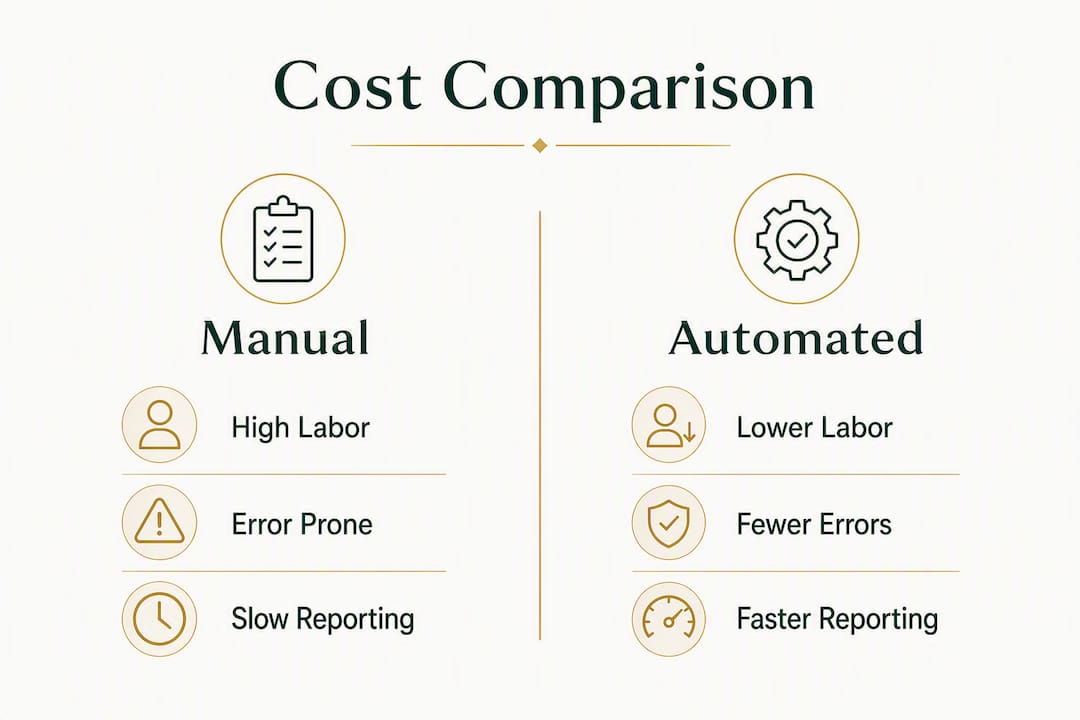
Manual accounting costs more because hidden labor, error correction, delayed decisions, and compliance exposure create recurring, compounding expenses that far exceed what software or outsourcing would cost. The apparent savings of skipping accounting software disappear quickly once you account for what your team is actually spending time on.
Here is the short version of where the money goes:
- Labor and productivity: Skilled finance staff often spend 25–40 hours per month on repetitive data entry and reconciliation that could be automated.
- Error correction and rework: A single error found during audit can consume 4–8 hours of highly paid staff time.
- Slow reporting and decision lag: Manual closes take considerably longer than automated processes, which can close in just a few business days.
- Compliance and audit risk: Missing audit trails invite scrutiny, penalties, and expensive remediation.
- Cash-flow drag: Late invoicing and slow receivables tie up working capital unnecessarily.
- Fraud and weak controls: Manual systems lack the separation of duties and access logs that deter fraud.
- Growth ceiling: Manual processes break under volume, forcing costly workarounds or emergency hires.
The aggregate impact is real. Manual processes typically cost the average finance team $20,000 or more per year in hidden time, errors, and cleanup, and that figure does not include opportunity costs from slow decisions.
Table of Contents
- Why manual accounting costs more: the hidden cost categories
- What do the numbers actually look like?
- How to calculate what manual accounting costs your business
- What actually moves the needle on reducing these costs
- When does automation or outsourcing actually pay back?
- The talent tax most business owners never see coming
- What to audit in your manual processes this week
- Key Takeaways
- The cost you stop seeing is the one that grows the fastest
- Kelliworks gives you a full accounting department without the overhead
- Sources and further reading
Why manual accounting costs more: the hidden cost categories
Most business owners see manual accounting as a cost-avoidance strategy. The reality is that each category below generates recurring, measurable losses.
Labor and productivity
Your bookkeeper or accountant is likely one of the most expensive hourly workers in your back office. When that person spends much of their week on data entry, bank reconciliation, and spreadsheet maintenance, you are paying a skilled professional to do work a software subscription handles automatically, leading to significant labor costs before considering errors.

Error correction and rework
Spreadsheets are error-prone by design. Research confirms that large spreadsheets commonly contain at least one material error, and those errors compound across reports and audits. When a mistake surfaces at year-end or during an IRS inquiry, fixing it can take 4–8 hours of highly paid staff time. That cost is almost never logged as a line item, so it stays invisible on your P&L while quietly draining resources.
Slow reporting and decision lag
Manual accounting processes extend month-end close times significantly longer than automated peers. That gap means you are making pricing, hiring, and cash management decisions on data that is weeks old. A pricing adjustment you could have made on the 3rd of the month gets made on the 15th, and the revenue you left on the table in those 12 days is a real cost with no invoice attached to it.
Compliance and audit risk
Manual systems rarely produce clean, timestamped audit trails. When the IRS or a state tax authority asks “who changed this figure and when,” a spreadsheet cannot answer that question reliably. The result is extended audit time, higher external advisor fees, and a meaningful risk of penalties. Missing or inconsistent audit trails increase both scrutiny and remediation costs in ways that a well-configured accounting platform largely prevents.
Cash-flow drag
Late invoicing is one of the most direct ways manual accounting hurts your bottom line. When invoices go out days late because someone had to manually compile them, your receivables cycle lengthens. You also miss early-payment discounts from vendors when your AP process is slow. Both effects increase your working capital requirement, which either costs you in interest or limits what you can invest in growth.

Fraud and internal control weaknesses
Manual processes depend on trust and habit rather than system-enforced controls. Without automated approval workflows, access logs, and segregation of duties, a single employee can create, approve, and pay a fraudulent invoice with no system-generated alert. The Association of Certified Fraud Examiners consistently finds that small businesses suffer disproportionately from occupational fraud, partly because they rely on manual, trust-based processes.
Scaling costs and process brittleness
A manual system that works at 50 invoices per month starts to crack at 200. The response is usually to hire another person rather than fix the process, which multiplies your labor cost without improving accuracy or speed. With the current U.S. accounting talent shortage, competing for scarce human resources to staff a manual process is a losing strategy, while automated teams scale capacity without adding headcount.
Pro Tip: Track the time your team spends on reconciliation and data entry for just one month using a simple time log. Most business owners are surprised to find the number is 2–3 times higher than they estimated.
What do the numbers actually look like?
Benchmarks give the hidden costs a concrete shape. The table below shows key figures drawn from industry research.
| Cost Driver | Manual Process | Automated Process | Source Benchmark |
|---|---|---|---|
| Hours/month on repetitive tasks | 25–40 hours | 5–8 hours | ReceiptFlow |
| Cost per invoice processed | ~$22 | ~$6.90 | Forwardly |
| Month-end close time | 5–10 business days | 1–2 business days | TechnologyCounter |
| Hours to fix one late-discovered error | 4–8 hours | Near zero (prevented) | Growthy |
| Estimated annual hidden cost | $20,000+ | Substantially lower | ReceiptFlow |
Manual invoice handling averages significantly higher cost per invoice compared to automation, resulting in substantial additional monthly and annual expenses for businesses processing many invoices.
Illustrative example — small SMB (10 employees, ~100 invoices/month):
- Monthly manual task hours convert to substantial labor cost at typical loaded rates.
- Invoice processing premium adds considerably to monthly costs based on volume and cost gap.
- Error correction consumes notable staff time and cost per error.
- Estimated monthly hidden cost is a significant amount when combining labor, invoice processing, and error correction.
- Annualized costs reach substantial levels for small businesses adhering to manual accounting.
Illustrative example — mid-sized business (30 employees, ~300 invoices/month):
- Monthly manual task hours translate to a significant labor cost at typical loaded rates for mid-sized businesses.
- Invoice processing premium contributes heavily to monthly costs depending on transaction volume and cost disparity.
- Error correction requires considerable staff time and cost per error.
- Estimated monthly hidden cost is substantial when factoring labor, invoice processing, and error correction.
- Annualized costs can be very high for mid-sized businesses maintaining manual accounting.
These are conservative estimates. They exclude compliance penalties, opportunity costs from slow decisions, and turnover costs, all of which add significantly to the total.
In 2026, 41% of finance teams still run meaningful manual accounting processes; teams with low automation often underestimate the hidden costs.
How to calculate what manual accounting costs your business
You do not need a consultant to run this math. Five inputs give you a reliable annual estimate.
- A — Loaded hourly rate: Your bookkeeper or accountant’s fully loaded cost (salary + benefits + payroll taxes), divided by monthly hours. A common SMB range is $35–$55/hour.
- B — Hours per month on manual tasks: Time spent on data entry, reconciliation, manual invoicing, and report assembly. Pull this from time logs or estimate by asking your team to track one week and multiply by four.
- C — Average hours per error correction: Use 6 hours as a conservative default if you have no data. Track actual correction time for one quarter to refine this.
- D — Number of transactions/invoices per month: Pull this from your bank statement or invoice register.
- E — Per-transaction manual handling cost: Use the $22 benchmark for invoices if you have no internal figure.
Worked example (conservative SMB):
- A = $40/hour, B = 25 hours/month → Monthly labor cost: $1,000
- C = 6 hours, 2 errors/month, A = $40 → Monthly rework cost: $480
- D = 80 invoices/month, E = $22 → Monthly invoice cost: $1,760
- Monthly total: $3,240 | Annual total: $38,880
Subtract what you would pay for accounting software or a virtual accounting service. The difference is your net annual cost of staying manual.
What business owners commonly undercount: staff turnover triggered by burnout, the cost of an accountant’s time during audit cleanup, and the revenue lost to slow pricing or hiring decisions. These three items alone can double the figure above for a growing business.
Pro Tip: Your bank’s transaction export and your invoicing tool’s sent-invoice log are the fastest proxies for inputs D and E. You can pull both in under 10 minutes and have a working estimate the same day.
What actually moves the needle on reducing these costs
Reducing manual accounting expenses does not require a full technology overhaul on day one. A phased approach keeps disruption low and delivers early wins that fund the next step.
Low-cost, quick wins
Automate bank reconciliations first. Cloud accounting platforms like QuickBooks Online or Xero connect directly to your bank feeds and match transactions daily, eliminating the single largest time sink in most small business accounting setups. Standardize your invoice template and use a receipt-capture app like Dext or Hubdoc to eliminate manual receipt entry. These three changes alone can recover 8–12 hours per month for most SMBs.
Medium-effort moves
Integrate your accounts payable and accounts receivable with your accounting software. Most modern AP/AR tools connect via API, meaning a paid invoice updates your books automatically. Add a basic two-step approval workflow for payments above a threshold you set, which addresses both fraud risk and audit trail gaps simultaneously. Centralizing documentation in a cloud folder linked to each transaction takes an afternoon to set up and saves hours during every future audit.
High-impact investments
End-to-end automation, or outsourcing to a virtual accounting provider, delivers the largest cost reduction. A virtual accounting department handles bookkeeping, reconciliation, reporting, and tax preparation, converting a variable, error-prone internal process into a fixed, predictable cost. For businesses spending $3,000+ per month on manual accounting labor, outsourcing typically costs less and produces faster, cleaner results.
“The way accounting has always been done isn’t sustainable — manual processes tend to be chaotic and time-consuming, and the challenges are now even greater.” — Institute of Management Accountants, Strategic Finance
Common traps to avoid: migrating all processes at once, skipping a data cleanup before automation, and failing to train staff on new tools. Each of these extends payback timelines and creates new errors.
Pro Tip: Start with one process, not the whole system. Bank reconciliation is the best first pilot because it has a clear before/after metric (hours saved per month) and zero risk of disrupting client-facing operations.
When does automation or outsourcing actually pay back?
The ROI question is not “can we afford to automate?” It is “can we afford not to?” Three triggers reliably indicate that the payback window is short.
- You spend more than 20 hours per month on manual accounting tasks. At $40/hour loaded, that is $800/month in labor cost that automation can largely eliminate.
- You process more than 50 invoices per month. The $15.10 per-invoice cost gap compounds fast above this volume.
- You have had one or more audit findings, penalties, or material errors in the past two years. Each incident signals systemic control weakness that will recur.
- You are struggling to recruit or retain accounting staff. Manual processes accelerate burnout and turnover, and replacing a skilled team member costs the equivalent of up to half a year’s salary when recruiting, onboarding, and lost institutional knowledge are included.
- Your month-end close takes longer than five business days. Decisions made on stale data carry an opportunity cost that compounds every month.
Typical payback timelines for SMBs: accounting software automation generally pays back in 3–6 months. Outsourcing to a virtual accounting provider typically pays back in 6–12 months, with the longer window reflecting a higher initial service cost offset by broader scope and faster error reduction.
Quick decision guide:
- Pilot automation first if your processes are mostly consistent and your team has capacity to manage a transition.
- Outsource immediately if you have high error rates, a recent audit finding, rapid growth, or no internal accounting expertise.
Automation often delivers 150–300% ROI in year one for teams that were running fully manual processes, with a 3–6 month payback period on software costs alone.
The talent tax most business owners never see coming
There is a cost category that rarely appears in any ROI spreadsheet: the price of asking skilled people to do work that does not use their skills.
When a senior accountant spends 30 hours per month on data entry and reconciliation, you are not just paying for those 30 hours. You are also losing the strategic analysis, forecasting, and financial guidance that person could have been delivering instead. That lost output has a real dollar value, even if it never shows up as a line item. Converting that time back into analysis and forecasting materially raises a firm’s strategic capacity, which is a competitive advantage that compounds over time.
The turnover dimension makes this worse. Manual accounting environments are high-burnout environments. Audit season, month-end crunch, and the constant pressure of error-prone processes push skilled staff toward employers who have modernized. When they leave, you absorb recruiting fees, onboarding time, and the loss of institutional knowledge that took years to build. Replacing a skilled accounting hire can cost the equivalent of half a year’s salary in total business impact. For a $65,000/year accountant, that is $32,500 in replacement cost, a figure that dwarfs most annual software subscriptions.
The Controllers Council notes that manual accounting is simply not sustainable for growing organizations, and the talent dimension is a primary reason. Automated teams attract and retain better people because the work is more interesting and less grinding.
At Kelliworks, we see this pattern consistently. The businesses that come to us most urgently are not always the ones with the worst books. They are often the ones who just lost their second bookkeeper in 18 months and cannot afford to rebuild from scratch again.
What to audit in your manual processes this week
You do not need a formal assessment to find the biggest leaks. A focused one-week review of five areas will surface the highest-priority fixes.
- Time sinks: Ask your bookkeeper to log every task for five business days. Anything consuming more than two hours per week that follows a repeatable pattern is an automation candidate.
- Error hot spots: Pull your last three bank reconciliations and count the number of manual adjustments. More than three per month signals a systemic problem, not a one-off.
- Audit trail gaps: Open your last 10 vendor payments and check whether each has a corresponding approved PO or invoice attached in your system. Missing documentation is your biggest audit liability.
- Collections lag: Calculate your average days sales outstanding (DSO). If it exceeds your stated payment terms by more than 10 days, late invoicing or slow follow-up is costing you cash.
- Approval bottlenecks: Identify any payment or expense that requires a physical signature or an email chain to approve. Each one is a fraud risk and a process delay.
Collect the evidence with three simple tools: a time log spreadsheet, a sample of 10 recent invoices, and your last two bank reconciliation files. You can complete this review in under four hours and leave with a prioritized list of fixes.
Pro Tip: Reviewing bookkeeping best practices before your audit week gives you a clear benchmark for what “good” looks like, so you can spot gaps faster.
For next steps, run a one-process pilot (bank reconciliation is the lowest-risk starting point), involve your bookkeeper in the tool selection, and consider an external consultant if your error rate or audit exposure is high. The goal of this week is not to fix everything. It is to know exactly where your money is going.
Spreadsheets and paper-based records make answering “who changed this and when” time-consuming and costly during audits — a problem that a properly configured cloud accounting platform eliminates by default.
Key Takeaways
Manual accounting costs the average SMB $20,000 or more per year in hidden labor, error correction, and compliance exposure, and the gap widens as transaction volume grows. In 2026, 41% of finance teams report less than a quarter of their finance processes are digitized or automated.
| Point | Details |
|---|---|
| Hidden costs are quantifiable | Use five inputs (loaded rate, manual hours, error rate, transaction count, per-invoice cost) to estimate your annual cost this week. |
| Labor is the largest driver | Finance staff spending a considerable amount of time each month on manual tasks represents substantial monthly labor costs before errors are counted. |
| Start with one quick win | Automating bank reconciliation alone recovers 8–12 hours per month with minimal disruption and no capital investment. |
| Talent tax compounds the loss | Replacing one burned-out accounting hire costs up to half a year’s salary, a figure that exceeds most annual software or outsourcing fees. For a $65,000/year accountant, this can mean $32,500 in replacement cost. |
| Kelliworks offers a direct path out | Kelliworks provides virtual bookkeeping, tax preparation, and financial consulting that replace manual processes with a fixed, predictable cost. |
The cost you stop seeing is the one that grows the fastest
Most business owners who stay with manual accounting are not being careless. They started with a spreadsheet when the business was small, it worked well enough, and switching felt risky. That logic made sense at 20 transactions per month. At 200, it is quietly expensive.
What I find most telling, working with small businesses every day, is that the owners who resist automation are often the ones who have absorbed the cost so gradually that it no longer registers as a cost. The extra hours their bookkeeper works during close, the errors that get quietly fixed before the report goes out, the invoice that went out three days late because someone was sick — none of these show up as a line item. They show up as a vague sense that the finances are always slightly behind, that the numbers never quite feel reliable, and that the team is always a little stretched.
The conventional wisdom says “if it isn’t broken, don’t fix it.” But manual accounting is broken in ways that are hard to see until you measure them. The businesses that make the switch consistently report not just cost savings, but a shift in how their team operates. When your bookkeeper stops spending 30 hours a month on data entry, they start asking better questions about the numbers. That shift is worth more than any software subscription.
The practical advice: do the five-input calculation from this article before you make any decision. If your annual hidden cost is under $10,000, a software-only approach may be sufficient. Above that threshold, and especially if you have had turnover or audit exposure, a full-service virtual accounting arrangement is almost always the faster path to a clean, reliable financial operation.
Kelliworks gives you a full accounting department without the overhead
Staying manual is a choice that costs more every month you wait. Kelliworks is the alternative: a full-service virtual accounting department that replaces your manual bookkeeping, reconciliation, and tax preparation with a clean, expert-managed process at a predictable monthly cost.

Clients who move to Kelliworks typically see faster month-end closes, fewer errors reaching their reports, and a bookkeeper who is no longer buried in data entry. The accounting services cover bookkeeping, tax preparation, and financial consulting, all tailored to the size and complexity of your business. There are no long-term contracts to negotiate and no need to recruit, train, or replace internal staff.
If you have run the cost calculation from this article and the number surprised you, the next step is straightforward. Learn why a virtual accountant makes financial sense for your business, or reach out to Kelliworks directly for a consultation.
Sources and further reading
The figures and benchmarks in this article draw from the following sources. Each is worth reviewing if you want to go deeper on a specific cost category.
- The Real Costs of Manual Accounting — IMA Strategic Finance: Authoritative IMA perspective on why manual processes are not sustainable for growing organizations.
- Manual Accounting System — Legal Information Institute, Cornell Law School: Authoritative legal definition of a manual accounting system for context and terminology grounding.



One Response