


A bookkeeper records every transaction and keeps your general ledger accurate. A controller manages the accounting operations built on top of that ledger, including internal controls, GAAP-ready reporting, and month-end close. Most small businesses need a solid bookkeeper first. You need a controller when transaction volume grows, month-end drags on, or investors and lenders start asking questions your bookkeeper can’t answer.
Watch for these signs you likely need a controller now:
- Month-end close takes weeks instead of days
- Bank reconciliations feel messy or perpetually behind
- You’re facing revenue recognition questions under ASC 606
- Investors or lenders are requesting audited or GAAP-compliant statements
Key Takeaways
The right financial hire depends on complexity, not company size. Bookkeeping accuracy comes first; controller-level oversight follows once close speed, reporting demands, or investor scrutiny require it.
| Point | Details |
|---|---|
| Bookkeepers handle transactions | Daily recording, reconciliations, and a clean ledger are the baseline every business needs. |
| Controllers manage operations | Month-end close, GAAP reporting, and internal controls become essential as complexity grows. |
| Five-day close is the benchmark | Slow closes taking weeks signal a broken process a controller can fix. |
| Cost gaps are real | Bookkeeper pay ranges $45,000 to $65,000; controller compensation can approach $150,000. |
| Kelliworks scales the layers | Bookkeeping, fractional controller, and virtual CFO support are added as your business grows. |
Table of Contents
- What Does a Bookkeeper Do Day to Day?
- What Does a Controller Actually Manage?
- Controller vs Bookkeeper: Key Differences at a Glance
- When to Hire a Bookkeeper vs a Controller
- How Bookkeeping and Controller Functions Work Together
- What Do Bookkeepers and Controllers Typically Cost?
- Is a Controller Higher Than an Accountant or CPA?
- The Recommended Path: Kelliworks’ Approach
- Sources
What Does a Bookkeeper Do Day to Day?
A bookkeeper handles the transactional heartbeat of your business. They record sales, enter bills, log payroll transactions, and reconcile your bank accounts, usually on a daily or weekly rhythm. This work builds the general ledger that everything else in your financial picture depends on.
The typical outputs are straightforward but essential:
- A clean, organized transaction journal
- Reconciled bank and credit card statements
- A trial balance that ties out correctly
- Basic monthly statements for tax preparation
Bookkeepers show up as in-house hires, freelancers, or outsourced services. Whichever route you take, look for the same quality signals: reconciliations completed on time, a chart of accounts that actually makes sense to someone outside the business, and clear notes explaining unusual transactions. A bookkeeper who can’t explain a weird entry from three months ago isn’t giving you a foundation you can trust.
What Does a Controller Actually Manage?
A controller runs the accounting operation, not just the transaction log. Core duties include managing the month-end close, producing GAAP-compliant financial statements, running variance analysis against budget, designing internal controls, and often overseeing the bookkeeping team itself.
The outputs look different from what a bookkeeper hands you:
- A GAAP-ready income statement and balance sheet
- Cash flow statements that hold up to scrutiny
- Management reports with real variance analysis, not just raw numbers
- Forecasting inputs a lender or investor can actually use
Controllers become essential the moment complexity outpaces basic bookkeeping. That includes investor due diligence, SaaS businesses navigating ASC 606 revenue recognition, or any business managing multiple entities that need consolidation. A controller’s most measurable impact is speed. Top-performing finance teams close their books in under five business days; a controller builds the checklist, delegation structure, and review cadence that makes that timeline possible.
Pro Tip: If your close still takes two or three weeks, don’t ask your bookkeeper to work faster. The bottleneck usually isn’t effort, it’s the absence of a structured close process, which is exactly what a controller builds.
Controller vs Bookkeeper: Key Differences at a Glance
The clearest way to separate these roles is by what each one owns. A bookkeeper owns historical accuracy. A controller owns controls, analysis, and forward-looking reporting.
| Dimension | Bookkeeper | Controller |
|---|---|---|
| Primary duties | Records transactions, reconciles accounts | Manages close, builds controls, oversees reporting |
| Typical outputs | Trial balance, reconciled statements | GAAP financials, variance reports, forecasts |
| Seniority and authority | Executes defined processes | Sets processes, signs off on accuracy |
| Frequency of work | Daily or weekly | Weekly to monthly, often on a close calendar |
| When to hire | From day one of operations | When complexity or diligence demands controls |
| Typical cost/staffing | Hourly, part-time, or outsourced | Fractional, part-time, or full-time senior hire |
Three things matter most for owners reading this table:
- A bookkeeper without controller oversight can produce accurate but unstructured books
- A controller without clean bookkeeping underneath has nothing reliable to analyze
- Investors and lenders judge your business by controller-level output, not raw transaction logs
When to Hire a Bookkeeper vs a Controller
The decision usually comes down to volume, complexity, and who’s asking for your numbers. If you’re a solo operator with a handful of monthly transactions, a bookkeeper alone may cover you for years. Once you add payroll complexity, multiple revenue streams, or outside stakeholders, the calculus changes.
Run through this quick checklist:
- Is your month-end close taking longer than two weeks? That’s a controller signal.
- Are you preparing for a raise, loan application, or acquisition? Bring in a controller before diligence starts, not during it.
- Do you have more than one entity or location? Consolidation needs controller-level structure.
- Is your current bookkeeper being asked to build forecasts or analyze variance? That’s a common mismatch that increases financial risk.
Full-time controllers make sense once you’re consistently paying for controller-level work anyway. Fractional or outsourced controllers work well for businesses that need the oversight but not five days a week of it, which is often the more cost-predictable path for growing companies. A virtual CFO can also serve this function for businesses needing controller support on a weekly or biweekly basis rather than daily.
Pro Tip: Don’t wait until an investor asks for your financials to fix a broken close process. Bring in fractional controller support at least two quarters before any fundraising conversation.
How Bookkeeping and Controller Functions Work Together
The two roles form a sequence, not a competition. Bookkeeping happens first: transactions get recorded, bank accounts get reconciled, and a preliminary close gets assembled. The controller then reviews that work, catches discrepancies, and finalizes reporting.
- Bookkeeper records and reconciles transactions
- Bookkeeper produces a preliminary close package
- Controller reviews for accuracy and control gaps
- Controller finalizes statements and reports to ownership
Segregation of duties matters here. The person recording transactions shouldn’t be the same person approving the final close. Weekly reconciliation checkpoints and a written monthly close checklist keep both roles accountable without constant back-and-forth.
What Do Bookkeepers and Controllers Typically Cost?
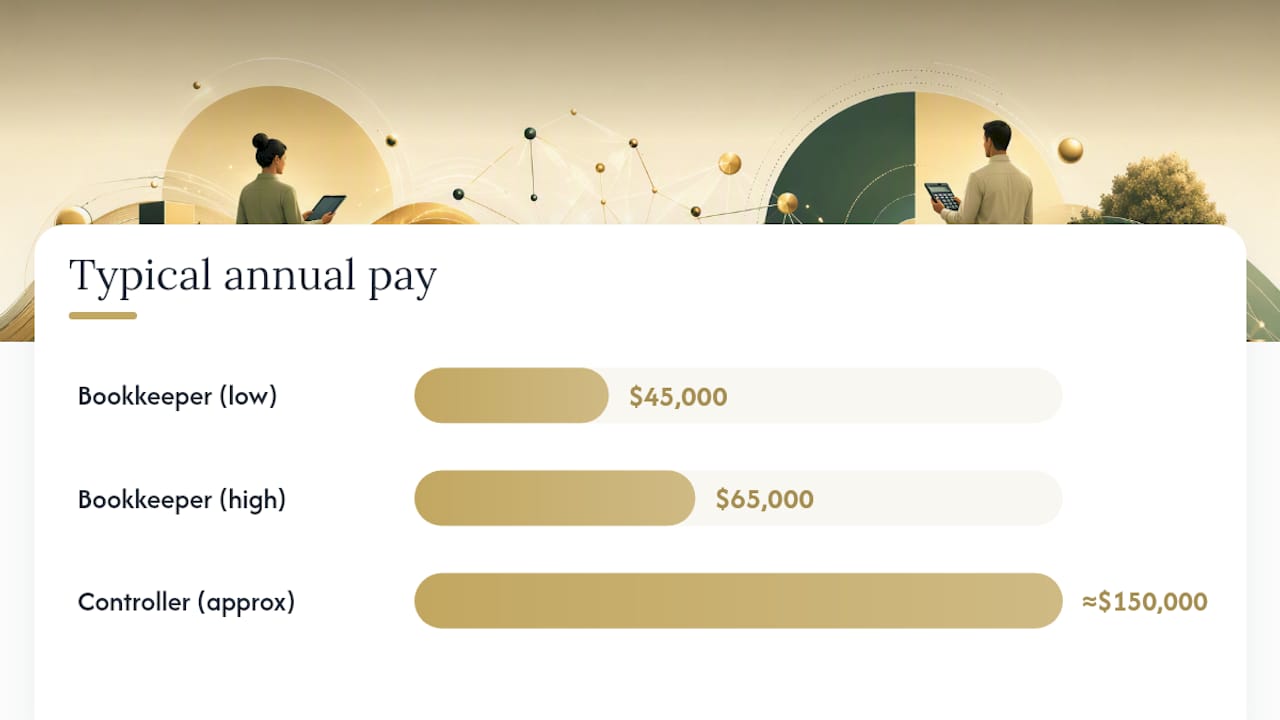
Cost is often the deciding factor, and the gap between roles is significant. A bookkeeper’s compensation typically falls between $45,000 and $65,000 annually, while a high-caliber controller’s median salary can approach $150,000, with real variation by region and experience level.
Your staffing options fall into a few camps:
- In-house full-time hire: highest cost, highest control, longest ramp time
- Fractional controller: lower cost, faster access to senior expertise, shared attention
- Outsourced accounting department: predictable monthly cost, scales with your business
- Hybrid: in-house bookkeeper paired with fractional controller oversight
Pro Tip: A fractional controller often costs a fraction of a full-time salary while still delivering the close discipline and reporting rigor that lenders and investors expect.
Is a Controller Higher Than an Accountant or CPA?
Many controllers hold a CPA license, but the roles aren’t identical. A CPA often specializes in tax preparation and assurance work, while controller duties focus on day-to-day accounting operations and internal controls.
- Controller sits above staff accountants in the accounting hierarchy
- CFO sits above the controller, focused on strategy rather than operations
- A CPA-certified controller adds credibility for audits and complex compliance work; a non-CPA controller can still excel at operational close and reporting
The Recommended Path: Kelliworks’ Approach
Get your bookkeeping foundation solid first. Predictable, reconciled books make every layer above them possible. Once close speed, reporting needs, or investor pressure hit the triggers outlined above, add controller-level oversight, whether fractional or full-time.
Controllers oversee accounting operations and month-end close, while virtual CFO services layer in forecasting, KPI development, and investor reporting on top of that foundation. Small businesses rarely need all three roles at once. They need the right one at the right stage.
Kelliworks builds this exact progression for clients: bookkeeping foundation first, fractional controller services when complexity demands it, and virtual CFO support when strategic planning becomes the priority. Clients typically see faster closes, cleaner financials, and forecasts they can actually hand to a lender.
Pro Tip: If you’re unsure which layer you need, start with a review of your current close process. That single conversation usually reveals the gap faster than guessing.
| Point | Details |
|---|---|
| Bookkeeping comes first | Clean, reconciled books are the foundation every controller function depends on. |
| Controllers solve speed and compliance | Hire one when close takes weeks, not days, or investors demand GAAP reporting. |
| Kelliworks scales with you | Bookkeeping, fractional controller, and virtual CFO support are layered as needed. |
A Note From Kelli
Working with small business owners for years has taught me that most people don’t need every service at once. They need the right layer of support at the right moment, and honest guidance on when that moment arrives. If you’re not sure whether you need a bookkeeper, a controller, or both, reach out for a quick assessment. It takes less time than you’d think.
Get the Right Financial Support, Starting Now
Kelliworks operates as a full virtual accounting department, so you’re never stuck choosing between a bookkeeper on Fiverr and a $150,000 full-time controller hire, leveraging expert financial consulting services to tailor solutions for your business. You get bookkeeping, fractional controller oversight, and strategic consulting under one roof, scaled to what your business actually needs today.

If your month-end close is dragging or you’re preparing for outside investment, start with a look at how a virtual accounting department can cover bookkeeping and controller-level work together. Book a quick assessment and we’ll tell you honestly which layer of support fits your business right now, not what sounds impressive on a service menu.
Sources
- Bookkeeper vs Controller: When to Upgrade Your Finance Function | Jumpstart Partners
- Virtual CFO Services for Small Business | Acculink CPA
This article is general information, not a substitute for advice from a qualified financial advisor. Consult a qualified financial professional about your own circumstances before acting on anything here.