


A payroll compliance checklist verifies six things every pay cycle: worker classification, new-hire paperwork, tax registrations, accurate timekeeping, correct withholding and deposits, and complete recordkeeping. Miss any one of them and you risk back taxes, penalties, or a Department of Labor audit you can’t defend because the paperwork simply isn’t there.
The single next step, if you do nothing else this week: assign one person to own payroll compliance and run a full compliance sweep on your very next pay cycle. Not “someone on the team.” One name, one set of duties.
Before you build out the full process, prioritize these 2026-specific pressure points:
- Expanded IRS e-filing thresholds that pull more small employers into mandatory electronic filing
- Growing state-level pay transparency rules that intersect with how you disclose wages and pay statements
- Federal reporting changes tied to recent tax legislation that affects how certain payroll items get reported
- State privacy and pay-statement law updates that vary by jurisdiction and change every year
Key Takeaways
A defensible payroll compliance checklist works because it assigns a named owner to every stage, from classification through year-end filing, and retains records for at least four years to satisfy the strictest federal clock.
| Point | Details |
|---|---|
| Classify workers before hiring | Document the employee vs. contractor decision in writing before the first payment. |
| Retain records for 4 years minimum | Adopt the IRS employment tax floor even where DOL rules allow a shorter window. |
| Separate I-9s from personnel files | Store I-9 forms independently to avoid disclosure and retention conflicts. |
| Build a recurring compliance calendar | Tie reconciliations and filing deadlines to actual pay dates, not a generic schedule. |
| Consider outsourcing the checklist | Kelliworks manages payroll processing, deposits, and recordkeeping so an SMB owner isn’t running this alone. |
Table of Contents
- Payroll Compliance Checklist: The Stage-by-Stage Sequence
- What 2026 Changes Most for Payroll Priorities
- Payroll Records Retention: What to Keep and for How Long
- Turning the Checklist Into a Recurring Process
- How Kelliworks Supports Every Stage of This Checklist
- Handling Wage Garnishments and Levies
- Minimum Wage and Break Law Compliance Across States
- Correcting Payroll Errors: The Right Sequence
- Payroll Data Privacy and Security Requirements
- What Actually Moves the Needle on Payroll Compliance
- Let Kelliworks Run Your Payroll Compliance Checklist
- Sources
Payroll Compliance Checklist: The Stage-by-Stage Sequence
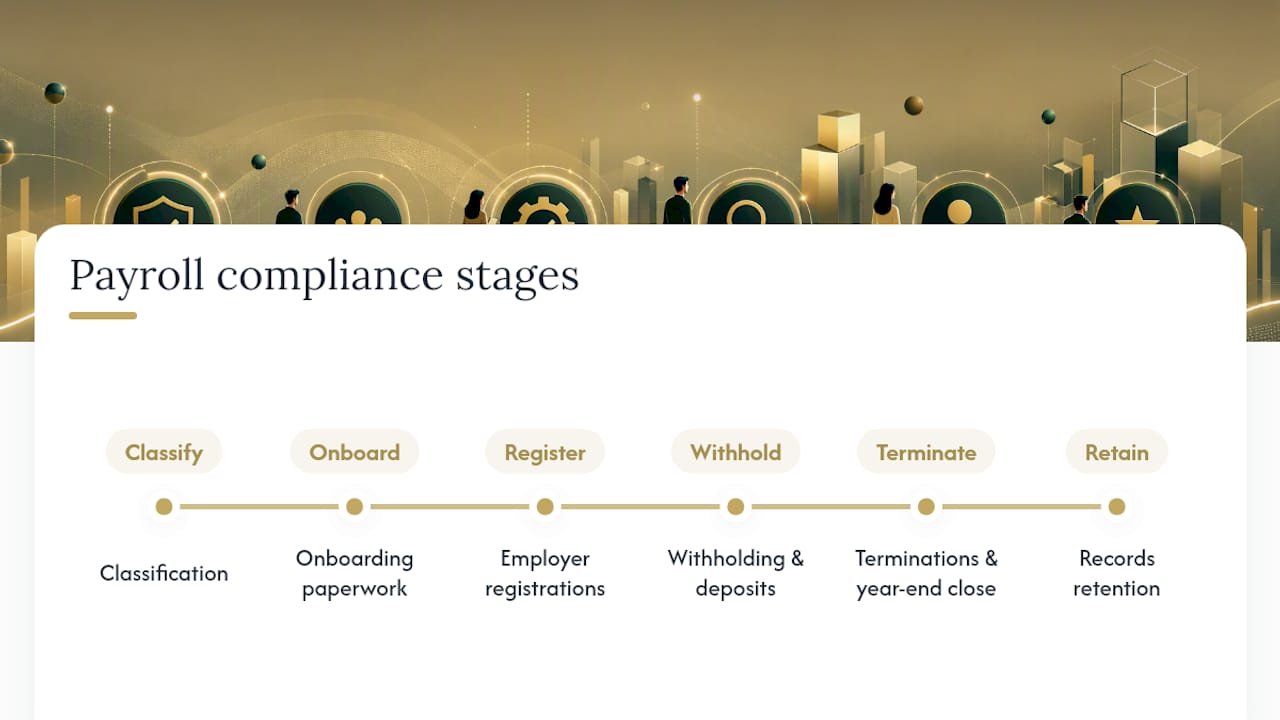
Most payroll failures don’t happen because a business owner doesn’t care about compliance. They happen because the checklist lives in someone’s head instead of on a calendar, and the one person who understood the process left for a new job in March. Building the checklist in stages, tied to the actual life cycle of an employee and a pay period, fixes that.
Pre-hire: get classification right before anyone signs anything
Worker classification is the single most expensive mistake on this list. Before you post a job or sign a contractor agreement, confirm:
- Behavioral control — do you direct how, when, and where the work gets done? If yes, that’s an employee relationship, not a contractor one.
- Financial control — does the worker have their own equipment, other clients, and the chance of profit or loss? Contractors typically do.
- Relationship type — is this ongoing and central to your business, or project-based and peripheral?
- Documentation — write down the classification decision and the reasoning behind it, before the first paycheck goes out.
Onboarding: paperwork that has to happen in the first week
Every new employee needs a completed Form W-4 for federal withholding, a completed Form I-9 verifying work eligibility, and the state equivalent of a W-4 if your state collects its own income tax. Add direct deposit authorization, benefits enrollment paperwork, and new-hire reporting to your state agency, which most states require within 20 days of the hire date.

Employer registrations you need before the first payroll runs
If you haven’t already, secure your federal Employer Identification Number (EIN), register for state withholding tax, and set up your State Unemployment Tax Act (SUTA) account. Some cities and counties layer on their own local withholding or occupational tax registration, so check your local labor department before assuming federal and state coverage is enough.
Per pay period: the checklist that actually repeats
- Confirm timekeeping records are accurate and signed off before payroll processes, especially for non-exempt employees where overtime miscalculation is the most common wage claim.
- Calculate overtime at a rate higher than regular pay for hours worked beyond the standard full-time threshold in a workweek, factoring in bonuses and commissions that are part of regular pay.
- Include every gross pay component: base wages, overtime, bonuses, commissions, and any PTO payout.
- Itemize the pay stub with gross pay, each deduction, net pay, and hours worked, since several states have specific pay-statement content requirements.
Pro Tip: Run a “reasonableness check” every pay period: compare this cycle’s total payroll cost to the last three cycles. A swing of more than a few percentage points with no obvious explanation (new hire, raise, bonus run) usually means a data entry error, not a real cost change.
Withholding, deposits, and filings
Withhold FICA (Social Security and Medicare), federal income tax, and applicable state and local taxes every pay period. Your deposit schedule for federal payroll taxes, monthly or semiweekly, depends on your total tax liability during a prior lookback period, so check your assigned schedule rather than assuming.
File Form 941 quarterly (or Form 944 annually if you qualify for that smaller-employer option), Form 940 annually for federal unemployment tax, and issue W-2s to employees and 1099-NEC forms to contractors by January 31. Reconcile quarterly 941 totals against annual W-2 totals before you file, because mismatches are one of the more common triggers for IRS correspondence.
Terminations and year-end close
Final paycheck timing rules vary sharply by state. Some require payment on the employee’s last day for involuntary terminations; others allow until the next regular payday. Confirm your state’s rule before the exit interview, not after. At year-end, reconcile every payroll tax deposit against your filed returns, verify W-2 totals tie to your general ledger, and close out your retention files before the new year’s records start piling up.
What 2026 Changes Most for Payroll Priorities
The regulatory landscape shifted enough in 2026 that a checklist built on 2023 assumptions will leave real gaps. Four areas deserve the top of your list this year.
- IRS e-filing expansion: more small and mid-sized employers now fall under mandatory electronic filing thresholds for information returns, which tightens the margin for late or paper-filed corrections.
- Pay transparency laws: a growing number of states now require salary ranges in job postings and, in some cases, pay-equity reporting, which means your payroll data has to be clean enough to support a public claim.
- Federal reporting changes: recent federal tax legislation altered how certain payroll items, including some tip and overtime reporting provisions, flow through to annual filings, which means your year-end W-2 process needs a fresh review rather than a copy-paste from last year.
- State privacy and pay-statement law updates: several states amended pay-statement content requirements or employee data-privacy rules in the past year, and the EEOC’s Equal Pay Act framework remains the backstop for wage-differential documentation if a pay-equity question ever surfaces.
None of these changes eliminate the older requirements. They stack on top of them, which is exactly why a static checklist from a few years ago stops being enough.
Payroll Records Retention: What to Keep and for How Long
Retention rules don’t come from one agency, they come from three, and each one runs its own clock. The DOL requires general payroll records for three years, and wage-computation records like timesheets and rate tables for two years. The IRS requires employment tax records for at least four years after the tax becomes due or is paid. Form I-9 carries its own separate rule: the longer of three years after hire or one year after termination.
The practical fix is to stop tracking three separate clocks. Adopt the four-year IRS floor for everything, and extend further if your state’s own statute demands it.
Your essential document list should include:
- Payroll register for every pay period
- Timesheets and time-clock data for non-exempt employees
- W-4s and state withholding forms, plus I-9s stored in a separate file
- Deposit and tax filing confirmations
- Deduction authorizations, especially for garnishments and benefits
- Pay stubs issued to every employee
Store records digitally with encryption, restricted access, and a central index so you can locate any single document fast. Several states give employees or agencies as little as 21 days to produce requested records, and a scattered filing system turns a routine request into a fire drill.
| Record Type | Federal Minimum Retention |
|---|---|
| Employment tax records (deposits, filings) | 4 years (IRS) |
| General payroll records | 3 years (DOL) |
| Wage-computation records (timesheets, rate tables) | 2 years (DOL) |
| Form I-9 | Longer of 3 years after hire or 1 year after termination |
Turning the Checklist Into a Recurring Process
A checklist that lives in a drawer doesn’t protect you. It has to become a process with named owners and a calendar.
- Assign three distinct roles: a classification owner who reviews new hires and contractor agreements, a payroll approver who signs off on each cycle before it runs, and a tax filer responsible for deposits and quarterly returns. Segregating these duties catches errors that one overloaded person would miss.
- Build a compliance calendar tied to your actual pay dates: reconciliation two days before each run, deposit due dates, and 941 filing windows each quarter.
- Add a reconciliation step before every deposit and filing: compare gross pay, withholding totals, and employer tax liability against the prior period’s baseline.
- Know your correction path in advance. If you catch an error after filing, you may need an amended 941-X or a corrected deposit, and knowing that process before you need it saves days.
Pro Tip: Put the compliance calendar on a shared calendar, not a spreadsheet only one person opens. The moment your payroll owner is out sick during a filing week, that visibility is what keeps a deadline from slipping.
How Kelliworks Supports Every Stage of This Checklist
Running this checklist alongside daily operations is exactly the burden Kelliworks was built to lift. Our payroll processing and compliance support map directly onto the stages above: we assign a dedicated owner to your account, handle deposit scheduling and reconciliations, maintain your recordkeeping in an organized digital system, and manage year-end filings including W-2 and 1099-NEC preparation.
Before a first consult, gather these so we can move fast:
- Your last four quarterly 941 filings
- Current employee W-4s and I-9s
- Your most recent payroll register
- A list of any contractors paid in the current year
Outsourcing payroll compliance isn’t about handing off control. It’s about handing off the parts of the process that carry the most audit risk, so the business owner’s attention goes back to running the business.
Handling Wage Garnishments and Levies
Wage garnishments arrive as a court order, an IRS levy, or a state child-support directive, and each one carries its own compliance obligation the moment it lands on your desk. You’re legally required to act on it. Ignoring a garnishment order doesn’t protect the employee. It exposes your business to liability for the amount you should have withheld.
Start by verifying the order is valid and applies to the correct employee. Federal law under the Consumer Credit Protection Act caps how much can be garnished from a single paycheck, generally the lesser of 25% of disposable earnings or the amount by which disposable earnings exceed 30 times the federal minimum wage, though child support orders can allow a higher percentage. Multiple garnishments on the same employee require you to apply a priority order, typically child support first, then federal tax levies, then other creditor garnishments, and the total withheld still can’t exceed the applicable cap.
Document every garnishment order in the employee’s file, separate from routine personnel records, and set up a recurring deduction that continues automatically until the order specifies otherwise or the agency issuing it sends a release. Remit withheld amounts to the correct agency on the schedule the order specifies, not on your normal payroll deposit schedule, since these often run on separate timelines.
If an employee disputes a garnishment, direct them to the issuing court or agency. Employers don’t have the authority to stop withholding based on an employee’s objection alone, and doing so without a formal release puts your business back in the liability seat.
Minimum Wage and Break Law Compliance Across States
Federal law sets the floor. Your state, and sometimes your city, usually sets the actual number you have to pay. When federal and state minimum wage rates differ, you pay whichever rate is higher for that employee, and the same layering applies to overtime rules, meal breaks, and rest breaks.
Several states require paid rest breaks, unpaid meal periods, or both, on a schedule tied to shift length, while federal law imposes no such requirement. A business operating in one state can run a fully compliant payroll process and still violate a neighboring state’s break law the moment it opens a second location. That’s the trap: compliance isn’t a single ruleset you learn once, it’s a jurisdiction-by-jurisdiction check you run every time you hire in a new location or a state updates its minimum wage, which many do annually.
Overtime rules for non-exempt employees follow the same layered logic. Federal law requires time and a half after 40 hours in a workweek, but a handful of states impose daily overtime thresholds regardless of the weekly total. Exempt employee classification carries its own salary-threshold test, and that threshold has moved more than once in recent years, so a job classified as exempt two years ago may no longer qualify.
The practical move is to check your state labor department’s current wage and break rules at least once a year, and again any time you add staff in a new state.
Correcting Payroll Errors: The Right Sequence
Payroll errors happen, usually a missed overtime calculation, a misclassified worker, or a withholding error that only surfaces at quarter-end. What separates a manageable fix from a compliance problem is how fast you catch it and how you document the correction.

The moment you find an error, quantify it precisely: how many employees, how many pay periods, and the exact dollar difference. Then correct the underlying pay first. If an employee was underpaid, issue the correction in the next available pay run, or sooner if the shortfall is significant. If withholding was calculated wrong, adjust the next period’s withholding to true it up, and document the adjustment in the employee’s payroll file.
For amounts already reported to the IRS, the correction path depends on what was filed. An error on a quarterly 941 typically requires Form 941-X to amend the original filing. An error discovered after W-2s were issued may require a Form W-2c correction sent to both the employee and the Social Security Administration. Timing matters here: the sooner you file the correction, the smaller the chance of a penalty for the original error compounding.
Keep a written log of every correction: what went wrong, when it was caught, who caught it, and what form or adjustment resolved it. That log becomes your best evidence in a future audit that this was an isolated error with a documented fix, not a pattern of neglect.
Payroll Data Privacy and Security Requirements
Payroll data is some of the most sensitive information your business holds: Social Security numbers, bank account details, and full compensation history in one file. Several states have layered data-privacy and breach-notification laws on top of federal requirements, which means how you store and share payroll data is its own compliance question, separate from wage and tax rules.
Store payroll records with encryption at rest and in transit, and restrict access to only the people whose job actually requires it. That usually means your payroll approver and one backup, not your entire management team. Keep Form I-9s in a file separate from general personnel records, since they contain identity documents that carry different disclosure rules than a standard employee file.
If you use a third-party payroll provider, confirm in writing who is responsible for producing records if a state agency requests them, and how fast you can get access if you switch providers or the vendor’s platform goes down during an audit window. A breach or a lost-access scenario during an active audit compounds one problem into two.
What Actually Moves the Needle on Payroll Compliance
Most payroll compliance advice treats every checklist item as equally urgent, and that’s where it goes wrong. Classification errors and missed deposits cause the overwhelming majority of penalty exposure. A slightly late pay stub or an imperfect break-time log matters far less than a contractor who should have been an employee for the last eighteen months.
The conventional wisdom also oversells automation as a full fix. Software calculates withholding correctly. It does not decide whether a new hire is exempt, catch a state’s updated break law, or notice that a garnishment order needs a different priority than the one you assumed. Those judgment calls still need a person who owns the outcome.
Prioritize in this order: get classification right first, build the recurring calendar second, and treat recordkeeping as the safety net underneath both. A business that nails those three rarely gets caught flat-footed, even when it’s behind on the smaller details.
Let Kelliworks Run Your Payroll Compliance Checklist
Kelliworks is the alternative to hiring a full-time payroll and compliance specialist: you get a dedicated team handling classification review, deposit scheduling, recordkeeping, and year-end filings, without adding headcount or a software subscription you have to manage yourself.

If you’ve read this far, you already know the checklist above takes real hours every pay cycle to run correctly, and a single missed deposit or misclassified contractor can cost far more than the time it would have taken to catch it. Our virtual accounting department was built for exactly this: small business owners who need payroll compliance handled with precision but don’t have the bandwidth to own it internally. We pair that with tax preparation support so your quarterly and year-end filings tie together cleanly instead of becoming two disconnected processes.
If you’re weighing whether outsourcing makes sense for your situation, our guide on why small businesses hire a virtual accountant walks through the real cost comparison. Ready to see where your current process has gaps? Schedule a free consultation and bring the four documents listed above. We’ll tell you exactly what needs fixing before your next pay cycle runs.
This article is general information, not a substitute for advice from a qualified financial advisor. Consult a qualified financial professional about your own circumstances before acting on anything here.
Sources
- DOL Fact Sheet: Recordkeeping (FLSA) — Wage and Hour Division
- IRS: Employment tax recordkeeping
- Payroll records: What they are and how long to keep | FirstHR