


Most eligible small businesses and startups can claim the federal R&D tax credit, even if they haven’t turned a profit yet. Qualified small businesses may elect to apply up to $500,000 of that credit against payroll taxes instead of waiting to owe income tax. Your next moves: check whether you pass the gross receipts test, tally your qualifying wages, supplies, and contract research costs, and attach Form 6765 to your timely filed return if you want the payroll-tax election.
- Confirm your gross receipts fall under the typical threshold for small businesses for the credit year
- Identify qualified research expenses across payroll, supplies, and contract research
- File Form 6765 with your original return; use Form 8974 and Form 941 to claim the payroll offset
Pro Tip: The payroll-tax election can only be made on your original, timely-filed return, including extensions. Miss that window and you lose the cash-now benefit for the year, even if you amend later.
Key Takeaways
The R&D tax credit reduces tax liability dollar-for-dollar, and eligible small businesses can convert up to $500,000 of it into immediate payroll-tax relief through a timely-filed election.
| Point | Details |
|---|---|
| Check QSB eligibility first | Confirm gross receipts under $5 million and no receipts more than five years back before doing anything else. |
| Election timing is fixed | The payroll-tax election must be made on your original, timely-filed return; amended returns can’t add it. |
| Use the ASC for simplicity | Most startups apply a 6% rate with no QRE history, or 14% over a three-year base once they have one. |
| Document as you go | Time logs, project notes, and invoices collected in real time hold up far better than records built after the fact. |
| Get filing support early | Kelliworks helps small businesses estimate QREs, build allocation methodology, and file Form 6765 on time. |
This article is general information, not a substitute for advice from a qualified financial advisor. Consult a qualified financial professional about your own circumstances before acting on anything here.
Table of Contents
- What Is the R&D Tax Credit, and How Is It Different From a Deduction?
- Do You Qualify as a Small Business for the R&D Credit?
- What Counts as Qualifying Research Under the Four-Part Test?
- Which Expenses Count as Qualified Research Expenses?
- How Do You Calculate the R&D Tax Credit?
- How Does the Payroll-Tax Election Work?
- What Are the Steps and Timeline to Claim the Credit?
- Should You Check State R&D Tax Credit Programs Too?
- What Documentation Do You Need to Support a Claim?
- What Mistakes Commonly Reduce or Void a Claim?
- How the R&D Payroll-Tax Election Actually Changes a Startup’s Runway
- Let Kelliworks Handle the R&D Credit Paperwork While You Run the Company
- Sources
What Is the R&D Tax Credit, and How Is It Different From a Deduction?
The federal R&D tax credit, formally the credit under IRC Section 41, rewards businesses for qualified research expenses (QREs) with a dollar-for-dollar reduction in tax owed. That’s a meaningfully different mechanic than a deduction, which only reduces the income you’re taxed on. A $50,000 deduction might save you $10,500 at a 21% rate. A $50,000 credit saves you the full $50,000.
Here’s what makes this credit particularly valuable for early-stage companies:
- It applies whether or not your company is profitable this year
- Unused credit amounts can typically carry forward to offset future tax liability
- Qualified small businesses can convert part of the credit into immediate payroll-tax relief instead of banking it as a carryforward
That last point is the one most founders miss. A profitable, tax-paying company gets its benefit as reduced income tax. A pre-revenue startup burning cash gets little from that same credit unless it makes the payroll-tax election, which turns the credit into real money against payroll tax liability owed right now.
Do You Qualify as a Small Business for the R&D Credit?
You likely qualify if your gross receipts are under $5 million for the credit year and you had no gross receipts in any tax year more than five years before that. This is the Qualified Small Business (QSB) test, and it’s the gate you have to pass before you can even consider the payroll-tax election.
Software and SaaS teams building new features, manufacturers refining a production process, engineering firms building prototypes, and companies developing internal tools under real technical uncertainty all commonly qualify. What typically doesn’t qualify: routine operational work, cosmetic updates with no technical uncertainty, or work that’s really just following an established playbook.
One gotcha catches a lot of funded startups off guard: interest income on invested capital counts toward gross receipts. A startup sitting on a large funding round earning interest can accidentally push itself over the $5 million threshold, or start the five-year lookback clock earlier than expected. Most pre-revenue startups still land safely inside the QSB window, but it’s worth running the numbers rather than assuming.
- Gross receipts within the small business eligibility range for the credit year
- No gross receipts in any tax year before the five-year lookback
- Watch for interest income quietly inflating your gross receipts figure
What Counts as Qualifying Research Under the Four-Part Test?
The IRS uses a four-part test to decide whether an activity qualifies, and every part has to be met. This is where a lot of founders either overclaim or underclaim, so it’s worth walking through each piece with real examples.

The four parts are: permitted purpose (the work aims to create or improve a business component, like a product, process, or software), technological in nature (it relies on principles of engineering, computer science, or the hard sciences), elimination of uncertainty (at the outset, you don’t know whether or how to achieve the result), and process of experimentation (you test alternatives through modeling, simulation, or trial and error).
| Activity | Qualifies? | Why |
|---|---|---|
| Building a new recommendation algorithm | Yes | Technical uncertainty about approach, tested through iteration |
| Redesigning your marketing website’s layout | No | No technological uncertainty, purely aesthetic |
| Testing three prototype materials for a physical product | Yes | Process of experimentation to resolve a technical unknown |
| Updating pricing on an existing subscription plan | No | Business decision, not a technical one |
| Developing an internal tool to automate a manual data process | Yes, if uncertain | Qualifies when the technical approach isn’t already known |
A dead-end counts too. If your engineering team tried an approach, hit a wall, and pivoted, that failed attempt still generally qualifies as long as the experimentation process and your documentation of it exist. The IRS doesn’t require success. It requires a genuine attempt to resolve uncertainty.
Which Expenses Count as Qualified Research Expenses?
Four categories of spending typically make up your QREs. Getting the allocation right here is where most of the real credit value gets found or lost.
- Wages for employees performing, supervising, or directly supporting qualified research
- Supplies consumed in the research process, excluding capital equipment
- Contract research, generally capped at 65% of amounts paid to third-party contractors
- Cloud and compute costs tied directly to research activities, where applicable
Most engineers and product teams don’t spend 100% of their time on qualifying work. An engineer who splits time between building new features and fixing customer support tickets only counts the qualifying portion. Time logs or a reasonable, consistently applied allocation method are what the IRS wants to see here, not guesswork after the fact.
Marketing, sales, routine software maintenance, and general administrative work generally don’t qualify. Separating operational tasks from genuine experimentation matters because mixing the two without a clear split is one of the fastest ways to shrink your credit under review.
Pro Tip: Set up project codes in your payroll or time-tracking system now, even if you’re not filing this year. A year of contemporaneous time data is worth more than any retroactive estimate you’ll try to reconstruct later.
How Do You Calculate the R&D Tax Credit?
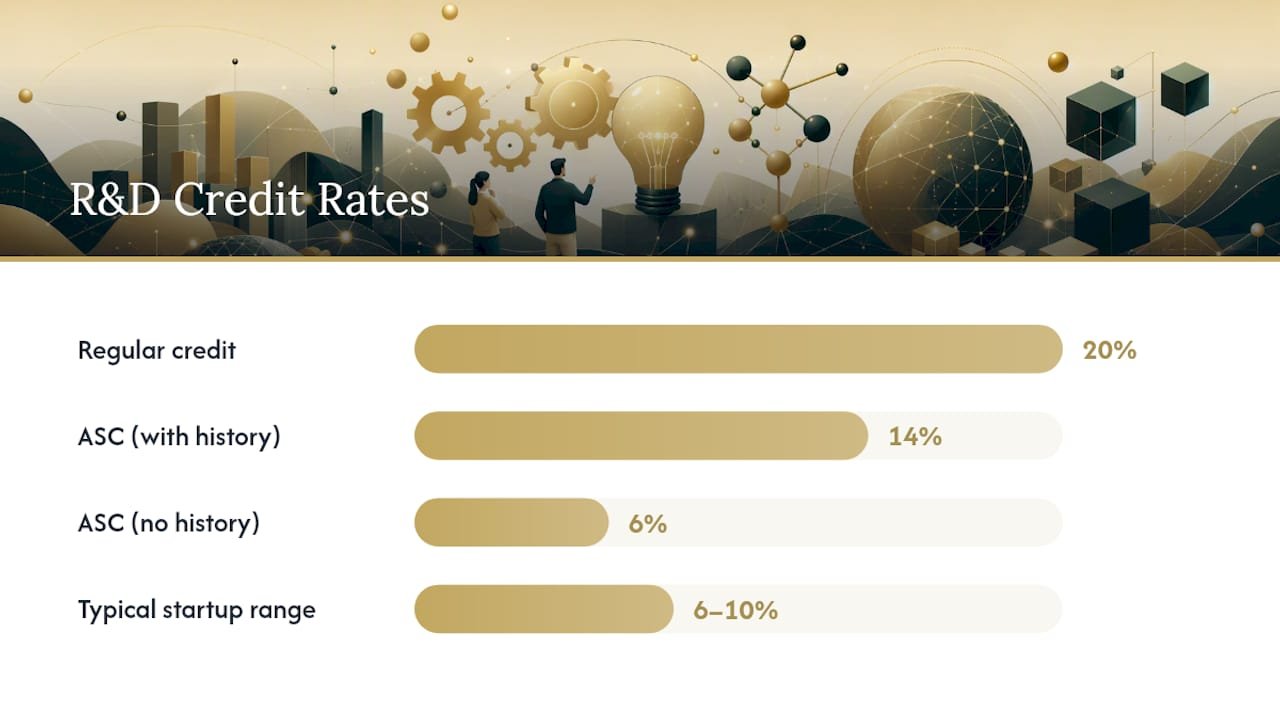
Two calculation methods exist, and Form 6765’s instructions walk through both. The regular research credit equals 20% of your QREs above a base amount tied to historical research spending relative to gross receipts. Most small businesses and startups instead use the Alternative Simplified Credit (ASC), which is simpler to apply.
Here’s how the ASC generally works:
- Calculate your QREs for the current year
- Take 50% of your average QREs from the prior three tax years as your base
- Apply a 14% rate to the amount of current-year QREs that exceeds that base
- If you have no QRE history for the prior three years, apply a 6% rate to your current-year QREs instead
A quick worked example: say your startup spent $400,000 on qualifying engineer payroll, plus $30,000 on supplies and contract research, for $430,000 in total QREs. Once you have a few years of history, that rate effectively climbs as the 14% calculation kicks in.
Typical startup ranges land around 6% to 10% of qualifying research spend as a conservative planning figure. Treat any ballpark number as a starting point. Your actual credit depends heavily on how cleanly you allocate wages and document the work.
How Does the Payroll-Tax Election Work?
If you’re a qualified small business, you can elect to apply up to $500,000 of your R&D credit against payroll taxes instead of income tax. That cap rose from $250,000 under the Inflation Reduction Act for tax years beginning after December 31, 2022, effectively doubling the cash relief available to funded startups still years away from owing income tax.
The filing sequence works like this:
- Complete Form 6765 and make the payroll-tax election on your original, timely-filed income tax return
- Report the elected amount on Form 8974
- Claim the credit on Form 941 (or Form 943 or 944, depending on your payroll filing type) starting the first calendar quarter after you file the income tax return with the election
The credit offsets your employer share of Social Security tax first, up to the applicable limit per quarter, then rolls to Medicare tax if any amount remains. Any unused portion typically carries forward to future quarters. If you use a PEO or reporting agent for payroll, confirm they know how to apply the Form 8974 credit on your behalf, since the mechanics differ slightly from standard employer filing.
What Are the Steps and Timeline to Claim the Credit?
Claiming the credit follows a fairly linear path, but the sequencing matters because one step is irreversible.
- Assess eligibility against the QSB gross receipts test and the four-part test
- Assemble QRE documentation: payroll records, time allocation, supply invoices, contractor agreements
- Complete Form 6765, including the payroll-tax election if you want the cash-now benefit
- File your income tax return on time, including extensions, with Form 6765 attached
- Starting the next calendar quarter, use Form 8974 alongside Form 941 to claim the payroll offset
The critical detail: the payroll-tax election has to happen on the original, timely-filed return. You cannot add it later through an amended return. If you miss the window for a given tax year, that year’s credit typically still carries forward against future income tax, just not against payroll tax for that year. Mark your extension deadline on the calendar the day you decide to elect. It’s the one date in this whole process you don’t get a second shot at.
Should You Check State R&D Tax Credit Programs Too?
State programs vary enormously, and the differences can change what the credit is actually worth to you. Some states offer their own payroll-style offsets, but most don’t. Many states also require the qualifying research to physically occur within the state, which matters if you have a distributed engineering team.
Check your state revenue department’s website directly rather than relying on general guidance, since state rules shift more often than federal ones. Some states, including California, have introduced startup-friendly provisions in recent years that can meaningfully add to what you’d get federally. Whether a state credit stacks with your federal claim, or requires separate documentation, depends entirely on that state’s own rules.
What Documentation Do You Need to Support a Claim?
Contemporaneous records beat reconstructed ones every time, and the IRS’s own Audit Techniques Guide makes clear what examiners look for.
Build a file that includes:
- Time-tracking records or contemporaneous logs of employee hours on qualifying projects
- Written project descriptions and technical reports explaining the uncertainty you were resolving
- Test plans, prototype records, and notes from experimentation
- Invoices for supplies and contract research payments
- Cloud and compute billing statements tied to specific projects
Practically, this means setting up project codes inside your payroll system, generating centralized reports on cloud spend by project, and keeping meeting notes that explain, in plain language, what technical problem you were trying to solve. Strong bookkeeping habits make this dramatically easier to pull together at filing time.
Pro Tip: Write a one-page methodology note explaining how you split employee wages between qualified and non-qualified work. A short, consistent explanation holds up far better under review than a spreadsheet with no context behind it.
What Mistakes Commonly Reduce or Void a Claim?
The most expensive mistake is simple: missing the payroll-tax election deadline because it wasn’t made on the original timely-filed return. Close behind that are vague project descriptions that don’t explain the technical uncertainty, missing contemporaneous time records, and blending non-technical work into qualified wages without a clear split.
Red flags that tend to draw scrutiny include oversized contractor claims with thin documentation, treating offshore contractor costs as fully eligible without checking the rules, and records that look like they were assembled after the fact rather than during the work. If your claim is large, spans multiple technical projects, or involves significant contractor spend, get a tax professional to review it before you file rather than after.
How the R&D Payroll-Tax Election Actually Changes a Startup’s Runway
Most founders think of the R&D credit as a nice-to-have that shows up on the tax return once a year. That framing misses the point entirely for anyone still burning cash. The payroll-tax election isn’t a tax optimization. It’s a cash infusion that shows up in your bank account through reduced payroll withholding, on a quarterly cadence, without you raising a dollar of new capital.
The conventional advice tends to bury this under generic “you might qualify for R&D credits” language, as if the credit itself is the prize. For a pre-revenue company, the carryforward version of this credit is close to worthless in year one. The election is the actual product. Everything else, the four-part test, the QRE tracking, the ASC math, exists to get you to a number you can legally put against payroll tax next quarter.
If you take one thing from this article, prioritize the timing over the precision. A rough but honest QRE estimate filed on time with the election beats a perfectly documented claim filed a week late with no election on it. You can refine your allocation methodology in later years. You cannot go back and elect for a year you already missed.
Let Kelliworks Handle the R&D Credit Paperwork While You Run the Company
Estimating your qualifying research spend, allocating engineer wages correctly, and hitting the original-return deadline for the payroll-tax election takes real bandwidth most founders don’t have during a growth quarter. Kelliworks works with small businesses and startups to identify qualifying research expenses, build a defensible allocation methodology, and prepare Form 6765 alongside the rest of your return, so the election gets made correctly and on time.
A first consultation covers three things: a quick eligibility check against the QSB gross receipts test, a rough estimate of your qualifying research expenses, and a documentation checklist tailored to your team’s actual workflow. If you’re weighing whether outsourced support makes sense for a claim this size, our breakdown of why hiring a virtual accountant pays off covers the trade offs in more detail. This article is general information, not tax advice specific to your situation. Reach out to Kelliworks to schedule a virtual accounting consultation and find out where your business actually stands.
Sources
- Form 6765, Credit for Increasing Research Activities (PDF) | Internal Revenue Service
- Startup R&D Payroll Tax Offset: Claim Up to $500K a Year | Debit & Co.



One Response