


Accounting service pricing refers to the fee structures and billing methods used to charge for services like bookkeeping, tax preparation, and financial consulting. The industry recognizes three main pricing models: hourly billing, fixed-fee retainers, and value-based pricing. Each model carries different cost implications depending on your business size, transaction volume, and the credentials of the professional you hire. Understanding how these structures work helps you budget accurately and avoid unexpected charges. Kelliworks works with small business owners every day who are surprised by what accounting actually costs. This guide gives you the full picture.
What is accounting service pricing and how does it work?
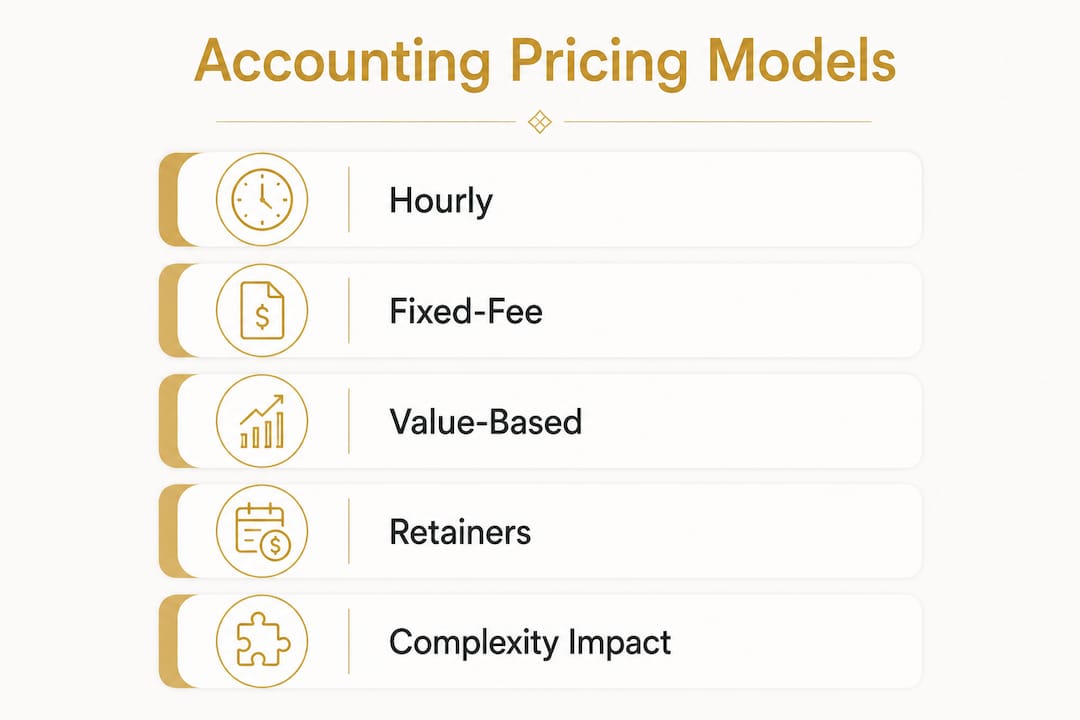
Accounting service pricing is the system by which accounting professionals set and communicate fees for their work. The three dominant structures are hourly billing, fixed-fee retainers, and value-based pricing. Each one affects your monthly budget differently, and knowing the difference protects you from sticker shock.
Hourly billing charges you for every hour the accountant works on your account. Rates vary widely based on credentials and location. The problem with hourly billing is unpredictability. A complex month with extra transactions or a tax question can push your bill far beyond your estimate.

Fixed-fee retainers bundle a defined set of services into one monthly or annual fee. This model gives you budget certainty and removes the anxiety of watching the clock. The tradeoff is that any work outside the agreed scope triggers an additional charge, so the scope definition matters enormously.
Value-based pricing ties fees to the perceived value delivered rather than time spent. An accountant who saves you $15,000 in taxes may charge a fee that reflects that outcome, not the hours logged. This model is growing quickly among specialized CPA firms and advisory practices.
The accounting profession is moving away from hourly billing. Hourly billing for CFO and controller services dropped from over 20% in 2024 to just 10% in 2025. That shift signals that the industry is aligning with what small business owners actually want: predictable costs.
Pro Tip: Before signing any fixed-fee agreement, request a detailed engagement letter that lists every included service. Tasks not named in that letter will cost extra.
What typical costs can small business owners expect?
Concrete numbers help you plan. The ranges below reflect real market data and vary based on service type, business complexity, and geography.
Bookkeeping fees
Monthly bookkeeping for small businesses typically runs $300–$800. Full-service accounting, which includes reporting, reconciliations, and advisory support, can reach $12,000 per month for larger or more complex operations. Total annual accounting costs for a small business generally fall between $5,000 and $25,000.
A freelancer with 50 monthly transactions sits at the lower end of that range. A retail business with payroll, inventory, and multiple revenue streams sits much higher.
Tax preparation fees
Annual business tax preparation most commonly falls in the $1,000–$1,499 range, with about 29% of firms pricing within that band. Individual returns with moderate complexity run $400–$599. Returns with rental income, self-employment schedules, or multi-state filings push costs higher.
Advisory and CFO services
Fractional CFO and controller services for small businesses are priced as monthly retainers. Fees vary widely based on scope, but entry-level advisory packages start well above standard bookkeeping rates. These services cover cash flow forecasting, financial reporting, and strategic planning.
| Service | Typical Monthly Cost | Annual Estimate |
|---|---|---|
| Basic bookkeeping | $300–$800 | $3,600–$9,600 |
| Full-service accounting | $1,000–$12,000 | $12,000–$144,000 |
| Business tax preparation | N/A (annual) | $1,000–$1,499 |
| Fractional CFO/advisory | $1,500–$5,000+ | $18,000–$60,000+ |
Geography also plays a real role. CPAs in major metro areas charge 30–50% more than professionals in smaller markets for equivalent services. A bookkeeper in rural Ohio charges less than one in Manhattan, even with identical credentials and software.
Credentials matter just as much as location. CPAs and Enrolled Agents command higher fees than uncredentialed bookkeepers, particularly for tax planning and advisory work. That premium reflects real expertise and compliance proficiency. For routine transaction recording, an uncredentialed bookkeeper may serve you well. For tax strategy, credentials justify the cost.
How do complexity and transaction volume affect accounting fees?
Business complexity is the single biggest driver of cost variation within any pricing model. More transactions mean more time, more reconciliations, and more risk of error. Accounting providers price that risk into their fees.
A business with 100 monthly transactions pays more than one with 30, even under a fixed-fee model. Providers tier their packages by transaction volume precisely because volume determines workload. When your business grows and transactions increase, expect your accounting fee to increase with it.
Multi-entity businesses add another layer of cost. If you own two LLCs and a holding company, your accountant must maintain separate books, produce separate reports, and often file separate returns. Each entity adds time and complexity.
Setup costs catch many small business owners off guard. Data migration, software configuration, and onboarding can add $1,500–$5,000 in upfront costs, depending on complexity and provider. That first-year total looks very different from the ongoing monthly fee. Budget for it separately.
Key complexity factors that raise your accounting fees include:
- Transaction volume: Higher monthly transactions increase bookkeeping time and cost.
- Payroll: Processing payroll adds a recurring service layer with its own fee structure.
- Inventory tracking: Product-based businesses require more detailed reconciliation.
- Multi-state operations: Each state adds filing requirements and compliance work.
- Multiple entities: Separate books and returns multiply the workload.
Pro Tip: Ask your provider how they define a “transaction” in their pricing. Some count each line item; others count each bank statement entry. The definition changes your cost significantly.
For a deeper look at cost-effective bookkeeping options, Kelliworks outlines practical approaches for businesses at every stage.
What should you consider when budgeting for accounting services?
Choosing an accounting provider based on the lowest advertised price is the most common budgeting mistake small business owners make. The base rate rarely tells the full story.
Follow these steps to evaluate any accounting proposal accurately:
- Request an itemized scope of work. Every service included in the fee should be named explicitly. Vague language like “general accounting support” creates room for disputes later.
- Ask about per-transaction fees. Low monthly base rates sometimes mask high per-transaction charges. A $200/month base fee plus $3 per transaction adds up fast for an active business.
- Clarify what triggers an out-of-scope charge. Under fixed-fee agreements, tasks outside the defined scope trigger additional fees. Know exactly where the boundary sits before you sign.
- Compare the full cost of outsourcing versus hiring in-house. A full-time bookkeeper costs $40,000–$55,000 per year in salary alone, before benefits and software. Outsourced accounting at $800/month totals $9,600 annually. The math favors outsourcing for most small businesses.
- Factor in setup and transition costs. First-year costs include onboarding, data migration, and software setup. Spread those costs across 12 months when comparing providers.
- Verify credentials match your needs. For basic bookkeeping, a credentialed bookkeeper suffices. For tax planning or advisory work, a CPA or EA brings expertise that pays for itself.
Good invoicing practices also support a healthy accounting relationship. Understanding invoicing etiquette for small business owners helps you maintain clean records that reduce your accountant’s workload and your fees.
Understanding the difference between bookkeeping and accounting services also helps you buy only what you actually need, rather than paying for a full-service package when basic bookkeeping covers your situation.
What I’ve learned about pricing conversations with small business owners
The most consistent pattern I see is that small business owners avoid asking about pricing details because they feel it signals distrust. That instinct costs them money.
The shift toward fixed-fee and value-based pricing is genuinely good news for small business owners. Predictable monthly costs make cash flow planning easier. But fixed-fee agreements only work in your favor when the scope is airtight. I have seen clients sign agreements with broad language, then receive surprise invoices for “additional services” that any reasonable person would have assumed were included.
The lowest-cost provider is rarely the best value. An uncredentialed bookkeeper at $200/month who misclassifies expenses or misses a deduction costs you far more than the $600/month CPA who catches it. The fee is visible. The cost of errors is not, until tax season.
My advice is direct: ask every provider three questions before signing. What is included? What triggers an additional charge? What are your credentials? A provider who answers those questions clearly and confidently is worth paying for.
— Kelli
How Kelliworks approaches accounting pricing for small businesses
Kelliworks operates as a full-service virtual accounting department built specifically for small business owners and freelancers. Our pricing model aligns with the industry shift toward fixed-fee and value-based structures, so you know exactly what you are paying each month.

We offer tailored packages covering bookkeeping, tax preparation, and financial consulting, each scoped clearly so there are no surprises. Whether you are a solo freelancer needing clean monthly books or a growing business that needs advisory support, we match the service level to your actual needs. Learn more about the benefits of virtual accounting and how a dedicated virtual accounting team compares to traditional options. If you are ready to get a clear picture of your accounting costs, we offer a free consultation to walk through your situation and recommend the right service level.
Key Takeaways
Accounting service pricing is defined by the pricing model, service scope, and business complexity, and understanding all three protects your budget and helps you choose the right provider.
| Point | Details |
|---|---|
| Three core pricing models | Hourly, fixed-fee, and value-based pricing each affect your monthly budget differently. |
| Typical cost ranges | Monthly bookkeeping runs $300–$800; annual business tax prep typically costs $1,000–$1,499. |
| Complexity raises fees | Transaction volume, payroll, and multi-entity structures all increase your accounting cost. |
| Scope clarity is critical | Fixed-fee agreements only protect your budget when every included service is named in writing. |
| Credentials affect rates | CPAs and Enrolled Agents charge more than uncredentialed bookkeepers, especially for tax and advisory work. |
FAQ
What is accounting service pricing?
Accounting service pricing refers to the fee structures used to charge for services like bookkeeping, tax preparation, and financial consulting. The three main models are hourly billing, fixed-fee retainers, and value-based pricing.
How much do accountants charge per month for small businesses?
Monthly bookkeeping for small businesses typically runs $300–$800, while full-service accounting can reach $12,000 per month depending on complexity and firm size.
What affects the cost of accounting services the most?
Service type, transaction volume, business complexity, provider credentials, and geographic location are the primary factors that drive accounting fees up or down.
Is fixed-fee pricing better than hourly billing for small businesses?
Fixed-fee pricing gives small business owners predictable monthly costs and removes the risk of unexpected hourly charges. It works best when the scope of work is clearly defined in a written agreement.
What are typical business tax preparation fees?
Annual business tax preparation fees most commonly fall in the $1,000–$1,499 range, with about 29% of accounting firms pricing within that band according to recent industry data.