


Backup withholding is a mandatory federal withholding of 24% on certain reportable payments, triggered when a payee has no correct taxpayer ID on file, fails to certify a Form W-9, or the IRS flags the account through a mismatch notice. Payers must act fast: start withholding once a CP2100 or CP2100A notice arrives or a Taxpayer Identification Number (TIN) is missing, then follow B Notice timing exactly. Payees fix it by submitting a correct, signed W-9 and resolving any outstanding IRS notice before the next payment cycle.
TL;DR:
- Backup withholding applies at a 24% rate to interest, dividends, broker transactions, rents, royalties, and certain government payments when a payee’s TIN is missing, incorrect, or flagged by the IRS.
- The IRS notices that trigger withholding include missing or invalid TINs, mismatches on filing notices, and direct IRS alerts of underreporting, requiring immediate payer action.
- Collecting signed W-9 forms and running TIN matching before payments prevent most backup withholding issues and ensure proper documentation.
- Once a CP2100 or CP2100A notice arrives, payers must start withholding within 30 business days and respond with correct paperwork or face liability.
- Proper procedures, including timely W-9 collection, verification, and documentation of notices, minimize costly mistakes and streamline compliance.
Table of Contents
- Which Payments Can Trigger Backup Withholding, and What’s the Rate?
- What Actually Triggers Backup Withholding?
- How Do You Complete and Certify Form W-9 Correctly?
- What Should Payers Do After a CP2100 Notice Arrives?
- How Do You Stop Backup Withholding Once It Starts?
- Who’s Exempt, and What Mistakes Cost the Most?
- Kelliworks Perspective: What Actually Prevents Backup Withholding Problems
- Let Kelliworks Handle Your W-9 and Backup Withholding Compliance
- Sources
- FAQ
Which Payments Can Trigger Backup Withholding, and What’s the Rate?
The backup withholding rate has held steady at a flat 24% since 2018, tied to the individual tax rate cuts under the Tax Cuts and Jobs Act. It applies only to specific reportable payments, not to every dollar that crosses a business’s books.
Payments that can be subject to backup withholding include:
- Interest and dividend payments
- Broker and barter exchange transactions
- Rents, royalties, and nonemployee compensation (the classic 1099-NEC scenario).
- Payment card and third-party network transactions
- Gross proceeds paid to attorneys
- Gambling winnings and certain government payments
Wages reported on Form W-2 fall outside this system entirely; regular payroll withholding governs those. Most real estate sale proceeds are also excluded, since they’re reported differently and don’t fall under the reportable-payment categories that trigger Topic No. 307. If you’re unsure whether a payment type qualifies as a 1099-reportable event in the first place, our guide on 1099 filing requirements breaks down the categories payers deal with most.
What Actually Triggers Backup Withholding?
Four distinct triggers require action, and each has its own paper trail.
- A missing TIN. The payee never provided a Social Security Number, EIN, or ITIN, or left the field blank on their W-9.
- An obviously incorrect TIN. Think nine digits that don’t match a valid SSN/EIN format, or a number with too few or too many digits.
- An IRS notice of a name/TIN mismatch. This is the CP2100 or CP2100A notice, sent when the name and TIN on a filed information return don’t match IRS records.
- An IRS underreporting notice. The IRS notifies the payer directly that a payee underreported interest or dividend income, and backup withholding must begin regardless of what the payee’s W-9 says.
Payers have a solicitation duty here. If a TIN is missing or obviously wrong, you must ask the payee for a corrected W-9 before or alongside starting withholding, according to the IRS B program guidance. A payee only crosses out item 2 on the certification (the part about not being subject to backup withholding) when the IRS has specifically notified them that they are subject to it for underreporting. Crossing it out without that notice is a certification error, not a shortcut.
How Do You Complete and Certify Form W-9 Correctly?
A valid W-9 needs three things: the correct legal name, the right TIN, and a signature under penalties of perjury. Skip any one of them and the form doesn’t protect the payer from backup withholding obligations.
Signing is required whenever the account involves interest, dividends, or broker transactions, and for certain accounts reopened after being inactive. For most other reportable payments, like nonemployee compensation, a signature is still standard practice even though the specific statutory signature requirement is narrower. The W-9 instructions also lay out exempt payee codes for entities like corporations, and instructions for crossing out item 2 only in IRS-notified underreporting cases.
Here’s what trips people up most:
- Writing “Applied For” in the TIN field when a new SSN or EIN application is pending
- Assuming “Applied For” pauses withholding indefinitely
- Forgetting that some payments require immediate withholding regardless of pending TIN status
Pro Tip: If a new vendor writes “Applied For,” a 60-calendar-day awaiting-TIN period applies to certain interest, dividend, and tradable-instrument payments before backup withholding kicks in, per Publication 1281. But nonemployee compensation doesn’t get that grace period. If you’re paying a contractor and they hand you an “Applied For” W-9, withhold from the very first payment unless you’ve confirmed the payment type qualifies for the waiting period.
There’s also a lesser-known $500 exception: if total reportable payments during the waiting period stay under $500, a payer generally doesn’t need to withhold on that specific transaction, though the underlying TIN issue still needs resolution.
What Should Payers Do After a CP2100 Notice Arrives?
Receiving a CP2100 or CP2100A starts a clock. Payers generally have 30 business days from the notice date to begin backup withholding on the account in question, and the B program page allows payers to start earlier if they choose. Waiting past that window without action creates real liability exposure.
The IRS distinguishes between First and Second B Notices, and the difference matters:
- First B Notice: Send it within 15 business days of the CP2100/CP2100A, requesting a corrected W-9.
- Second B Notice: Triggered by a second mismatch on the same account within three years; this time, a signed W-9 alone isn’t enough.
- Second notice verification: The payee must provide a copy of their Social Security card or an IRS Letter 147C confirming their EIN.
Running proactive TIN matching through the IRS e-services system before payments even go out catches most mismatches before they become CP2100 problems at all. It’s one of the few genuinely preventive controls in this whole process.
Once withholding starts, the deposited amounts get reported on Form 945, the annual return for nonpayroll federal income tax withholding, separate from payroll tax filings. Deposit schedules follow the same monthly or semi-weekly rules that apply to other federal tax deposits, and the withheld amount also needs to show up on the relevant 1099 or W-2G issued to the payee. For businesses juggling vendor payments alongside payroll, our accounts payable automation guide covers how to build TIN verification into the onboarding process before it becomes a notice problem.
How Do You Stop Backup Withholding Once It Starts?
Stopping withholding comes down to fixing whatever triggered it, and doing so promptly.
- Submit a corrected, signed W-9 with an accurate TIN, or the appropriate W-8 form if you’re a foreign person or entity rather than a U.S. taxpayer.
- If the IRS notified the payer directly for underreporting, contact the IRS following the instructions in that notice; only cross out item 2 on a future W-9 once the IRS confirms you’re no longer subject to withholding.
- Claim withheld amounts back on your tax return. Backup withholding isn’t lost money. It’s federal income tax withheld in advance, reported to you on your 1099 or W-2G, and claimed as a payment against your tax liability when you file.
Pro Tip: Keep every 1099, W-2G, and B Notice correspondence in one folder by tax year. If your return gets questioned over a withholding credit claim, you’ll need to show the paper trail fast, and scrambling for it in April is a bad way to spend an afternoon.
Who’s Exempt, and What Mistakes Cost the Most?
Certain payees including corporations, government entities, and specific trusts qualify as exempt from backup withholding and may claim an exemption code on Form W-9, sidestepping backup withholding on interest and dividend payments entirely. A payer can generally accept a claimed exemption at face value unless there’s actual knowledge it’s false.
The costliest mistakes tend to repeat across small businesses:
- Accepting an incomplete or unsigned W-9 just to keep a vendor onboarding process moving
- Skipping the First B Notice step and jumping straight to withholding without documentation
- Treating “Applied For” as a blanket pass instead of checking which payment type actually qualifies for the 60-day window
The fix is procedural, not heroic: collect W-9s before the first payment goes out, run TIN matching as a standing habit rather than a reaction, and log every B Notice step with dates. Our 1099 vs W-2 classification guide is a useful companion here, since misclassifying a worker often surfaces the same TIN documentation gaps that lead to backup withholding trouble.
Kelliworks Perspective: What Actually Prevents Backup Withholding Problems
Most backup withholding failures aren’t tax mistakes. They’re onboarding mistakes that surface months later as tax problems. We’ve seen it happen the same way over and over: a vendor gets paid before their W-9 is even collected, and by the time a CP2100 shows up, nobody remembers who was supposed to chase down the paperwork.
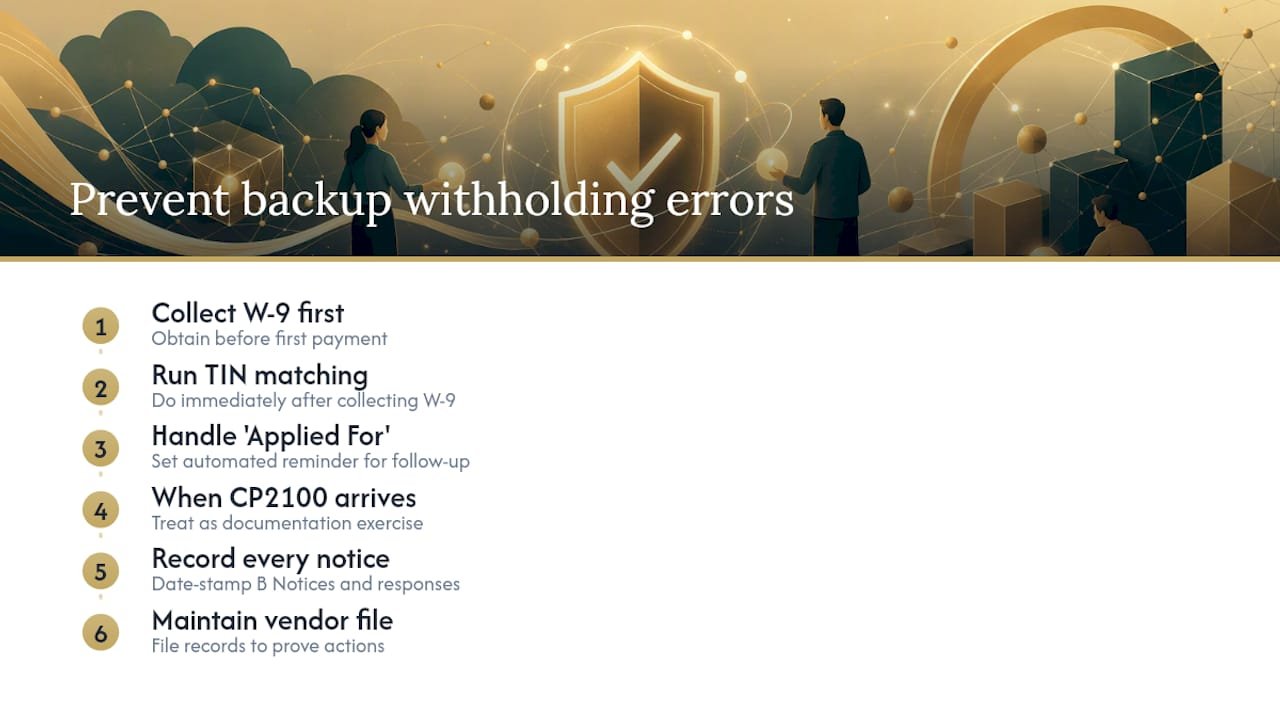
The fix that actually works is boring and procedural. Collect the W-9 before the first check goes out, run it through TIN matching immediately, and set an automated reminder if anything comes back “Applied For.” When a CP2100 does land, treat it as a documentation exercise, not a scramble. Every notice, every B Notice sent, every response received goes into the vendor file with a date stamped on it. That file is what protects you if the IRS ever asks why withholding started when it did, or why it didn’t.
For businesses that would rather have this handled than manage it themselves, our payroll compliance checklist walks through the adjacent reporting deadlines that tend to collide with 1099 season anyway.
— Kelli
Let Kelliworks Handle Your W-9 and Backup Withholding Compliance
Chasing down corrected W-9s, tracking B Notice deadlines, and filing Form 945 on top of everything else on your plate isn’t where your time is best spent. Outsourcing backup withholding compliance can integrate vendor onboarding, TIN verification, and 1099 reporting into your regular bookkeeping cycle to prevent urgent issues when a CP2100 notice arrives.

Whether you need help setting up a clean vendor intake process or you’re already staring down a mismatch notice with a deadline attached, our tax preparation and filing services cover W-9 collection, IRS notice response, and the reporting that follows. Schedule a consultation and let us walk through where your current process stands before the next reporting deadline hits.
This article is general information, not a substitute for advice from a qualified financial advisor. Consult a qualified financial professional about your own circumstances before acting on anything here.
FAQ
What Is Backup Tax Withholding in the US?
Backup withholding is a flat 24% federal withholding applied to certain reportable payments, like interest, dividends, or nonemployee compensation, when a payee’s TIN is missing, incorrect, or unresolved after an IRS notice. It’s an enforcement mechanism, not a penalty; withheld amounts get credited back to the payee at tax time.
How Do I Know If I’m Subject to Backup Withholding?
You’re subject to it if you didn’t provide a TIN on your W-9, provided one that doesn’t match IRS records, or received a notice that you underreported interest or dividend income. If a payer starts withholding 24% from your payments and you haven’t received prior notice explaining why, ask them directly which trigger applied.
Should I Cross Out Item 2 on My W-9?
Cross out item 2 only if the IRS has specifically notified you that you’re subject to backup withholding for underreporting interest or dividends. Doing it without that notice is a certification error that can cause more confusion than it solves, since it misrepresents your actual status to the payer.
Who Is Required to Withhold Backup Withholding?
Any business or individual making reportable payments, like interest, dividends, or independent contractor compensation, must apply backup withholding when a required trigger occurs, per IRS guidance on the B program. This applies to businesses of every size that issue 1099s, not just large corporations with dedicated payroll departments.