


Business financial wellness is the state of managing your company’s finances effectively enough to meet obligations, invest in growth, and sustain operations with confidence. The term is informal, but the underlying discipline has a formal name: business financial health. Both describe the same goal. For small business owners, this is not a luxury concept. 82% of small businesses fail due to cash flow mismanagement, not lack of profitability. That single fact reframes the entire conversation. Revenue is not the measure of survival. Control is.
What is business financial wellness, and why does it matter?
Business financial wellness means your company has present financial control, future security, emergency protection, and spending aligned with your goals. Ramit Sethi’s framework from I Will Teach You to Be Rich defines financial wellness as the point where money enhances life rather than causes anxiety. Applied to a business, that translates to knowing your numbers, trusting your cash position, and making decisions from a place of clarity rather than stress.
The importance of financial wellness for businesses goes beyond avoiding failure. A financially well business can hire confidently, weather slow seasons, and pursue opportunities without scrambling for emergency credit. Small businesses are especially exposed because thin margins and limited reserves leave almost no room for error. When cash runs short, payroll, rent, and supplier relationships all suffer at once.
Business financial health is not a destination you reach once. Financial wellness is operational, not static. It requires ongoing monitoring, adjustment, and planning. Think of it as a practice, not a certificate.

What are the core metrics that measure business financial health?
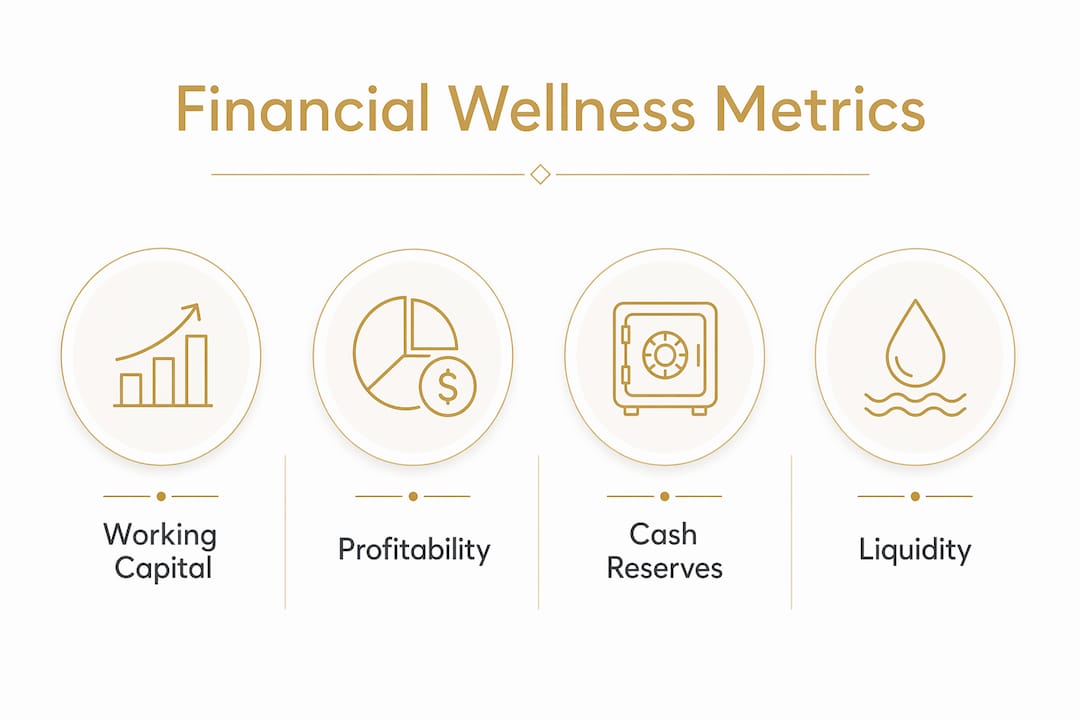
No single metric captures true financial health. Owners must track liquidity, solvency, profitability, and efficiency at the same time. Each metric tells a different part of the story.
| Metric | Healthy Range | What It Signals |
|---|---|---|
| Working capital ratio | 1.2–2.0 | Ability to cover short-term obligations |
| Gross margin (service businesses) | Above 50% | Pricing and delivery efficiency |
| Cash reserves | 3–6 months of expenses | Buffer against disruption |
| Cash conversion cycle | Shorter is better | Speed of turning work into cash |
| Debt-to-equity ratio | Below 2.0 for most SMBs | Degree of financial leverage |
Working capital ratio measures current assets divided by current liabilities. A ratio below 1.0 signals the business cannot reliably meet its short-term obligations. A ratio above 2.0 may indicate idle cash that could be deployed more productively.
Gross margin reveals whether your pricing covers the cost of delivering your product or service. For service businesses, gross margin below 50% signals hidden pricing or delivery inefficiencies that need immediate attention.
Cash reserves are the most overlooked metric. The average small business holds only 27 days of cash reserves, well below the recommended 3–6 months. That gap is the difference between surviving a slow quarter and closing the doors.
Pro Tip: Track your cash conversion cycle monthly. It measures how long it takes to turn a completed job into collected cash. A long cycle drains your reserves even when sales are strong.
How does business financial wellness differ from personal financial wellness?
Personal financial wellness focuses on individual peace of mind, debt reduction, and retirement security. Business financial wellness adds a layer of complexity. You are managing operational cash flow, vendor liabilities, payroll timing, tax obligations, and profitability targets simultaneously.
The goals also differ. Personal wellness aims for stability and freedom from financial anxiety. Business wellness aims for sustainability and growth, which sometimes requires taking on calculated debt or holding less cash to fund expansion. These are not opposing ideas, but they require different frameworks.
- Personal financial wellness centers on net worth, savings rate, and debt elimination.
- Business financial wellness centers on liquidity, gross margin, working capital, and cash flow timing.
- Both require present financial control as the foundation.
- Both fail when owners focus only on one number, whether that is personal income or business revenue.
The most common mistake small business owners make is equating revenue with financial health. A business can show strong top-line revenue while quietly running out of cash. Focusing only on revenue growth can mask structural financial risks, including a deteriorating working capital ratio or a gross margin that has quietly slipped below the danger threshold.
Investopedia’s framework for measuring company financial health reinforces this point. Tracking liquidity, solvency, profitability, and efficiency simultaneously is the only way to get an accurate picture. Dropping any one of those four lenses creates blind spots that can be fatal.
How to achieve financial wellness as a small business owner
Financial wellness strategies for small businesses fall into four practical categories: diagnostics, forecasting, reserves, and controls. Applying all four creates a system that works without requiring you to obsess over your books every day.
-
Run a financial health diagnostic quarterly. Compare your working capital ratio, gross margin, and cash reserves against industry benchmarks. This tells you where you stand relative to peers, not just whether you feel okay about the numbers.
-
Switch from annual budgets to 13-week cash flow forecasts. Experienced CFOs prioritize short-term forecasting because it catches liquidity problems before they become existential. Annual budgets are too broad to catch a cash crunch arriving in six weeks.
-
Build cash reserves deliberately. Set a target of 3 months of operating expenses as your minimum. Automate a transfer to a separate reserve account each time revenue comes in. Treat it like a fixed expense.
-
Adopt a financial control system. The Conscious Spending Plan, popularized by Ramit Sethi, automates financial wellness without micromanagement. The business equivalent is setting up automatic reporting, payment schedules, and reserve contributions so the system runs itself.
-
Integrate crisis management into your financial planning. Crisis management practices mediate the impact of financial wellness on business resilience. That means having a written plan for what you will cut, defer, or draw on if revenue drops 30% for 60 days.
-
Review financial reports for decisions, not just compliance. Real value comes from interpreting reports to make informed decisions, not just keeping clean books. Your profit and loss statement, balance sheet, and cash flow statement each answer a different question. Read all three.
Pro Tip: Pair your 13-week cash flow forecast with a simple bookkeeping system that updates weekly. The forecast only works if the underlying data is current.
What are the early warning signs of poor financial wellness?
Catching problems early is far less costly than reacting to a crisis. These are the clearest red flags that your business financial health is deteriorating.
- Cash flow shortages despite profitability. Your income statement shows profit, but your bank account is empty. This is the most common and most dangerous disconnect in small business finance.
- Working capital ratio below 1.2. You are approaching the point where current liabilities exceed current assets. Vendor payments, payroll, or tax obligations are at risk.
- Gross margin slipping below 50% in a service business. Your pricing no longer covers delivery costs efficiently. This compounds quickly as volume grows.
- Cash conversion cycle lengthening. Clients are paying slower, or you are paying suppliers faster than you are collecting. Either direction drains reserves.
- No written cash reserve target. If you do not have a defined reserve goal, you almost certainly do not have adequate reserves.
“Owners often misinterpret clean books as financial health. Real value is in interpreting financial reports to make informed decisions rather than just tracking revenue.” — TooKand Financial Health Guide
When two or more of these signs appear together, the right move is to bring in professional help. A bookkeeper can restore visibility. A fractional CFO or accounting firm can diagnose the root cause and build a recovery plan. Waiting until a crisis forces the conversation costs far more than acting early. For businesses planning for growth, mergers, or an eventual exit, financial story clarity becomes a critical asset, not just an internal management tool.
Key Takeaways
Business financial wellness requires monitoring cash flow, working capital, gross margin, and reserves together, because no single metric tells the full story.
| Point | Details |
|---|---|
| Cash flow beats revenue | 82% of small business failures trace to cash flow mismanagement, not lack of profit. |
| Track four metric categories | Monitor liquidity, solvency, profitability, and efficiency simultaneously for an accurate picture. |
| Use 13-week forecasts | Short-term cash flow forecasting catches liquidity problems before they become critical. |
| Build 3-month reserves | The average small business holds only 27 days of cash, far below the recommended minimum. |
| Wellness is operational | Financial health requires ongoing monitoring and crisis planning, not a one-time review. |
Financial wellness is a practice, not a finish line
After working with small business owners for years, the pattern I see most often is this: owners wait until something breaks before they look at the numbers. They know revenue is up, so they assume everything is fine. Then a slow month hits, a client pays late, and suddenly there is not enough cash to cover payroll.
The uncomfortable truth is that financial wellness requires the same discipline as physical health. You do not check your blood pressure once and declare yourself healthy forever. You monitor regularly, adjust when something is off, and build habits that protect you before a crisis arrives.
The owners who sleep well at night are not the ones with the highest revenue. They are the ones who know their working capital ratio, have three months of reserves set aside, and run a 13-week cash flow forecast every week. That level of control is not complicated. It is consistent.
Revenue obsession is the single biggest financial trap I see in small businesses. A business can grow its way into insolvency if margins are thin and cash conversion is slow. The fix is not to stop growing. The fix is to build financial controls that scale with the business. Pair your cost-saving accounting practices with regular diagnostics, and you will catch problems while they are still small.
— Kelli
How Kelliworks supports your business financial health
Small business owners should not have to choose between running their business and understanding their finances. Kelliworks functions as a full-service virtual accounting department, handling bookkeeping, tax preparation, and financial consulting so you have the clarity to make confident decisions.

Kelliworks helps owners set up the reporting systems, cash flow tracking, and financial diagnostics that turn raw numbers into real decisions. Whether you need to get your books current, build a cash reserve plan, or finally understand what your financial statements are telling you, the accounting services at Kelliworks are built for exactly that. Schedule a free consultation to see where your business stands and what it would take to get to genuine financial wellness.
FAQ
What is business financial wellness in simple terms?
Business financial wellness is the ability to meet your financial obligations, maintain cash reserves, and make informed decisions about growth without constant financial stress.
How is business financial health different from profitability?
A business can be profitable on paper and still fail. Financial health includes cash flow timing, working capital, and reserves, not just whether revenue exceeds expenses.
What is a healthy working capital ratio for a small business?
A working capital ratio between 1.2 and 2.0 is considered healthy. A ratio below 1.0 signals the business may struggle to meet short-term obligations.
How often should small business owners review their financial metrics?
Monthly reviews of cash flow and working capital are the minimum. A full financial health diagnostic, comparing all key metrics against benchmarks, should happen at least quarterly.
When should a small business owner seek professional financial help?
Seek help when cash flow shortages appear despite profitability, when reserves fall below one month of expenses, or when financial reports are not being reviewed regularly for decisions.



One Response