


Track your available cash today, build a 13-week rolling forecast this week, invoice everything outstanding, and negotiate one payables deadline. Those four moves stabilize most small businesses within 30 days. The Small Business Administration and Federal Reserve both point to forecasting discipline and realistic financing comparisons as the difference between a temporary squeeze and a real crisis, and that discipline is exactly what effective accounting support builds every week.
TL;DR:
- Most small businesses can stabilize within 30 days by tracking cash daily, building a 13-week forecast, invoicing promptly, and negotiating payables deadlines.
- Checking accounts receivable, accounts payable, and cash on hand weekly enables early identification of payment delays or shortfalls before they become crises.
- Building a reserve of three to six months of operating expenses provides a buffer against seasonal dips, late payments, or unexpected expenses.
- Using a weekly updated 13-week forecast helps identify payroll gaps or tax deadlines early, allowing time for financing or spending adjustments.
- Operational fixes such as same-day invoicing, electronic payments, deposits, and renegotiating supplier terms significantly improve cash flow without relying on costly financing.
Table of Contents
- What cash flow really means and the statements that show it
- Which reports and numbers to check, and how often
- Practical moves that improve cash flow this month
- Building a monthly and 13-week cash forecast
- Financing choices and what they really cost your cash
- Bookkeeping habits and tools that keep cash visible
- How KelliWorks helps clients stabilize and forecast cash flow
- The owner’s role in keeping cash under control
- Turning this into a plan with KelliWorks
- Authoritative templates and official guidance
- Sources
- FAQ
What cash flow really means and the statements that show it
Cash flow is the money moving in and out of your business over a given period. It is not the same as profit, and confusing the two is one of the fastest ways to get blindsided. A landscaping company can invoice $40,000 in April, post a healthy profit on paper, and still be unable to make payroll if that $40,000 has not been collected yet. Profit is an accounting result. Cash is what is actually sitting in your bank account.
Three reports tell you the full story. The profit and loss statement shows revenue and expenses over time. The balance sheet shows what you own and owe at a single moment. The cash flow statement breaks your cash movement into three categories: operating (day-to-day revenue and expenses), investing (equipment or asset purchases and sales), and financing (loans, owner draws, and debt payments). Reading all three together, not just your bank balance, is what separates reactive owners from prepared ones.
Two numbers matter more than most owners realize:
- Cash runway: how many months your business can operate at current spending before cash hits zero, assuming no new revenue.
- Burn rate: how much cash your business spends, net of income, each month.
The IRS also draws a distinction that affects how these numbers get recorded: businesses using the cash method count income and expenses when money actually changes hands, while those on the accrual method (often required once inventory becomes a material income factor) record transactions when they are earned or incurred. Your accounting method shapes what your cash flow statement looks like, so knowing which one applies to your business is not optional.
Which reports and numbers to check, and how often
You do not need forty metrics. You need a handful, checked on a fixed schedule, so surprises show up early instead of on payday.
- Accounts receivable aging and days sales outstanding (DSO): shows how long customers take to pay and flags which invoices are turning into collection problems.
- Accounts payable days: tracks how much room you have before a bill is due, so you can sequence payments instead of paying everything the moment it lands.
- Cash on hand, measured in months of operating expenses: the clearest single gauge of how much runway you actually have.
- Weekly cash position: your real-time bank balance plus anything clearing in the next few days.
Review AR aging and AP schedules weekly, not monthly. A 13-week rolling cash plan updated weekly, per Yale SOM practitioner guidance, turns forecasting into a real decision tool instead of a historical record, because it forces you to react to a projected shortfall while you still have weeks to fix it, not days.
Building a cash reserve is recommended by most small-business guidance, as per Xero’s small-business cash flow guidance. Having some reserve gives you room to absorb a slow month, a late-paying client, or a seasonal dip without reaching for expensive short-term financing.
Practical moves that improve cash flow this month
Fixing cash flow is rarely about one big decision. It is a sequence of small operational changes, most of which cost nothing to implement and pay off within a billing cycle.
- Invoice the same day work is completed. Every day between finishing a job and sending the invoice is a day added to your collection cycle for no reason.
- Accept electronic payments. ACH transfers and card payments get deposited faster than mailed checks and remove the excuse of a check being “in the mail.”
- Offer a small early-payment discount on larger invoices. A modest discount for payment within ten days often costs less than the financing you would otherwise need to cover the gap.
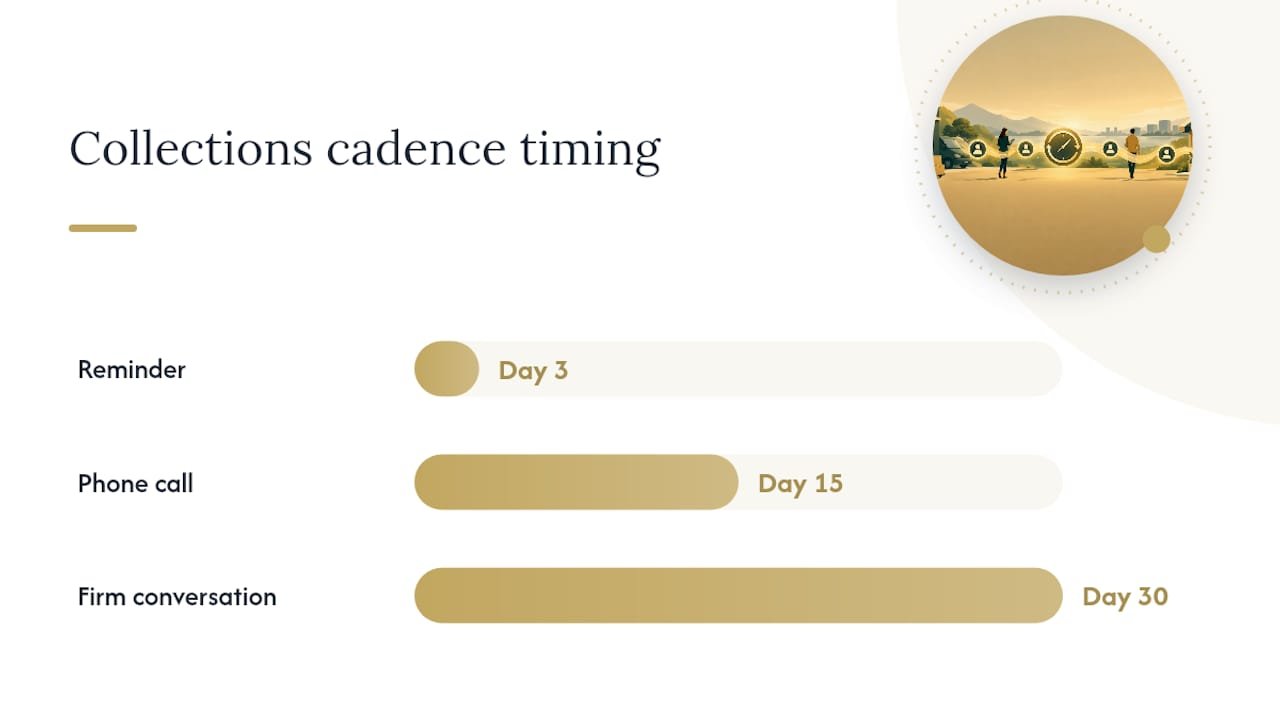
- Set a collections cadence and stick to it. A reminder at day 3 past due, a call at day 15, and a firm conversation at day 30 keeps receivables from drifting into write-off territory.
- Ask for deposits or retainers on new or larger projects. This shifts some of the cash-timing risk off your business and onto the front end of the relationship.
- Negotiate payment terms with suppliers rather than assuming they are fixed. Many vendors will extend net-30 to net-45 for reliable customers who ask.
- Take early-payment discounts from suppliers only when your own cash position supports it. A 2% discount is not a good deal if paying early puts you at risk of missing payroll.
- Audit recurring subscriptions and services quarterly. Software licenses, unused subscriptions, and duplicate tools are common places where budget leaks quietly drain cash.
- Cut or pause nonessential spending before it becomes a habit, not after a shortfall forces the decision.
- Reduce inventory days on hand where your business model allows it. Cash sitting in unsold stock is cash you cannot use elsewhere.
- Use just-in-time ordering for fast-moving or perishable inventory to avoid tying up cash in goods that sit on shelves.
- Lease or rent equipment instead of buying outright when a purchase would strain your reserve, especially for seasonal or infrequent needs.
Pro Tip: Run your AR aging report every Monday morning before you do anything else. Catching a slow payer in week two is a phone call; catching it in week eight is a collections problem.
Seasonal businesses face a version of this that deserves its own note. A retailer that makes most of its annual revenue in November and December needs a cash plan that assumes summer months will run lean, not one built on last month’s numbers. Building a reserve during peak season specifically to cover the slow months is not optional planning; it is the plan.
Taxes deserve the same forward attention. Quarterly estimated payments, payroll tax deposits, and sales tax remittances are all cash outflows with fixed dates that do not move because business is slow that month. Missing them creates penalties on top of the original cash problem, so they belong on your forecast calendar the same as rent or payroll.
Building a monthly and 13-week cash forecast
A cash forecast is simply a list of what money is coming in, what is going out, and when, laid out far enough ahead that you can act before a gap becomes a crisis. Building one takes three steps: list every expected receipt with its likely date, list every scheduled payment including payroll, rent, loan payments, and taxes, then net them week by week or month by month to see your projected balance.
For most small businesses, a monthly forecast covering the next 90 days is a reasonable starting point. But the 13-week rolling model that Yale SOM practitioner guidance describes is the sharper tool when cash is tight, because a full quarter of weekly visibility surfaces a payroll gap or a tax deadline collision while you still have time to arrange financing or adjust spending. The plan updates every single week: last week’s actual numbers replace projections, and a new thirteenth week gets added to the end, so you always have a full quarter of forward visibility.
Your forecast should draw on these inputs:
- Your accounts receivable schedule, weighted by how reliably each client actually pays on time.
- Fixed obligations: payroll, rent, loan or lease payments, and insurance.
- Debt service and any balloon payments coming due.
- Tax deposits and estimated payments tied to your accounting method.
| Forecast component | Update frequency | Primary source |
|---|---|---|
| Weekly cash position | Weekly | Bank balance and pending transactions |
| AR schedule | Weekly | Invoicing system, AR aging report |
| Payroll and fixed obligations | Monthly, confirmed weekly | Payroll calendar, lease and loan agreements |
| Tax deposits | Per filing deadline | Accounting method and IRS schedule |
Matching your forecast categories to your actual chart of accounts matters more than owners expect. When the SBA’s sales forecasting guidance and your bookkeeping use the same line items, comparing what you projected against what actually happened takes minutes instead of a full afternoon of reconciling mismatched categories.
Financing choices and what they really cost your cash
Financing can bridge a real gap, but it should follow operational fixes, not replace them. A line of credit is generally the right tool for short, recurring gaps, since you draw only what you need and pay interest on that balance alone. A term loan suits a larger, one-time need like equipment or an expansion, with a fixed repayment schedule you can build directly into your forecast. Business credit cards work for small, short-term purchases, but carrying a balance month to month is one of the more expensive ways to cover a cash gap.
Merchant cash advances and invoice factoring deserve real caution. Federal Reserve analysis of small business credit notes that these nonbank products are typically priced using factor rates rather than an annual percentage rate, and a factor rate can mask a cost that runs far higher than it first appears. Before signing, convert the factor rate to an effective APR or a cost-per-period so you can compare it honestly against a bank loan or line of credit.
Nonbank financing is often faster to access but frequently costs more, according to Federal Reserve reporting on small business credit options. Speed has a price, and that price is worth knowing before you need the money urgently.
Before signing with any lender, ask:
- What is the total cost, expressed as an APR or effective rate, not just the advertised fee?
- What is the actual repayment cadence: daily, weekly, or monthly?
- Are there prepayment penalties if you pay the balance off early?
- What happens to the repayment schedule if a slow month hits?
Operational fixes, faster invoicing, tighter collections, a trimmed budget, should come first whenever they can close the gap. Financing is the right call when the gap is larger than operations alone can close in time, or when the opportunity being financed (inventory for a confirmed order, equipment that increases capacity) will generate the cash to repay it.
Bookkeeping habits and tools that keep cash visible
None of this works without current books. A forecast built on numbers that are three weeks stale is not a forecast, it is a guess with a spreadsheet attached.
A simple weekly checklist covers the essentials:
- Reconcile your bank and credit card accounts against your books.
- Update your AR aging report and flag anything past 30 days.
- Review your AP schedule and confirm nothing is due that you have not planned for.
- Check your actual cash position against last week’s forecast and note the variance.
On the software side, look for three capabilities rather than a specific brand: automatic bank feed syncing so transactions do not need manual entry, invoicing automation that sends reminders without you chasing clients by hand, and built-in forecasting or cash flow reporting. Resources like this comparison of accounting software categories walk through what these feature sets typically include if you are evaluating options.
Many owners reach a point where outsourcing bookkeeping makes more sense than doing it themselves at 10 PM after a full day of running the business. A dedicated bookkeeping routine run by someone whose job is exactly this tends to catch problems earlier simply because it happens consistently, not squeezed in when there is time.
How KelliWorks helps clients stabilize and forecast cash flow
We built our accounting services around exactly this problem: small business owners who understand their industry deeply but do not have the bandwidth to also run a tight cash operation. Our cash flow management work pairs with bookkeeping, payroll processing, and tax planning so that every part of your financial picture feeds the same forecast instead of living in separate spreadsheets nobody has time to reconcile.
What that looks like in practice:
- We set up and maintain a rolling cash forecast tied to your actual chart of accounts.
- We manage weekly bookkeeping so your AR aging and AP schedule are always current, not reconstructed at month end.
- We handle payroll timing and tax planning together, so neither one blindsides your cash position.
- We flag budget leaks and recurring costs worth cutting as part of ongoing consulting, not a one-time audit.
Clients who move from reactive bookkeeping to a maintained weekly cash routine consistently describe the same shift: less anxiety about the bank balance and more confidence making decisions about hiring, inventory, or growth.
Financial clarity is not a luxury for a small business. It is the difference between reacting to cash problems and planning around them.
Whether outsourcing makes sense depends on where you are. If you are comfortable in a spreadsheet and your cash position is stable, DIY forecasting with a solid template can carry you. Once payroll, tax deadlines, and growth start competing for the same hours you would need to forecast well, that is usually the point where a virtual accounting partner pays for itself in avoided mistakes alone.
The owner’s role in keeping cash under control
Cash flow problems rarely start as cash flow problems. They start as a delayed invoice nobody followed up on, a subscription nobody canceled, a forecast nobody updated past the first month. The owner is the only person positioned to catch all three, because everyone else in the business is focused on their own piece of it.
Being the cash champion in your own business does not mean doing all the bookkeeping yourself. It means treating the weekly cash review as a fixed appointment, the same way you would treat a client meeting, and not letting a busy week be the reason it gets skipped.
Three things worth doing this quarter, in order: build your 13-week rolling forecast and commit to updating it every week, pick one AR change (same-day invoicing, a deposit requirement, a firmer collections cadence) and implement it fully, and cut one recurring cost that has been sitting on autopilot longer than you can justify. None of these takes more than a few hours. All three together change how your business feels to run.
— Kelli
Turning this into a plan with KelliWorks
Reading about cash flow management and actually having a working forecast on your desk are two different things, and the gap between them is usually time, not knowledge. That is the gap we close.
Our services map directly onto the problems this article covers:
- Tax planning and preparation to keep estimated payments and deadlines from colliding with your slow months.
A first consultation is a straightforward conversation about where your cash position stands today and which of these pieces would move the needle fastest for your business. If you want a second set of eyes on your forecast and your books before the next slow month hits, book a consultation with KelliWorks and we will start there.
Authoritative templates and official guidance
For readers who want the primary sources directly, the SBA’s business plan and financial projection guidance covers cash flow statements and funding requests, the Federal Reserve’s Consumer & Community Context report breaks down small business credit options, and IRS Publication 538 explains cash versus accrual accounting. SCORE’s cash flow training resources offer free templates worth bookmarking alongside these.
This article is general information, not a substitute for advice from a qualified financial advisor. Consult a qualified financial professional about your own circumstances before acting on anything here.
Sources
- Write your business plan | U.S. Small Business Administration
- Consumer & Community Context: Credit options for small businesses | Federal Reserve (March 2025)
- IRS Publication 538 (Accounting Periods and Methods)
- Cash Management Principles in a Small Business (Yale SOM, 2025)
- Cash flow management: Simple steps for small businesses | Xero US
FAQ
How much cash flow should a small business have?
Small-business guidance from Xero recommends building toward a reserve of 3 to 6 months of operating expenses. That range gives most businesses enough buffer to absorb a slow month or a late-paying client without turning to expensive short-term financing.
What are some good cash flow ideas for a small business?
The highest-impact changes are invoicing the same day work finishes, accepting electronic payments, requiring deposits on larger projects, and negotiating longer payment terms with suppliers. Pairing those with a 13-week rolling forecast updated weekly turns these tactics into a repeatable routine rather than one-off fixes.
What is the best cash flow software for small businesses?
The right choice depends on your business, but look for automatic bank sync, invoicing automation, and built-in forecasting rather than choosing based on brand alone. KelliWorks helps clients set up and maintain forecasting inside their existing bookkeeping system as part of our accounting services.
Is it true that most small businesses fail due to cash flow problems?
Cash flow issues are widely cited as a leading cause of small-business failure, though the exact figure varies by source and methodology. What is well documented is that businesses without a regular forecasting habit are slower to spot a shortfall coming, which is why the SBA recommends including cash flow projections in ongoing business planning, not just at startup.