


To hire employees in the US, you classify the worker correctly, get your employer registrations in place, verify work eligibility on the first day, collect tax forms, run payroll through a compliant system, and report the hire to your state. None of these steps is hard on its own. The trouble is that missing one can be costly, and the deadlines are short.
This guide walks through the process in order. It is written for small business owners, startups and foreign companies that are hiring in the United States for the first time.
TL;DR
- Decide first whether the person is an employee or an independent contractor. The IRS tests look at control over how, when and where the work is done.
- Complete Form I-9 within 3 business days of the employee’s first day of paid work.
- Collect tax withholding forms, register with your state, and report the new hire to the state registry.
- Payroll is the step most owners underestimate, especially when employees live in more than one state.
- Foreign companies need a plan for US entity, state registration and payroll before the first hire starts.
Table of Contents
- Step 1: Decide whether you are hiring an employee or a contractor
- Step 2: Get your employer foundations in place
- Step 3: Know the federal rules that apply to you
- Step 4: Find and recruit the right person
- Step 5: Complete Form I-9 on time
- Step 6: Collect tax forms and report the hire
- Step 7: Set up payroll correctly
- Step 8: Plan the first 90 days
- Hiring in the US as a foreign company
- Our perspective: hire the person, but build the system first
- How we can help
- FAQ
- Sources
Step 1: Decide whether you are hiring an employee or a contractor
Before anything else, you must correctly classify the person doing the work. The IRS states that you must first classify a person as either an independent contractor or an employee when they perform work for you.
The core question is control. If you direct how, when and where the work is done, the person is generally an employee. If they run their own business, set their own methods and serve other clients, they may be a contractor.
This is the most common pitfall we see with new businesses. Treating an employee as a contractor can expose you to unpaid employment taxes and penalties. If you do use contractors, you will also have 1099 filing requirements to meet at year end.
A quick self-check before you decide:
- Do you set the person’s schedule and require them to work set hours?
- Do you provide the tools, software and training?
- Does the person work only for you, on an ongoing basis?
- Could you change how they do the work at any time?
If most answers are yes, plan for an employee. If you are unsure, ask a tax professional before the first paycheck or invoice, not after.
Step 2: Get your employer foundations in place
You cannot run payroll without an entity and an employer identity. The IRS hiring employees page lists the records and forms you need to secure when you hire, including proof of the employee’s eligibility to work in the US and their tax withholding information.
In practice, the foundation looks like this:
- A legal business structure. Sole proprietors can hire, but many owners form an LLC or corporation first. If you need help, our business formation team handles incorporation, registered agent service and business banking setup.
- An Employer Identification Number (EIN) from the IRS.
- State employer registrations. These typically cover state income tax withholding and unemployment insurance. Requirements vary by state, so check with the state where the employee will work.
- Workers’ compensation insurance. Most states require it once you have employees, with rules that differ by state.
- A business bank account, so payroll and taxes are not mixed with personal funds.
If you own an LLC, the way it is taxed changes how you pay yourself. Our guide to US LLC payroll setup explains that one tax choice.
Step 3: Know the federal rules that apply to you
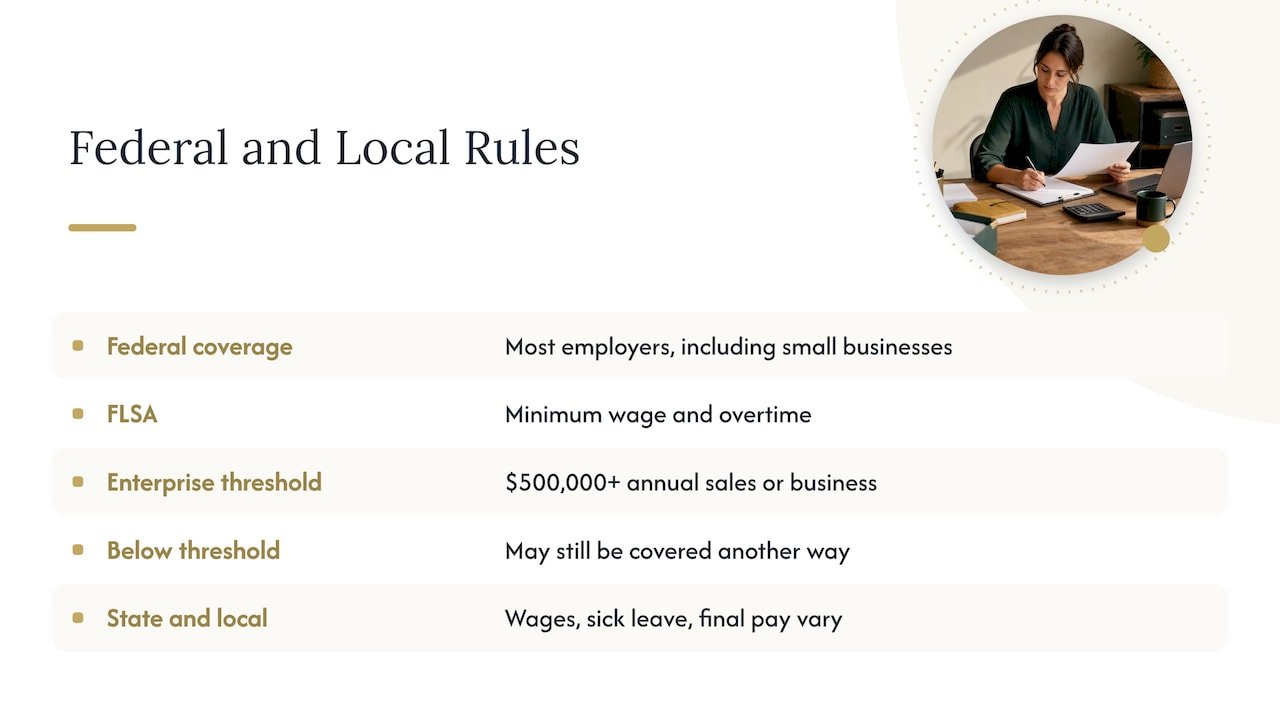
Federal labor law applies to most employers, even very small ones. The Department of Labor’s small business compliance page explains that its Wage and Hour Division enforces many of the federal employment laws that new and small businesses must follow.
One to understand early is the Fair Labor Standards Act (FLSA), which covers minimum wage and overtime. The DOL’s fact sheet on new businesses explains that enterprise coverage applies to businesses with annual sales or business done of $500,000 or more. It also notes that even a business below that level may still be covered in other ways, so do not assume you are exempt.
The DOL also offers free elaws Advisors, interactive tools that help you work through questions such as overtime and worker coverage before an audit does it for you.
State and local rules add another layer. Minimum wage, paid sick leave and final paycheck timing differ by state and sometimes by city, so confirm the rules where your employee works.
Step 4: Find and recruit the right person
Most owners start with a job board, but there is a free public option worth knowing. American Job Centers, funded by the Department of Labor, operate at about 2,400 locations nationwide. Their business services include screening and recruitment help, access to job boards and, in some cases, space for on-site interviews.
Whatever channel you use, write the job description before you post. Define the duties, hours, pay and whether the role is exempt or non-exempt from overtime. That last point drives your payroll setup later, so decide it with your accountant rather than guessing.
What about hiring foreign workers?
If the person you want to hire is not authorized to work in the US, the process is much more involved. Visa programs are regulated by more than one agency. For example, employers using the H-2B program for temporary nonagricultural work must show through the Department of Labor that there are not enough able, willing and qualified US workers. In fiscal year 2025, DHS and DOL made nearly 65,000 supplemental H-2B visas available in sectors such as hospitality, landscaping and seafood processing.
Immigration questions belong with an immigration attorney. What we can do is make sure your payroll, tax and compliance setup is ready once the person is cleared to work.
Step 5: Complete Form I-9 on time
Every employer must verify work eligibility for every new hire. USCIS requires employers to complete and retain Form I-9 for every person they hire to work for pay in the US.
The deadline is tight. Section 2 must be completed within 3 business days of the hire date, which means the first day of work for pay. The employee completes Section 1 no later than that first day. For a job that lasts fewer than 3 days, the form must be completed by the first day.
You examine original, unexpired documents the employee presents, and you cannot tell them which documents to show. Improperly completed forms can lead to civil money penalties under the Immigration and Nationality Act, as the USCIS page above explains.
A simple workflow prevents most errors:
- Send the offer letter with a reminder to bring identity and work authorization documents on day one.
- Put the I-9 on the first-day checklist, with a named person responsible.
- Set a calendar reminder for the third business day.
- Store completed forms in a consistent, secure place.
Our new hire paperwork checklist puts every form in one place.
Step 6: Collect tax forms and report the hire
Beyond the I-9, new employees complete a federal Form W-4 for income tax withholding, and most states have their own withholding form. IRS Publication 15, the Employer’s Tax Guide, has a section on hiring new employees that covers these requirements, including verifying eligibility to work in the US.
New hire reporting is another step owners miss. Each state runs a new hire registry, and the reporting deadline is set by the state. Many states use 20 days or fewer from the start date. Check your state’s registry for its exact deadline, and report each hire promptly. A payroll provider can often send the report when you add the employee, which is one good reason not to run payroll by hand.
Step 7: Set up payroll correctly
Payroll is where hiring becomes a recurring obligation. You withhold income tax and the employee’s share of Social Security and Medicare, pay your own share of payroll taxes, deposit them on schedule and file the required returns. Mistakes compound quickly, and the penalties for late deposits add up.
If you want a full walk-through, start with our guide to setting up US small business payroll in 7 steps. Then read about the payroll tax traps for small businesses, and keep our payroll compliance checklist for 2026 nearby.
Hiring in more than one state
Remote work means your first employee may not live in your state. Each state where an employee works can bring its own registration, withholding and unemployment insurance rules. Plan for this on day one with our multi-state payroll rules guide.
Step 8: Plan the first 90 days
Compliance gets the person on payroll. Onboarding is what keeps them. A written plan for the first weeks helps a new hire understand priorities and helps you spot problems early. A structured 30-60-90 day onboarding plan is a good starting point for the manager’s side of it.
At a minimum, decide who will train the new hire, what they should achieve by the end of each month and when you will check in.
Hiring in the US as a foreign company
If your company is based outside the US, the sequence changes. You will usually need to decide how the worker will be engaged, whether through a US entity, a contractor arrangement where it is legitimate, or another structure. Each route carries different tax and compliance consequences, and a worker who is really an employee cannot be turned into a contractor by contract language alone.
If you are setting up a US presence, read our guide on expanding a business to the US as a foreign small business. It covers the penalty risks that surprise foreign owners.
Our perspective: hire the person, but build the system first
We work with small business owners who are excited to bring on their first employee and nervous about getting the paperwork wrong. Both reactions are reasonable.
What we see most often is not a dramatic violation. It is a small gap: a misclassified helper, an I-9 completed on day five, a state registration missed because the employee works from another state. Each one is easy to prevent and stressful to fix.
Our advice is to set up the system before the offer goes out. That means a clear classification decision, a business structure and bank account that are ready, a payroll process that handles withholding and state reporting, and a checklist for day one. We frequently help clients audit worker relationships before tax season, so they enter filing time with confidence rather than questions.
You do not need to become a payroll expert. You need a partner who is, and a process you can follow.
— Kelli
How we can help
KelliWorks is a virtual accounting department for small businesses, with virtual and in-person support. If you are about to make your first hire, our accounting and payroll services cover bookkeeping, payroll processing and tax planning. Our business management team supports compliance, workflows and payroll and HR solutions. For a conversation about your situation, you can book a consultation.
FAQ
How soon must I complete Form I-9 for a new employee?
You must complete Section 2 within 3 business days of the employee’s first day of work for pay. The employee completes Section 1 by their first day. Missing the deadline, even by a day, can lead to penalties.
Can I hire someone as a contractor to avoid payroll?
Only if they truly are an independent contractor. The IRS looks at the actual relationship, including how much control you have over how, when and where the work is done. Calling someone a contractor does not change their status, and misclassification can lead to unpaid employment taxes and penalties.
Do I need to register in every state where I have an employee?
Generally you must comply with the rules of each state where an employee works, which can include withholding and unemployment insurance registration. The details vary by state. Check each state’s requirements before the employee starts, or ask your accountant.
Can a foreign company hire employees in the US?
Yes, but the setup needs planning. You must address the worker’s authorization to work, how you will employ them, and how payroll taxes and state registrations will be handled. An accountant and an immigration attorney should both be involved early.
Sources
- IRS: Businesses with employees
- IRS: Hiring employees
- IRS: Publication 15, Employer’s Tax Guide
- U.S. Department of Labor: New and Small Businesses
- U.S. Department of Labor: Fact Sheet #27, New Businesses Under the FLSA
- U.S. Department of Labor: elaws Advisors
- CareerOneStop: American Job Centers
- USCIS: Supplemental H-2B visas for fiscal year 2025
- USCIS: Completing Form I-9
- USCIS: Completing Section 2, Employer Review and Attestation