


To open a US subsidiary, you choose a legal structure (usually a C-Corp or an LLC), pick a state, appoint a registered agent, file formation documents, get an EIN from the IRS and open a US bank account. The filing itself is quick. The work that follows, including banking, tax filings and annual reports, is what trips up most foreign parents.
We help foreign and domestic small businesses through this every day. This guide gives you the order of operations, the decisions that are hard to reverse and the compliance duties that start the moment the entity exists.
TL;DR
- Six core steps: structure, state, registered agent, formation filing, EIN, bank account.
- Most foreign parents choose a C-Corp for its familiar governance and simpler tax treatment. An LLC is more flexible but brings pass-through tax questions.
- State filing fees are often under $300, but fees, annual reports and franchise taxes vary widely by state.
- Banking is usually the slowest step, so start it early.
- Foreign-owned entities have extra IRS reporting, such as Form 5472. Keep the subsidiary’s books separate from the parent’s from day one.
Table of Contents
- Subsidiary or branch office: decide this first
- The six steps to open a US subsidiary
- What to do after the entity exists
- A realistic timeline and budget
- Foreign ownership rules in your home country
- Our perspective: set up the books before you set up the bank
- How Kelliworks helps you open a US subsidiary
- Common mistakes to avoid
- FAQ
- Sources
Subsidiary or branch office: decide this first
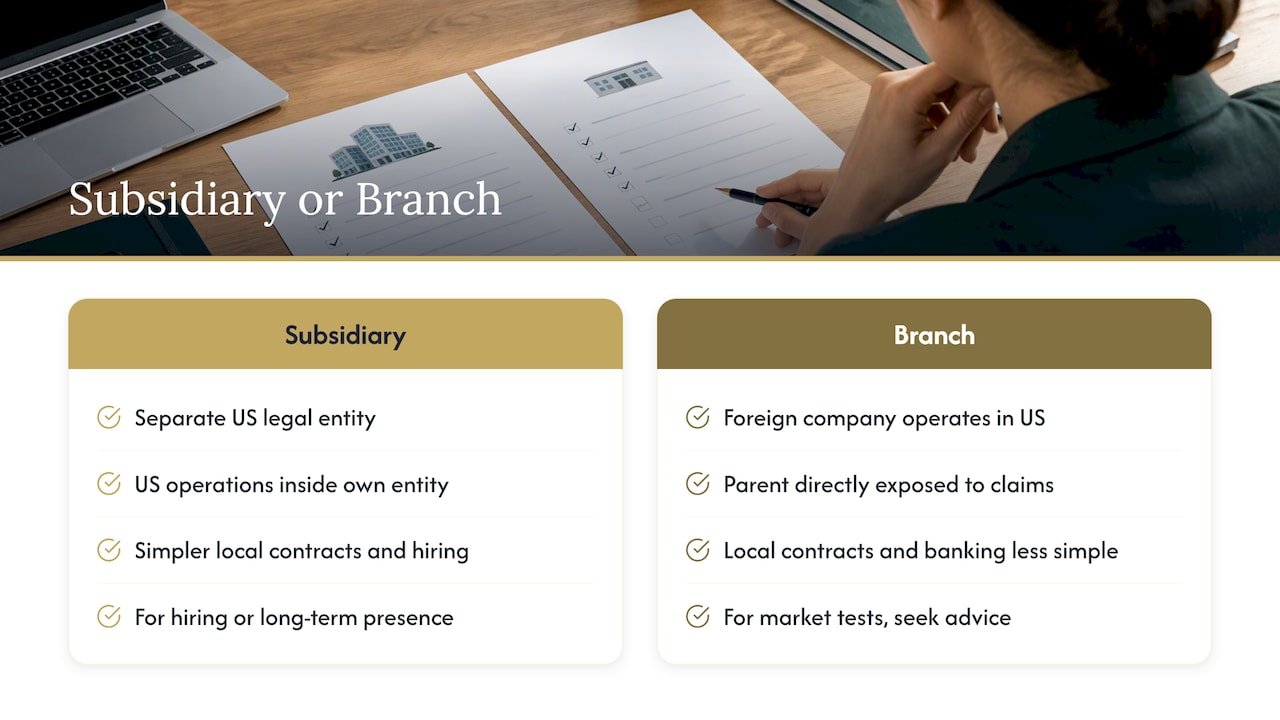
There are two main ways to expand into the US: a subsidiary or a branch office. A subsidiary is a separate US legal entity that your company owns. A branch is simply your foreign company operating in the US. MintzEdge describes both options and points to the subsidiary as the route for a long-term presence.
The practical reason is liability. A branch exposes the parent company directly to US claims and obligations. A subsidiary keeps US operations inside their own entity, which also makes contracts, hiring, invoicing and banking simpler for the people you deal with locally.
If you only want to test the market for a few months with no employees, talk to an advisor before forming anything. If you plan to hire, lease space or sign customer contracts, form the subsidiary.
The six steps to open a US subsidiary
The sequence below follows the process described by Globalization Partners. We add the order in which things go wrong in practice.
1. Choose the legal structure
Foreign companies usually choose between a C-Corporation and a Limited Liability Company. The comparison:
| Factor | C-Corp | LLC |
|---|---|---|
| Governance | Board, officers, shareholders: familiar to most foreign parents | Flexible operating agreement |
| Tax treatment | Taxed as a separate corporation | Pass-through by default, which can get complicated with foreign owners |
| Best fit | Hiring, outside investment, long-term US operations | Smaller or simpler operations with clear tax advice |
| Foreign-owner reporting | Form 5472 for 25% foreign-owned corporations | Form 5472 for foreign-owned disregarded entities |
The research we reviewed notes that C-Corps are frequently favored by foreign parents for their familiar governance and more straightforward US corporate tax treatment. LLCs offer operational flexibility but can create pass-through tax effects that suit international ownership structures less well.
Neither is right for everyone. Your home country’s tax treatment of the US entity matters as much as US rules, so have both sides reviewed before you file.
2. Select the state
Delaware is famous for business-friendly law, but it is not automatically the best choice. If your people and office are in Texas, a Delaware corporation may need to register in Texas as well. You then pay Delaware’s charges and Texas’s fees. MintzEdge makes this point about double franchise tax and qualification costs.
Ask three questions:
- Where will employees, an office or inventory be?
- Do investors or lenders expect a particular state?
- What are the formation fee, annual report and tax costs in each candidate state?
The SBA also reminds owners that you register, pay taxes and get licenses where you locate, so location drives your obligations.
3. Appoint a registered agent
Every state requires a registered agent with a physical address in that state to receive legal and government notices. Missing a notice can lead to a default judgment or a lapse in good standing. Use a reliable service rather than a founder’s personal address.
4. File formation documents
A corporation files Articles of Incorporation. An LLC files Articles of Organization. You also prepare bylaws or an operating agreement, name the initial directors or members, and issue shares or membership interests to the parent. Check that your chosen name is available in the state.
The cost is modest. Total registration costs are typically under $300 in many states, though this varies widely by state and structure. Budget separately for legal review and for ongoing annual fees.
5. Get an EIN
The Employer Identification Number is the entity’s federal tax ID. You need it to open a bank account, hire, file taxes and report to the IRS. A nonresident founder usually has no Social Security number, which complicates the application. We cover the options in our guide to getting a US EIN as a nonresident founder.
The IRS Form SS-4 is the application form. Mistakes on it cause delays, so make sure the responsible party and entity type match your formation documents.
6. Open a US business bank account
This is often the biggest bottleneck. US banks apply strict Know Your Customer rules, and many still require a director to visit in person. If travel is not possible, plan time to vet online and fintech banks that accept foreign-owned entities.
Bring your formation documents, EIN confirmation, ownership details, parent company documents and passports for the owners. Start the bank process as soon as the EIN arrives, not after.
What to do after the entity exists
Formation is the starting line. These are the duties that follow.
Keep finances separate from the parent
The subsidiary should have its own bank account, its own books and written agreements for any money that moves between it and the parent. Loans, management fees and capital contributions need documentation. Mixing funds weakens the liability protection you formed the entity to get, and it creates headaches at tax time.

File the IRS forms foreign ownership requires
A US corporation that is 25% or more foreign-owned, and a foreign-owned disregarded entity, must report transactions with related parties on Form 5472. For tax years beginning on or after January 1, 2017, this applies to foreign-owned disregarded entities too. The IRS publishes a dedicated filing address for these disregarded entity filings, separate from the general address, so check it before you mail anything.
Failing to file, or filing incomplete returns, can bring severe penalties. Our article on avoiding a $25,000 penalty when expanding to the US walks through how foreign small businesses get caught.
Understand what changed on beneficial ownership reporting
In August 2026, FinCEN issued a final rule permanently removing the beneficial ownership reporting requirement for US companies and US persons. Certain foreign entities registered to do business in the US still report. A subsidiary formed in a US state is a US company, so it falls on the exempt side. Your foreign parent should confirm its own status. For the plain-English version, read our beneficial ownership reporting changes guide.
Calendar state annual reports and foreign qualification
Most states want an annual or biennial report and a fee. Miss it and the state can move your entity out of good standing, then dissolve it. Our guide to state annual report requirements explains how to stay current.
Foreign qualification is often misunderstood. Experts note it has nothing to do with your company coming from abroad. It is the registration you need in a US state where you do substantial business, such as having employees or an office, when your entity was formed in a different state. Skipping it can leave you unable to enforce contracts there.
Set up payroll before the first hire
If the subsidiary will employ people, register for state payroll taxes, collect W-4 and I-9 forms, and choose a payroll provider before the first paycheck. Hiring in more than one state adds rules. See our checklist on multi-state payroll rules before you place your first out-of-state hire.
A realistic timeline and budget
The filing itself can take days. Most of the elapsed time comes from the steps around it.
| Stage | What drives the time |
|---|---|
| Structure and state decision | Tax advice in both countries |
| Formation filing | State processing speed |
| EIN | Whether the founder has a US tax ID and which method you use |
| Bank account | KYC checks and, often, an in-person visit |
| First compliance calendar | Setting up books, payroll and annual report dates |
Plan for the whole process to run longer than the formation filing suggests. Some guides put the total at several months once legal, financial and administrative tasks are included.
On cost, separate three buckets:
- One-time: state filing fee, registered agent, legal review.
- Recurring: annual report fees, registered agent renewal, franchise or similar taxes where they apply.
- Professional: bookkeeping, payroll and tax preparation, including IRS forms specific to foreign ownership.
The third bucket is the one people forget. Build it into your first-year budget.
Foreign ownership rules in your home country
Before you commit capital, check what your own country allows and requires. Rules on foreign ownership and outbound investment differ widely. For one contrast, see how foreigners can own a business in Singapore, where the conditions look quite different from the US. A US subsidiary is generally open to foreign owners, but your home-country reporting still applies.
Our perspective: set up the books before you set up the bank
Most foreign founders ask us how fast they can form the company. We think the better question is how cleanly the company will run for its first twelve months.
The small businesses we work with are rarely hurt by the formation filing. They are hurt by what comes after: a missed annual report, an unreported related-party transaction, a founder’s personal card paying US vendors, or payroll started without state registration. Each is cheap to prevent and expensive to repair.
So we recommend a few habits from day one:
- Open a dedicated subsidiary bank account and never run personal expenses through it.
- Document every transfer between parent and subsidiary as a loan, a capital contribution or a fee.
- Connect the bank feed to accounting software in the first week, so every transaction is categorized from the start.
- Put annual report, payroll tax and IRS filing dates on one shared calendar.
This is not glamorous work, but it is what gives you confidence when an investor, a bank or the IRS asks a question. Our approach is personalized: a virtual accounting department that works with your parent company’s reporting calendar as well as US deadlines.
— Kelli
How Kelliworks helps you open a US subsidiary
We handle formation and the accounting that follows. Through our business formation service we support incorporation, registered agent service, business banking setup and compliance and annual report filing. Our business management team covers financial management and compliance, workflows and payroll and HR solutions. For ongoing books and tax work, see our accounting and bookkeeping services or tax preparation and filing.
We work virtually or in person, so you can start before you travel. If you want to talk through your structure and state, book a free consultation.
Common mistakes to avoid
- Forming in Delaware by default while operating elsewhere, then paying twice.
- Treating the EIN as an afterthought. Without it, the bank and payroll stall.
- Ignoring tax in the parent’s country. A US structure that is efficient in the US can be inefficient at home.
- Mixing parent and subsidiary funds. It weakens the separation you set out to create.
- Missing annual reports. Loss of good standing can block banking and contracts.
- Skipping foreign qualification in states where you hire or lease.
FAQ
How long does it take to open a US subsidiary?
The state filing can be done in days, depending on the state and the processing option you pick. The full process, including EIN, bank account and compliance setup, takes longer, and some guides say several months. Banking is usually the slowest part.
Should my US subsidiary be a C-Corp or an LLC?
Many foreign parents choose a C-Corp for its familiar governance and straightforward corporate tax treatment. An LLC offers flexibility but can create pass-through tax complications for international owners. Have a tax professional review both US and home-country treatment before you decide.
Does a US subsidiary have to report beneficial owners to FinCEN?
No, not under the current rule. In August 2026 FinCEN removed the requirement for US companies and US persons. Only certain foreign entities registered to do business in the US still report. Check your parent company’s status separately.
Can I open the bank account without traveling to the US?
Sometimes, but not at every bank. Many US banks still want a director in person, so plan for vetting online and fintech options that accept foreign-owned entities if you cannot travel. Start early and have your formation documents and EIN ready.
What IRS forms does a foreign-owned subsidiary file?
Beyond its regular tax return, a 25% foreign-owned US corporation or foreign-owned disregarded entity generally files Form 5472 to report related-party transactions. Filing errors can bring severe penalties, so have a US accountant prepare it.
Sources
- Checklist for Foreign Companies Expanding into the US, MintzEdge
- Setting Up a U.S. Subsidiary: Compliance & Strategy, Globalization Partners
- Launch your business, Small Business Administration
- Form SS-4, IRS
- Form 5472, IRS
- Where to file: Forms beginning with the number 5, IRS
- FinCEN Permanently Ends Beneficial Ownership Reporting Requirements, FinCEN