


An SBA loan application rests on two sets of financial statements: your business statements (balance sheet, profit and loss, and a projection) and a personal financial statement on SBA Form 413 from each owner. Lenders read them side by side with your tax returns, so every number has to agree. We walk you through what to prepare, how to get it right, and where applications stall.
TL;DR
- Plan on a business balance sheet, a profit and loss statement, a one-year income projection, recent business and personal tax returns, and SBA Form 413 for each owner.
- Form 413 is a snapshot of you as an individual, not your company. It must match your other documents.
- Owners with a 20% stake or more generally must personally guarantee the loan, and lenders can ask others too.
- Since July 2026, 7(a) and 504 financing can total up to $10 million, so larger requests mean more scrutiny of your numbers.
- Clean, current books made before you apply are the fastest way to avoid delays.
Table of Contents
- The financial statements an SBA lender asks for
- SBA Form 413: the personal financial statement
- Personal guarantees and what they mean for your statements
- What changed in 2026: larger loan limits
- Our perspective: lenders read a story, not just numbers
- A pre-application checklist you can use this week
- Common mistakes that slow an SBA application
- How we help you get loan-ready
- Is your loan information public?
- FAQ
- Sources
The financial statements an SBA lender asks for
Requirements vary by lender and loan program, so your lender’s checklist is the final word. Still, the core package is consistent. The SBA 7(a) paperwork commonly includes a balance sheet, a profit and loss statement and a one-year income projection, alongside SBA Forms 1919, 912 and 413.
Here is how the pieces fit together.
| Document | What it shows | Who prepares it |
|---|---|---|
| Balance sheet | Assets, liabilities and owner’s equity on a given date | Your bookkeeper or accountant |
| Profit and loss statement | Revenue, costs and profit over a period | Your bookkeeper or accountant |
| Income projection | Expected revenue and how you will reach it | You, with your accountant |
| Business tax returns | What you reported to the IRS, usually several years | Your tax preparer |
| SBA Form 413 | Each owner’s personal assets, liabilities and income | Each owner |
A 504 loan adds project paperwork. One certified development company’s 504 application checklist includes real estate purchase agreements, construction bids and equipment lists on top of the financial statements.
Interim statements and tax returns
Lenders generally want historical tax returns plus an interim balance sheet and profit and loss that are recent. How many years and how recent depends on the lender, so ask early. If your last closed month is stale, close the books before you submit, not after the lender asks. Our guide on closing small business books for taxes shows how to do that without a scramble.
Why your statements must agree with each other
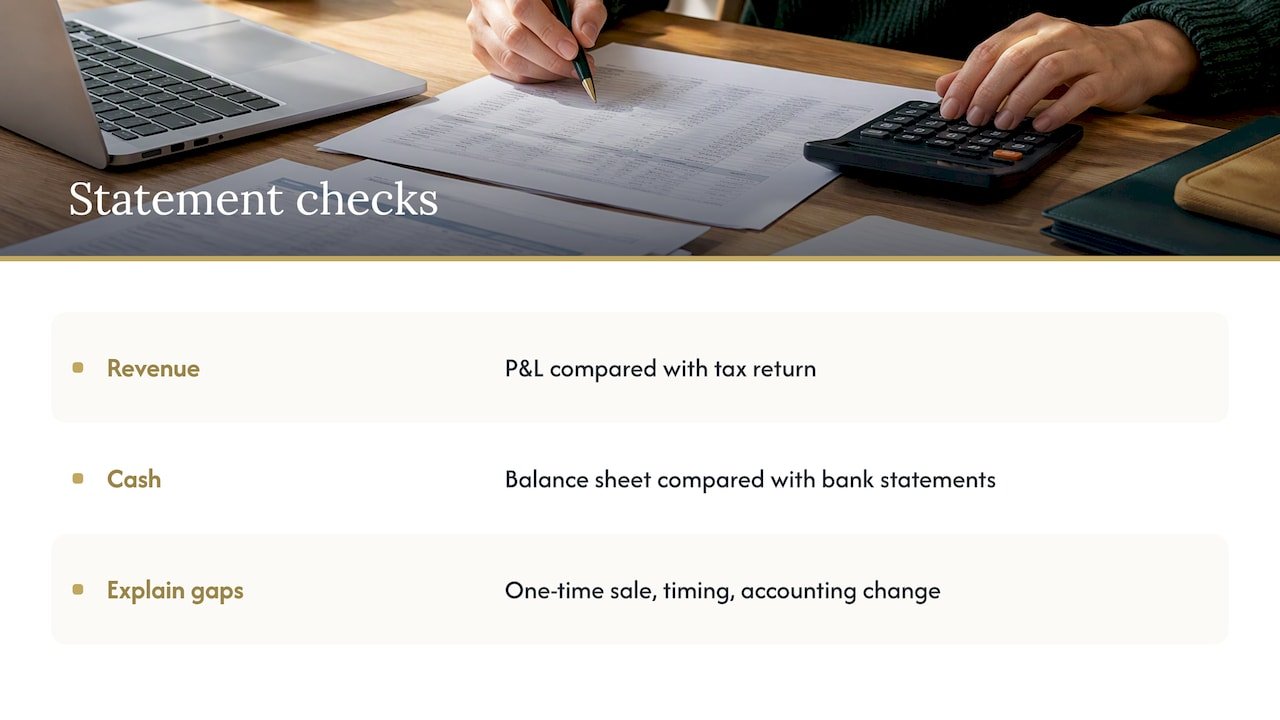
Underwriters compare revenue on your profit and loss to your tax return, and cash on your balance sheet to your bank statements. A gap is not automatically a problem, but an unexplained gap is. Write a short note for any difference: a one-time sale, a timing issue, a change in accounting method.
SBA Form 413: the personal financial statement
Form 413 is the document most owners underestimate. It tells the lender what you own, what you owe and what you earn as an individual, and it sits alongside your business tax returns and financial statements. The SBA says it uses the form to assess repayment ability and creditworthiness for 7(a), 504 and disaster loans.
Who has to complete it
Every owner of 20% or more, and anyone else the lender requires. Under 13 CFR 120.160, holders of at least a 20 percent ownership interest generally must guarantee the loan, and the lender may require guarantees from other people when it deems that necessary. Treat 20% as a floor, not a ceiling.
One detail catches married applicants: according to Coffman Capital’s guide, a legally married applicant’s form must be completed and signed jointly with the spouse, even if the spouse is not a guarantor. Confirm this with your lender before you finalize the form.
How to fill it out accurately
- Work from a single date. Pull every balance as of the same day so the snapshot is consistent.
- Use realistic market values. For cars and personal property, use what someone would pay today, not what you paid. Vehicle valuation tools such as Kelley Blue Book are standard support for your figures.
- Attach an addendum when space runs out. If you have more accounts or holdings than the form fits, printed brokerage or bank statements are generally a cleaner way to show the detail.
- List contingent liabilities. Personal guarantees on other debts, pending legal claims and tax obligations belong on the form.
- Check it against everything else. The numbers should be consistent with your tax returns and business statements, because inconsistency is a common cause of underwriting delays.
Personal guarantees and what they mean for your statements
The guarantee is a separate personal obligation. It does not shrink because the SBA guarantees part of the loan to the lender. As one explainer on LLC protection puts it, owners often misunderstand this and assume the company structure shields them fully. That is why lenders look hard at your personal balance sheet: it is the backstop.
If you have a business partner with a smaller stake, ask your lender early whether it will request their statement. Surprises late in the process cost weeks.
What changed in 2026: larger loan limits
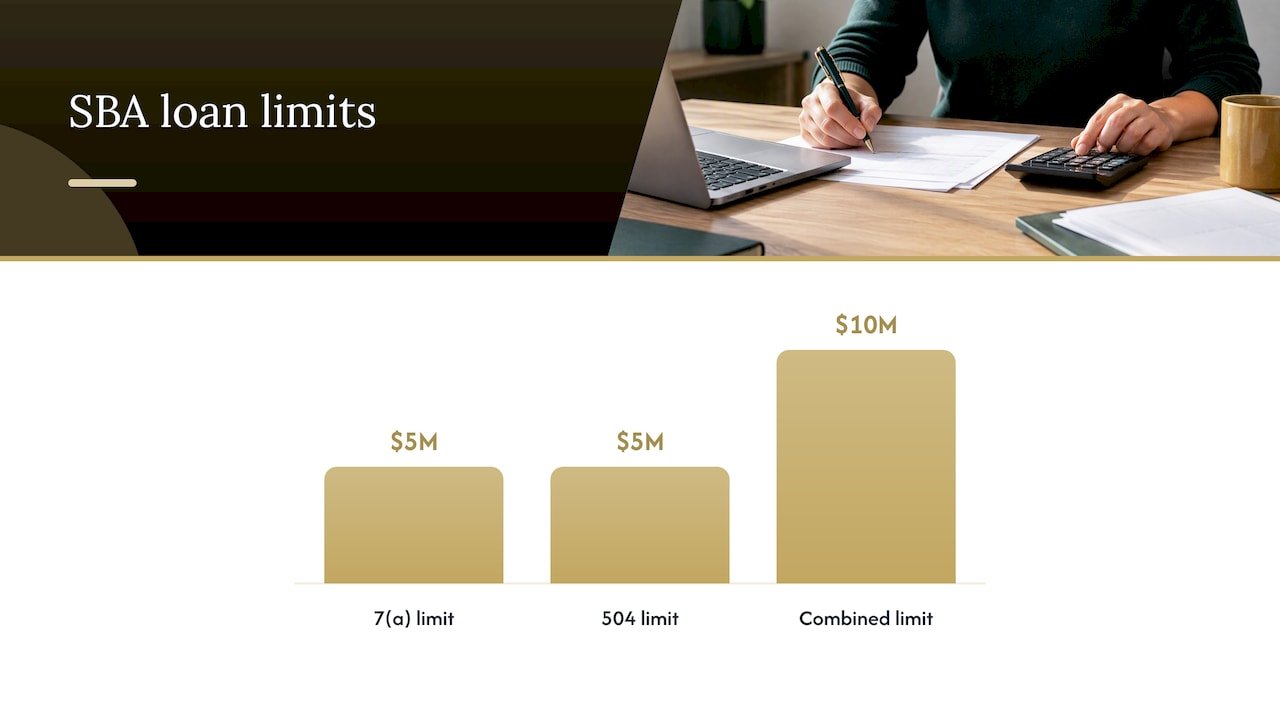
On May 18, 2026, the SBA announced that it was doubling the cumulative 7(a) and 504 limit to $10 million. Under the policy, qualified borrowers who secure a 7(a) loan first may access up to $5 million through each program, for a combined $10 million.
For your statements, the practical point is simple. A bigger request invites a deeper look at your historical performance, your debt load and your projections. If you are weighing how to structure financing for a specialized project, such as SBA green loans for commercial solar, your financial model and statements will carry the argument.
Our perspective: lenders read a story, not just numbers
We work with small business owners who are strong operators and tired bookkeepers. The pattern we see is consistent: the loan is rarely the hard part. The hard part is that the books were built for the owner’s daily needs, not for an underwriter.
Here is what we advise before anyone submits an application:
- Reconcile every account first. A balance sheet that ties to bank and credit card statements answers half the lender’s questions before they are asked.
- Categorize consistently. If your profit and loss changes categories from month to month, trends become unreadable.
- Separate personal and business spending. Mixed transactions make both Form 413 and your profit and loss harder to defend.
- Build the projection from your real numbers. A projection that grows 40% with no explanation invites questions. One tied to your actual margins and capacity does not.
- Know your statements. If you cannot explain a line on your own balance sheet, you will struggle when the lender asks. Our guide to reading financial statements helps.
We would rather you spend a few weeks cleaning up than a few months answering lender follow-ups. Owners who arrive prepared tend to feel calmer and negotiate from a stronger position.
— Kelli
A pre-application checklist you can use this week
- Ask your lender for its exact document list and any required forms or formats.
- Close the books through the most recent month and reconcile all accounts.
- Produce a balance sheet and a profit and loss for the periods the lender requests.
- Gather business and personal tax returns. If any are missing or wrong, resolve that first. See our guide to amended business tax returns if you need to fix an error.
- Prepare a debt schedule listing each loan, lender, balance, rate, payment and maturity.
- Draft the one-year income projection with written assumptions.
- Complete Form 413 for each required owner as of one date, with addenda for extra detail.
- Compare every document for consistency, and write a short note for any known difference.
If your filings are behind, tackle that before you apply. Lenders see tax compliance as a sign of how you run the business, and our business tax extension guide explains what an extension does and does not cover.
Common mistakes that slow an SBA application
Statements that do not match
Revenue on the profit and loss differs from the tax return, and nobody can say why. Reconcile before you submit.
Stale or unsigned documents
A balance sheet from nine months ago or a form missing a signature goes back to you. Date everything and sign what requires a signature.
Optimistic personal valuations
Inflated home, vehicle or business-interest values are easy for a lender to check. Use defensible market figures and keep the support.
Forgetting liabilities
Credit cards, lines of credit, back taxes, co-signed loans and guarantees all belong on the form. Omissions look worse than large debts.
Skipping the management view
Lenders want to see that you track performance regularly. Monthly management reports show that you catch cash problems early, and our piece on the role of financial statements explains why that habit matters.
How we help you get loan-ready
KelliWorks is a virtual accounting department for small businesses, with virtual and in-person support. We handle bookkeeping and accounting, including balance sheets, budgets and financial forecasting, so your statements are accurate before they reach a lender. If back filings are the obstacle, our tax preparation and filing service covers outstanding returns, with a one-time $150 deposit for outstanding tax returns. If you are still setting up your company or banking, see business formation and banking setup.
Want a second pair of eyes on your package? Book a consultation and we will tell you where it stands.
Is your loan information public?
Once a loan is approved, recipient names and total approved amounts are subject to disclosure under FOIA. Your tax returns, personal financial statements, credit reports and business plans remain confidential. Public SBA datasets exist, but they do not include private financial records.
FAQ
Do I need audited financial statements for an SBA loan?
Most small business applicants do not provide audited statements. Lenders typically accept internally prepared or accountant-prepared statements, but requirements differ by lender and loan size. Ask your lender what level of preparation it expects before you commission any work.
What is the 20% rule for SBA loans?
It refers to ownership. Under 13 CFR 120.160, holders of at least 20 percent of the business generally must guarantee the loan. Lenders can also require guarantees from other individuals when they consider it necessary.
Does my spouse have to sign Form 413?
According to the guide cited above, a legally married applicant must complete and sign the form jointly with a spouse, even when the spouse is not a guarantor. Because lender practice can vary, confirm your situation with your lender or an SBA resource partner.
Can I combine 7(a) and 504 loans?
Yes, within limits. As of July 2026, eligible borrowers can access up to $10 million in combined SBA-backed financing: up to $5 million through 7(a) and up to $5 million through 504, per the SBA announcement.
Sources
- SBA 7(a) paperwork explained: business and affiliate financial statements
- SBA Form 413 Personal Financial Statement guide (Stacking Capital)
- PFS 413 Guide (Coffman Capital)
- SBA 504 application checklist (CMDC)
- 13 CFR 120.160, Loan conditions
- Personal Guarantee, the Exception to Your LLC Protection
- SBA doubles cumulative 7(a) and 504 loan limit to $10 million
- Small businesses now eligible for $10 million in SBA financing
- How to search the SBA EIDL loan recipients list (LegalClarity)